Skyrmions Tune the Spin Wave Symphony
![Magnon excitations in frustrated magnets exhibit a complex, Mexican hat-like dispersion-distinct from their chiral counterparts-and are closely matched to the size of localized skyrmions, suggesting a strong interplay between these magnetic phenomena and a unique dynamic around these topological textures, as evidenced by calculations performed with parameters [latex]J_1 = 1[/latex], [latex]J_2 = 0.5[/latex], [latex]h = 0.225/S[/latex], and [latex]K = 0.15[/latex].](https://arxiv.org/html/2601.00363v1/1_Panel_A.png)
New research reveals how localized magnetic swirls called skyrmions dramatically alter the behavior of spin waves in frustrated magnets, creating exotic states with potential for novel magnonic devices.
New research reveals how localized magnetic swirls called skyrmions dramatically alter the behavior of spin waves in frustrated magnets, creating exotic states with potential for novel magnonic devices.

This review explores the exciting potential of non-Hermitian physics in manipulating magnons, opening doors to advanced spintronic devices and functionalities.

The KATRIN experiment is pushing the boundaries of precision measurement to determine the absolute mass of the elusive neutrino.

New research leverages the power of entanglement measures to diagnose critical behavior in a complex theoretical framework linking gravity and quantum mechanics.
A new look at the foundations of physics suggests causality isn’t a universal law, but a consequence of the universe’s structure and its march toward disorder.
![The study demonstrates that a probability density function-which reduces to the normal distribution assumed in the Black-Scholes Model when [latex]\beta = 0[/latex]-influences call option pricing, as observed with parameters of [latex]r = 10\%[/latex], [latex]S\_0 = 20[/latex], [latex]K = 20[/latex], [latex]T = 1 year[/latex], and [latex]\sigma = 25\%[/latex].](https://arxiv.org/html/2601.00293v1/x3.png)
Researchers are exploring the potential of quantum mechanics to refine financial modeling and address the limitations of traditional option pricing methods.
![Hypercrystal drift modulation utilizes a pulse sequence - characterized by alternating signs and a non-zero average field - to induce carrier drift momentum [latex] p_{D} [/latex] distinct from the pump impulse [latex] p_{M} [/latex], resulting in a time-dependent dielectric permittivity [latex] {\bf D}(t) [/latex] that exhibits directional dependence - parallel and perpendicular components relative to the modulation field [latex] {\bf E}_{M} [/latex] - as demonstrated in calculations performed for a heavily doped gallium arsenide sample with a relaxation time of [latex] \tau_{0} = 0.1 [/latex] and a modulation interval of [latex] T_{M} = 20 [/latex] fs.](https://arxiv.org/html/2601.00547v1/x2.png)
Researchers have demonstrated a novel method for creating hyperbolic time crystals by dynamically modulating the movement of charge carriers within a material.
![The study demonstrates complementarity between pseudoscalar meson decay and axion-like particle (ALP) contributions to missing-proton-energy events at an Electron-Ion Collider, with sensitivity bounds defined in the [latex]\{g_{a\chi}, f_{a}^{-1}\}[/latex] plane for ALP masses of 0.25 GeV (solid curves) and 1 GeV (dashed curves), assuming negligible background.](https://arxiv.org/html/2601.00068v1/x4.png)
A novel search strategy at the future Electron-Ion Collider could reveal subtle signals of new particles by looking for events where a proton seemingly disappears.
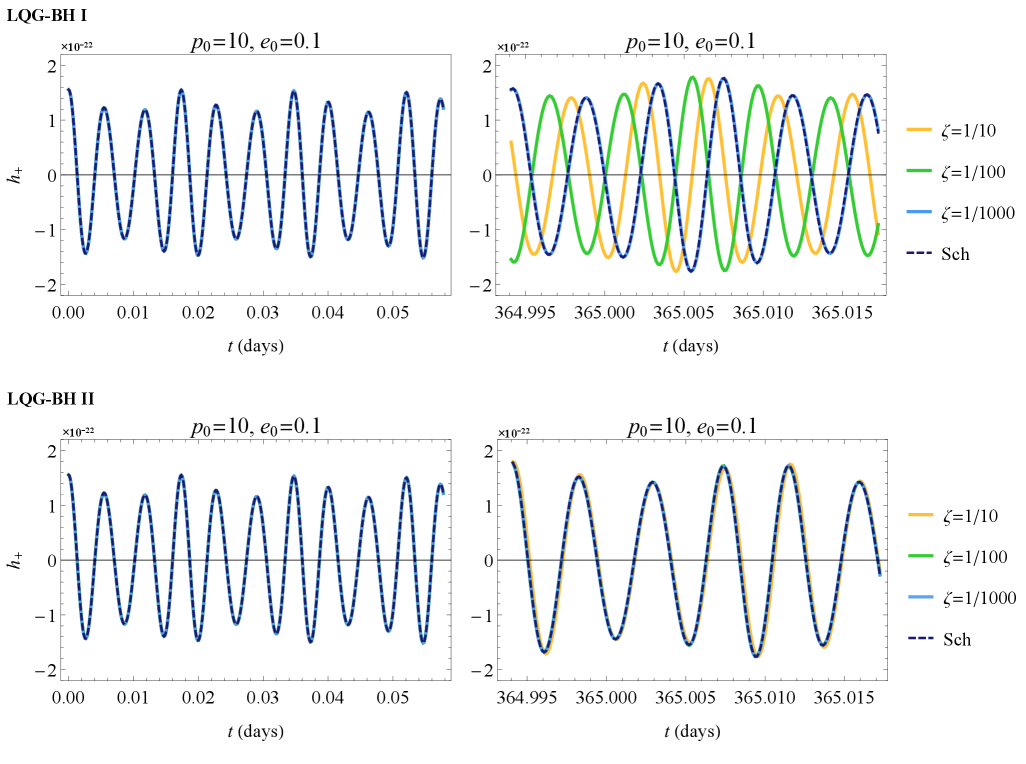
A new study explores how future gravitational wave detectors could reveal subtle signatures of quantum gravity near black holes.

A new perspective on quantum criticality emerges as researchers explore the interplay between topological states and the breakdown of conventional order.