Uncovering Hidden Order: AI Spots Phase Transitions in Complex Systems
![As system size increases from [latex]L=8[/latex] to [latex]L=14[/latex], latent variance exhibits sharpening peaks approaching a critical value of [latex]h_c=1[/latex], a behavior consistent with quantum finite-size scaling and indicative of a quantum critical region mirroring the diverging susceptibility observed in classical systems.](https://arxiv.org/html/2602.14928v1/figures/latent_trajectories.png)
A new machine learning framework autonomously identifies critical points and exotic behavior in both classical and quantum materials, offering a powerful tool for materials discovery and fundamental physics research.
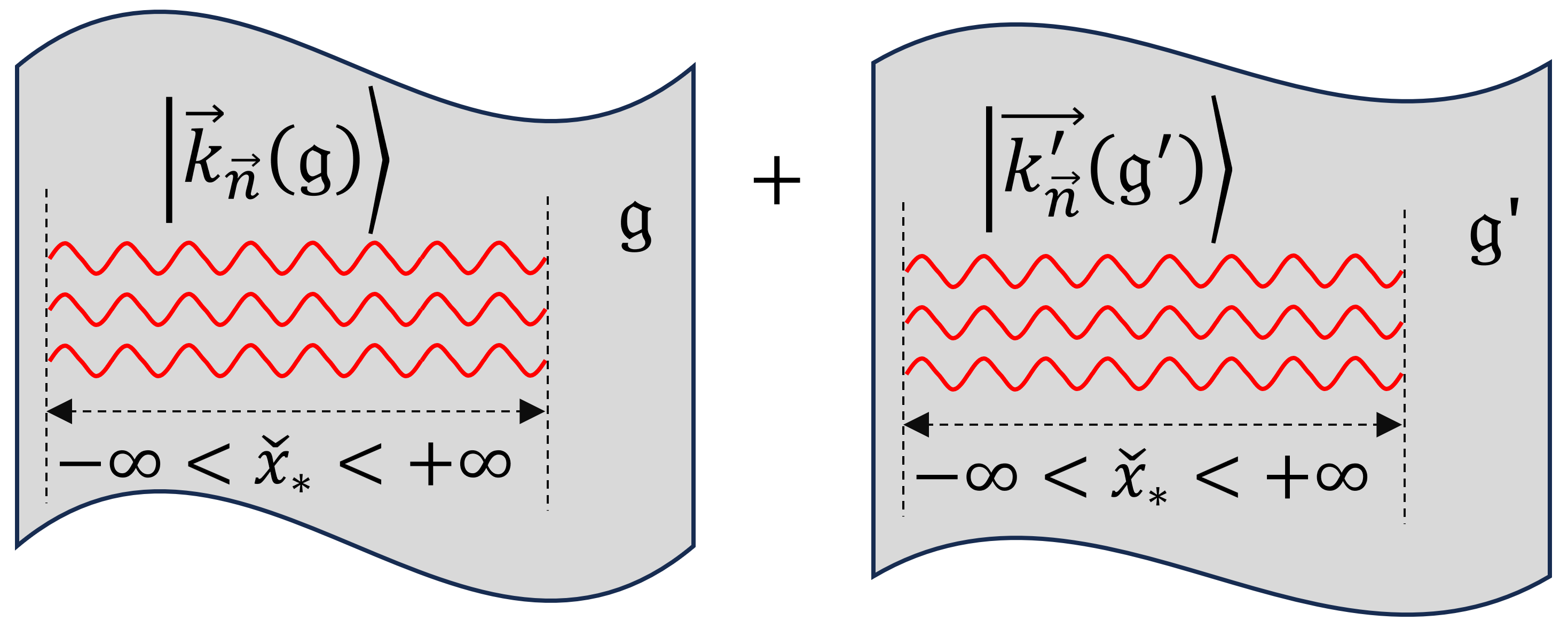
![The study demonstrates that the fraction of impurities escaping the host gas increases with initial momentum-quantified as [latex]Q/k_F[/latex]-though reported experiments focus on lower momenta-specifically below [latex]2.3k_F[/latex]-and dissipationless flow is maintained when [latex]Q/k_F \leq 0.6[/latex].](https://arxiv.org/html/2602.12320v1/x6.png)
![The study contrasts the field content required to compute entanglement entropy between subregions [latex]\bm{A\_{1}}[/latex] and [latex]\bm{A\_{2}}[/latex] within the frameworks of standard conformal field theory and double holography, revealing that while standard CFT relies on quantum fields across both subregions and their union, the double holographic approach utilizes distinct “Q-EWs” - [latex]\mathcal{W}\_{\bm{A\_{1}}}[/latex] and [latex]\mathcal{W}\_{\bm{A\_{2}}}[/latex] - to characterize entanglement, highlighting a fundamental difference in how these theories approach the same quantum information problem.](https://arxiv.org/html/2602.12627v1/figures/%22semiclassical.png%22)
![A binary Bose-Einstein condensate, subjected to spin-dependent periodic potential and increasing intercomponent interactions [latex]g_{12}[/latex], transitions from partially miscible quasicrystalline density clusters exhibiting eightfold rotational symmetry-observed at moderate [latex]g_{12}[/latex]-to complete phase separation as interactions strengthen, effectively dissolving the delicate order within the system.](https://arxiv.org/html/2602.13129v1/x4.png)
![The analysis of SYK data, specifically the moments [latex]\ln(\overline{\xi(w)^{2}})/N[/latex] evaluated at [latex]q=4[/latex], [latex]\beta=20[/latex], and [latex]L=1000[/latex], demonstrates strong alignment with the classical action predicted by the wormhole model-characterized by the functional form [latex]c\_1 w \ln(c\_2 w)[/latex]-and yields fitted constants of approximately [latex]c\_1 \approx 0.94[/latex] and [latex]c\_2 \approx 0.53[/latex].](https://arxiv.org/html/2602.12339v1/x53.png)
![The band structure of a triplet topological superconductor-specifically LaNiGa2-reveals that a strong triplet pairing interaction [latex]\omega = 1[/latex] sustains gapless superconductivity due to band sticking at the zone boundary, while weaker interactions [latex]\omega < 1[/latex] break degeneracy and introduce a gap in quasiparticle excitation.](https://arxiv.org/html/2602.12514v1/Fig5.png)