Evolving Reasoning: How AI Can Learn From Its Mistakes
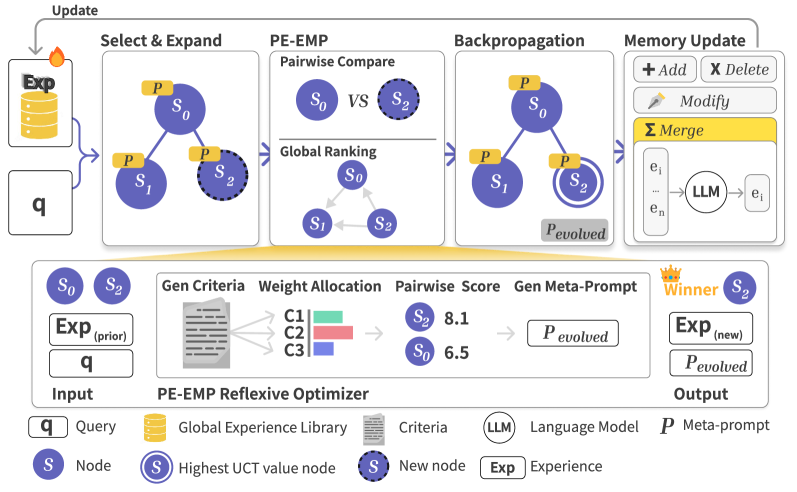
A new approach combines search algorithms with experience replay to enable large language models to continuously refine their problem-solving skills without retraining.
A new approach combines search algorithms with experience replay to enable large language models to continuously refine their problem-solving skills without retraining.
![The study establishes model-independent exclusion limits on the production rates of additional Higgs bosons ([latex]H_{2,3}[/latex]) against the Standard Model-assuming a 125 GeV Higgs-through analysis of [latex]b2b_2[/latex] and [latex]b4b_4[/latex] observables evaluated in both laboratory and center-of-mass frames, with sampled data from the Two-Higgs-Doublet Model ([latex]C2HDM[/latex])-where the mass of [latex]H_{2,3}[/latex] falls between twice the top quark mass-further constraining potential deviations from established particle physics.](https://arxiv.org/html/2602.04511v1/x31.png)
New research explores how studying the debris from top quark collisions can reveal clues about additional Higgs bosons predicted by extensions to the Standard Model.
![The study visualizes real-space lattices of [latex]2d_{x^2-y^2}[/latex] and [latex]d_{xy}[/latex] wave amplitudes, alongside their corresponding Brillouin zones, to demonstrate the fundamental relationship between spatial wave patterns and their momentum-space representations.](https://arxiv.org/html/2602.04854v1/x3.png)
A new theoretical analysis reveals the unique spin-polarized currents and topological electronic structure of 2D d-wave altermagnets, paving the way for advanced spintronic devices.
A novel approach reimagines relativistic quantum field theory by framing quantum fields as evolving probability distributions, offering fresh insights into real-time dynamics and entanglement.
![Meson exchange facilitates interactions between quark-antiquark pairs [latex]q\bar{q}[/latex] and quark triplets [latex]qqq[/latex], demonstrating a fundamental mechanism governing particle interactions.](https://arxiv.org/html/2602.04090v1/x2.png)
A new review explores the evolution of our understanding of matter’s building blocks, from traditional quark models to the surprising discovery of multi-quark states and their implications for hadron structure.
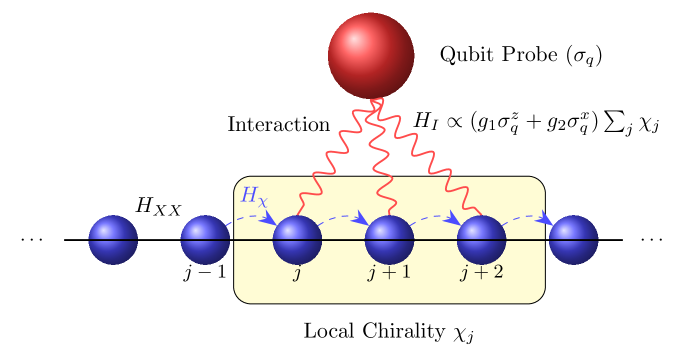
New research demonstrates a pathway to detect analogue Hawking radiation using a quantum sensor embedded within a chiral spin chain, offering a novel platform for studying quantum gravity effects.
![The study demonstrates that tau pair spin correlations exhibit entanglement-quantified by [latex]\mathcal{C}>0[/latex]-and nonlocality-signaled by [latex]\mathfrak{m}\_{12}>1[/latex]-as functions of center of mass energy and scattering angle, revealing intrinsic quantum properties within particle interactions.](https://arxiv.org/html/2602.03960v1/m12.png)
Future lepton colliders offer an unprecedented opportunity to explore the fundamental nature of quantum entanglement and nonlocality in high-energy particle collisions.
![Electron-mediated nuclear spin-spin interactions induce a decoherence time [latex]T_2[/latex] that is demonstrably sensitive to the electronic correlation length ξ, with calculations-using parameters including a flip angle of 75° and a dissipation parameter set to zero-showing [latex]T_2 \approx 145\,\rm{s}[/latex] for [latex]\xi = 2.5\rm{a}[/latex], a value corroborated by experimental measurements in YBa2Cu3O7-δ and aligning with prior theoretical work, as evidenced by simulations performed on a 200x200 lattice of 40,000 spins.](https://arxiv.org/html/2602.02732v1/x9.png)
New simulations leverage the power of GPU computing to model the complex interactions of strongly correlated electrons, offering insights from nuclear magnetic resonance data.
![The study demonstrates consistent convergence on challenging 20-dimensional benchmarks-Ackley, Rastrigin, and Schwefel functions-achieved through an initialization of 10 points, iterative proposal of 10 candidates, and averaging across 10 independent runs, as evidenced by decreasing objective values and minimized feature-space distance to the global optimum-[latex] \min ||x - x^*|| [/latex]-across all tested functions.](https://arxiv.org/html/2602.03319v1/img/math/math_res.png)
A new framework leverages the principles of information theory to efficiently navigate complex materials spaces and accelerate the discovery of optimal compounds.
![The reflection probability [latex]R(\omega)[/latex] of a charged Bardeen black hole is demonstrably modulated by the parameters α and β, with increasing α suppressing reflection and increasing β enhancing it-a complementary behavior observed across variations of [latex]\alpha = 0.1, 0.2, 0.3[/latex] at fixed [latex]\beta/M = 1[/latex] and [latex]\beta = 1, 1.5, 2[/latex] at fixed [latex]\alpha = 0.2[/latex], given parameters [latex]M = 1[/latex], [latex]Q = 1[/latex], and [latex]q = 0.1[/latex].](https://arxiv.org/html/2602.02586v1/x27.png)
New research explores how the interplay of dark matter, cosmic strings, and electrical charge alters the fundamental properties and observable signatures of Bardeen black holes.