Author: Denis Avetisyan
A new study reveals that the language used in short application responses can predict early success in a demanding quantum computing program.
Topic modeling and sentence embeddings of student motivation language correlate with academic performance in a selective quantum computing education track.
Identifying predictive signals of student success remains a challenge, particularly within rapidly evolving STEM fields. This study, ‘Curiosity Over Hype: Modeling Motivation Language to Understand Early Outcomes in a Selective Quantum Track’, investigates whether latent motivational cues within brief Spanish application responses can forecast engagement and performance in an early quantum computing program (N=241 applicants). Results suggest that language reflecting curiosity and a learning mindset correlates with higher grades and attendance, demonstrating the potential of combining topic modeling with sentence embeddings from small language models for analyzing such data. Could this portable analytical approach provide valuable insights for early mentoring and support within rigorous STEM pipelines, and ultimately broaden participation in quantum computing?
The Quantum Ecosystem: Cultivating Curiosity in Perú
QuantumHub Perú represents a focused initiative to cultivate the next generation of quantum computing experts through a carefully structured, two-stage program. The pipeline’s selective nature aims to identify and support individuals demonstrating high potential in this rapidly evolving field. Participants progress through sequential modules, each designed to build upon the prior, fostering a deep understanding of both theoretical foundations and practical applications. This tiered approach allows for targeted skill development, ensuring that emerging talent receives the necessary training to contribute meaningfully to the advancement of quantum technologies and establish a robust quantum ecosystem within Perú.
The success of talent pipelines like QuantumHub Perú hinges not only on identifying promising individuals, but also on deeply understanding why they apply. Distinguishing between intrinsic and instrumental motivations is paramount; those driven by genuine curiosity and a passion for quantum computing – intrinsic motivation – are more likely to persevere through challenges and contribute meaningfully to the field. Conversely, individuals motivated primarily by external factors – such as career advancement or prestige – may demonstrate less sustained engagement. Therefore, a nuanced comprehension of these underlying drivers allows for program design that fosters intrinsic interest, ensuring a pipeline not simply of skilled individuals, but of dedicated and innovative quantum scientists. Optimizing for long-term engagement requires tailoring mentorship, project selection, and overall program culture to nurture that initial spark of curiosity and translate it into lasting commitment.
A preliminary review of applications to QuantumHub Perú highlighted a critical need for a detailed analysis of stated motivations. While initial responses provided valuable qualitative data, a systematic approach was required to differentiate between intrinsic drives – a genuine fascination with quantum computing itself – and instrumental motivations, such as career advancement or prestige. Researchers determined that simply categorizing responses wasn’t sufficient; a nuanced understanding of the relative strength of these drivers was necessary. This led to the development of a methodology for carefully examining applicant statements, identifying key phrases and themes, and quantifying the prevalence of each motivational type. The findings from this analysis will directly inform program design, allowing for the creation of initiatives that cultivate lasting engagement and maximize the impact of QuantumHub Perú on the emerging quantum workforce.
Mapping the Latent Structure of Motivation
Latent Dirichlet Allocation (LDA) was employed as the primary topic modeling technique to identify key themes present in the corpus of admission responses. Prior to applying LDA, each response was converted into a numerical representation using sentence embeddings generated by the EmbeddingGemma-300M model. This model, a compact multilingual language model, produces vector representations that capture the semantic meaning of sentences, allowing LDA to effectively group responses based on shared topical content. The combination of EmbeddingGemma-300M and LDA facilitated the discovery of latent themes without requiring pre-defined keywords or categories, enabling an unbiased exploration of the motivations expressed within the admission data.
Sentence embeddings utilized for topic modeling were generated using EmbeddingGemma-300M, a compact multilingual language model. These embeddings represent each sentence as a dense vector in a high-dimensional space, where the proximity of vectors reflects semantic similarity between the corresponding sentences. This approach allows the algorithm to identify relationships between words and concepts beyond simple keyword matching, capturing nuanced meanings and contextual information. The resulting vector representations facilitated effective topic modeling by enabling the identification of clusters of semantically similar responses, ultimately revealing the underlying themes present in the admission data.
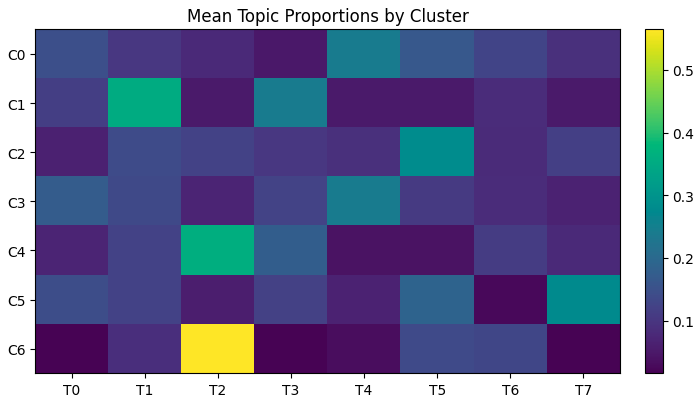
Following the generation of sentence embeddings, dimensionality reduction was performed using Uniform Manifold Approximation and Projection (UMAP) to facilitate more effective clustering. The reduced-dimensionality data was then subjected to density-based clustering utilizing the Hierarchical Density-Based Spatial Clustering of Applications with Noise (HDBSCAN) algorithm. This approach allowed for the identification of motivational clusters based on data density, while also explicitly identifying outliers. Analysis revealed that 11.2% of data points were classified as noise by HDBSCAN, indicating these points did not belong to any discernible cluster and were excluded from subsequent thematic analysis.
Validating Motivational Profiles: A Statistical Inquiry
Cluster quality was evaluated using the Silhouette Score, Adjusted Rand Index (ARI), and Normalized Mutual Information (NMI). These metrics indicated a robust separation between the identified motivational profiles based on the clustering algorithms employed. However, while the clusters themselves were internally consistent, the agreement between Latent Dirichlet Allocation (LDA) and Spectral Latent Mixture Modeling (SLM) clustering approaches was limited. Specifically, the ARI between LDA and SLM was 0.068, and the NMI was 0.163, suggesting only modest overlap in the groupings produced by each method.
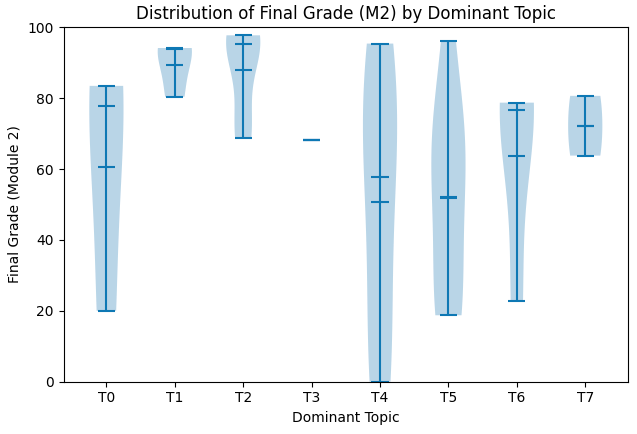
Statistical analysis failed to demonstrate a significant correlation between identified motivational topics and student performance metrics. Specifically, both Analysis of Variance (ANOVA) and the Kruskal-Wallis test yielded non-significant results when examining the association between dominant motivational topic and student grades (p = 0.182) and attendance (p = 0.127). These p-values, exceeding the conventional significance threshold of 0.05, indicate that any observed differences in grades or attendance across the motivational topic groups are likely due to random chance rather than a systematic relationship.
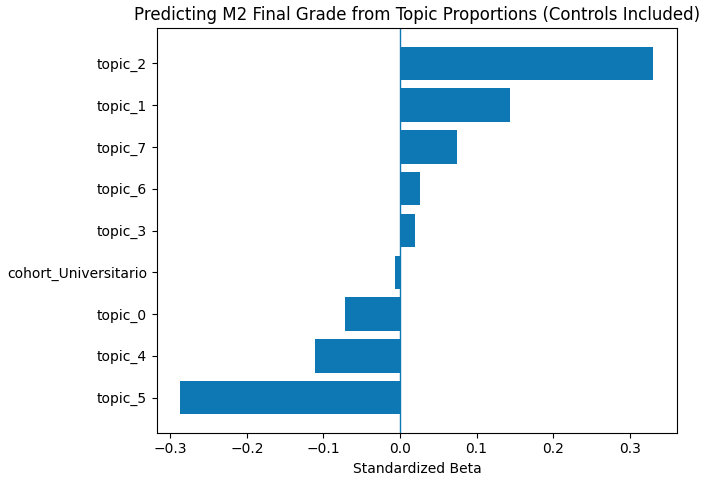
Regression analyses were conducted to quantify the predictive power of motivational topic proportions on academic outcomes. Linear Regression, used to model grades, yielded an R-squared value of 0.029, indicating that topic proportions explain only 2.9% of the variance in grades. Logistic Regression, employed to predict passing status, resulted in a pseudo-R-squared of 0.038, suggesting that 3.8% of the variance in passing or failing can be attributed to the identified motivational topics. These low R-squared and pseudo-R-squared values demonstrate a weak statistical relationship between the derived motivational profiles and objective measures of academic performance.
Beyond the Pipeline: Cultivating a Thriving STEM Ecosystem
Research consistently demonstrates a strong link between a student’s inherent enthusiasm for learning – their intrinsic motivation – and their success in STEM disciplines. This suggests that cultivating curiosity and a genuine passion for exploration is paramount, potentially outweighing traditional metrics like standardized test scores or prior knowledge. When students are driven by internal rewards – the joy of discovery, the satisfaction of problem-solving – they exhibit greater engagement, persistence, and ultimately, higher academic performance. Educators and program designers are increasingly recognizing the need to move beyond simply conveying information and instead focus on creating learning environments that spark wonder and allow students to pursue their own questions, fostering a lifelong love of STEM that extends far beyond the classroom.
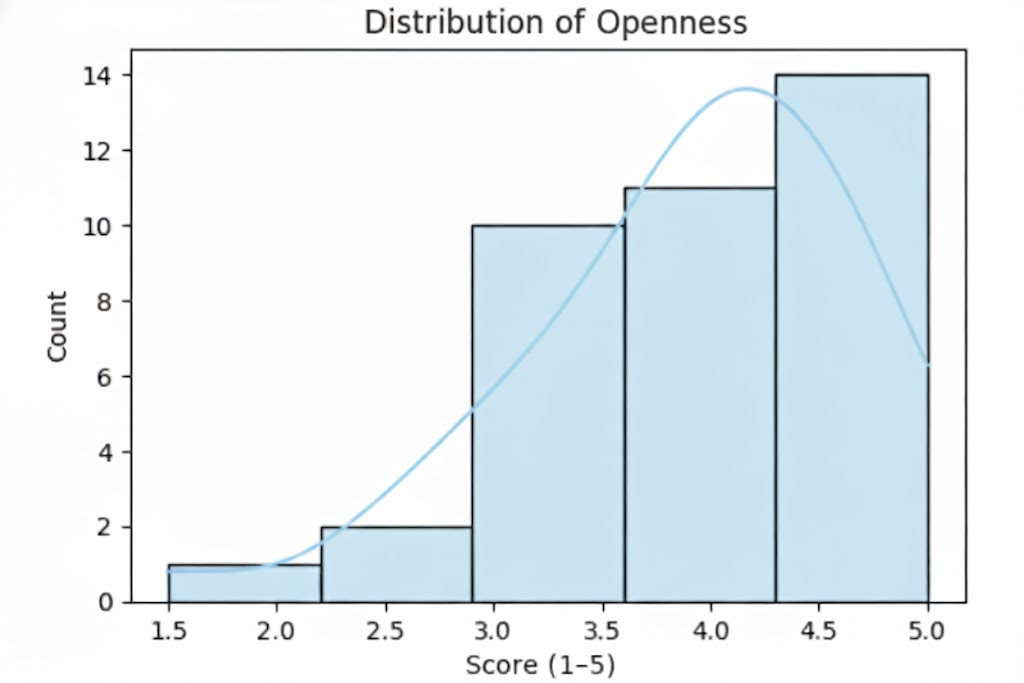
Researchers are increasingly acknowledging that academic success in STEM isn’t solely determined by innate ability or motivation, but is also shaped by fundamental personality traits. Studies incorporating the Big Five Inventory – a widely-used psychological assessment – reveal that traits like openness to experience function as significant covariates in predicting performance. This means that while intrinsic motivation demonstrably impacts outcomes, understanding an individual’s baseline openness – their imagination, intellectual curiosity, and willingness to embrace new ideas – provides a more complete and nuanced picture. By statistically controlling for openness, investigations can more accurately pinpoint the unique contribution of motivational factors and tailor educational interventions to better suit diverse learning styles and cognitive profiles, ultimately enhancing the potential for innovation and achievement.
The predictive power of intrinsic motivation and personality traits extends far beyond the initial scope of this study, offering a valuable framework for STEM programs across diverse disciplines. By integrating assessments of motivational drive alongside established personality inventories, educators can proactively identify students not simply capable of academic success, but genuinely driven by the process of discovery. This targeted approach allows for the development of tailored curricula and mentorship opportunities, fostering an environment where innate curiosity is nurtured and channeled into innovative problem-solving. Ultimately, the consistent application of this framework promises to cultivate a generation of STEM professionals characterized not only by technical skill, but also by a persistent passion for pushing the boundaries of knowledge and driving meaningful advancements.
The pursuit of predictive metrics in educational pipelines often fixates on easily quantified stability, yet this study subtly suggests such metrics are merely delayed indicators of inevitable transformation. It’s not surprising, then, that curiosity-framed language correlates with positive outcomes; the system isn’t rewarding ‘correct’ answers, but the sustained energy of inquiry itself. As Niels Bohr observed, “The opposite of a trivial truth is another trivial truth.” The researchers, through topic modeling and sentence embeddings, haven’t discovered a magic formula for success, but rather, a means of observing the subtle energetic states of a growing system-a system that will inevitably evolve beyond the initial conditions, defying simple prediction. The focus on motivation, revealed through brief responses, highlights that the system isn’t built, it’s cultivated.
The Currents Shift
This work, like all attempts to quantify the ephemeral, reveals more about the map than the territory. The correlation between expressed curiosity and performance in a demanding technical track is… predictable. What’s less certain is whether such signals cause success, or merely echo a pre-existing disposition. Every metric, however cleverly derived, is a prophecy of unintended consequences; a system designed to identify ‘motivated’ students may, in time, select for those skilled at appearing motivated. The pipeline itself will adapt to the measurement, not necessarily to genuine intellectual hunger.
The portability of the method-combining topic modeling with smaller language models-is a practical virtue, but a fleeting one. The cost of computation diminishes, while the subtlety of language does not. Future iterations will inevitably demand larger models, and with them, a corresponding increase in the opacity of the signals. One suspects the true value lies not in prediction, but in the process of continually re-evaluating what ‘motivation’ even means in the face of evolving curricula and student demographics.
Order is just a temporary cache between failures. This study doesn’t solve the problem of identifying potential, it merely shifts the point of leverage. The real work lies not in building better filters, but in cultivating ecosystems where curiosity can flourish independently of any evaluation. The question isn’t ‘who will succeed?’ but ‘what conditions allow more people to become curious?’
Original article: https://arxiv.org/pdf/2602.19659.pdf
Contact the author: https://www.linkedin.com/in/avetisyan/
See also:
- What Song Is In The New Supergirl Trailer (& What It Means For The DC Movie)
- TV legend Carol Kirkwood reveals the reasons why she decided to retire after 28 years with BBC
- Highly Anticipated Strategy RPG Finally Sets Release Date (And It’s Soon)
- Why is Tech Jacket gender-swapped in Invincible season 4 and who voices her?
- Alan Ritchson’s Reacher Future Looks Hopeful Thanks To Amazon’s 10/10 Action Thriller Series
- Way of the Hunter 2 adds PS5, Xbox Series versions
- We Need More Open World Games to Feature This Genre
- MOUSE: P.I. For Hire Loops in Caravan Palace for A Catchy New Track Ahead of April 16 Release
- Beyond the Horizon: Unveiling the Holographic Universe
- Almost Five Years, Zero Releases: Sony Has Wasted Bluepoint’s Potential
2026-02-24 21:33