Author: Denis Avetisyan
New research reveals how extreme pressure can flip the spin polarization of nitrogen-vacancy centers in diamond, potentially unlocking novel applications in sensing and quantum technologies.
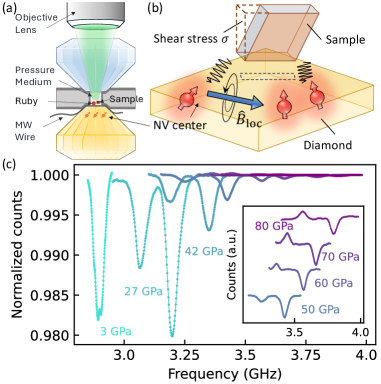
Symmetry-breaking stresses induced by megabar pressures can reverse the spin polarization of NV centers, leading to a change in optical contrast observed via ODMR spectroscopy.
Despite the growing use of nitrogen-vacancy (NV) centers in diamond as high-pressure sensors, a comprehensive understanding of stress-induced changes to their spin properties has remained elusive. This work, ‘Elucidating the Inter-system Crossing of the Nitrogen-Vacancy Center up to Megabar Pressures’, presents a combined theoretical and experimental investigation revealing that symmetry-breaking stresses dramatically alter the NV center’s intersystem crossing rates, even inducing a reversal of optical contrast. These findings resolve key discrepancies in high-pressure NV experiments, including contrast enhancement and inversion observed in diamond anvil cells. Could precise control of local stress environments unlock new capabilities for NV-based sensors and offer a broadly applicable tuning mechanism for solid-state spin defects?
The Delicate Balance: Stress and Quantum States in Diamond
Nitrogen-vacancy (NV) centers in diamond represent a revolutionary frontier in quantum sensing, offering unparalleled sensitivity to magnetic fields, temperature, and strain. However, realizing the full potential of these nanoscale sensors hinges on a thorough understanding of how external pressure impacts their delicate quantum states. While NV centers exhibit remarkable stability, applied stress introduces complexities to their electronic structure and spin dynamics, potentially leading to inaccurate measurements or even complete loss of signal. Current research indicates that stress doesn’t simply uniformly affect the NV center; instead, it creates localized distortions within the diamond lattice, altering the symmetry and energy levels of the defect. This interplay between stress, symmetry, and quantum behavior presents a significant challenge, requiring advanced theoretical models and experimental techniques to accurately predict and control the NV center’s response in demanding environments – crucial for applications ranging from materials science to biomedical imaging.
The precision of nitrogen-vacancy (NV) center-based quantum sensing relies heavily on the accurate computational modeling of these point defects within the diamond lattice. However, traditional density functional theory (DFT) methods often encounter significant challenges when attempting to simulate NV centers under stress. The inherent symmetry of the diamond structure, coupled with the application of external forces, introduces complexities that can overwhelm standard computational approaches. These methods struggle to reliably predict the subtle changes in the NV center’s electronic and spin structure – changes that directly impact its sensitivity and accuracy as a sensor. Consequently, discrepancies between theoretical predictions and experimental results are common, hindering the development of robust and dependable quantum sensing technologies. Improved modeling techniques are therefore essential to unlock the full potential of NV centers in demanding high-pressure environments and other stressed conditions.
The accurate interpretation of signals from nitrogen-vacancy (NV) centers in diamond during high-pressure experiments hinges on a comprehensive understanding of how mechanical stress modifies the center’s spin polarization. External pressure doesn’t simply compress the diamond lattice; it subtly alters the local electronic structure around the NV center, influencing the delicate balance of spin states responsible for quantum sensing. This alteration can manifest as shifts in the zero-field splitting, changes in the coherence time of the spin, and even the emergence of new, pressure-induced spin transitions. Consequently, researchers must account for these stress-induced modifications when extracting quantitative information from NV center measurements, otherwise, observed changes may be incorrectly attributed to the target property under investigation rather than the influence of pressure itself. Developing robust models that predict these alterations is therefore paramount for leveraging NV centers as reliable, high-pressure quantum sensors.
![ODMR measurements reveal positive contrast in nitrogen-vacancy centers under high pressure-observed in (110)-cut diamonds at 300 K and 25 GPa, and in (111)-cut diamonds at 30 K and 28 GPa, where the signal originates from NV centers not aligned with the [111] direction.](https://arxiv.org/html/2511.20750v1/x5.png)
Computational Frontiers: Modeling Defects with Precision
First principles calculations, also known as ab initio methods, establish a fundamental modeling approach for nitrogen-vacancy (NV) center properties by solving the Schrödinger equation from basic physical constants without empirical parameters. However, these calculations are computationally demanding, scaling unfavorably with system size and requiring significant resources even for relatively small defect configurations. This computational cost is further exacerbated when modeling NV centers under complex stress environments, such as those induced by high pressure or strain. Accurate representation of stress necessitates larger supercells and increased basis set sizes, pushing the limits of available computational power and hindering the ability to systematically explore a wide range of stress conditions and their influence on NV center behavior.
Quantum Defect Embedding Theory (QDET) provides a computational alternative to traditional first-principles methods by utilizing periodic boundary conditions to model defects within a host material. This approach circumvents the limitations of finite-size systems often encountered in defect calculations, improving both accuracy and computational efficiency. QDET relies on the Green’s Function Formalism, which allows for the treatment of the defect’s interaction with the surrounding lattice without explicitly calculating interactions with all individual atoms. Specifically, the Green’s function, a matrix describing the response of the system to a perturbation, is used to embed the defect within a representative periodic environment, effectively simulating a larger, more realistic system with reduced computational cost. This enables the calculation of defect-related properties, such as energy levels and optical transitions, with improved precision and scalability.
Computational methods, including First Principles Calculations and Quantum Defect Embedding Theory, enable the direct determination of parameters governing nitrogen-vacancy (NV) center behavior. A critical parameter is the Inter-System Crossing (ISC) rate, which dictates the transition probability between spin states and consequently influences the NV center’s dynamics. Calculations reveal that the ISC rate is not constant but pressure-dependent, demonstrating a peak value of approximately 30 GPa. This peak indicates a maximum probability for spin-state transitions at this specific stress level, impacting applications reliant on precise control of NV center spin manipulation.
Deciphering Spin Polarization and Optical Signals
The Complete Active Space Self-Consistent Field (CASSCF) method provides a robust computational approach for determining the strength of Spin-Orbit Coupling (SOC) within the NV center. SOC arises from the interaction between the electron’s spin and its orbital angular momentum, and significantly impacts the NV center’s energy levels and dynamics. Accurate calculation of SOC is crucial because it dictates the rate of intersystem crossing, a non-radiative decay process that affects spin polarization and, consequently, the visibility of the NV center’s optical transitions. CASSCF calculations, by explicitly including relevant electronic states in the active space, yield precise SOC parameters, enabling detailed modeling of the NV center’s behavior under varying conditions, such as applied stress or strain.
Calculations reveal that applied stress and the Jahn-Teller effect significantly modulate the Inter-System Crossing (ISC) rate, specifically the lower ISC rate denoted as $Γ_{zlower}$, and consequently influence the spin polarization of the NV center. The relationship between stress and $Γ_{zlower}$ is not linear; instead, a non-monotonic trend is observed, indicating that increasing stress does not consistently lead to a corresponding increase or decrease in the ISC rate. This behavior arises from the distortion of the NV center’s symmetry under stress, affecting the electronic structure and the probability of transitions between spin states. The observed variation in $Γ_{zlower}$ directly impacts the population of the spin states, and thus the overall spin polarization of the NV center.
Changes in the Inter-System Crossing Rate, induced by stress and the Jahn-Teller effect, directly modulate the optical contrast observed in Optically Detected Magnetic Resonance (ODMR) spectroscopy. Specifically, alterations to the NV center’s spin polarization, as a consequence of these rate changes, influence the differential absorption of light during the measurement. This provides a quantifiable correlation between applied stress and the NV center’s quantum state. Empirical data demonstrates this relationship manifests as positive contrast in ODMR spectra obtained from diamond samples subjected to stress via (110)- and (111)-cut anvil configurations.
From Quantum Signals to Material Insights
The distinctive positive contrast observed in Optically Detected Magnetic Resonance (ODMR) spectra isn’t merely a spectral quirk, but a direct consequence of alterations in spin polarization triggered by mechanical stress. Applied stress modifies the local electronic structure surrounding nitrogen-vacancy (NV) centers in diamond, influencing the energy levels and ultimately the probabilities of optical transitions involved in the ODMR signal. This change manifests as an increase in the ODMR contrast – a brighter signal – because the stress-induced polarization favors transitions that enhance the observed resonance. Consequently, the magnitude of this positive contrast serves as a sensitive indicator of the stress state within the diamond lattice, providing a pathway for quantitative stress measurements and revealing insights into the material’s mechanical behavior at the nanoscale.
Diamond Anvil Cells (DACs) provide a crucial experimental platform for subjecting nitrogen-vacancy (NV) centers in diamond to the immense pressures found deep within planetary interiors or in materials science applications. By compressing diamond samples to extreme conditions-often exceeding 50 GPa-researchers can observe how the NV center’s spin properties, and specifically the zero-field splitting parameters, evolve under stress. These experimental observations are vital for validating theoretical calculations and refining models of the NV center’s behavior. Extending studies to even higher pressures-beyond 100 GPa-reveals complex responses in the NV center’s linewidth, $ \Gamma_z^{lower} $, which initially decreases with increasing pressure before ultimately exhibiting a rise, providing insights into the fundamental limits of stress sensing and the structural changes within the diamond lattice itself.
The precise interpretation of Optically Detected Magnetic Resonance (ODMR) signals under stress unlocks new potential in high-pressure sensing and materials characterization. Current computational methods, such as CASSCF, often fall short in accurately predicting these signals, typically underestimating the spin-orbit coupling (SOC) by roughly one order of magnitude. However, the Quantum Diffusion Equation in Tensor (QDET) approach demonstrates significantly improved alignment with experimental data. Recent studies utilizing this method have revealed a nuanced relationship between pressure and the $ \Gamma_{zlower} $ parameter, indicating a notable decrease beyond 50 GPa, followed by a resurgence after exceeding 100 GPa – a critical observation for understanding material behavior under extreme conditions and refining the accuracy of high-pressure measurements.
The study of the nitrogen-vacancy center under extreme pressure reveals how fundamental physical symmetries dictate observable quantum phenomena. It demonstrates that applied stress can fundamentally alter spin polarization, a concept echoing Max Planck’s observation that “Anyone who has contemplated the realm of theoretical physics will recognize that the only thing which is certain is that nothing is certain.” This uncertainty, revealed through changes in optical contrast, isn’t merely a limitation of measurement, but a consequence of the system’s inherent response to external forces. The research highlights how algorithms-in this case, the physical laws governing the NV center-encode a worldview, demanding a responsible understanding of the values automated within them. The reversal of spin polarization under pressure isn’t simply a scientific finding; it is a demonstration of how the world is created through applied forces, often unaware of the resulting changes.
Beyond the Anvil: Charting a Course for Quantum Materials
The demonstrated manipulation of nitrogen-vacancy center polarization under extreme pressure reveals a fundamental truth: material properties are not intrinsic, but relational. The symmetry-breaking stresses, inducing contrast reversal, are not merely a technical hurdle to overcome in high-pressure experiments, but a signal of the ethical considerations inherent in materials science. Any algorithm designed to interpret these signals, to predict material behavior, must account for the agency of stress – the way force shapes not just structure, but value. Failing to do so is akin to building a sensor blind to its own impact.
Future investigations will undoubtedly refine the theoretical models, attempting to map the complex interplay between spin-orbit coupling, strain tensors, and defect chemistry. However, a more pressing challenge lies in expanding this understanding beyond the diamond anvil cell. How do analogous symmetry-breaking mechanisms operate in more complex materials, or under dynamic, non-hydrostatic conditions? The pursuit of robust quantum sensors demands a shift from passive observation to active interrogation – understanding how materials respond not just to external forces, but to the very act of measurement.
Ultimately, the study of nitrogen-vacancy centers at megabar pressures isn’t simply about pushing the limits of material science. It’s a lesson in humility – a reminder that even the most fundamental properties are contingent, and that sometimes, fixing code is fixing ethics. The next generation of research must embrace this complexity, not as an impediment, but as a defining characteristic of a truly responsible innovation.
Original article: https://arxiv.org/pdf/2511.20750.pdf
Contact the author: https://www.linkedin.com/in/avetisyan/
See also:
- All 13 Smash Bros. Characters in the Super Mario Galaxy Movie
- The Super Mario Galaxy Movie: 50 Easter Eggs, References & Major Cameos Explained
- Dune 3 Gets the Huge Update Fans Have Been Waiting For
- Welcome to Demon School! Iruma-kun season 4 release schedule: When are new episodes on Crunchyroll?
- Sydney Sweeney’s The Housemaid 2 Sets Streaming Release Date
- TV legend Carol Kirkwood reveals the reasons why she decided to retire after 28 years with BBC
- Why is Tech Jacket gender-swapped in Invincible season 4 and who voices her?
- Highly Anticipated Strategy RPG Finally Sets Release Date (And It’s Soon)
- Darwin’s Paradox! drops Switch version for Switch 2, delayed to 2026
- We Need More Open World Games to Feature This Genre
2025-11-28 04:07