Author: Denis Avetisyan
New research explores how violations of fundamental symmetry and the presence of exotic matter alter the geometry around charged black holes, potentially leaving observable traces in gravitational wave or electromagnetic signals.
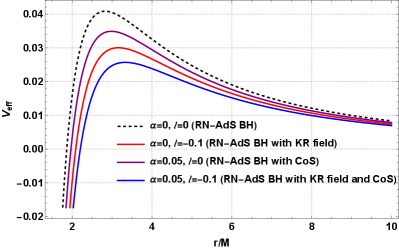
This review analyzes the effects of spontaneous Lorentz symmetry breaking and a cloud of strings on the photon sphere, innermost stable circular orbit, and event horizon of Letelier-AdS charged black holes within the framework of Kalb-Ramond gravity.
The persistent challenge of reconciling general relativity with quantum field theory necessitates exploration beyond conventional spacetime symmetries. This is the driving force behind ‘Effects of spontaneous Lorentz Symmetry breaking on Letelier-AdS charged black boles within Kalb-Ramond gravity’, a study investigating how violations of Lorentz invariance, coupled with Kalb-Ramond gravity and a surrounding cloud of strings, modify black hole spacetime. Our analysis reveals significant alterations to photon trajectories, test particle dynamics, and the resulting observable signatures, including modifications to black hole shadow geometry and quasi-normal mode frequencies. Could these effects be detectable through current or future gravitational wave and black hole imaging observations, offering a pathway to probe fundamental physics beyond the Standard Model?
Deconstructing Gravity: Beyond Einstein’s Framework
Despite its century of success, General Relativity, Albert Einstein’s celebrated theory of gravity, faces challenges when applied to the universe at its largest scales. Observations of galactic rotation curves, the accelerating expansion of the universe driven by dark\, energy, and the inferred presence of dark\, matter suggest that our current understanding of gravity may be incomplete. These cosmological puzzles have motivated physicists to explore modifications to General Relativity, not to discard it entirely, but to extend its framework. Current research focuses on introducing new fields or altering the Einstein-Hilbert action – the mathematical foundation of General Relativity – to account for these discrepancies. The goal isn’t simply to ‘fix’ the theory, but to develop a more comprehensive model that seamlessly integrates gravity with the observed cosmos, potentially revealing new physics beyond our current grasp.
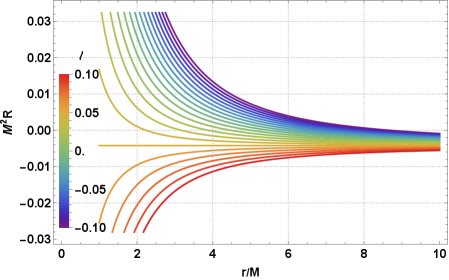
A comprehensive exploration of alternatives to General Relativity hinges on the development of sophisticated mathematical tools to describe spacetime geometry beyond the standard framework. While Einstein’s theory elegantly connects gravity to the curvature of spacetime, modifications aimed at resolving cosmological anomalies – such as dark energy and dark matter – often necessitate more complex geometric descriptions. These frameworks extend beyond the relatively simple Riemannian geometry of General Relativity, potentially incorporating torsion, non-metricity, or extra dimensions. Researchers utilize advanced mathematical constructs, including modified field equations and the analysis of higher-order curvature invariants like the R_{abcd} Riemann tensor and its contractions, to model these deviations. The ability to precisely quantify spacetime curvature through scalars like the Ricci Scalar R and the Kretschmann Scalar R_{abcd}R^{abcd} becomes even more critical, allowing for rigorous testing of alternative theories against observational data and ensuring mathematical consistency within these expanded geometric landscapes.
The very fabric of spacetime isn’t merely a passive backdrop for cosmic events, but an actively curved geometry that is gravity. This curvature isn’t a visual distortion, but a quantifiable property described mathematically by scalars such as the Ricci Scalar R and the Kretschmann Scalar K. These scalars essentially measure how much spacetime bends and warps in the presence of mass and energy. A larger Ricci Scalar indicates stronger gravitational effects in a specific region, while the Kretschmann Scalar provides a comprehensive measure of spacetime curvature, revealing the presence of gravitational waves or singularities. Consequently, understanding these scalars isn’t just an exercise in abstract mathematics; it’s fundamental to predicting the motion of objects, the bending of light, and the evolution of the universe itself, dictating everything from planetary orbits to the formation of black holes.
Re-Sculpting Spacetime: Effective Sources and Their Influence
Modifications to gravitational models are achieved by introducing effective sources which directly influence the metric function, g_{\mu\nu}, thereby defining the spacetime geometry. These sources are mathematical constructs representing energy-momentum distributions not accounted for in standard General Relativity. Altering the metric function changes the paths of geodesics, affecting how objects move under gravitational influence and consequently altering observable phenomena. The introduction of these effective sources allows for exploration of deviations from the predictions of Einstein’s field equations without necessarily invoking entirely new fundamental theories; instead, they represent a phenomenological approach to understanding potential gravitational anomalies or the influence of currently unmodeled physical processes on spacetime curvature.
Modifications to spacetime geometry can be achieved through the introduction of effective sources that alter the metric function. These sources include an Effective Cosmological Constant, representing a uniform energy density throughout space, and an Effective Charge, which mimics the gravitational effects of a concentrated charge distribution. Furthermore, a Cloud of Strings-hypothetical extended objects-can contribute to the overall gravitational field, differing from point-mass sources by introducing a non-negligible spatial extent and potentially altering the long-range behavior of gravity as described by G_{\mu\nu}. These effective sources provide a means of investigating deviations from General Relativity without necessarily invoking entirely new gravitational theories.
Kalb-Ramond gravity, a modification of general relativity, introduces a non-metric tensor field, the Kalb-Ramond field B_{\mu\nu}, which couples to the electromagnetic field strength. This coupling allows for the exploration of Lorentz symmetry breaking through the generation of a preferred direction in spacetime. Specifically, the presence of the B_{\mu\nu} field can induce a birefringence effect on photons, meaning the speed of light becomes direction-dependent, violating a core tenet of special relativity. Experimental searches for such violations focus on observing variations in the speed of light based on photon polarization and direction, providing potential evidence for Lorentz symmetry breaking predicted by Kalb-Ramond gravity and related theories.
Shadows and Orbits: Probing Gravity’s Footprint
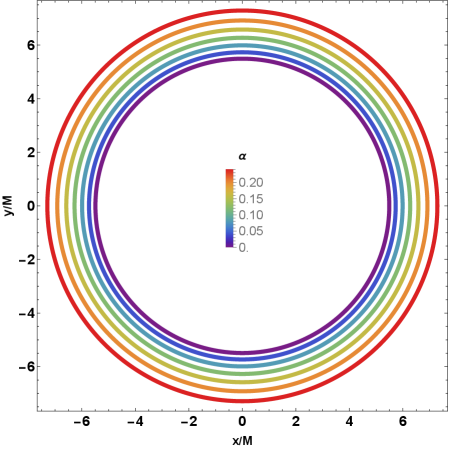
The black hole shadow, a consequence of strong gravitational lensing, is directly influenced by spacetime geometry; deviations from standard general relativity modify both the shadow’s size and shape, offering a potential observational probe of alternative theories of gravity. For a non-rotating, spherically symmetric Schwarzschild black hole, the photon sphere – the circular orbit where photons can travel in any direction – defines a radius of 3\sqrt{3}M, where M represents the black hole’s mass. This photon sphere radius is directly linked to the apparent size of the black hole shadow; alterations to spacetime, such as those introduced by modifications to gravity or the presence of exotic matter, will change this radius and, consequently, the shadow’s observed dimensions. Precise measurements of the black hole shadow, therefore, provide constraints on parameters defining these modified spacetimes.
The Innermost Stable Circular Orbit (ISCO), a critical radius defining the inner edge of accretion disks around black holes, is demonstrably altered by modifications to spacetime. Specifically, calculations reveal a quantifiable relationship between the ISCO radius (r_{ISCO}) and parameters characterizing Lorentz symmetry breaking and the presence of a cloud of strings. For a Schwarzschild black hole, r_{ISCO} = 6M, however, deviations from this value are predicted as the strength of Lorentz violation increases, or with changes to the cloud of strings’ tension and density. These alterations to r_{ISCO} directly impact the efficiency of accretion and the observed spectra of accreting black holes, providing a potential observational probe for these exotic spacetime modifications.
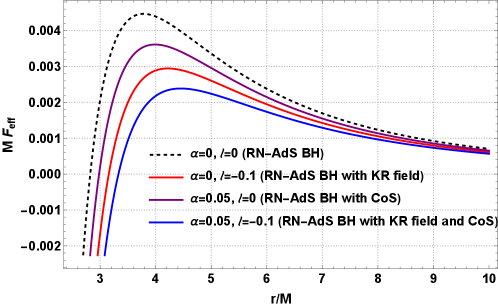
Analysis of the Effective Potential, V_{eff}(r, \theta), allows for the prediction of alterations in orbital dynamics around modified black holes. This potential, derived from the geodesic equation, incorporates both gravitational and any additional forces arising from modifications to general relativity, such as those stemming from Lorentz symmetry breaking or string cloud parameters. By examining the minima and stability of orbits within this potential, we can determine the Innermost Stable Circular Orbit (ISCO). Shifts in the ISCO radius directly correlate with changes in the orbital frequencies and stability of particles, impacting the observed dynamics of accretion disks and providing a measurable signature of the modifications to spacetime. Specifically, a decrease in the ISCO radius indicates increased orbital frequencies and a potentially higher rate of energy extraction from the system.
Mapping the Unknown: New Tools for a New Cosmology
Duan’s Phi-Mapping Theory offers a novel approach to characterizing black hole solutions by leveraging the principles of topology – the study of shapes and their properties. This method doesn’t focus on the specific geometry of a black hole, but rather on the relationships between different points within its spacetime, creating a ‘map’ of its essential features. By analyzing these maps, physicists can identify subtle changes – phase transitions – that indicate shifts in the black hole’s fundamental properties, such as its mass, charge, or rotational speed. These transitions are critical because they reveal how black holes respond to external influences and could potentially explain the evolution of these enigmatic objects over cosmic timescales. The power of Phi-Mapping lies in its ability to detect these transitions even when traditional geometric methods fail, offering a more robust and comprehensive understanding of black hole behavior and potentially uncovering new classes of black hole solutions previously hidden from view.
Investigating black hole solutions benefits from examining them within the context of Anti-de Sitter (AdS) spacetime, a unique geometrical construct possessing constant negative curvature. This framework allows physicists to explore how gravity behaves in environments dramatically different from our own universe, which has a generally positive curvature. The negative curvature inherent in AdS spacetime simplifies certain calculations and offers a novel perspective on black hole thermodynamics and stability. Furthermore, AdS spacetimes provide a holographic duality with conformal field theories, suggesting a deep connection between gravity and quantum mechanics; this allows researchers to model gravitational phenomena using more tractable quantum systems. Consequently, studying solutions within AdS spacetime isn’t merely an abstract mathematical exercise; it’s a powerful tool for gaining insights into the fundamental nature of gravity and potentially resolving long-standing paradoxes in theoretical physics.
The exploration of black hole solutions, facilitated by techniques like Phi-Mapping, extends beyond theoretical curiosity, offering a pathway to probe gravity’s behavior in the most extreme cosmic conditions. Current research suggests these findings have tangible implications for understanding the universe’s evolution, particularly regarding fundamental symmetries like Lorentz invariance. Subtle violations of Lorentz symmetry, if they exist, could manifest in the properties of black holes and, crucially, be constrained by observational data-specifically, the detailed shape of the black hole shadow. Moreover, alternative theories proposing exotic structures around black holes, such as ‘clouds of strings’, are also subject to observational tests through shadow analysis, allowing scientists to refine or rule out these models. This interplay between theoretical advancements and observational astronomy promises a deeper comprehension of gravity and the fundamental laws governing the cosmos.
The investigation into Letelier-AdS charged black holes, particularly concerning spontaneous Lorentz symmetry breaking, exemplifies a dedication to dismantling established frameworks to reveal underlying mechanisms. Just as a sculptor chips away at stone to reveal a form, this research probes the boundaries of known physics, challenging the assumed homogeneity of spacetime. Leonardo da Vinci observed, “Simplicity is the ultimate sophistication.” This principle resonates deeply; the pursuit of understanding often requires stripping away complexity to expose the fundamental elegance governing these exotic gravitational systems, even if it means questioning the very foundations upon which current models are built. The analysis of modified photon spheres and test particle dynamics isn’t simply about refining calculations, but about reverse-engineering the universe’s blueprint.
Where Do We Go From Here?
The exercise, predictably, reveals more questions than answers. This particular dismantling of Lorentz symmetry, grafted onto a charged AdS black hole and complicated by a stringy atmosphere, serves mostly to highlight how little is truly understood about the universe’s foundational rules. The observed modifications to the photon sphere and innermost stable circular orbit are, after all, merely consequences of the initial breakage – a carefully chosen deformation. The real puzzle isn’t what happens when symmetry falters, but why it should in the first place. Is this spontaneous breaking a fundamental aspect of quantum gravity, or simply a mathematical artifact, a ghost in the AdS machine?
Future work will undoubtedly refine the model, perhaps incorporating more realistic string configurations or exploring different symmetry-breaking mechanisms. However, a more fruitful approach may lie in shifting the focus. Rather than imposing violations of Lorentz invariance, the challenge becomes devising experiments – and the Event Horizon Telescope offers a tantalizing, if indirect, path – to detect them. The theoretical edifice is only as strong as its empirical foundation, and until a genuine signal emerges, these explorations remain elegant thought experiments, meticulously tracing the cracks in a potentially illusory structure.
The ultimate irony, of course, is that the search for symmetry breaking is, itself, a search for deeper, hidden symmetries. Perhaps the universe isn’t dismantling its rules, but revealing a more complex set, one that requires a complete re-evaluation of the game. The black hole, it seems, continues to offer not answers, but invitations to disassemble everything known.
Original article: https://arxiv.org/pdf/2601.10303.pdf
Contact the author: https://www.linkedin.com/in/avetisyan/
See also:
- The Super Mario Galaxy Movie: 50 Easter Eggs, References & Major Cameos Explained
- 10 Best Free Games on Steam in 2026, Ranked
- Surprise Isekai Anime Confirms Season 2 With New Crunchyroll Streaming Release
- Sydney Sweeney’s The Housemaid 2 Sets Streaming Release Date
- Skate 4 – Manny Go Round Goals Guide | All of the Above Sequence
- Why is Tech Jacket gender-swapped in Invincible season 4 and who voices her?
- Welcome to Demon School! Iruma-kun season 4 release schedule: When are new episodes on Crunchyroll?
- 10 Best Supporting Actress Oscar Wins That Are Indisputable
- Highly Anticipated Strategy RPG Finally Sets Release Date (And It’s Soon)
- Forza Horizon 6 ‘Prologue’ gameplay
2026-01-17 11:03