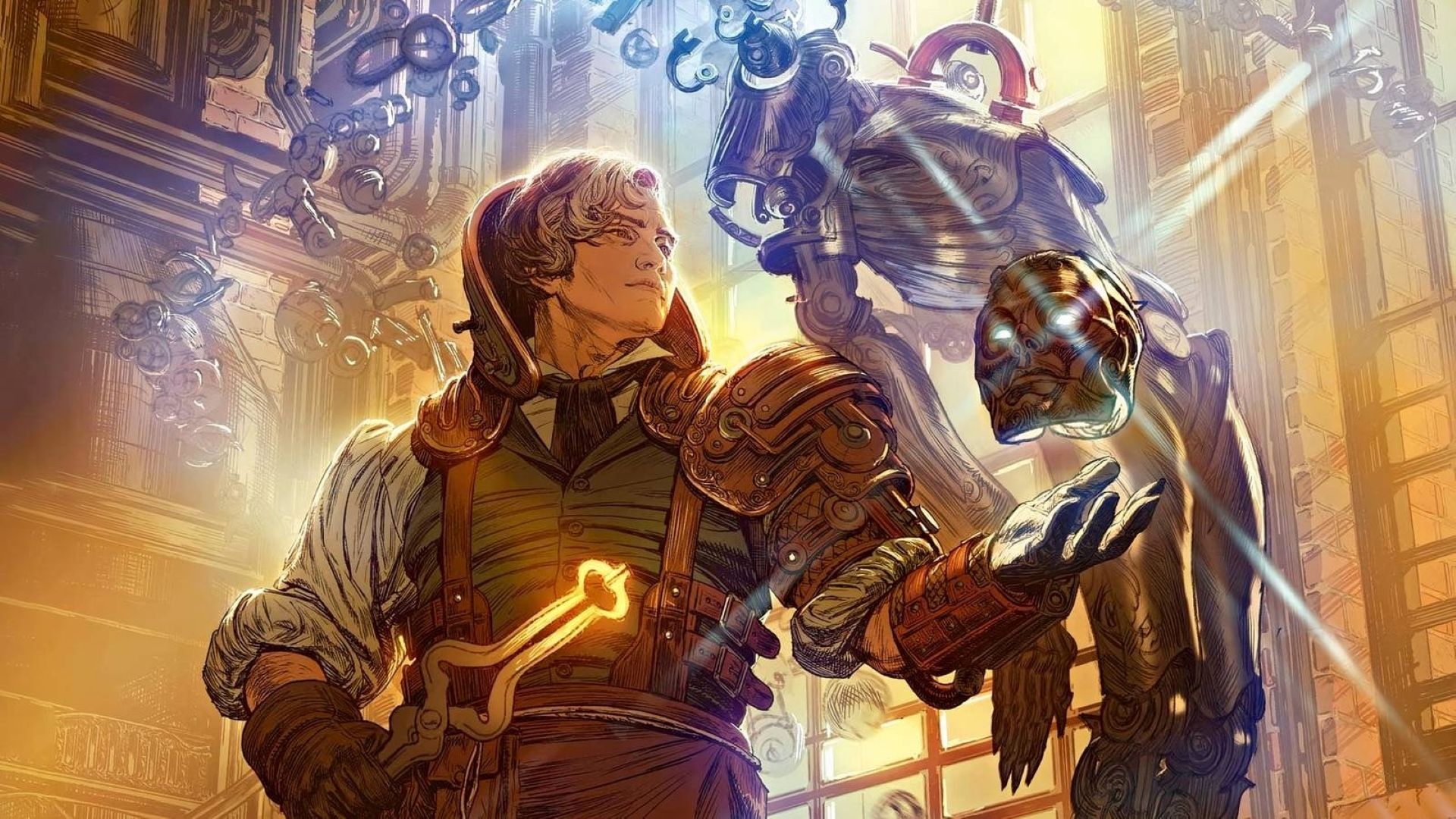
The new sourcebook, Eberron: Forge of the Artificer, doesn’t relaunch the Eberron campaign setting, but rather refreshes and modernizes it for the current 5th Edition rules. It also addresses some of the setting’s previous weaknesses.
Eberron is a unique setting for Dungeons & Dragons, blending magic with technology like trains and airships. It has a steampunk feel, meaning it combines fantastical elements with advanced, often gear-driven, inventions.
Although it hasn’t become as widely popular as the Forgotten Realms – particularly since the success of Baldur’s Gate 3 – Eberron still has a dedicated fanbase who appreciate its unique approach to the Dungeons & Dragons universe.
Eberron: Forge of the Artificer Transforms a D&D Class
The book Eberron: Forge of the Artificer isn’t a complete guide to the Eberron campaign setting. Instead, it’s designed to be used alongside the 2019 book, Eberron: Rising from the Last War, which provides a more detailed look at the world’s history and background.
This book mainly provides updated rules, focusing on character choices. The section for Dungeon Masters helps create adventures tied to the setting’s unique features, expands on airship combat, and introduces new possibilities for building and customizing Bastion strongholds.
The first new content for Eberron: Forge of the Artificer is a revised version of the Artificer class, one of the few core classes in Dungeons & Dragons not originally published in the Player’s Handbook.
Artificers combine magic with technology. While they don’t have as many traditional spells as Wizards, they compensate with unique abilities and a flexible range of magical options. Recently, the class has been redefined by its strong focus on creating and utilizing magical items, which are now central to what it means to be an Artificer.
A key update for the Artificer class involves swapping the Infuse Item ability for Replicate Magic Item. This lets players craft potent equipment with some advance planning. Later on, they can dismantle these items to gain other benefits, like regaining spell slots.
Replicate Magic Item is a powerful skill that’s now central to playing the Artificer class. As Artificers gain experience and level up, they learn more “plans,” which let them create a wider variety of magical items.
Okay, so as a fan, I’ve been thinking about the Artificer class. They might not be the best at straight-up healing like a Cleric, or stacking buffs like a Bard, but they can seriously boost the whole party’s power! It really comes down to how willing they are to share their creations and gear with everyone else – that’s where they really shine and make a difference.
Replicate Magic Item might be a little too powerful, so Dungeon Masters may want to review what an Artificer can create with it before allowing it in their campaign. Letting players instantly get items like a Wand of Secrets or Sending Stones could disrupt the DM’s planned storyline, and this problem could become more frequent as the game goes on.
A new Artificer class, the Cartographer, has been added, and they use magical maps to navigate and explore. While the Cartographer has some impressive skills, especially useful in campaigns focused on exploration, it feels more thematically suited to the Ranger class than the Artificer.
The Artificer update is the main feature of Eberron: Forge of the Artificer, significantly improving this unique class. The update modernizes the Artificer to match the rules and design found in the 2024 Player’s Handbook.
Eberron: Forge of the Artificer Species & Dragonmarks Have Changed
Dragonmarks are a central feature of the Eberron world – magical symbols that appear on people at birth and give them special abilities if they learn to control them. The recent book, Eberron: Forge of the Artificer, has updated how Dragonmarks work to fit with the new character Backgrounds. Now, when creating a character, players can choose to gain a Dragonmark instead of an Origin Feat at the very beginning of the game, at level 1.
A major improvement to Dragonmarks is how widely available they now are. In past versions of Eberron, Dragonmarks were limited to certain races—for example, only halflings could possess the mark of House Jorasco.
Although the backstory connects most Dragonmarks to certain families or races, the game rules are flexible, giving players a lot of choice in which ones they use.
Similar to the school-based Feats from Strixhaven, many Dragonmark Feats grant characters a limited selection of spells, which is very helpful for spellcasters. These Feats are so useful that players are strongly encouraged to choose them, and they’re a great way to learn about the world they’re set in.
The campaign setting Eberron: Forge of the Artificer features revised versions of four player races: Changeling, Kalashtar, Shifter, and Warforged. It’s worth noting that the Changeling and Shifter races were previously updated in the sourcebook Mordenkainen Presents: Monsters of the Multiverse.
Warforged are now treated like any other creature when it comes to healing. Unlike some other constructs, there’s no special explanation needed for why healing magic works on them, because the Cure Wounds spell now heals any creature the caster touches, regardless of whether it’s a construct or not.
The Kalashtar, already known as a strong race, have received some helpful updates. They now have an easier time resisting effects that target their personality and mental abilities, their telepathic Mind Link ability is clearer, and they can pick up a new skill each day after finishing a long rest.
It’s a bit of a letdown that the Changeling and Shifter haven’t been significantly updated. The Shifter gets a small benefit to Charisma checks when transformed, but that’s all. This felt like a good opportunity to create fresh takes on these creatures, different from those in Mordenkainen Presents: Monsters of the Multiverse, and it’s disappointing that their changes are so minor.
The Khoravar is a new option for players in Eberron: Forge of the Artificer, and it’s essentially a reimagining of the Half-Elf. Both Half-Elves and Half-Orcs were left out of the latest Player’s Handbook, but the Khoravar brings a version of the Half-Elf back into the game.
The Khoravar is slightly more powerful than a standard Half-Elf. It gains a free, basic spell from the Cleric, Druid, or Wizard spell lists, and can automatically avoid being knocked unconscious once per day after a long rest. While these are improvements, the difference isn’t significant.
Eberron Isn’t Great for New D&D Players
As we’ve discussed, Eberron: Forge of the Artificer doesn’t provide a complete picture of the Eberron setting. The book often directs players to Rising from the Last War for additional information, which is a drawback for newcomers. Ideally, a comprehensive sourcebook should offer a detailed exploration of the world and its backstory, and this book doesn’t quite deliver that.
The story is divided into three main parts: “Sharn Inquisitives,” which focuses on detectives solving crimes; “Dragonmark Intrigue,” centered around wealthy criminals and their conflicts; and “Morgrave Expeditions,” which involves exploring ancient ruins and searching for treasure.
As a big fan of Eberron, I’m really excited about the ‘Dragonmarked Intrigue’ chapter! It finally brings Renown rules to the setting, which is awesome because it means actually getting rewarded for helping out different factions. It’s cool that these rules were first introduced in the new Dungeon Master’s Guide, so it feels like a natural extension of everything.
Being part of a dragonmarked house offers a significant advantage, as the political complexities of these powerful families are impossible to overlook. In Eberron, everyone inevitably gets drawn into choosing a side, and the dragonmarked houses are central to that dynamic.
Morgrave Expeditions revisits the Group Patron system from Tasha’s Cauldron of Everything, using Morgrave University as a central hub for players. The university’s staff offer quests and adventures. This is a standout feature from Eberron: Forge of the Artificer because it’s easily adaptable to almost any campaign setting with very little effort from the Dungeon Master.
These three campaign chapters provide only basic frameworks for the noble Houses and factions within Eberron. While they include a few new creature stats, Dungeon Masters looking for ready-to-use content will find it somewhat limited.
This book really suffers from not including enough information from Eberron: Rising from the Last War. It feels more like it’s meant for people who already know and love the setting, rather than being a good way to introduce newcomers to it.
Eberron Now Has Expanded Airship Rules
Look, there’s absolutely nothing stopping me from throwing airships into my D&D game – especially if I’m running a Spelljammer campaign. But honestly, they’d just be something I made up as the DM. It’s actually pretty easy to explain why they exist in a fantasy world, though. I could just say some powerful wind elementals or genies magically lifted the ship into the air. Problem solved!
As a longtime D&D player, I’ve always loved the Eberron setting, and honestly, airships are huge there. They’re just a fundamental part of the world! So, it’s awesome to see that the new Eberron: Forge of the Artificer book gives them a really thorough rules overhaul – it totally makes sense, and I’m excited to see how it plays out.
The rules for airships are a more developed take on the ship rules from Spelljammer, which were known for being somewhat basic and incomplete in the 5th Edition of Dungeons & Dragons. The Eberron: Forge of the Artificer sourcebook really improves the experience, making airships and combat feel unique and giving players clear incentives to improve their vessels.
The game now features more than just airships – there are also updated rules for player bases called Bastions. These Bastions, detailed in the new Dungeon Master’s Guide, serve as a home base between adventures and can be improved and customized.
The Eberron: Forge of the Artificer expansion added a new feature: Bastions, which are essentially mobile fortresses that travel with the players. While powerful and useful as adventure bases, they are costly to acquire and keep running, and their presence will significantly impact the way campaigns are played.
If players can easily hire skilled mercenaries and support staff, they’ll be prepared for many of the challenges the Dungeon Master presents.
While a mobile base isn’t a new idea – the Turn of Fortune’s Wheel campaign had something similar – that was built specifically around it, much like most Spelljammer material. Having a moving base could create challenges, but it gives the Dungeon Master interesting options, and these rules connect nicely to the Renown system introduced in the book, making them feel like a natural part of the world.
The biggest problem with Eberron: Forge of the Artificer is that it feels like an add-on rather than a complete guide. If you want to run a campaign in Eberron, you’ll still need the original book to fully understand the setting.
This book has many helpful rules and improvements that can be used in different game worlds, making it worthwhile, especially for players. However, it only provides part of what you need to fully experience the Eberron setting.
Read More
- Gold Rate Forecast
- Looks Like SEGA Is Reheating PS5, PS4 Fan Favourite Sonic Frontiers in Definitive Edition
- Arknights: Endfield – Everything You Need to Know Before You Jump In
- Dune 3 Gets the Huge Update Fans Have Been Waiting For
- Hazbin Hotel Secretly Suggests Vox Helped Create One of the Most Infamous Cults in History
- Jack Osbourne Shares Heartbreaking Tribute to Late Dad Ozzy Osbourne
- 22 actors who were almost James Bond – and why they missed out on playing 007
- 5 Weakest Akatsuki Members in Naruto, Ranked
- Action Comics #1096 is Fun Jumping-On Point for Superman Fans (Review)
- Every Upcoming Transformers Movie: Release Dates, Details, & Everything We Know
2025-12-10 22:15