Author: Denis Avetisyan
A new study provides the first detailed look at how X-ray emissions change over time in the aftermath of a star being torn apart by a black hole.
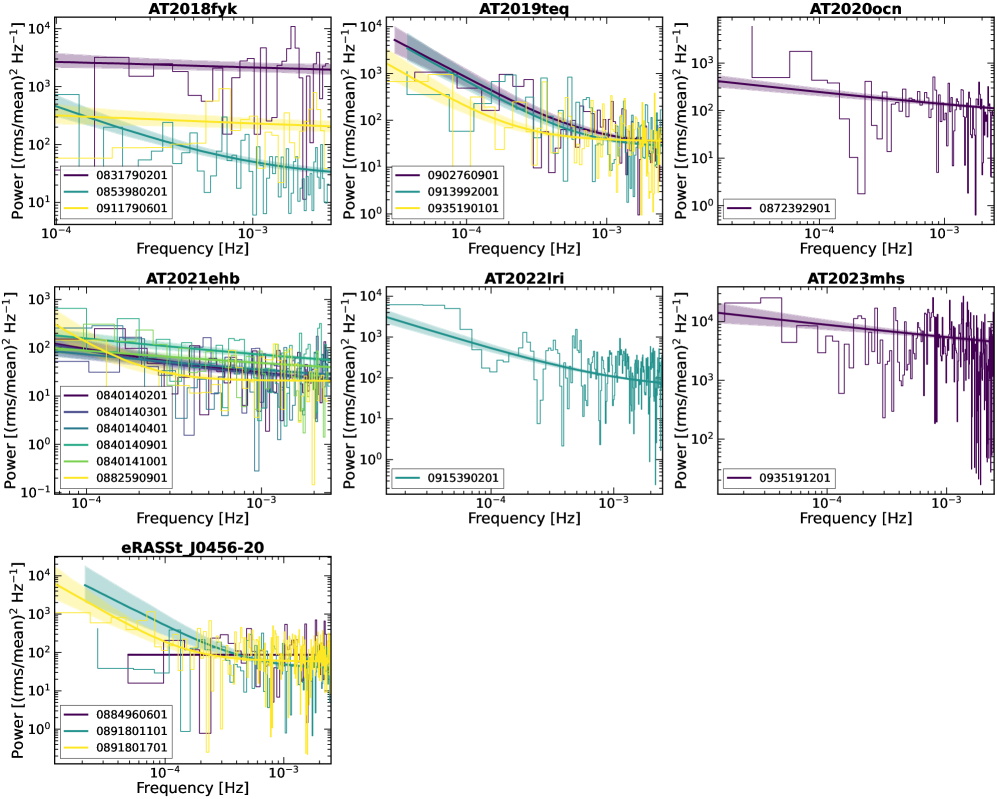
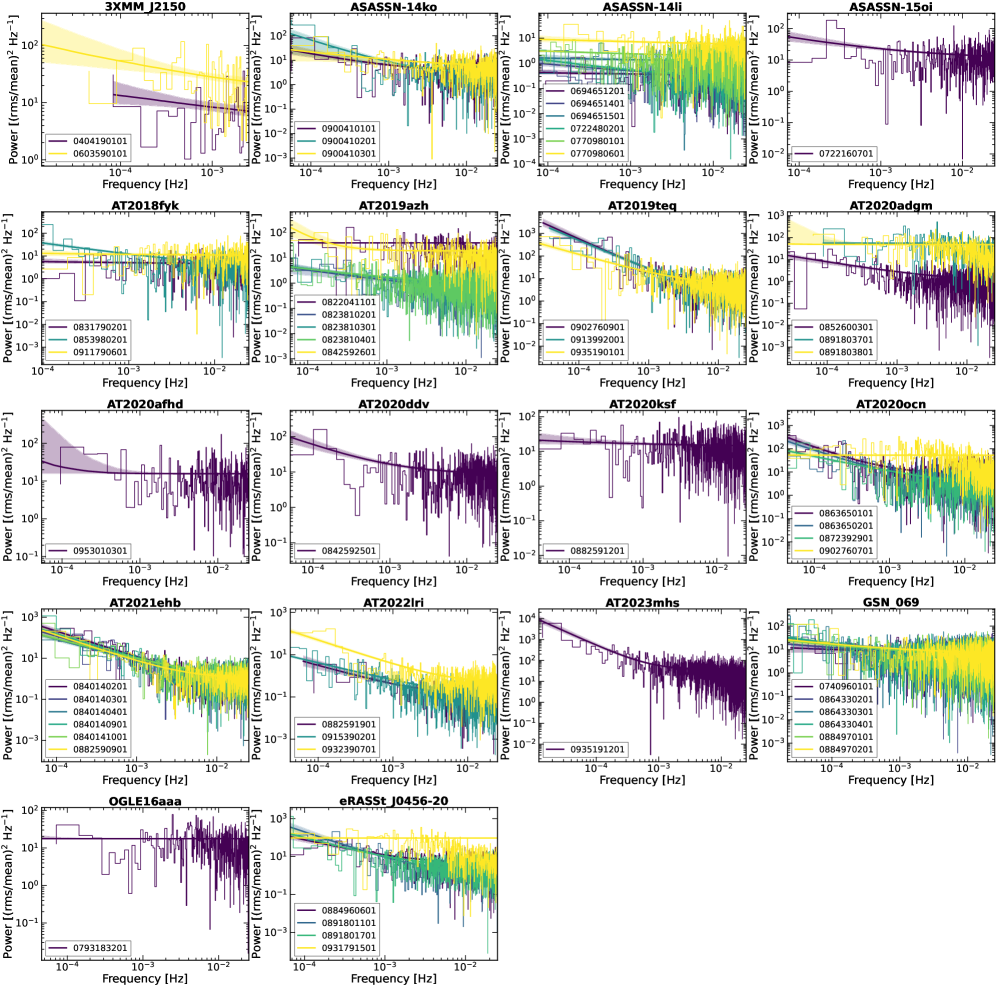
Systematic analysis of X-ray spectral-timing properties reveals distinct variability patterns in tidal disruption events compared to active galactic nuclei, providing insights into the structure and dynamics of TDE accretion disks and coronae.
While accretion onto supermassive black holes is well-studied in active galactic nuclei (AGN), the dynamics of newly formed accretion flows remain poorly understood. This paper, ‘X-ray Spectral-Timing Properties of Tidal Disruption Events’, presents a systematic analysis of X-ray variability in tidal disruption events (TDEs) to probe the microphysics of these nascent systems. We find that TDEs exhibiting hard X-ray coronae display steeper power spectral densities and greater variability than those dominated by thermal emission, differing significantly from established AGN behavior. These results suggest a unique origin and evolution for coronae in TDEs-but how do these transient accretion flows ultimately connect to the long-term evolution of supermassive black holes?
The Allure of the Abyss: Engines at the Galactic Core
At the heart of most, if not all, large galaxies lies a supermassive black hole, a gravitational behemoth with a mass millions to billions of times that of our Sun. These aren’t simply cosmic vacuum cleaners; they are remarkably efficient engines of energy production. Material drawn towards the black hole doesn’t fall directly in, but instead forms a swirling disk, and it is the friction and compression within this disk that generates tremendous heat and radiation. This process releases energy across the electromagnetic spectrum-from radio waves to visible light and even
The phenomenal energy output of supermassive black holes isn’t a direct result of the black hole itself, but rather from the material it consumes. Surrounding these gravitational behemoths are accretion disks – vast, swirling structures composed of gas, dust, and other cosmic debris. As this material spirals inward, it doesn’t fall directly into the black hole; instead, it orbits faster and faster, colliding with itself and generating immense friction. This frictional heating raises the temperature of the disk to millions of degrees, causing it to glow brilliantly across the electromagnetic spectrum. The energy released from this process – a consequence of gravitational potential energy being converted into heat and light – is what powers the intense luminosity observed from the centers of galaxies, far exceeding the output of even billions of stars.
The intense activity surrounding black holes isn’t directly visible, but rather revealed through the radiation emitted by the material swirling around them in accretion disks. These disks glow across the entire electromagnetic spectrum, from radio waves to gamma rays. Thermal emission, produced by the disk’s heated material, provides information about its temperature and structure, while non-thermal emission – generated by highly energetic particles accelerated in magnetic fields – unveils the presence of powerful jets and extreme particle physics. By carefully analyzing the characteristics of this radiation – its intensity, spectral shape, and polarization – astronomers can effectively map the physical conditions within the accretion disk, including temperature gradients, density profiles, and magnetic field strengths, ultimately painting a picture of the engine powering these cosmic behemoths.

Whispers from the Abyss: Decoding Variability
X-ray emission serves as a primary diagnostic for studying accretion disks around black holes due to its direct relation to the extreme temperatures and physical processes occurring within these structures. However, the observed X-ray flux is rarely constant; instead, it exhibits substantial temporal variability across a wide range of timescales. This variability originates from numerous physical processes within the accretion disk, including instabilities, turbulence, and localized heating events. Consequently, analyzing X-ray data requires sophisticated statistical techniques to disentangle these contributing factors and accurately characterize the underlying disk properties; simply measuring the average flux provides an incomplete and potentially misleading picture of the system’s behavior.
Power Spectral Density (PSD) analysis is a technique used to decompose the observed fluctuations in X-ray emission from accretion disks into their constituent frequencies and amplitudes, thereby revealing the underlying physical processes driving the variability. The PSD essentially quantifies the power, or variance, of the X-ray signal as a function of frequency; different physical mechanisms contribute distinct spectral signatures. For example, broad-band noise often indicates turbulent motions within the disk, while quasi-periodic oscillations (QPOs) suggest instabilities or orbital dynamics. The slope of the PSD, often denoted as
Power Spectral Density (PSD) analysis of X-ray emission provides insights into the physical processes within accretion disks by characterizing the frequency and amplitude of variability. Turbulence within the disk is a primary driver of this variability, and its presence is revealed through the PSD slope, denoted by α. Observations indicate that Tidal Disruption Events (TDEs) exhibit significantly shallower PSD slopes, with α values ranging from 0.1 to 1.2, compared to Active Galactic Nuclei (AGN) which typically have α values around 2. This difference in α values suggests distinct turbulent properties or variability mechanisms operate in TDEs versus AGN, potentially related to the different accretion flow structures and dynamics in each system.
Mapping the Darkness: Methods for Analysis
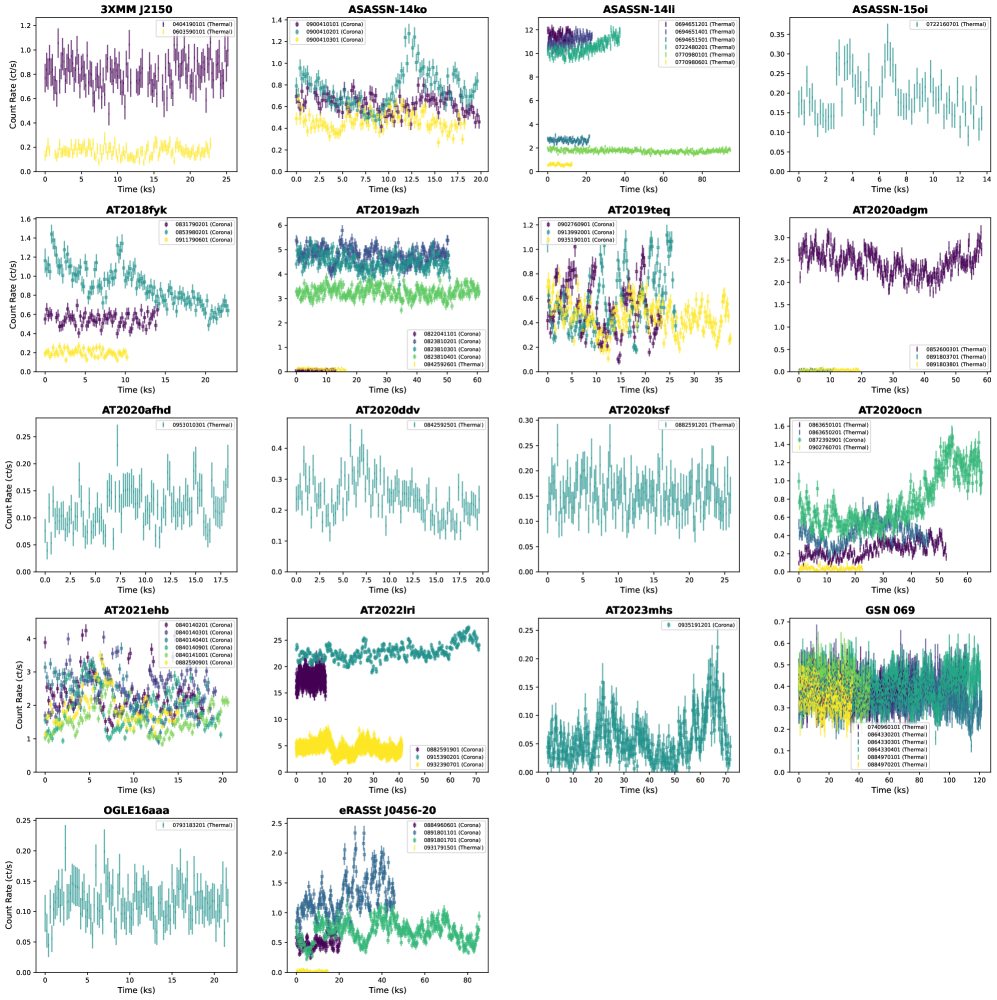
XMM-Newton is a space observatory utilizing X-ray telescopes to generate light curves, which are graphical representations of X-ray intensity as a function of time. These light curves are fundamental to analyzing variable X-ray sources, allowing researchers to identify and characterize phenomena such as flares, eclipses, and pulsations. The telescope’s large collecting area and high sensitivity enable the detection of faint or rapidly varying sources, providing data crucial for studying black holes, neutron stars, and active galactic nuclei. Data acquired by the telescope’s instruments, including the European Photon Imaging Camera (EPIC) and Reflection Grating Array (RGA), are processed to create these light curves, which serve as the primary input for subsequent timing and spectral analyses.
Spectral timing is an analytical method in X-ray astronomy that moves beyond analyzing energy spectra or temporal variations independently; it simultaneously considers both to provide a more complete characterization of X-ray emission. Traditional spectral analysis determines the distribution of energy within the X-ray photons, while timing analysis examines variations in the intensity of X-ray emission over time. Spectral timing integrates these datasets, allowing researchers to identify relationships between energy and time, such as the energy dependence of variability or the evolution of spectral features with time. This combined approach is particularly useful for studying rapidly variable sources, like accreting compact objects, where changes in the spectrum occur on timescales of seconds or even milliseconds, enabling a more detailed understanding of the physical processes at play.
Astronomical data reduction and analysis pipelines increasingly utilize Astropy, a core Python package providing standardized tools and data formats for the astronomical community. Astropy facilitates tasks such as file I/O, data manipulation, and astronomical coordinate transformations. Its modular design allows for easy integration with other scientific Python packages, and it includes specialized routines for common astronomical operations like handling FITS files, performing unit conversions, and managing astronomical coordinates. Furthermore, Astropy supports a wide range of astronomical data types and provides functionality for statistical analysis and modeling, enabling researchers to efficiently process and interpret complex datasets obtained from telescopes like XMM-Newton.
The Echo of Chaos: Power Laws and Accretion
The prevalence of power law shapes in power spectral densities (PSDs) of accreting systems points to a fundamental mechanism driving their observed fluctuations: a cascading energy release across a vast range of scales. This isn’t a single, coherent burst of energy, but rather an initial input that breaks down into successively smaller and faster variations, much like a waterfall fragmenting into countless droplets. The resulting PSD exhibits a characteristic
The characteristic power-law distribution frequently observed in the power spectral densities of accreting systems points to a fundamental role for turbulence within the accretion disk. This isn’t simply random motion; instead, energy cascades down through a range of scales, from large-scale instabilities to smaller, more chaotic eddies. This turbulent cascade directly fuels the fluctuations in X-ray emission, creating the observed variability. Essentially, the disk isn’t emitting a steady glow; rather, localized heating and cooling events, driven by turbulence, contribute to the flickering observed as X-ray variability. The prevalence of power-law shapes suggests this turbulent process is a common and potentially universal feature of accretion, regardless of the specific system-be it a black hole, neutron star, or protostar-allowing for a unified understanding of how these objects produce their observed X-ray signatures.
Recent investigations of Tidal Disruption Events (TDEs) demonstrate correlation timescales – the duration over which variations in brightness persist – consistently fall below 1000 seconds. This positioning between the dynamical timescale, dictated by orbital motion within the disrupted star’s remains, and the thermal timescale, governing heat distribution, offers crucial insight into the turbulent processes at play within the accretion disk formed after the disruption. The observed timescales suggest turbulence isn’t dominated by either purely orbital or thermal effects, but rather a complex interplay between them. Furthermore, a clear positive correlation has been established between the centroid and width of spectral lines, and the temperature of the disk in sources exhibiting outflows; this connection underscores the strong coupling between the accretion disk’s characteristics and the launching of these energetic outflows, suggesting a shared origin and a fundamental relationship between energy dissipation and material ejection.
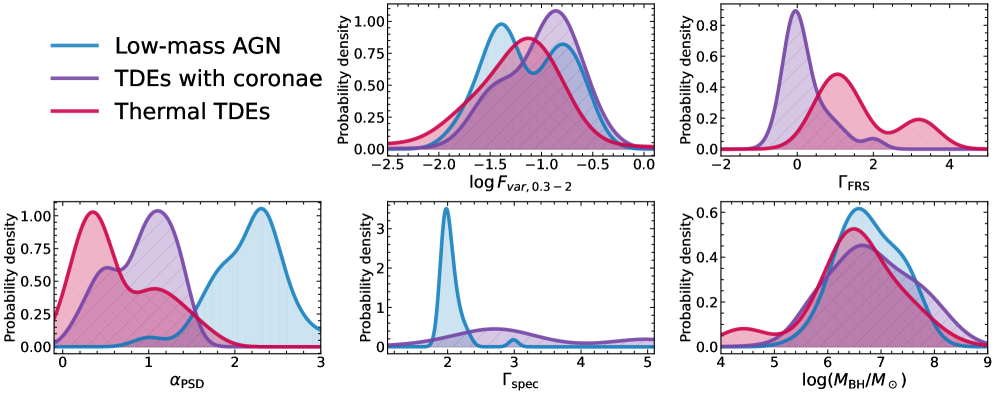
The analysis of X-ray spectral-timing properties in tidal disruption events reveals a universe that resists easy categorization. Each measurement, as the data painstakingly demonstrates, is a compromise between the desire to understand the corona and accretion disk dynamics, and the reality that refuses to be understood. It seems fitting, then, to recall Albert Einstein’s observation: “The most incomprehensible thing about the world is that it is comprehensible.” This paper illuminates the subtle distinctions between TDEs and active galactic nuclei, yet simultaneously underscores the vastness of what remains unknown, a humbling reminder that any theoretical framework constructed may, like matter crossing the event horizon, ultimately vanish beyond our grasp.
What’s Next?
The systematic analysis of X-ray variability in tidal disruption events, as presented, reveals distinctions from active galactic nuclei – a divergence readily apparent in power spectral density and energy dependence. However, such observations merely sharpen the edges of what remains fundamentally unknown. To posit unique coronal and accretion disk properties in TDEs is to construct a model destined, perhaps, for the same fate as all models: eventual confrontation with data exceeding its predictive capacity. Any attempt to refine these interpretations requires detailed, time-resolved spectral modeling, coupled with magnetohydrodynamic simulations capable of capturing the complex interplay between the disrupted star and the black hole.
A critical limitation remains the scarcity of events sufficiently well-sampled to allow robust statistical comparisons. Future surveys, particularly those utilizing wide-field X-ray telescopes, will be essential to increase the sample size and identify rarer, more extreme TDEs. Moreover, the observed variability timescales suggest the presence of compact emission regions; discerning their precise location and geometry demands interferometric observations at the highest possible frequencies. Gravitational lensing around a massive object allows indirect measurement of black hole mass and spin; any attempt to predict object evolution requires numerical methods and Einstein equation stability analysis.
Ultimately, the study of TDEs serves not simply to illuminate the behavior of matter in extreme gravity, but to remind one of the limits of understanding. Each observation, each refined model, is a temporary scaffolding erected against the abyss of the unknown – a structure inevitably vulnerable to the ceaseless erosion of new data.
Original article: https://arxiv.org/pdf/2602.16868.pdf
Contact the author: https://www.linkedin.com/in/avetisyan/
See also:
- What Song Is In The New Supergirl Trailer (& What It Means For The DC Movie)
- Eurogamer Gives ARC Raiders 2/5 Over AI Voices, Dropping Metacritic Score from 94 to 84
- Gold Rate Forecast
- Miss Super Sentai After Cancellation? Watch These 5 Anime to Fill the Void
- After 13 Years, Someone Earned One of the Hardest Achievement Trophies in Gaming
- Jaleco Sports: Bases Loaded II announced for PS5, Switch; now available
- Digimon Is Getting a New RPG in 2026 (And You Probably Missed It)
- New Open-World “AAAA” Game Coming From Tomb Raider Developer
- 10 Best Long-Running Anime That Will Keep Fans Busy For Years
- Spider-Man 4 Rumor Roundup Reveals Sadie Sink’s Role With Power Change & More
2026-02-22 08:53