Author: Denis Avetisyan
New simulations explore how phase transitions in the early universe, specifically within a symmetron dark energy model, affect the formation of large-scale structures and generate detectable signatures in cosmic defect networks.
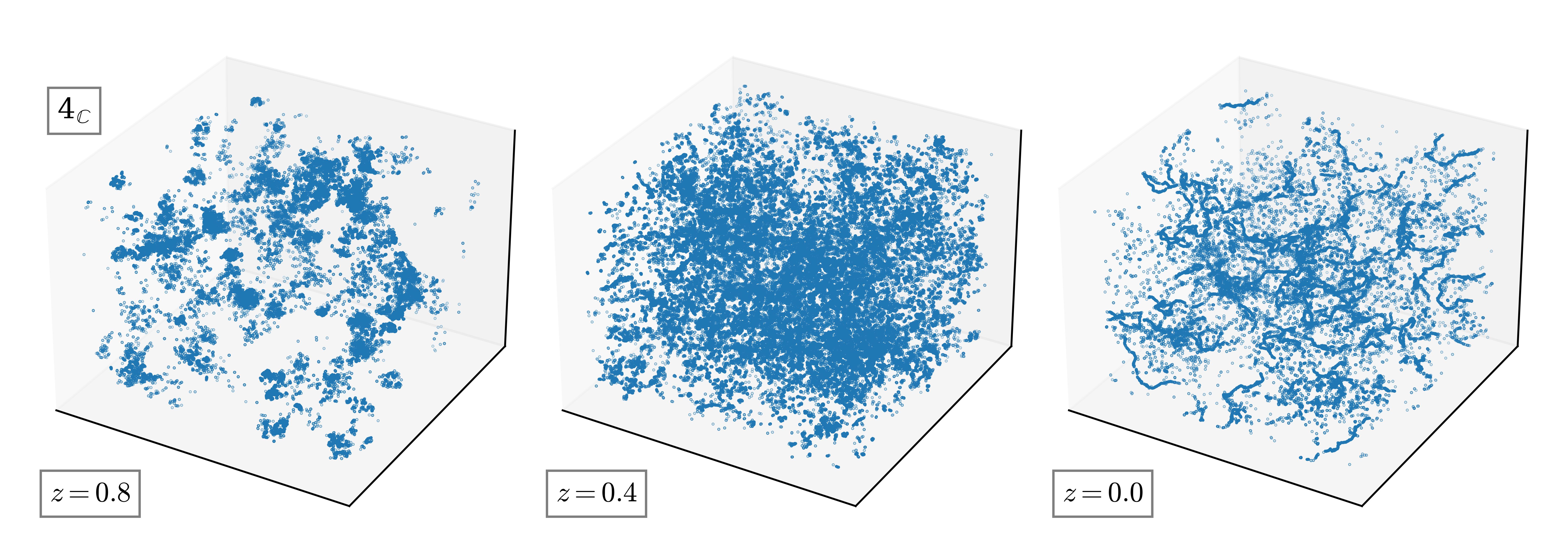
This review details cosmological simulations investigating the impact of cosmic strings and domain walls on structure formation within a symmetron dark energy framework.
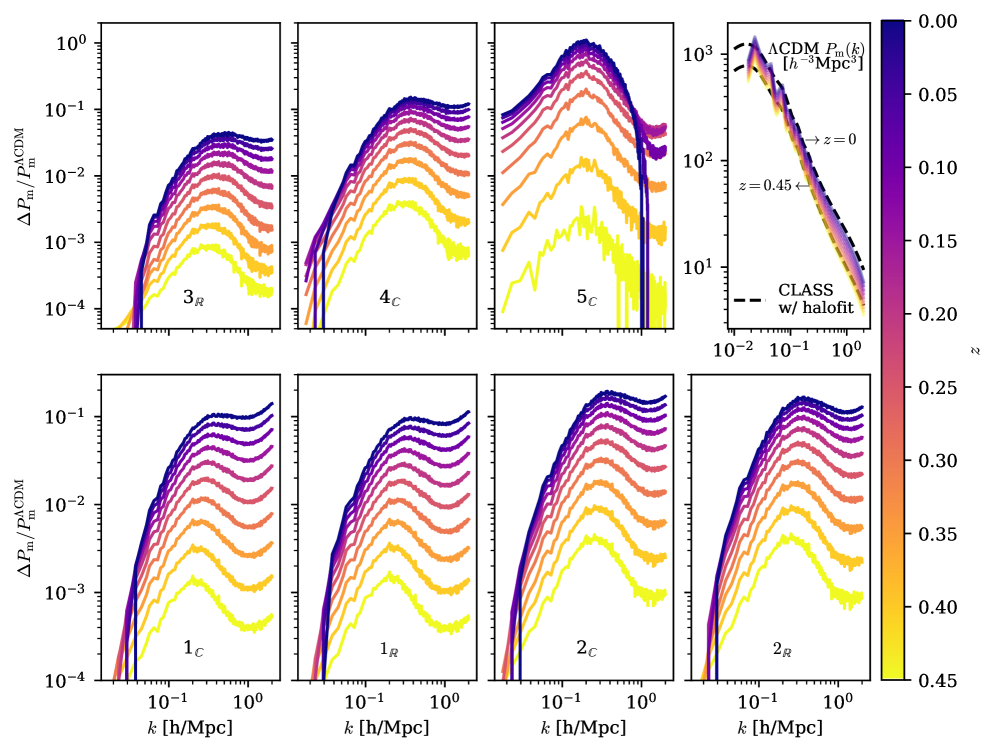
Recent cosmological data increasingly favour dark energy models exhibiting phantom-crossing behaviour, necessitating explorations beyond standard ΛCDM. This motivates the study presented in ‘Cosmic strings, domain walls and environment-dependent clustering’, which investigates environment-dependent structure formation arising from a late-time phase transition driven by a non-minimally coupled scalar field-specifically, a generalization of the symmetron producing cosmic strings and domain walls. Through fully relativistic cosmological simulations, we demonstrate that such models can induce significant, yet potentially observable, departures from standard gravity in underdense regions, altering the matter power spectrum and halo mass function by up to ~15% at k \sim 0.3-0.5 h Mpc^{-1}. Could detailed analysis of low-redshift density fluctuations and marked halo power spectra reveal the distinctive signatures of these defect networks and confirm the existence of a fifth force influencing cosmic structure?
The Illusion of Order: Introducing the Symmetron
The prevailing cosmological model, known as LambdaCDM, has remarkably aligned with a vast array of astronomical observations, from the cosmic microwave background to the distribution of galaxies. However, this model isn’t without its difficulties. Current measurements of the universe’s expansion rate, determined through observations of distant supernovae and the cosmic microwave background, exhibit a significant discrepancy – the ‘Hubble tension’. Furthermore, explaining the accelerating expansion itself requires the introduction of Λ, dark energy, the physical origin of which remains a mystery. These persistent challenges suggest that LambdaCDM may be an incomplete description of the universe, motivating exploration of new physics beyond its standard framework and prompting investigations into alternative models capable of resolving these outstanding puzzles.
The symmetron model posits a compelling alternative within the realm of dark sector physics, addressing limitations in the standard LambdaCDM cosmological framework. This theory introduces a new scalar field – the symmetron – that doesn’t interact with gravity in the conventional manner, but instead exhibits a unique, non-minimal coupling to ordinary matter. This interaction isn’t a universal force, but rather activates only when matter densities fall below a certain threshold, effectively screening the symmetron’s influence in regions of high density like our solar system while allowing it to exert effects on larger, cosmological scales. Consequently, the symmetron offers a potential explanation for the observed accelerating expansion of the universe and the persistent ‘Hubble tension’ without requiring drastic modifications to general relativity, presenting a nuanced pathway toward resolving fundamental discrepancies in cosmological measurements.
The Symmetron model postulates the existence of a previously unobserved fundamental force, distinct from gravity, electromagnetism, and the strong and weak nuclear forces. This ‘fifth force’ arises from the symmetron field, and crucially, its strength isn’t uniform across all matter; it couples more strongly to matter in regions of lower density. Consequently, this differential interaction could subtly alter the growth of cosmic structures, like galaxies and galaxy clusters, over billions of years. Simulations suggest that the presence of this fifth force could lead to measurable deviations from the predictions of standard cosmology, potentially resolving discrepancies between observations and the LambdaCDM model – particularly in the large-scale distribution of matter and the rate of cosmic expansion. Detecting this force would not only validate the symmetron model, but also open a new window into the fundamental nature of dark matter and the forces governing the universe.
Simulating Cosmic Evolution: A Computational Mirror
N-body simulations are utilized to model cosmological evolution incorporating the symmetron field, a dynamic scalar field proposed as a dark matter candidate. These simulations, executed on the Eiger supercomputer, employ a specialized code, ‘SimulationCode’, designed to accurately trace the gravitational interactions of a large number of particles representing dark matter and baryonic matter. The methodology involves initializing particle positions and velocities according to specified cosmological parameters, then integrating their equations of motion forward in time, accounting for both gravity and the symmetron field’s influence on gravitational interactions. This computational approach allows for the tracking of structure formation, including the growth of dark matter halos and the distribution of matter on large scales, providing a testbed for symmetron dark matter models.
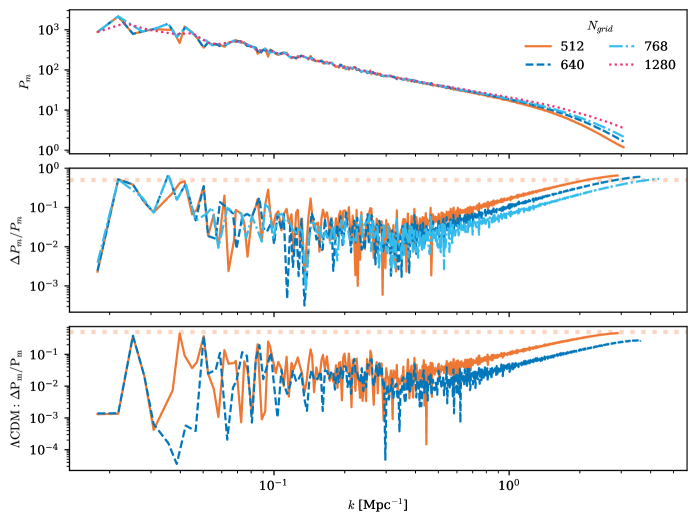
The simulations quantify matter and dark matter distribution via the MatterPowerSpectrum and HaloMassFunction, both influenced by the symmetron field. The MatterPowerSpectrum details the amplitude of density fluctuations as a function of spatial scale, while the HaloMassFunction describes the abundance of dark matter halos across different masses. Convergence testing demonstrated an error of approximately 1.4 at k=2 h/Mpc, indicating the simulations achieve a statistically significant level of accuracy in modeling these distributions under the influence of the symmetron field. This error measurement represents the difference between successive simulation runs, ensuring the results are stable and reliable.
Characterization of the cosmic environment surrounding structures like dark matter halos is performed using advanced statistical techniques, specifically ‘MarkedStatistics’. This methodology allows for a high-precision quantification of the density and distribution of matter in the vicinity of these halos, going beyond simple counts to assess environmental influences on their formation and evolution. Computationally, achieving this level of precision for simulations with a resolution of N = 1280^4 requires approximately 30.6 x 10³ CPU-hours, reflecting the substantial processing demands of accurately modeling these complex cosmic interactions.
Cosmic Phase Transitions: Echoes of Symmetry Breaking
Simulations indicate the symmetron field can drive a phase transition within the universe, fundamentally altering matter distribution and resulting in the formation of atypical large-scale structures. This transition is not uniform; its manifestation is spatially dependent and linked to the local matter density. The symmetron field’s influence causes variations in gravitational interactions, effectively modifying the expansion rate and growth of structures at specific cosmological scales. Consequently, regions exhibiting different symmetron field strengths will demonstrate discernable differences in their matter density profiles and the resulting cosmic web morphology, leading to the creation of unique and potentially observable structures not predicted by standard ΛCDM cosmology.
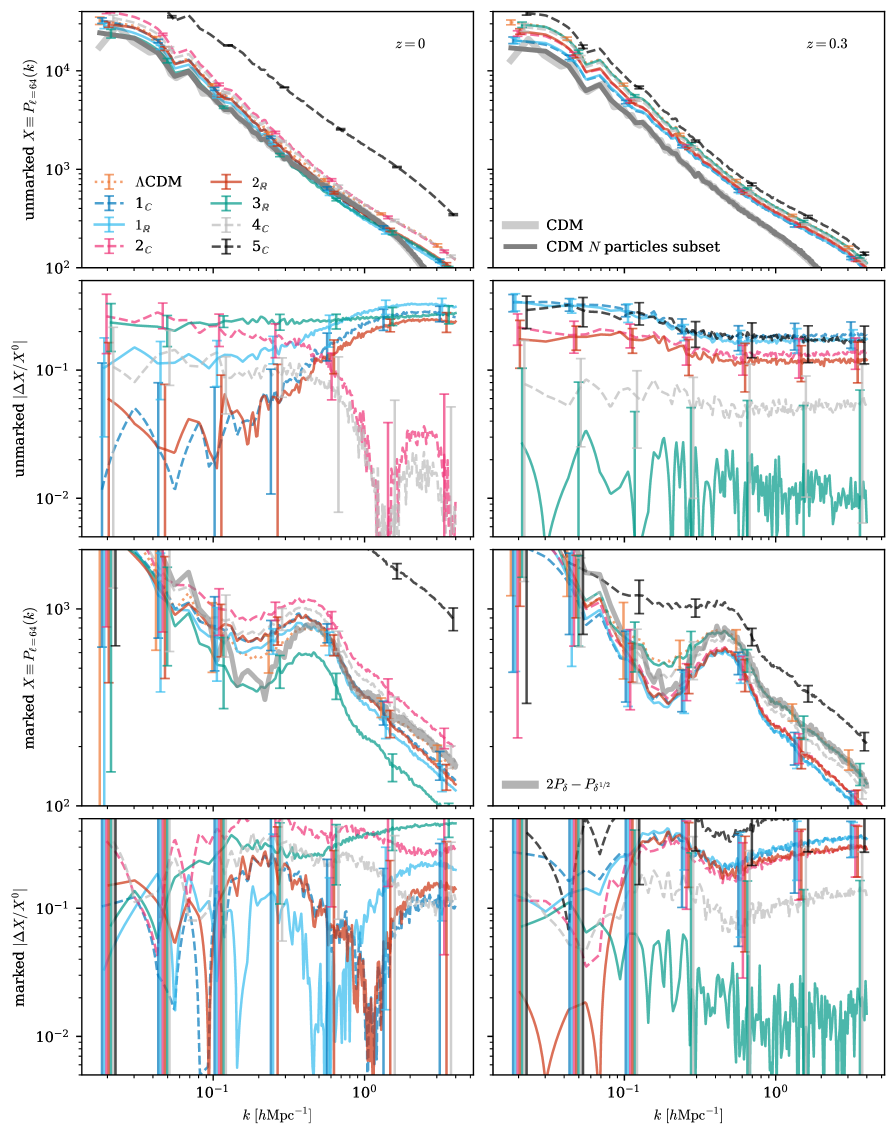
Analysis of our simulations reveals that symmetron-induced phase transitions demonstrably alter the distribution of cosmic voids. These transitions create unique, measurable patterns within underdense regions, shifting the matter power spectrum by up to approximately 15% at specific scales. This relative difference is not uniform; the magnitude of the shift is scale-dependent and concentrated within particular frequency bands of the power spectrum. The observed modifications to the void distribution provide a potential observational signature for detecting the symmetron field and validating the occurrence of this phase transition within the universe’s large-scale structure.
The occurrence of a structure-induced phase transition is directly correlated with local matter density; regions with specific density thresholds will exhibit a transition while others remain unaffected. Detection of these transitions relies on mapping the cosmic web and analyzing the resulting large-scale structure. Variations in the distribution of matter, particularly within underdense regions (voids), serve as key indicators. Precise measurements of the matter power spectrum, with a focus on scales where symmetron effects are predicted, can reveal relative differences of up to ~15% compared to standard cosmological models, providing evidence for the phase transition. This analysis necessitates high-resolution simulations and observational data to accurately characterize the cosmic web and identify subtle structural anomalies.
Topological Relics: Ghosts of a Broken Symmetry
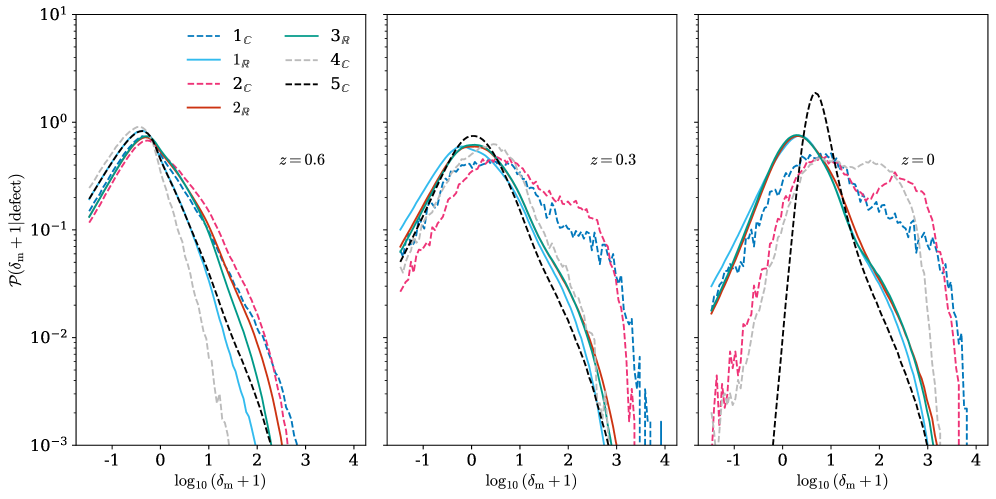
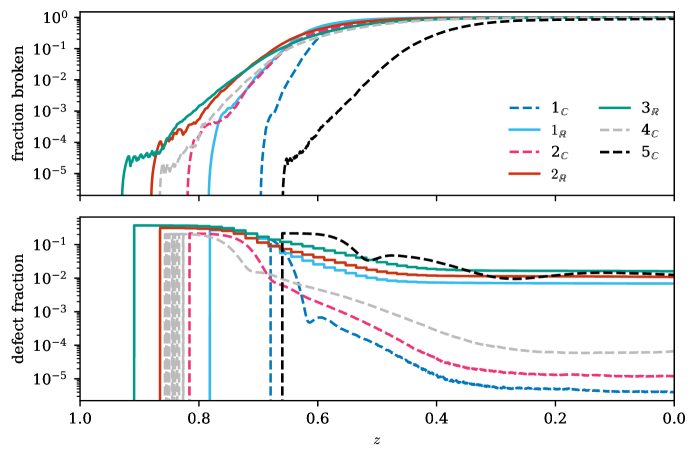
The symmetron field, as a dynamical dark energy model, doesn’t just propose a new force; its very nature necessitates the creation of topological defects during the universe’s evolution. As the symmetron field transitioned to its current state, akin to water freezing into ice, imperfections were inevitable. These imperfections manifest as ‘StringDefects’ – one-dimensional ripples in the field – and ‘DomainWalls’ – two-dimensional boundaries separating regions with different symmetron values. Critically, these aren’t merely theoretical curiosities; they are stable, relic structures from the phase transition itself, persisting throughout cosmic history. Their formation is a direct consequence of the field’s symmetry-breaking process, analogous to how defects arise in crystal growth or the formation of textures in liquid crystals, and represent a unique signature of the symmetron’s existence within the fabric of spacetime.
Though directly observing topological defects like StringDefects and DomainWalls presents a significant observational hurdle, their influence isn’t necessarily hidden from view. These relics of the symmetron field’s phase transition would have subtly altered the distribution of matter in the early universe, leaving detectable imprints on the cosmic web. Specifically, the gravitational influence of these defects would have created slight variations in the density of dark matter and baryonic matter, influencing the formation and evolution of galaxies and large-scale structures. Researchers theorize that by meticulously mapping the distribution of galaxies and analyzing the patterns within the C_{l} spectrum of the cosmic microwave background, evidence of these subtle distortions – and thus, the existence of the symmetron – might be revealed, offering a unique window into the universe’s formative moments.
Confirmation of topological defects – specifically StringDefects and DomainWalls – would represent a pivotal advancement in cosmological understanding, serving as a robust signature of the symmetron field’s existence. These defects, formed during the phase transition associated with the symmetron, aren’t simply theoretical curiosities; their detection would provide compelling evidence that the symmetron actively shaped the universe’s large-scale structure. Observing subtle imprints of these relics – perhaps through gravitational lensing or their influence on galaxy distributions – would move the symmetron from a hypothetical particle to a confirmed component of the cosmos, offering insights into the mechanisms governing the universe’s evolution and potentially revealing new physics beyond the Standard Model.
Beyond LambdaCDM: A New Era of Cosmological Inquiry
Cosmological models attempting to explain the accelerating expansion of the universe rely heavily on the ‘DarkEnergyEquationOfState’, which describes the relationship between dark energy’s pressure and density. Recent research focuses on the symmetron model, a proposed dynamical dark energy candidate, and its potential to alleviate the persistent ‘Hubble tension’ – the discrepancy between locally measured expansion rates and those inferred from the early universe. Through meticulous analysis of observational data, including measurements of large-scale structure and gravitational lensing, scientists are progressively narrowing the range of permissible symmetron properties. These constraints, combined with sophisticated numerical simulations, allow for a more precise refinement of the Dark Energy Equation of State, potentially bringing cosmological parameters into better agreement and offering a compelling alternative to the standard ΛCDM model. This approach doesn’t simply adjust a constant; it explores a dynamic dark energy field, opening avenues for understanding the fundamental physics driving the universe’s expansion.
Upcoming cosmological surveys focused on mapping the Cosmic Microwave Background are poised to deliver critical tests of the symmetron model, a proposed explanation for dark energy. These investigations aren’t simply seeking confirmation, but rather precise measurements capable of detecting subtle deviations from standard cosmological predictions. Researchers anticipate that signals stemming from the symmetron field – variations in the distribution of matter and energy – could manifest within the Cosmic Microwave Background at a measurable level, potentially ranging from 5 to 30 percent. This range signifies a substantial opportunity for both confirming the model’s validity and, crucially, refining its parameters, allowing for a more accurate depiction of dark energy’s influence on the universe’s expansion and structure formation. The sensitivity of these future surveys promises a new era of precision cosmology, capable of distinguishing between competing dark energy theories and potentially resolving long-standing puzzles about the universe’s fate.
Cosmological research stands poised at a threshold, with the potential to move beyond simply measuring the expansion of the universe to genuinely understanding its driving forces. This investigation doesn’t just offer incremental improvements to existing dark energy models; it proposes a pathway toward unraveling the fundamental physics governing cosmic evolution. By exploring scenarios like the symmetron model, scientists aim to distinguish between various theoretical explanations for dark energy – whether it’s a cosmological constant, a dynamic field, or even a modification of gravity itself. Successfully identifying the nature of dark energy will not only resolve the long-standing Hubble tension, but also provide crucial insights into the interconnectedness of fundamental forces and the ultimate fate of the universe, offering a more complete and nuanced picture of the cosmos than ever before.
The pursuit of understanding dark energy, as exemplified by the symmetron model investigated within this study, necessitates a rigorous calibration of theoretical predictions against observational data. Multispectral observations enable calibration of accretion and jet models, a methodology central to discerning subtle density fluctuations indicative of phase transitions and defect networks. Pierre Curie aptly stated, “One never notices what has been done; one can only see what remains to be done.” This sentiment resonates deeply; even with advanced cosmological simulations, the limitations of current models become apparent upon comparison with EHT data, highlighting the ongoing need for refinement and the vast expanse of unknowns that still lie beyond our current comprehension of structure formation.
Where Do the Ripples Lead?
The exploration of symmetron models, and indeed any attempt to modify gravity to explain dark energy, reveals a fundamental tension. Researcher cognitive humility is proportional to the complexity of nonlinear Einstein equations. Simulations, while increasingly sophisticated, remain interpretations, bounded by computational resources and, more crucially, by the assumptions encoded within the initial conditions and chosen parameter space. The identification of potential defect signatures-cosmic strings, domain walls-offers a tantalizing prospect, yet observation will invariably confront the limitations of both instrument sensitivity and our theoretical capacity to disentangle these signals from other astrophysical phenomena.
Further investigation necessitates a broadened scope, extending beyond the linear regime and embracing the full nonlinear evolution of these defect networks. The interplay between defects and structure formation demands a more rigorous treatment of backreaction effects-the influence of small-scale inhomogeneities on the overall cosmic expansion. Black holes demonstrate the boundaries of physical law applicability and human intuition; a truly robust model must account for the possibility that its own predictions may ultimately dissolve into informational obscurity beyond observational horizons.
The enduring challenge lies not merely in refining cosmological simulations, but in acknowledging the inherent epistemic limits of any attempt to construct a complete picture of the universe. The search for dark energy, therefore, becomes less a quest for a definitive answer and more an exercise in carefully calibrated intellectual humility.
Original article: https://arxiv.org/pdf/2601.15234.pdf
Contact the author: https://www.linkedin.com/in/avetisyan/
See also:
- Gold Rate Forecast
- Looks Like SEGA Is Reheating PS5, PS4 Fan Favourite Sonic Frontiers in Definitive Edition
- Dune 3 Gets the Huge Update Fans Have Been Waiting For
- Jack Osbourne Shares Heartbreaking Tribute to Late Dad Ozzy Osbourne
- Arknights: Endfield – Everything You Need to Know Before You Jump In
- 5 Weakest Akatsuki Members in Naruto, Ranked
- Action Comics #1096 is Fun Jumping-On Point for Superman Fans (Review)
- Hazbin Hotel Secretly Suggests Vox Helped Create One of the Most Infamous Cults in History
- Antiferromagnetic Oscillators: Unlocking Stable Spin Dynamics
- Dungeon Stalkers to end service on June 9
2026-01-23 05:09