Author: Denis Avetisyan
New research explores the limitations of using holographic duality to fully capture entanglement between quantum bits in the presence of magnetic fields.
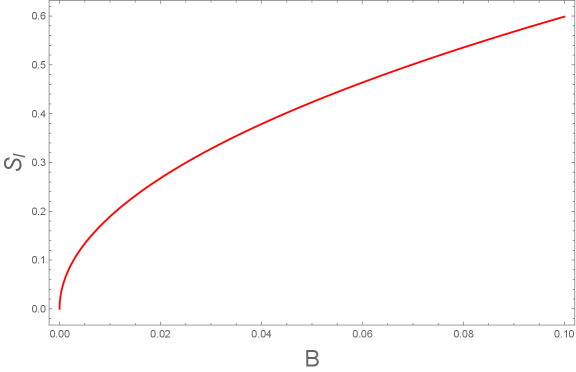
A comparison of holographic timelike entanglement entropy and pseudoentropy reveals differing scaling behaviors, suggesting a gap in our understanding of entanglement in strongly coupled systems.
A fundamental challenge in connecting quantum information theory with gravity lies in reconciling different definitions of entanglement entropy across disparate systems. This is explored in ‘HTEE vs. Pseudo-Entropy in Magnetic Fields’, which compares holographic timelike entanglement entropy-derived from the \mathcal{N}=4 super-Yang-Mills theory via the AdS/CFT correspondence-with the pseudo-entropy of a two-qubit system undergoing thermal transitions in a magnetic field. The analysis reveals marked discrepancies in their scaling behavior, suggesting that the holographic timelike entanglement entropy may not fully capture the pseudo-entropy in this specific context. Does this indicate a limitation in utilizing holographic methods to probe entanglement in strongly coupled systems, or does it point to a need for refined mappings between these quantities?
Beyond Simple Correlation: The Limits of Entanglement
Entanglement entropy, a fundamental measure of quantum correlation, has long served as a crucial tool in characterizing quantum systems – but its application is inherently restricted. Originally conceived for pure states – quantum states described by a single wavefunction – this metric falters when confronted with the more complex reality of mixed states. These mixed states, representing statistical ensembles of pure states, are overwhelmingly prevalent in any physical system interacting with an environment, due to decoherence and thermal fluctuations. Consequently, the standard formulation of entanglement entropy, relying on the purity of the state, provides an incomplete, and often inaccurate, depiction of correlations within these ubiquitous mixed states, necessitating the development of more generalized measures capable of capturing the full extent of quantum information.
While entanglement entropy effectively measures correlations in idealized, pure quantum states, most real-world systems exist as mixed states-probabilistic combinations of pure states arising from interactions with an environment. Consequently, entanglement entropy falls short in accurately characterizing these ubiquitous, complex scenarios. To address this limitation, physicists have developed pseudoentropy, a generalization designed to quantify correlations within mixed states. Unlike its predecessor, pseudoentropy doesn’t rely on a pure state description and instead focuses on the reduced density matrix, providing a more robust measure of quantum information even when complete knowledge of the system is unavailable. This advancement is crucial for understanding phenomena in areas like condensed matter physics and quantum field theory, where mixed states are the norm rather than the exception, and for developing more realistic quantum technologies.
Quantifying correlations within mixed quantum states-those inevitably encountered in real-world systems-demands more than simply characterizing the density matrix ρ. While the density matrix provides a complete description of the state, calculating pseudoentropy-a generalization of entanglement entropy for mixed states-requires discerning the underlying quantum structure beyond this statistical representation. Traditional approaches falter because the density matrix obscures the specific correlations present, treating all mixed states with the same statistical properties regardless of their origins. Therefore, a more nuanced understanding of the state’s composition-identifying the pure states contributing to the mixture and their respective probabilities-is crucial. This pursuit compels researchers to explore methods that can effectively ‘reconstruct’ the underlying quantum state from its statistical properties, hinting at a deeper connection between information content and the fundamental nature of quantum correlations.
The challenge of quantifying correlations within mixed quantum states has driven researchers toward holographic approaches, fundamentally linking quantum information to the seemingly disparate realm of gravity. This methodology proposes that the computation of pseudoentropy, and other quantum informational quantities, can be recast as a geometric problem in a higher-dimensional spacetime. By leveraging the anti-de Sitter/conformal field theory (AdS/CFT) correspondence – a cornerstone of string theory – the entanglement structure of a quantum system is mapped onto the geometry of a black hole in the AdS space. Specifically, the pseudoentropy can be determined by calculating the area of a minimal surface, or Ryu-Takayanagi surface, extending into the bulk gravitational space. This holographic reconstruction offers a powerful tool for studying strongly correlated quantum systems, circumventing the computational complexities inherent in directly analyzing the quantum state, and providing new insights into the fundamental connection between quantum information and spacetime geometry.
Gravity’s Quantum Mirror: A Duality Worth Exploring
The Anti-de Sitter/Conformal Field Theory (AdS/CFT) correspondence is a conjectured duality relating a theory of quantum gravity in a d+1-dimensional Anti-de Sitter (AdS) space to a Conformal Field Theory (CFT) living on the d-dimensional boundary of that space. This correspondence posits a complete equivalence between the two theories, meaning that any calculation performed in one theory has a corresponding calculation in the other. Critically, this allows problems intractable in the quantum gravity setting – such as calculating strongly coupled systems – to be mapped to the, potentially more manageable, CFT side, and vice-versa. The duality is particularly valuable because it provides a non-perturbative definition of quantum gravity, circumventing many of the challenges associated with traditional perturbative approaches.
The AdS/CFT correspondence enables the reformulation of calculations traditionally performed within a quantum field theory as geometric problems in a dual gravitational theory. Specifically, the pseudoentropy – a quantity typically computed using complex quantum mechanical methods – can be determined by calculating the area of certain surfaces within the gravitational dual spacetime. This translation leverages the holographic principle, where information about a volume of spacetime is encoded on its boundary. By mapping quantum entanglement to geometric properties like surface area, intractable quantum calculations can, in principle, be simplified and addressed using classical geometric techniques within the gravitational description. The resulting value of the surface area directly corresponds to the pseudoentropy of the dual quantum system.
The Ryu-Takayanagi (RT) proposal, originally formulated for computing entanglement entropy in static spacetimes using minimal area surfaces, has been extended to calculate pseudoentropy in time-dependent scenarios. This extension involves replacing the static area-minimizing surface with a timelike extremal surface Σ. The pseudoentropy is then proportional to the area of this Σ, evaluated at a specific time. This approach allows for the translation of quantum information calculations, specifically those involving time evolution, into geometric problems within the dual gravitational theory, providing a holographic correspondence between the quantum system and its gravitational representation. However, the scaling behavior of pseudoentropy computed via this extended RT proposal can differ from direct calculations within the quantum field theory.
Calculating pseudoentropy via the AdS/CFT correspondence and the Ryu-Takayanagi proposal requires the determination of the area of a Timelike Extremal Surface (TES) in the gravitational dual. Analysis demonstrates that the scaling behavior of the pseudoentropy, as derived from the area of the TES, does not match the expected scaling observed in direct quantum field theory calculations. Specifically, discrepancies arise when examining the dependence of pseudoentropy on system parameters, indicating a deviation from the anticipated relationship established through conventional quantum computation of entanglement measures. This suggests that while the duality provides a geometric interpretation, refinements or corrections may be necessary to fully reconcile the holographic calculation with the results obtained from the quantum field theory side.
The Einstein-Maxwell Toolkit: Laying the Gravitational Foundation
The Einstein-Maxwell action serves as the foundational element of our holographic computation by providing a field theory that incorporates both gravity and electromagnetism. This action, expressed mathematically as S = \in t d^4x \sqrt{-g} \left( \frac{R}{16\pi} - \frac{1}{4} F_{\mu\nu}F^{\mu\nu} \right), where R is the Ricci scalar and F_{\mu\nu} is the electromagnetic field strength tensor, defines the dynamics of spacetime geometry influenced by electromagnetic fields. Utilizing this action allows us to model scenarios where gravity and electromagnetism are intertwined, essential for investigating the holographic correspondence and its application to strongly coupled systems; specifically, it establishes the gravitational side of the duality, enabling calculations of quantum field theory observables via classical gravitational computations.
The Einstein-Maxwell action, expressed as S = \in t d^4x \sqrt{-g} (R - \frac{1}{4}F_{\mu\nu}F^{\mu\nu}), governs the dynamics of the coupled gravitational and electromagnetic fields. Specifically, the action’s variation with respect to the metric tensor g_{\mu\nu} yields the Einstein field equations, defining the spacetime curvature, while variation with respect to the electromagnetic four-potential A_{\mu} produces Maxwell’s equations. Solving these equations provides the metric g_{\mu\nu} and the electromagnetic field F_{\mu\nu}, thus constructing the specific spacetime geometry required for holographic calculations; this geometry represents a gravitational background with an embedded electromagnetic field, crucial for modeling entanglement in dual conformal field theories.
Analytic continuation is a technique used to define functions outside of their original domain of convergence. In the context of holographic calculations, quantities such as the generating functional for entanglement entropy are initially defined for specific values of parameters – typically those ensuring convergence of the series or integral representations. To explore the behavior of these quantities in regimes inaccessible through direct calculation – such as strong coupling or extended time scales – analytic continuation is employed. This process involves extending the definition of the function to a larger domain in the complex plane, allowing for the evaluation of the quantity at values of parameters where the initial definition does not hold. The validity of results obtained through analytic continuation relies on the uniqueness of the analytic extension and careful consideration of potential singularities within the extended domain.
A two-qubit system, when exposed to an external magnetic field B, serves as a verifiable model within the Einstein-Maxwell holographic framework. Analysis of this system reveals a direct relationship between the holographic timelike entanglement entropy (HTEE) and the strength of the applied magnetic field. Specifically, calculations demonstrate that HTEE scales proportionally to the square root of B, or \sqrt{B}. This scaling behavior provides empirical support for the connection between gravitational dynamics, electromagnetism, and quantum entanglement as described by the Einstein-Maxwell action, and validates the holographic approach to quantifying entanglement in strongly correlated systems.
From Matrices to Geometry: A Deeper Connection Revealed
Recent calculations reveal a profound connection between quantum states and the geometry of spacetime. Specifically, the Transition Matrix, which fully characterizes a quantum system’s evolution, isn’t merely described by a geometric object, but is demonstrably encoded within the area of a Timelike Extremal Surface. This surface, a specific configuration within the gravitational background, effectively acts as a geometric ‘storage’ for quantum information; changes in the quantum state directly translate to alterations in the surface’s area. The implication is that quantum mechanics and general relativity are far more intertwined than previously understood, suggesting that the very fabric of spacetime may fundamentally underpin the principles governing quantum behavior, and that information about a quantum system isn’t just in the universe, but is a part of its geometric structure.
The state of a two-qubit system, typically described by a Density Matrix in quantum mechanics, exhibits a profound connection to the underlying gravitational background, as recent calculations demonstrate. This isn’t merely an analogy; the Density Matrix, which encapsulates all possible quantum states and their probabilities, is mathematically interwoven with the geometry of spacetime. Specifically, the study reveals that the information encoded within the Density Matrix directly influences, and is influenced by, the curvature of spacetime. This suggests that quantum information isn’t simply in spacetime, but is an integral component of its structure, potentially hinting at a deeper, more fundamental relationship between quantum mechanics and gravity. The calculations establish that changes in the quantum state of the two qubits manifest as alterations in the gravitational field, and vice versa, providing a concrete, albeit theoretical, link between the quantum realm and the fabric of the universe.
The application of an external magnetic field fundamentally alters the geometric encoding of quantum information. Calculations reveal that the holographic entanglement entropy (HTEE) scales with the square root of the magnetic field strength \sqrt{B}, a striking departure from the quadratic B^2 scaling observed in traditional quantum mechanical calculations of pseudoentropy. This nuanced relationship demonstrates that the geometric representation of quantum states, as manifested through the Timelike Extremal Surface, responds differently to external influences than its quantum mechanical counterpart. The \sqrt{B} scaling suggests a more subtle interplay between the magnetic field and the underlying spacetime geometry, indicating that the holographic principle provides a unique perspective on how quantum information is encoded and affected by external forces.
The study demonstrates a fundamental connection between quantum information and the underlying geometry of spacetime, revealing a universal geometric contribution to the imaginary part of the pseudoentropy – a constant value of \pi c/6. This finding is particularly striking because it emerges even when considering a simple Thermal State, devoid of complex quantum correlations. The consistent presence of this geometric term suggests that the structure of spacetime itself inherently encodes quantum information, acting as a foundational element in the description of quantum systems. This result goes beyond simply relating quantum mechanics and gravity; it proposes that geometric properties are not merely a consequence of quantum phenomena, but an integral component of quantum information itself, regardless of the system’s complexity.
The pursuit of elegant theoretical mappings, as demonstrated by this exploration of Holographic Timelike Entanglement Entropy and pseudoentropy, invariably runs headfirst into the brick wall of reality. This paper meticulously details discrepancies in scaling behavior – a predictable outcome. It’s reminiscent of building a beautiful transition matrix only to discover production data exhibits a delightful, chaotic divergence. As John Locke observed, “All mankind… being all equal and independent, no one ought to harm another in his life, health, liberty or possessions.” Similarly, no theoretical construct, however pristine, remains untouched by the messy realities of physical systems. The authors find the holographic approach doesn’t fully capture pseudoentropy; a polite way of saying the map is not the territory, and infinite scalability remains a marketing term.
The Road Ahead
The observed scaling discrepancies between pseudoentropy and its holographic analogue aren’t surprising. The AdS/CFT correspondence provides a beautiful mapping, but mappings are, at best, approximations. It turns out that elegant theory rarely survives contact with a fully realized system. The bug tracker, one anticipates, will soon fill with instances where this particular holographic timelike entanglement entropy falls short of capturing the nuances of even a two-qubit pseudoentropy calculation. This isn’t a failure of holography, necessarily, but a reminder that correspondence is not identity.
Future work will inevitably focus on refinements – attempting to force the holographic result to align with the pseudoentropy via increasingly complex gravitational configurations or modified boundary conditions. One suspects this will yield diminishing returns. A more fruitful avenue may lie in accepting the mismatch as a signal – a clue regarding the limitations of entanglement entropy as a complete descriptor of quantum information, even in seemingly simple systems. Perhaps pseudoentropy isolates a feature of entanglement that the gravitational dual simply cannot, or will not, reproduce.
The pursuit of a perfect holographic match feels increasingly like polishing brass on a sinking ship. The real progress won’t come from minimizing the error, but from understanding why the error exists. The system doesn’t deploy – it lets go. And the data, as always, will tell the tale – eventually.
Original article: https://arxiv.org/pdf/2602.20843.pdf
Contact the author: https://www.linkedin.com/in/avetisyan/
See also:
- The Super Mario Galaxy Movie: 50 Easter Eggs, References & Major Cameos Explained
- All 13 Smash Bros. Characters in the Super Mario Galaxy Movie
- TV legend Carol Kirkwood reveals the reasons why she decided to retire after 28 years with BBC
- Dune 3 Gets the Huge Update Fans Have Been Waiting For
- Highly Anticipated Strategy RPG Finally Sets Release Date (And It’s Soon)
- Welcome to Demon School! Iruma-kun season 4 release schedule: When are new episodes on Crunchyroll?
- Sydney Sweeney’s The Housemaid 2 Sets Streaming Release Date
- Why is Tech Jacket gender-swapped in Invincible season 4 and who voices her?
- After 13 Years, Someone Earned One of the Hardest Achievement Trophies in Gaming
- Supergirl Director Breaks Down Kara Zor-El & Superman’s ‘Older-Sibling Dynamic’
2026-02-26 00:37