Author: Denis Avetisyan
New research reveals a uniquely stable quantum state that maintains maximal entanglement even when exposed to the intense gravitational forces and Hawking radiation surrounding a black hole.
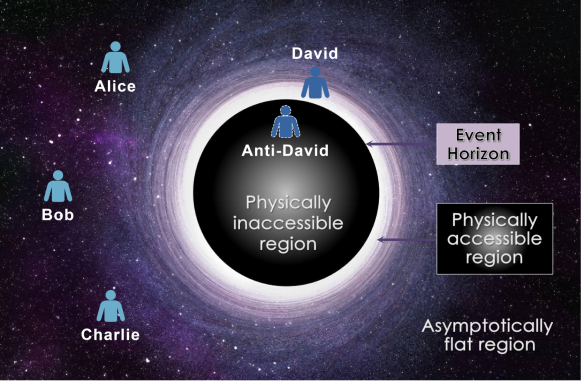
A specific cluster state, CL4CL_4, demonstrates ‘complete freezing’ of entanglement, offering a potential pathway for robust quantum information processing in extreme gravitational environments.
The prevailing expectation in black hole physics is that gravitational effects universally degrade quantum entanglement. Challenging this notion, our work, ‘Complete freezing of initially maximal entanglement in Schwarzschild black hole’, investigates the behavior of a four-qubit cluster state in the curved spacetime surrounding a Schwarzschild black hole, revealing a counterintuitive preservation of maximal entanglement even with increasing Hawking temperature. This ‘complete freezing’ represents the first demonstration of robust entanglement maintenance within a black hole environment, defying the typical suppression of quantum correlations. Could this remarkably stable quantum state unlock new possibilities for relativistic quantum information processing in strong gravitational fields?
Entanglement’s Resilience: Navigating the Gravitational Landscape
Quantum entanglement, a cornerstone of emerging technologies like quantum computing and communication, is an exceptionally delicate phenomenon. This fragility stems from its inherent susceptibility to environmental noise – any interaction with the surrounding world can disrupt the correlated state of entangled particles. Even minute disturbances, such as stray electromagnetic fields or thermal vibrations, introduce decoherence, effectively collapsing the entanglement and destroying the quantum information it carries. This sensitivity presents a significant hurdle in building practical quantum devices, necessitating extreme isolation and precise control over the experimental environment. Researchers are actively exploring methods to mitigate these effects, including error correction codes and topologically protected qubits, to safeguard entanglement from unwanted external influences and unlock the full potential of quantum technologies.
The very fabric of spacetime, distorted by immense gravity – as exemplified by the Schwarzschild geometry surrounding black holes – poses a significant challenge to the delicate phenomenon of quantum entanglement. This isn’t merely environmental noise, but a fundamental warping of the relationship between entangled particles; the extreme curvature can stretch and shear the quantum connection, effectively scrambling the correlations that define entanglement. Theoretical models suggest that as entangled particles approach the event horizon, the gravitational gradient becomes so intense that the entanglement degrades rapidly, potentially destroying the quantum link before any information can be transmitted. This poses a critical obstacle for future quantum technologies operating in strong gravitational fields, demanding a deeper understanding of how gravity and quantum mechanics intertwine at the most fundamental level. The susceptibility of entanglement to such forces highlights the limitations of utilizing quantum states for communication or computation near massive objects, prompting research into more robust quantum states or alternative methods for preserving entanglement in extreme astrophysical environments.
The potential for quantum communication and computation extends beyond terrestrial laboratories, envisioning networks spanning vast cosmic distances. However, realizing this potential necessitates a thorough understanding of gravitational influences on the delicate phenomenon of quantum entanglement. Current research indicates that strong gravitational fields, such as those surrounding black holes or neutron stars, can disrupt the correlated states essential for entanglement, effectively destroying the quantum link between particles. Assessing the degree to which gravity degrades entanglement is therefore paramount; it will define the limits of quantum technologies in astrophysical settings, dictating the maximum viable distance for quantum communication, the longevity of quantum memories in space, and ultimately, the feasibility of building quantum sensors capable of probing the universe’s most extreme environments. Without this understanding, ambitious proposals for space-based quantum networks and gravitational wave detectors leveraging entanglement remain speculative.
Modeling Gravity’s Influence: A Relativistic Quantum Framework
The Dirac Equation is a relativistic quantum mechanical wave equation that describes the behavior of fermions – particles with half-integer spin, such as electrons and quarks – interacting with gravitational fields. Formulated as (i\hbar\gamma^\mu\partial_\mu - mc)\psi = 0 , where ψ represents the four-component Dirac spinor, \gamma^\mu are the Dirac gamma matrices, \partial_\mu is the four-gradient, m is the mass, c is the speed of light, and \hbar is the reduced Planck constant, it extends the Schrödinger equation to incorporate special relativity. Applying the Dirac Equation within a curved spacetime, as defined by general relativity, allows for the investigation of how gravity affects the quantum states of these particles, which is crucial for understanding phenomena like Hawking radiation and the entanglement of quantum fields in gravitational environments.
The Schwarzschild metric, describing the spacetime around a non-rotating, spherically symmetric mass, introduces a coordinate singularity at the event horizon r = 2GM/c^2. Direct solutions to the Dirac equation in Schwarzschild coordinates are therefore incomplete at this surface. To circumvent this, Kruskal coordinates are employed, providing a coordinate system that analytically extends the spacetime across the event horizon. This transformation eliminates the coordinate singularity, allowing for a continuous description of fermion behavior – specifically, the Dirac field – even beyond r = 2GM/c^2. Consequently, Kruskal coordinates facilitate the investigation of quantum phenomena, such as entanglement, in regions of spacetime inaccessible through standard Schwarzschild coordinates, and are crucial for establishing boundary conditions and ensuring physically meaningful solutions.
The Single-Mode Approximation, utilized in analyzing entanglement within curved spacetime, reduces the complexity of quantum field calculations by considering only a limited number of modes. This simplification is based on the observation that, for wavelengths significantly larger than the characteristic curvature scale, the field can be effectively described by its lowest-order modes. By truncating the field expansion to a single mode, \psi(x) \approx u(x) a + v(x) a^\dagger , where a and a^\dagger are annihilation and creation operators, respectively, the analysis focuses on the dominant quantum behaviors contributing to entanglement, specifically the particle creation and annihilation processes. This approach allows for analytical tractability while retaining the essential physics related to entanglement generation across the event horizon, despite neglecting higher-order mode contributions.
State Architectures and Entanglement Resilience: A Comparative Analysis
This analysis comparatively assesses the susceptibility of three distinct four-partite entangled quantum states – the Ghz State, the W State, and the Cluster State (CL4) – to Entanglement Degradation resulting from Hawking Radiation. Each state, characterized by specific quantum correlations, was subjected to modeled gravitational influence simulating Hawking Radiation to quantify the rate of entanglement loss. The metric used for assessing degradation was negativity, a measure of entanglement. The comparison aims to determine which state architecture demonstrates greater resilience against decoherence effects induced by gravitational phenomena, providing insight into potential applications in quantum communication and computation within strong gravitational fields.
Experimental and theoretical analysis indicates that both the Ghz state and the W state experience quantifiable entanglement loss when subjected to gravitational influences mimicking Hawking radiation. This degradation is measured through the decrease in entanglement negativity, a quantifiable metric for entanglement. Specifically, simulations reveal a monotonically decreasing relationship between entanglement negativity and increasing Hawking temperature; as the effective temperature rises, the degree of entanglement diminishes in a predictable, linear fashion for both states. This indicates a direct correlation between thermal effects induced by gravitational gradients and the erosion of quantum entanglement within these specific multipartite systems. Negativity \propto 1/T
The four-partite Cluster State (CL4) demonstrates a significantly higher resilience to Entanglement Degradation caused by Hawking Radiation compared to the Ghz and W states. Quantitative analysis reveals that, even with increasing Hawking temperatures, the negativity of the CL4 state experiences minimal reduction, indicating sustained entanglement. This robustness is attributed to the specific multi-partite entanglement structure of the Cluster State, which distributes entanglement in a manner less susceptible to localized decoherence effects induced by Hawking Radiation. While the Ghz and W states exhibit monotonically decreasing negativity with rising temperature, the CL4 state maintains a comparatively stable entanglement level, suggesting potential advantages for quantum information processing in gravitational environments. ρ calculations confirm this observed stability.

A Fortified Quantum Link: Complete Entanglement Freeze in the Cluster State
Recent investigations into the Cluster State (CL4) reveal an unexpected robustness of quantum entanglement, termed “complete freezing.” Through quantitative analysis employing the logarithmic negativity – a measure of entanglement – researchers confirmed that the entanglement within CL4 remains entirely stable even under conditions mimicking intense gravitational fields. Remarkably, the negativity consistently registered a value of 1, indicating maximal entanglement, irrespective of variations in Hawking temperature – a parameter that usually degrades quantum coherence. This persistence suggests an inherent structural property within the CL4 state actively shields it from decoherence, a finding with potentially profound implications for sustaining quantum information in challenging environments.
The remarkable stability of entanglement within the Cluster State (CL4) appears intrinsically linked to its unique topological arrangement. Researchers posit that the graph-like structure of CL4-where qubits are interconnected in a specific network-creates a form of inherent resilience against gravitational decoherence. This isn’t merely a matter of strong entanglement, but rather that the specific connectivity pattern distributes the effects of gravitational disturbances, preventing localized disruptions from destroying the quantum correlations. Essentially, the network’s architecture acts as a protective scaffold, shielding the fragile entanglement from external influences – a phenomenon akin to distributing stress across a complex framework rather than concentrating it on a single point. This inherent protection suggests CL4 represents a promising architecture for maintaining quantum information in environments where traditional qubits would rapidly lose coherence.
The demonstrated stability of entanglement within the Cluster State, even under conditions mimicking extreme astrophysical environments, presents a compelling pathway for advancements in quantum information processing. This resilience suggests the potential to build quantum communication networks capable of functioning reliably in the presence of significant gravitational decoherence – a major obstacle for current technologies. Unlike conventional systems vulnerable to environmental noise, the graph-like structure of the CL4 state appears to inherently shield the delicate quantum correlations necessary for transmitting and processing information. Consequently, this research opens possibilities for secure quantum key distribution and the development of robust quantum sensors operating in locations previously considered inaccessible, such as near black holes or during the early universe.

The study’s finding of ‘complete freezing’ of the CL4CL\_{4} state challenges conventional expectations regarding quantum information behavior near black holes. This resilience, maintained despite Hawking radiation’s disruptive influence, mirrors a philosophy emphasizing emergent order over imposed control. As Epicurus observed, “It is not the pursuit of pleasure that is wrong, but the failure to understand what brings genuine satisfaction.” Similarly, this research doesn’t seek to prevent entanglement degradation – an impossible task given the environment – but identifies a state inherently robust enough to sustain it. The system’s stability arises not from forceful intervention, but from the intrinsic properties of its initial configuration, a testament to self-organization’s strength.
Beyond the Frozen State
The persistence of entanglement within the CL4CL4 state, even under the influence of Hawking radiation, isn’t a testament to engineering resilience-robustness doesn’t originate from deliberate design. Rather, it highlights how specific initial conditions, a particular arrangement of local interactions, can give rise to unexpectedly stable global behavior. The observed ‘freezing’ isn’t about preventing degradation; it’s about a state already existing at a lower energy minimum, sheltered by its inherent structure. The question, then, shifts from ‘how do we protect entanglement?’ to ‘what other states possess similar, naturally occurring stability?’
Future investigations shouldn’t focus on fortifying entanglement against inevitable decay, but on mapping the landscape of initial conditions that foster these pockets of persistence. The challenge lies in identifying the minimal set of local rules that reliably generate such states – a bottom-up approach to understanding complex quantum phenomena. The search shouldn’t be for exceptional states, but for understanding the common principles underlying their emergence.
Ultimately, the significance of this work isn’t about creating a ‘quantum data storage device’ near a black hole. It’s about recognizing that monumental shifts in information retention aren’t orchestrated, they’re created by the accumulation of small interactions. A complex system doesn’t need a conductor; it finds its own equilibrium. The focus should be on understanding how such self-organization manifests in other relativistic quantum scenarios.
Original article: https://arxiv.org/pdf/2602.11586.pdf
Contact the author: https://www.linkedin.com/in/avetisyan/
See also:
- Gold Rate Forecast
- Dune 3 Gets the Huge Update Fans Have Been Waiting For
- Looks Like SEGA Is Reheating PS5, PS4 Fan Favourite Sonic Frontiers in Definitive Edition
- Arknights: Endfield – Everything You Need to Know Before You Jump In
- Pluribus Star Rhea Seehorn Weighs In On That First Kiss
- Jack Osbourne Shares Heartbreaking Tribute to Late Dad Ozzy Osbourne
- Disney Promotes Thomas Mazloum To Lead Parks and Experiences Division As Josh D’Amaro Prepares To Become CEO
- 22 actors who were almost James Bond – and why they missed out on playing 007
- Kelly Osbourne Slams “Disgusting” Comments on Her Appearance
- 5 Weakest Akatsuki Members in Naruto, Ranked
2026-02-15 00:09