Author: Denis Avetisyan
Researchers have developed a novel approach to quantifying entanglement in spacetime, offering a powerful tool for exploring the quantum nature of gravity.
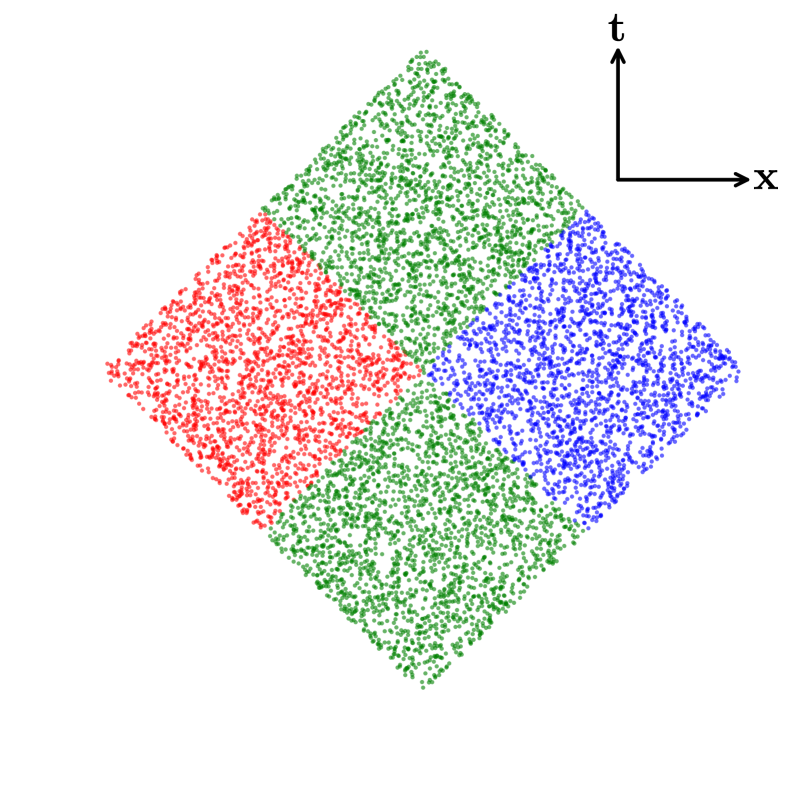
This work presents a spectrally defined spacetime entropy for quasifree fields, applicable to both continuous and discrete spacetime geometries like causal sets.
Calculating entanglement entropy in curved spacetime and for quantum field theories presents ongoing challenges in regularization and defining entropy covariantly. This paper, ‘Spectral Spacetime Entropy for Quasifree Theories’, introduces a novel spacetime formulation of entanglement entropy, employing spectral decomposition to provide a robust and generally applicable method for quasifree fields. This approach not only facilitates calculations in standard scenarios but also extends to contexts lacking a well-defined Cauchy surface, such as in causal set theory, potentially revealing signatures of spacetime discreteness-as demonstrated by a modified entanglement scaling coefficient in 1+1 dimensions. Could this spectrally defined spacetime entropy offer a pathway towards resolving the information paradox and a deeper understanding of quantum gravity?
The Fabric of Reality: Spacetime and Its Quantum Shadows
Quantum Field Theory, the bedrock of modern particle physics, fundamentally describes the universe through the lens of a Spacetime Manifold – a mathematical space representing the interwoven fabric of space and time. This framework elegantly explains interactions between particles as disturbances within this manifold, but its classical depiction faces significant hurdles when gravity becomes exceptionally strong. In scenarios like those near black holes or during the universe’s earliest moments, the very structure of the Spacetime Manifold is predicted to become highly curved and potentially unstable, leading to singularities where the theory breaks down. These extreme gravitational regimes demand a more nuanced understanding, hinting at the necessity of incorporating quantum gravity – a theoretical framework that would reconcile quantum mechanics with general relativity and provide a robust description of spacetime itself at all scales. Consequently, researchers are actively exploring modifications to the classical Spacetime Manifold concept, such as incorporating non-commutative geometry or discrete spacetime structures, in an attempt to resolve these theoretical inconsistencies and unlock a more complete picture of the universe.
The HilbertSpace serves as the fundamental mathematical stage upon which all quantum states exist and evolve within Quantum Field Theory. This abstract vector space isn’t merely a convenient tool; its very structure is inextricably linked to the underlying spacetime manifold describing the universe. Each point in spacetime effectively contributes a dimension, or degree of freedom, to the HilbertSpace, dictating the possible configurations of quantum fields. Consequently, alterations to the spacetime geometry – such as those caused by strong gravitational fields – directly impact the HilbertSpace’s structure, influencing how quantum states are defined and how they interact.
The GreenFunction serves as a fundamental tool for charting how disturbances – anything from electromagnetic waves to gravitational ripples – propagate through the universe. It essentially maps out all possible responses to a localized impulse, providing a complete picture of the disturbance’s evolution in both space and time. However, its calculation and interpretation are inextricably linked to the underlying Spacetime Manifold – the mathematical model of spacetime itself.
Beyond the Continuous: Discreteness and Causal Sets
Causal Set Theory posits that spacetime is not a continuous manifold, as described by General Relativity, but is instead fundamentally discrete. This means spacetime is composed of a collection of discrete elements – the Causal Sets – which are partially ordered sets defining the causal relations between events. Instead of points existing within a continuum, events are the fundamental elements, and the ordering defines which events can causally influence others. This discrete structure aims to avoid the divergences and infinities encountered when quantizing gravity on a continuous spacetime background. The theory proposes that the familiar continuous spacetime emerges as an approximation from the underlying discrete causal structure at large scales, analogous to how a digital image appears continuous when viewed at sufficient resolution.
The emergence of spacetime from underlying causal relations in Causal Set Theory proposes that the continuous fabric of spacetime is not fundamental, but rather an approximation of a more basic, discrete structure. Instead of points existing within a pre-defined spacetime, the theory posits that spacetime itself is built from the partial order defined by these causal relations – specifically, which events can causally influence others. This approach offers a potential quantization of gravity because the discrete nature of the causal set naturally introduces a minimum length scale, effectively eliminating the ultraviolet divergences that plague traditional attempts to combine general relativity and quantum mechanics. By focusing on the fundamental relationships between events rather than the events themselves as existing within a spacetime, the theory seeks to define a quantum theory of gravity where spacetime geometry is a derived property, not a foundational assumption.
Causal Set Theory addresses the incompatibility between general relativity and quantum mechanics by prioritizing causality as the fundamental aspect of spacetime. Traditional approaches attempt to quantize the geometry of spacetime itself, leading to divergences and non-renormalizable theories. Instead, Causal Set Theory posits that spacetime is fundamentally discrete, composed of a partially ordered set of events where the order represents causal relationships. This focus on causality, rather than continuous geometry, aims to avoid the problematic quantization of gravity by providing a framework where the fundamental degrees of freedom are the causal relations themselves. The theory proposes that the smooth spacetime of general relativity emerges as an approximation of this underlying discrete causal structure, potentially resolving inconsistencies at the Planck scale where quantum effects and gravity are both strong.
Entanglement as a Probe: Entropy and Discrete Spacetime
Entanglement entropy quantification relies on the Wightman function, formally a two-point correlation function
The Sorkin-Johnston state is a specific assignment of amplitudes to the edges of a simplicial spacetime, designed to define a quantum state on a discrete manifold. Crucially, it provides a covariant definition of the Wightman function
Calculations of entanglement entropy within the discrete spacetime framework reveal a logarithmic scaling behavior. Specifically, the entropy, measured as a function of the region’s boundary size, increases proportionally to the natural logarithm of that size
Regularization and Thermal Aspects: Discreteness Refined
Calculating entanglement entropy in quantum field theory often encounters divergences stemming from the infinite degrees of freedom inherent in continuous spacetime. Spectral truncation provides a powerful regularization technique to address this issue by effectively limiting the number of relevant modes considered in the calculation. This method involves imposing a maximum energy or momentum cutoff, analogous to discretizing the system, thereby rendering the entropy finite and well-defined. The approach focuses on approximating the continuous spectrum of the operator with a finite number of eigenstates, enabling precise numerical computations without the need for ad-hoc renormalization schemes. Through spectral truncation, researchers can explore the fundamental properties of entanglement in quantum field theory and gain insights into the nature of spacetime itself, paving the way for a deeper understanding of quantum gravity and black hole physics. The resulting
Recent computations have extended the scope of discrete spacetime analysis to encompass causal sets containing up to 900 elements – a significant leap beyond previous efforts and currently the largest such calculation performed. This advancement wasn’t merely about increasing scale; it served as a crucial validation of the computational methodology employed for calculating entanglement entropy in these discretized spacetime models. The successful execution of these complex calculations demonstrates the feasibility of the approach, paving the way for explorations of more substantial and potentially physically relevant causal sets. The ability to handle such a large number of elements strengthens confidence in the results obtained and opens new avenues for investigating quantum gravity phenomena within a discrete spacetime framework, moving closer to a deeper understanding of the universe’s fundamental structure.
Calculations of thermal entropy density for both scalar fields and Dirac fermions yielded results consistent with the established behavior of harmonic oscillators, providing strong validation for the derived entropy formula. This correspondence suggests that the regularization techniques applied to the discrete spacetime model accurately capture the expected thermodynamic properties of quantum fields. Specifically, the observed entropy density – a measure of disorder – aligns with predictions based on the equipartition theorem for harmonic oscillators, where each degree of freedom contributes
Future Directions: Weaving Geometry and Quantum Gravity
SpacetimeAlgebra offers a robust mathematical language for characterizing the fundamental geometry of spacetime, extending beyond the traditional approaches of differential geometry. This framework isn’t limited to smooth, continuous spacetime; it elegantly handles discrete geometries – those built from fundamental, indivisible units – which are increasingly relevant in theories like loop quantum gravity and causal set theory. By representing geometric objects and transformations using Clifford algebra, SpacetimeAlgebra allows researchers to investigate how discreteness at the Planck scale might manifest in observable phenomena. The power of this approach lies in its ability to encode both metric and orientational information within a single algebraic structure, simplifying complex calculations and offering new insights into the nature of spacetime itself. Specifically, it provides tools to analyze how relationships between discrete spacetime elements define volume, distance, and causality, paving the way for a deeper understanding of quantum gravity and the universe’s underlying structure.
The Rindler wedge, a model representing the spacetime experienced by a constantly accelerating observer, proves invaluable when investigating the fundamental challenges posed by horizons and the information paradox within the context of discrete spacetime geometries. By simulating acceleration, this framework effectively creates an event horizon analogous to that surrounding a black hole, allowing researchers to study how information behaves as it seemingly vanishes beyond this boundary. Crucially, examining information loss through the lens of discrete models-where spacetime is not continuous but composed of fundamental, indivisible units-offers a novel approach to potentially resolving the paradox. These calculations, conducted within causal set theory, explore whether the inherent discreteness of spacetime impacts the fate of information, suggesting that quantum effects and the structure of spacetime at the Planck scale could play a vital role in preserving information that appears lost to an external observer.
Recent calculations examining entanglement entropy within a causal set framework reveal a subtle, yet potentially significant, deviation from expectations based on continuous spacetime models. Specifically, the observed coefficient governing entanglement entropy is marginally larger in the discrete causal set scenario. This suggests that the fundamental discreteness of spacetime – the idea that spacetime isn’t infinitely divisible but composed of fundamental building blocks – could genuinely influence quantum entanglement. Alternatively, this increased coefficient might stem from boundary effects inherent in the finite approximations used in these calculations, prompting further investigation into the role of boundary conditions and their impact on quantum information. Disentangling these possibilities is crucial for understanding whether this observed difference represents a genuine signature of discrete spacetime geometry or an artifact of the computational methods employed.
The pursuit of a spectrally defined spacetime entropy, as detailed in this work, echoes a fundamental elegance. The article’s focus on a covariant approach, leveraging the spectral decomposition of quasifree fields, strives for a harmony between mathematical rigor and physical intuition. This resonates with Carl Sagan’s observation: “Somewhere, something incredible is waiting to be known.” The research subtly suggests that understanding the entropy of spacetime – particularly in the context of quantum gravity and discrete structures like causal sets – requires not just calculation, but a poetic appreciation for the underlying order. The minor elements of spectral analysis, when carefully considered, create a sense of harmony in the theoretical framework, hinting at a deeper, more unified understanding of the universe.
What Lies Beyond?
The pursuit of spacetime entropy, as outlined in this work, reveals not an arrival, but a refinement of the questions. To define entanglement entropy spectrally, even for quasifree fields, feels less like a solution and more like an elegant restatement of the problem. The true challenge, of course, lies in extending this framework beyond perturbation theory. A spectrally defined entropy is only as useful as its robustness against the inevitable complexities of interacting quantum fields – and the genuinely discrete structures that may underpin reality. The current formulation hints at a path, but the symphony remains unfinished.
A crucial next step involves confronting the limitations inherent in the quasifree assumption. How does entanglement, and its associated entropy, manifest in genuinely strong gravitational fields? Can a spectrally decomposed approach retain its covariance – and its interpretational clarity – when faced with the non-perturbative regime? The answer likely resides in a deeper understanding of the Hilbert space structure itself, and how it deforms – or fails to deform – under extreme conditions. A certain humility is warranted; simplicity in code emerges through clarity, not through avoidance of complexity.
Ultimately, this work serves as a call for further exploration of the interplay between information theory, spectral methods, and the elusive quest for quantum gravity. The beauty of this approach is not merely in its mathematical form, but in the invitation it extends: to seek a deeper, more harmonious understanding of spacetime as an emergent property of entanglement. The elegance isn’t optional; it is a sign of a deep understanding, and hints at a universe where simplicity and complexity dance in equal measure.
Original article: https://arxiv.org/pdf/2602.16782.pdf
Contact the author: https://www.linkedin.com/in/avetisyan/
See also:
- What Song Is In The New Supergirl Trailer (& What It Means For The DC Movie)
- Gold Rate Forecast
- Eurogamer Gives ARC Raiders 2/5 Over AI Voices, Dropping Metacritic Score from 94 to 84
- One of Hulu’s Best New Shows Lands on Disney+ Ahead of Season 2
- 5 Best Superman-Centric Crossover Events
- OpenAI says GPT‑5 cuts political bias — but is 30% enough?
- Harry Potter Season 2 Gets a Positive Update as Delayed Release Confirmed
- Round Up: The Outer Worlds 2 Could Be One of the Best RPGs of the Year, Say Positive Previews
- I Had High(ish) Hopes For Five Nights At Freddy’s 2, But My Two Most Glaring Issues Make Me Wary About A Third Movie
- Ariana Grande and More Celebs React to Golden Globes 2026 Nominations
2026-02-20 23:21