Well, folks, Ethereum’s Fusaka upgrade is officially live on the mainnet. And no, this isn’t just another “routine” update; it’s actually a BIG deal. The upgrade dropped at epoch 411392 at 21:49:11 UTC, and the Ethereum account was all like, “Upgrade in progress… activating Fusaka @ epoch 411392 // 21:49:11 UTC,” because who doesn’t love a good timestamp? A few moments later, it’s all, “Fusaka is live on Ethereum mainnet!” Cue the confetti… or not, depending on how much you care about this.
Here’s the scoop: Fusaka brings us three major things (or so they say). First up, PeerDAS, which now unlocks an impressive 8x data throughput for rollups-because who doesn’t love more data? This means rollup-based layer 2 networks can now publish more to the network than your aunt can post pictures of her cats. Next, there are UX improvements via the R1 curve & pre-confirmations. (Yes, I’m still trying to figure out what that actually means.) Finally, it’s all about prepping Ethereum for scaling, gas limits, and whatever other buzzwords are still hot in the world of blockchain. Oh, and they’ll keep monitoring for issues over the next 24 hours, so don’t worry. Someone’s on it!
Why Fusaka Is ‘Significant’ (According to Vitalik, of Course)
Now, Vitalik Buterin decided to bless us with his thoughts on why Fusaka is “significant.” (Because if Vitalik says it, we all have to believe it, right?) He said, “PeerDAS in Fusaka is significant because it literally is sharding.” Oh, okay, Vitalik, I guess we’re just casually dropping sharding into the conversation like it’s a hot potato. He continued, “Ethereum is coming to consensus on blocks without requiring any single node to see more than a tiny fraction of the data.” Translation: Ethereum can now agree on blocks without downloading all the data. The future is here, people. It’s like magic, but with fewer rabbits and more data packets.
But wait, there’s more. He reminds us that sharding has been the dream of Ethereum since 2015 (and no, I don’t think he’s been sleeping since then). And let’s not forget about the whole data availability sampling thing since 2017. Fusaka is finally bringing all of that to life. But hey, it’s not the end-all-be-all of sharding. It’s just, you know, “a fundamental step forward.” How exciting!
However, Vitalik was very clear that Fusaka doesn’t solve all Ethereum’s problems. He pointed out that we can process O(c^2) transactions on L2s, but not on the Ethereum L1 (whatever that means). So, yeah, there’s that. Then there’s the whole “proposer/builder bottleneck,” where the builder needs to have ALL the data to build the block. Can we please just get a distributed block-building system already? Oh, and don’t even get him started on the “sharded mempool.” Yep, still don’t have that either.
But hey, don’t let that get you down. Vitalik says we’re in for two more years of “refining the PeerDAS mechanism,” carefully scaling it up, and maybe, just maybe, one day scaling Ethereum’s gas as well. (Here’s hoping.) And of course, let’s not forget the big “congrats” to all the Ethereum researchers and core devs who’ve been working on this forever. Fusaka isn’t just another protocol update-it’s the beginning of the promised sharding era! 🎉
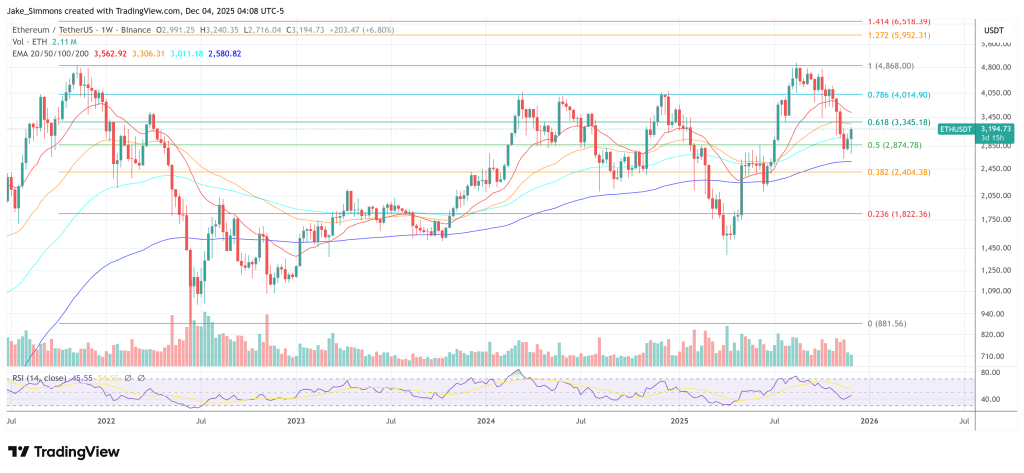
As of now, ETH is chilling at $3,194. Not bad, right?
Read More
- Surprise Isekai Anime Confirms Season 2 With New Crunchyroll Streaming Release
- The Super Mario Galaxy Movie: 50 Easter Eggs, References & Major Cameos Explained
- 10 Best Free Games on Steam in 2026, Ranked
- Starfield (PS5) Review – A Successful Cross-Console Voyage
- Preview: Sword Art Online Returns to PS5 as a Darker Open World Action RPG This Summer
- ‘Project Hail Mary’: The Biggest Differences From the Book, Explained
- All 7 New Supes In The Boys Season 5 & Their Powers Explained
- Frieren: Beyond Journey’s End Gets a New Release After Season 2 Finale
- Sydney Sweeney’s The Housemaid 2 Sets Streaming Release Date
- Silver Rate Forecast
2025-12-04 17:13