Author: Denis Avetisyan
New research explores how thermal fluctuations drive the formation of short-range condensates in complex quantum systems.
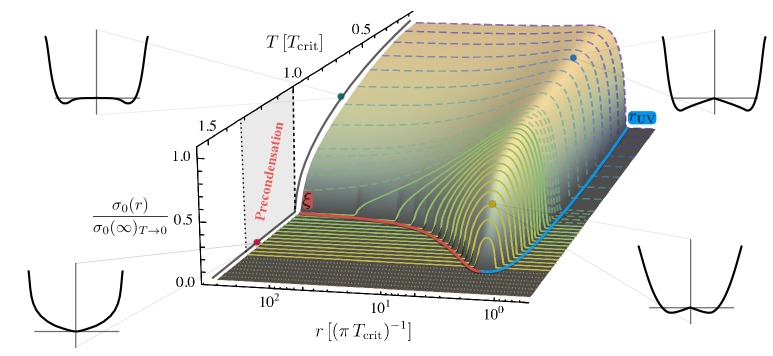
Functional renormalization group analysis reveals enhanced precondensation in gauge-fermion theories and its link to competing dynamics at finite temperatures.
The emergence of spatial inhomogeneities near continuous phase transitions challenges the conventional picture of homogeneous order parameter condensation. This work, ‘Thermal precondensation in gauge-fermion theories’, investigates a peculiar phenomenon-precondensation-where a condensate forms only over finite length scales in the chiral limit of gauge-fermion systems. We demonstrate, using functional renormalization group methods, that this precondensation regime is amplified by increasing the number of fermion flavours and arises from competing chiral symmetry breaking and restoration dynamics. Could this behaviour offer insights into the emergence of complex phases and potentially shed light on physics beyond the Standard Model?
The Illusion of Sharp Transitions
The conventional understanding of chiral symmetry breaking posits a distinct phase transition – a sharp shift from a state where chiral symmetry is intact to one where it is spontaneously broken, manifesting in the mass of previously massless particles. However, accumulating evidence challenges this simplified picture, revealing scenarios where the transition isn’t so definitive. Instead of an abrupt change, some systems exhibit a gradual weakening of symmetry, suggesting the existence of an intermediate region where symmetry is only partially broken. This nuanced behavior indicates that the standard theoretical frameworks, designed for sharp transitions, may be inadequate to fully describe the complex interplay of forces at work in these systems, necessitating a reevaluation of the fundamental assumptions governing the process and a search for more sophisticated models capable of capturing this subtlety.
Recent investigations reveal a fascinating departure from the conventional understanding of symmetry breaking, showcasing an intermediate state where symmetry isn’t simply present or absent, but rather, partially broken. This ‘precondensation’ regime isn’t uniform; instead, it’s distinguished by the emergence of spatial inhomogeneities – regions exhibiting varying degrees of symmetry breaking coexisting within the system. These domains, differing in their order parameter, create a textured landscape where the transition isn’t a sharp, instantaneous shift, but a gradual evolution across space. This challenges the established paradigm and suggests that many systems don’t undergo transitions via abrupt, collective behavior, but rather through the nucleation and growth of ordered regions, creating a complex interplay between order and disorder before reaching a fully broken symmetry state.
Investigating the ‘precondensation’ regime-the state preceding full symmetry breaking-demands a departure from conventional theoretical frameworks. Existing tools, often designed to describe abrupt phase transitions, struggle to capture the subtle interplay of fluctuating order parameters and emergent spatial structures characteristic of this intermediate phase. Researchers are now focusing on developing novel approaches, such as functional renormalization group methods and non-perturbative effective field theories, to accurately model the dynamics of \langle \bar{q}q \rangle and other relevant condensates. Crucially, a refined understanding of the relevant degrees of freedom-beyond simple order parameters-is essential. This includes considering the role of topological defects, domain walls, and spatially modulated patterns that arise from the partial breaking of symmetry, ultimately revealing a more nuanced picture of how order emerges from disorder.

Whispers Before the Storm: Inhomogeneous Condensates
Precondensation, occurring prior to the full formation of a Bose-Einstein condensate, is defined by spatial variations in the condensate density. Unlike a uniform condensate where the order parameter is consistent throughout the system, precondensation results in the emergence of inhomogeneous condensates characterized by domains where the condensate fraction fluctuates. These fluctuations arise from the interplay between interactions and the increasing population of particles occupying the lowest energy states as the system approaches the condensation temperature. The resulting condensate is not globally ordered, but exhibits localized regions of high and low density, differing from the macroscopic wave function typically associated with fully formed condensates. This spatial heterogeneity is a defining characteristic of the precondensation regime and distinguishes it from both the gaseous phase and the fully condensed state.
The domain size of inhomogeneities in precondensation regimes directly influences macroscopic condensate properties. Smaller domain sizes, approaching the scale of the interparticle separation, lead to increased condensate fluctuations and a blurring of the phase boundary. Conversely, larger domain sizes, extending over many interparticle distances, result in a more structured, albeit still inhomogeneous, condensate. The relationship between domain size and condensate properties is not linear; critical exponents govern this dependence, defining how characteristics like the condensate fraction and compressibility change as the system approaches the condensation point. Specifically, the domain size dictates the characteristic length scale for momentum correlations, influencing the observed dispersion relations and the overall condensate behavior in this intermediate phase between a normal gas and a fully homogeneous condensate.
The formation of momentum-dependent condensates during precondensation arises from modifications to the system’s dispersion relation, \omega(k) , where ω represents frequency and k is the wavevector. As the condensate forms non-uniformly, the relationship between energy and momentum deviates from the standard \omega \propto k^2 dependence observed in uniform Bose-Einstein condensates. This alteration results in a condensate where the occupation of momentum states is not solely determined by the lowest energy levels; instead, a distribution of momenta is populated, contributing to a condensate with momentum-dependent properties. Consequently, observable characteristics like superfluidity and interference patterns exhibit a dependence on the initial momentum distribution within the condensate.
A Non-Perturbative Lifeline: Functional Renormalization Group
The Functional Renormalization Group (FRG) is utilized to investigate precondensation due to its capacity as a non-perturbative technique. Unlike perturbative methods which rely on small deviations from a solvable point and therefore fail in strongly interacting regimes, FRG systematically integrates out degrees of freedom, allowing for the study of systems with strong correlations. This is achieved through a continuous momentum-space evolution of the effective average action \Gamma_k, where k serves as an infrared cutoff. By tracing the flow of \Gamma_k from high to low energies, FRG provides access to the full quantum phase diagram and allows for the identification of non-perturbative phenomena such as precondensation, which are inaccessible to standard perturbative calculations.
The Functional Renormalization Group (FRG) provides a means of investigating gauge-fermion systems – the standard theoretical description of interacting fermions and gauge bosons – without the need for perturbative expansions. Traditional methods often rely on approximating interactions as small deviations from free behavior, which becomes invalid in strongly correlated regimes. FRG, however, integrates out quantum fluctuations gradually, allowing for a systematic treatment of all interaction strengths. This approach avoids the limitations inherent in expansions around free theories, enabling the study of phase transitions and critical phenomena in systems where perturbative calculations fail, such as those exhibiting strong correlations or non-trivial topological order. The method’s formulation allows for the inclusion of all possible interactions between the fermions and gauge fields, providing a non-perturbative solution to the system’s effective action.
Application of the Functional Renormalization Group (FRG) technique allows for the construction of a phase diagram characterizing the system’s behavior as control parameters are varied. This diagram delineates regions of stability and instability, specifically identifying the parameter ranges where precondensation – the emergence of a partially ordered state preceding full condensation – occurs. By tracing the flow equations within the FRG framework, we can determine the critical parameters at which precondensation transitions to other phases, and quantify the associated critical exponents. This process provides a detailed understanding of the conditions necessary for observing precondensation, including temperature, coupling strength, and external fields, without reliance on perturbative expansions.
The Weight of Numbers: Nf and Nc’s Influence
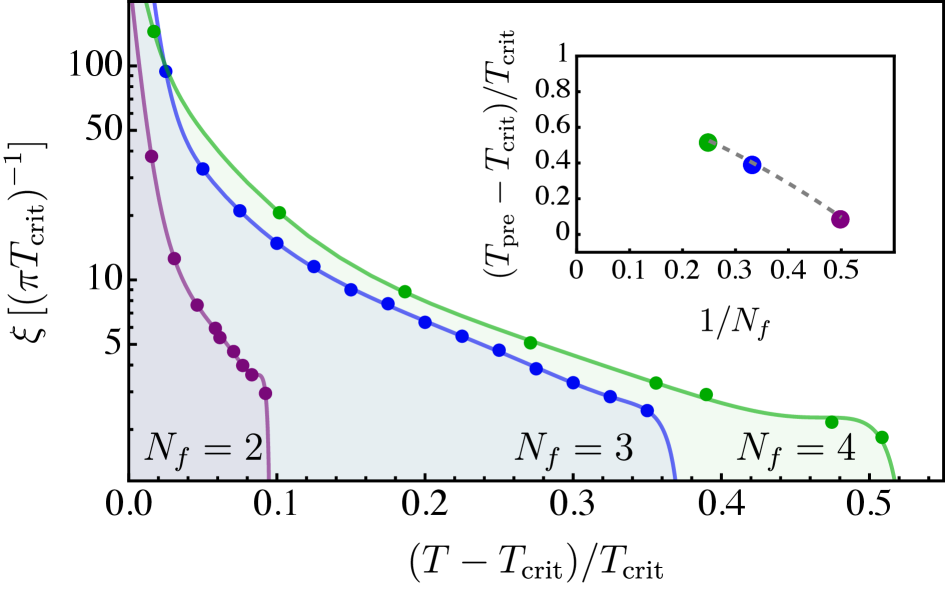
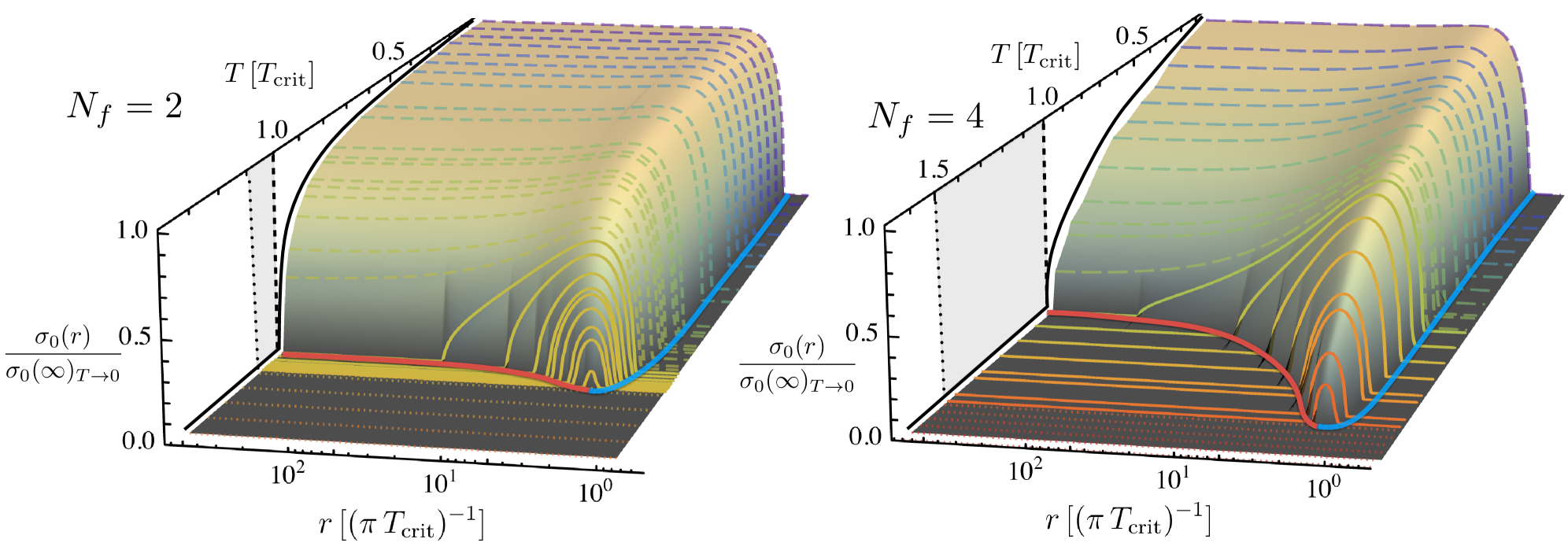
The fundamental characteristics of quantum chromodynamics, specifically the number of fermion flavors (N_f) and colors (N_c), exert a profound influence on the system’s behavior, particularly in the emergence of precondensation – a phenomenon preceding the full chiral symmetry breaking phase transition. These parameters dictate the strength of quantum fluctuations and the interplay between fermionic and bosonic excitations; a larger number of flavors generally enhances the tendency towards forming Cooper pairs and, consequently, facilitates the onset of precondensation at higher temperatures. Investigations reveal that as N_f increases, the temperature window over which precondensation is observed expands, suggesting a tunable pathway to control the transition driven by the system’s inherent particle content. This sensitivity highlights the crucial role of N_f and N_c in determining the overall phase structure and the emergence of collective phenomena within strongly interacting matter.
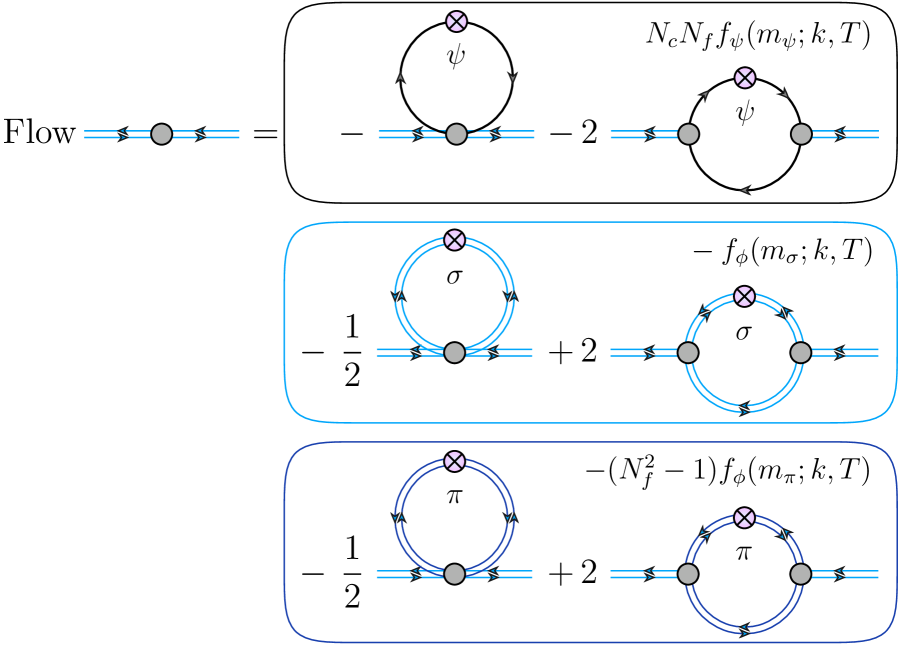
The fundamental nature of the quantum phase transition is governed by a delicate interplay between fermionic and bosonic fluctuations. Fermions, particles with half-integer spin, inherently promote chiral symmetry breaking – a phenomenon where the symmetry between left- and right-handed particles is spontaneously broken, leading to the formation of mass. Conversely, bosonic fluctuations, arising from particles with integer spin, possess a restorative tendency, working to uphold the system’s symmetry. The resulting phase-whether a state exhibiting broken symmetry or one preserving it-is thus dictated by the balance between these competing forces. A dominance of fermionic fluctuations fosters a phase characterized by symmetry breaking, while a prevalence of bosonic activity stabilizes the symmetric phase, highlighting the critical role of these quantum excitations in determining the system’s overall behavior.
Investigations into the behavior of this system reveal a compelling relationship between the number of fermion flavors (Nf) and the temperature range over which precondensation occurs. Analysis, conducted with Nf values of 2, 3, and 4, consistently demonstrates that as the number of fermion flavors increases, so too does the temperature window conducive to precondensation. This suggests a heightened sensitivity to fluctuations as more flavors are introduced, allowing the system to exhibit precondensation characteristics over a broader temperature scale before the full phase transition is realized. The observed trend highlights the crucial role of fermionic degrees of freedom in mediating the transition and influencing the emergence of this precondensed state.
Beyond QCD: A Universal Language of Strong Interactions
Functional Renormalization Group (FRG) calculations reveal a nuanced picture of chiral symmetry breaking and its precursor, precondensation, within strongly correlated systems. These investigations demonstrate that the breaking of chiral symmetry-a fundamental concept in particle physics-doesn’t occur as a sudden transition, but rather emerges gradually through the development of a condensate even before the symmetry is fully broken. This precondensation manifests as fluctuations in the system, effectively softening the relevant degrees of freedom and paving the way for the symmetry-breaking phase. The FRG approach provides a non-perturbative framework to explore these intricate dynamics, capturing effects often missed by traditional methods, and offering valuable insights into the collective behavior of strongly interacting particles – a cornerstone for understanding phenomena in quantum chromodynamics and related fields.
The effective potential offers a compelling framework for investigating thermal phase transitions and the dynamics of the chiral order parameter in strongly interacting systems. This approach doesn’t track individual particles, but instead focuses on the probability of different field configurations, effectively smoothing over quantum fluctuations. As temperature changes, the shape of this potential alters, dictating the stability of various phases – a phenomenon akin to a landscape where valleys represent stable states and hills represent unstable ones. Specifically, the minimum of the effective potential defines the vacuum state of the system, and shifts in this minimum signal phase transitions, such as the restoration of chiral symmetry at high temperatures. By meticulously mapping the effective potential, researchers can predict critical temperatures, analyze the order of the transition – whether it’s a smooth crossover or a sharp, discontinuous jump – and ultimately, gain insight into the fundamental behavior of matter under extreme conditions, mirroring processes believed to occur in the early universe and within neutron stars.
The resonance observed in functional renormalization group studies extends beyond a specific model, offering a crucial lens through which to examine Quantum Chromodynamics (QCD) and analogous strongly correlated systems. Understanding the dynamics of chiral symmetry breaking – a phenomenon where symmetries of the underlying laws are not reflected in the system’s lowest energy state – is paramount in QCD, as it’s directly linked to the generation of mass for hadrons like protons and neutrons. This research demonstrates that the mechanisms driving precondensation – the initial formation of order before a full phase transition – are likely universal, appearing not only in the context of particle physics but also potentially in condensed matter systems exhibiting similar strong interactions, such as certain types of magnets or superconductors. Consequently, these findings provide a unified framework for investigating the emergence of complex behavior in diverse physical scenarios, suggesting shared underlying principles governing the behavior of strongly interacting fermions.
The pursuit of elegant theoretical frameworks, as demonstrated by this investigation into precondensation, inevitably collides with the harsh realities of implementation. This paper meticulously charts the interplay between chiral symmetry breaking and its restoration-a delicate balance easily disrupted by the complexities of finite temperature systems. It’s a familiar pattern; the model predicts a graceful transition, production reveals a fragmented landscape of competing dynamics. As Richard Feynman once observed, “The best way to have a good idea is to have a lot of ideas.” This work, in its careful examination of momentum dependence and flavor number effects, embodies that principle-a relentless exploration of the many ways a seemingly coherent theory can fracture under scrutiny, leaving behind a trail of useful, if imperfect, approximations.
Where Does This Leave Us?
The investigation into precondensation, as detailed within, merely clarifies the inevitable complexity of gauge-fermion systems. The finding that increasing flavor numbers exacerbate this phenomenon is less a revelation than a confirmation that adding features almost always adds problems. It’s a predictable escalation of scale, and a reminder that elegant theoretical constructs rarely survive contact with the realities of many-body physics. The functional renormalization group methods employed represent a sophisticated tool, but, like all tools, they provide answers contingent on the approximations made-and those approximations are, at best, educated guesses.
Future work will undoubtedly refine the approximations, explore different truncation schemes, and attempt to bridge the gap between these theoretical calculations and experimental observations. The observed interplay between symmetry breaking and restoration is intriguing, yet the precise mechanisms driving these dynamics, particularly the role of momentum dependence, remain obscure. It is likely that increasingly elaborate models will be required, each adding layers of complexity, and thus, new opportunities for unforeseen consequences.
The history of theoretical physics is littered with ‘breakthroughs’ that ultimately became specialized cases, or simply wrong. This research, while valuable, will likely join that collection. If this work truly unlocks something fundamental, it will almost certainly reveal five new things that don’t quite fit. If the code looks perfect, no one has deployed it yet, and that’s always the test.
Original article: https://arxiv.org/pdf/2602.11265.pdf
Contact the author: https://www.linkedin.com/in/avetisyan/
See also:
- Gold Rate Forecast
- Looks Like SEGA Is Reheating PS5, PS4 Fan Favourite Sonic Frontiers in Definitive Edition
- Pluribus Star Rhea Seehorn Weighs In On That First Kiss
- Dune 3 Gets the Huge Update Fans Have Been Waiting For
- Arknights: Endfield – Everything You Need to Know Before You Jump In
- 22 actors who were almost James Bond – and why they missed out on playing 007
- Kelly Osbourne Slams “Disgusting” Comments on Her Appearance
- Antiferromagnetic Oscillators: Unlocking Stable Spin Dynamics
- 5 Weakest Akatsuki Members in Naruto, Ranked
- 10 Steamiest Erotic Thriller Movies of the 21st Century
2026-02-14 19:03