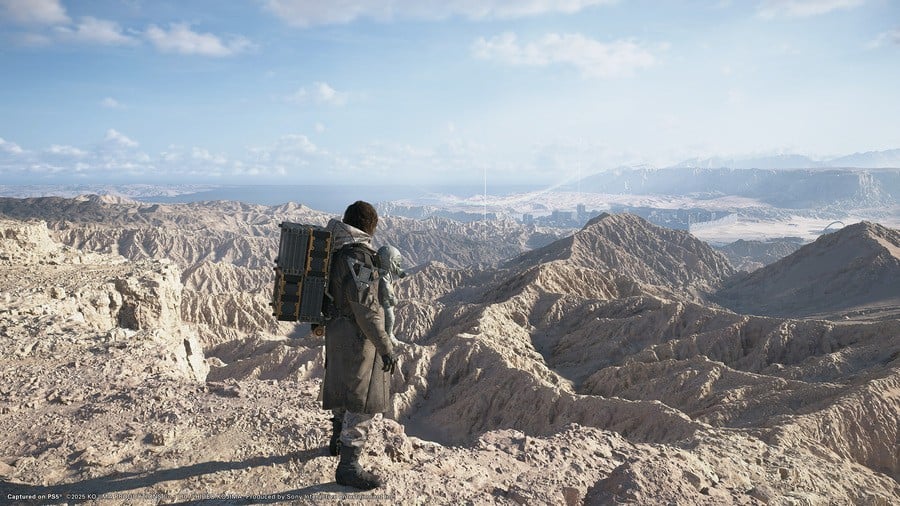
Kojima Productions created the Death Stranding games using their Decima game engine, and the results in both games have been remarkably impressive.
Decima is a game engine created by Guerrilla Games. It powers the Horizon series, known for its beautiful graphics and smooth performance even in expansive open-world environments.
Currently, Kojima Productions appears to be the only game development team besides PlayStation Studios using this specific technology. A recent interview shed some light on why they selected it to bring Sam Bridges’ journey to life.
In an interview with Automaton, Akio Sakamoto, the lead technology officer at KojiPro, explained why the Decima engine was the best option for both Death Stranding and its sequel, Death Stranding 2: On the Beach.
He admits the engine can be a bit tricky to learn, but its extensive capabilities were exactly what the studio needed for their game.
Sakamoto explained that the engine had many of the features needed for creating a vast, open-world game. Although it wasn’t as user-friendly as some commercial options, its powerful tools for analyzing how the game renders were a major advantage. He especially appreciated being able to access detailed data without needing separate software. The development environment, designed for big teams working on complex projects, also had features he’d always wanted in his previous engine. Considering all of this, they chose to use Decima.
He points out that no single game engine is perfect for every project, but Decima is a powerful tool that lets them create things that would be very challenging with other engines.
Sakamoto then explained how two memorable environments in Death Stranding 2 were created, sharing technical details about the process. He highlighted the opening mountain scene and a later scene featuring a massive fireworks display, both of which run smoothly without any slowdown or performance problems.
Despite having around 25 million polygons, the opening landscape still ran smoothly, according to Sakamoto. This performance was largely thanks to the power of the Decima engine’s rendering technology.
He also mentioned that Kojima Productions and Guerrilla Games have a close working relationship, with frequent meetings to discuss and share progress on their game engine.
To add features our projects require, we often customize the game engine directly – sometimes even building new ones from scratch. We then provide Guerrilla with the underlying code for these improvements, allowing them to benefit from our work, as Sakamoto explains.
It’s not often you hear open discussion like this, so we’re excited to share these findings. Guerrilla Games has built a powerful engine that, when used skillfully, can deliver truly stunning visuals. We’re curious to see if Decima becomes more popular within the industry, and if Kojima Productions will continue to use it in future games.
Read More
- Pluribus Star Rhea Seehorn Weighs In On That First Kiss
- Gold Rate Forecast
- Kelly Osbourne Slams “Disgusting” Comments on Her Appearance
- Looks Like SEGA Is Reheating PS5, PS4 Fan Favourite Sonic Frontiers in Definitive Edition
- Arknights: Endfield – Everything You Need to Know Before You Jump In
- Hideo Kojima Says He Was Never Told About The Matrix Creators Wanting Him to Make a Game
- ‘Marty Supreme’ Ending, Explained
- ’90s Cartoon Reboot & TMNT Connection!
- Goat 2 Release Date Estimate, News & Updates
- Dune 3 Gets the Huge Update Fans Have Been Waiting For
2026-02-18 15:07