Author: Denis Avetisyan
A novel magnetometer design leveraging a ferromagnet lattice promises enhanced sensitivity in the search for ultralight dark matter particles.
![This work projects the sensitivity of a proposed ferromagnet lattice magnetometer to ultralight dark matter couplings, demonstrating constraints-shown as a solid red curve-that improve upon existing limitations derived from both the literature [15,16] and single ferromagnet magnetometers [8], based on calculations utilizing a <span class="katex-eq" data-katex-display="false">1\ \mathrm{m}</span> shield size and established parameter configurations.](https://arxiv.org/html/2602.17291v1/x4.png)
This review details a new approach to detecting axion-like particles by exploiting coherent spin dynamics and mitigating dipole-dipole interactions within a ferromagnet lattice.
Despite comprising a significant portion of the universe, the nature of ultralight dark matter (ULDM) remains elusive, demanding increasingly sensitive detection strategies. This work, ‘Ultralight Dark Matter Detection with a Ferromagnet Lattice’, proposes a novel magnetometer leveraging a lattice of levitated ferromagnets to enhance ULDM detection through collective spin dynamics and suppression of disruptive dipole-dipole interactions. By coherently combining multiple ferromagnets, we demonstrate a pathway to significantly exceed the sensitivity of existing single-ferromagnet implementations, even revealing a lattice-induced enhancement for axion-photon interactions. Could this approach unlock a new window into the fundamental properties of dark matter and finally reveal its true nature?
Unveiling the Universe’s Hidden Mass: The Quest for Weak Signals
The composition of dark matter, a substance making up approximately 85% of the universe’s mass, represents a fundamental gap in modern physics. Despite its prevalence, dark matter does not interact with light, rendering it invisible to traditional telescopes and detection methods. This necessitates a paradigm shift in experimental design, pushing researchers to explore novel techniques beyond conventional particle physics. Current investigations prioritize strategies focused on detecting the subtle gravitational effects of dark matter, or its exceedingly rare interactions with ordinary matter – interactions so faint they require instruments of unprecedented sensitivity. The pursuit of these weak signals isn’t merely a search for a missing ingredient; it’s a quest to redefine understanding of the universe’s structure and evolution, prompting innovation across diverse fields like quantum sensing and materials science.
The search for dark matter has long been hampered by the expected feebleness of its interactions with ordinary matter. Conventional detection strategies, designed to capture signals from heavier, more interactive dark matter candidates, prove largely ineffective when applied to ultralight dark matter (ULDM). These particles, potentially possessing masses billions of times smaller than an electron, interact with magnetic fields in ways that produce extraordinarily subtle shifts – changes so minute they are easily lost in the noise of terrestrial and cosmic backgrounds. This presents a significant challenge; the predicted interaction strengths are several orders of magnitude weaker than those previously targeted, necessitating a paradigm shift in detector technology and signal processing techniques to even have a chance of observing these elusive particles. The faintness of the expected signal effectively requires instruments to discern the equivalent of a whisper in a hurricane, demanding unprecedented levels of precision and shielding.
The search for dark matter increasingly relies on the development of magnetometers with unprecedented sensitivity. These devices aren’t looking for collisions in the traditional sense, but rather the subtle disturbances dark matter particles are predicted to induce in magnetic fields. Because ultralight dark matter interacts so weakly, the expected signals are incredibly faint-on the order of zeptoteslas, or a trillionth of a trillionth of a tesla. Resolving these minute fluctuations requires shielding the sensors from all terrestrial magnetic noise-vibrations, radio waves, even the Earth’s own magnetic field-and employing materials with exceptional magnetic properties. Advances in quantum sensing, superconducting circuits, and atomic magnetometry are driving the creation of these next-generation detectors, offering a potential pathway to finally unveiling the nature of this elusive substance that makes up approximately 85% of the matter in the universe.
A Lattice of Sensitivity: Leveraging Levitated Ferromagnets
The ‘Ferromagnet Lattice’ consists of an array of levitated ferromagnets utilized to increase the platform’s sensitivity to Ultra-Light Dark Matter (ULDM)-induced magnetic fields. By employing multiple magnets, the system maximizes polarized spin, resulting in an N-fold enhancement of effective sensitivity compared to single-magnet detection schemes. This enhancement is directly proportional to the number of magnets in the lattice and allows for improved detection of extremely weak magnetic signals predicted by ULDM interactions. The lattice configuration also provides a larger effective detection volume, increasing the probability of ULDM interaction within the sensitive region of the experiment.
The measurement of coherent rotational dynamics within the Ferromagnet Lattice is achieved via a Superconducting Quantum Interference Device (SQUID) readout system. SQUIDs function as extremely sensitive magnetometers, capable of detecting minute changes in magnetic flux. By monitoring the magnetic moments of the levitated ferromagnets with the SQUID, the system precisely tracks their rotational motion, including both precession and nutation. This is accomplished by coupling the magnetic moment of each ferromagnet to the SQUID loop, allowing for high-resolution detection of changes in magnetic field as the magnets rotate. The SQUID readout provides the necessary sensitivity and bandwidth to characterize the coherent dynamics, which are critical for detecting the subtle signatures of ultra-light dark matter interactions.
High-Frequency Magnetic Field Modulation is implemented to mitigate the effects of disruptive magnetic dipole-dipole interactions between levitated ferromagnets. These interactions, arising from the close proximity of the magnets, create unwanted coupling and reduce the sensitivity of the magnetometric platform. By applying a modulated magnetic field oscillating at a frequency significantly higher than the Larmor precession frequency of the target signal, these inter-magnet interactions are effectively suppressed. This modulation introduces a time-varying potential energy that averages out the dipole-dipole coupling over time, allowing for a more accurate measurement of ultra-weakly interacting dark matter (ULDMs) and enhancing the overall sensitivity of the Ferromagnet Lattice.
Precision in the Balance: Analyzing Noise and Magnetic Susceptibility
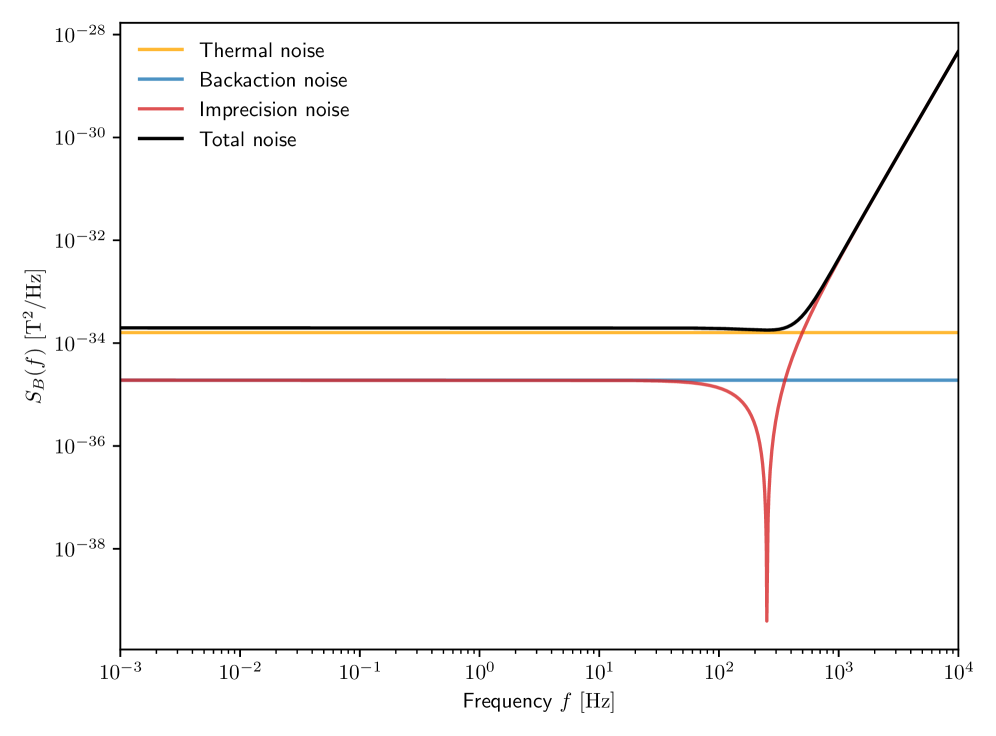
The fundamental detection limit in precision measurement is influenced by several noise sources exhibiting differing dependencies on the number of collective measurements, denoted as ‘N’. Thermal Noise, originating from thermal fluctuations, scales inversely with N, meaning collective readout techniques reduce its impact by a factor of 1/N. In contrast, Backaction Noise, arising from the disturbance of the measured system, remains independent of N; however, mitigation strategies like noise rebalancing can be employed. Finally, Imprecision Noise, linked to the inherent uncertainty in state estimation, decreases with the square of N – reducing to 1/N^2 – and can be further improved through dynamical renormalization techniques.
The susceptibility matrix, denoted as χ, mathematically defines the linear relationship between an applied magnetic field, \mathbf{H} , and the resulting magnetization, \mathbf{M} , within a ferromagnetic material; this is expressed as \mathbf{M} = \chi \mathbf{H} . Critically, χ is a tensor, reflecting the anisotropic magnetic properties of the material and the directional dependence of the magnetization response. Accurate determination of the susceptibility matrix is essential for signal extraction, as it allows for the deconvolution of the measured magnetic response to isolate the applied field and quantify the material’s magnetic characteristics. Furthermore, understanding the off-diagonal elements of χ is vital for characterizing cross-sensitivity to fields applied in different directions, which can introduce systematic errors if not properly accounted for during measurement and analysis.
Angular momentum, a fundamental property of rotating systems, directly manifests in ferromagnetic materials as a collective spin. The Einstein-de Haas effect demonstrates the physical relationship between angular momentum \textbf{L} and magnetic moment \textbf{M} via the proportionality constant γ, expressed as \textbf{L} = \gamma \textbf{M}. Consequently, the Einstein-de Haas frequency, derived from the precession of the magnetization vector, provides a critical calibration parameter for interpreting measurements of ferromagnetic response. Accurate determination of this frequency is essential for correctly relating applied fields to observed changes in magnetization and for distinguishing genuine signals from noise, particularly when analyzing weak magnetic signals.
Beyond Detection: Expanding the Horizon of Scientific Inquiry
The experimental platform demonstrates a unique capacity to detect interactions stemming from several theoretical dark matter candidates, specifically those mediated by ‘Axion-Photon Coupling’, ‘Axion-Electron Coupling’, and the hypothetical ‘Dark Photons’. This sensitivity arises from the platform’s design, which isn’t limited to a single interaction type, allowing it to probe a broader range of potential dark matter signatures than many conventional detectors. The ability to search for interactions involving both photons and electrons, alongside the possibility of detecting dark photons – particles that could interact with standard model particles via a hidden force – positions this technology as a versatile tool in the ongoing quest to understand the nature of dark matter and its elusive interactions with the visible universe. This broad sensitivity is crucial, as the true nature of dark matter remains unknown, and multiple interaction mechanisms are plausible.
A key advantage of this experimental setup lies in its dramatically improved signal-to-noise ratio, enabling the potential detection of ultralight dark matter (ULDM). The sensitivity stems from a cavity mode enhancement, scaling with several critical factors: 0.1 <i> N </i> gaγ <i> \sqrt{2ρDM} </i> μ / L^2. Here, ‘N’ represents the number of resonant cavities, ‘gaγ’ denotes the axion-photon coupling constant, ‘ρDM’ signifies the local dark matter density, ‘μ’ is the permeability, and ‘L’ is the cavity length. This scaling suggests that even exceedingly weak interactions, characteristic of ULDM candidates, can produce a measurable signal, particularly when utilizing a large number of cavities and maximizing the local dark matter density. The enhanced sensitivity opens a pathway to probe previously inaccessible regions of the ULDM parameter space and potentially unveil the nature of dark matter itself.
The principles underpinning this highly sensitive platform extend far beyond the search for dark matter, offering compelling opportunities in precision measurement and fundamental physics. The same techniques used to amplify the subtle signals potentially produced by axions – namely, the resonant enhancement within a carefully designed cavity – can be adapted to detect extraordinarily weak electromagnetic fields. This capability holds promise for applications ranging from materials science, where minute magnetic anomalies can reveal critical material properties, to medical diagnostics, where faint biomagnetic signals could provide early indicators of disease. Furthermore, the platform’s sensitivity allows for stringent tests of fundamental physical principles, potentially probing for deviations from established theories and opening new avenues for exploring the universe’s underlying laws. The precision achievable with this technology offers a unique toolset for investigating phenomena at the very edge of current scientific understanding.
The pursuit of detecting ultralight dark matter necessitates a careful examination of signal enhancement techniques, akin to discerning patterns within complex systems. This research leverages a ferromagnet lattice to amplify the subtle interactions expected from axion-photon coupling, effectively increasing the signal-to-noise ratio. As Francis Bacon observed, “Knowledge is power,” and in this instance, the power lies in a meticulously designed system to reveal previously undetectable phenomena. By suppressing dipole-dipole interactions and harnessing coherent spin dynamics, the magnetometer functions as a sophisticated instrument for extracting knowledge from the quantum realm, demonstrating that understanding the underlying mechanisms allows for increasingly precise observations.
Where to From Here?
The proposition of a ferromagnet lattice as a dark matter detector neatly sidesteps several persistent challenges in axion and ultralight dark matter searches. However, any increase in sensitivity invariably reveals new frontiers of noise. The suppression of dipole-dipole interactions, while theoretically sound, demands careful experimental verification; the lattice must maintain the predicted coherence, and any deviation could obscure the very signals it intends to amplify. Future iterations will likely focus on scaling the lattice – increasing the number of ferromagnets – but this presents material science hurdles, demanding materials with both high magnetic moment and low dissipation.
A fascinating, if subtle, implication lies in the potential for this technique to probe beyond the standard axion-photon coupling paradigm. If coherent spin dynamics are indeed exploited, the system becomes sensitive to any interaction mediating between dark matter and the ferromagnetic material – a possibility that extends the search beyond well-defined theoretical models. This necessitates a parallel theoretical effort to predict the expected signals from these more exotic interactions.
Ultimately, the success of this approach, like all searches for the unseen, rests on a continuous cycle of refinement. The lattice is not merely a detector; it is a lens, focusing attention on the subtle patterns that may reveal the universe’s hidden mass. The true test will not be in achieving a positive detection, but in rigorously defining the limits of non-detection, and using that knowledge to inform the next, more insightful iteration.
Original article: https://arxiv.org/pdf/2602.17291.pdf
Contact the author: https://www.linkedin.com/in/avetisyan/
See also:
- What Song Is In The New Supergirl Trailer (& What It Means For The DC Movie)
- Why is Tech Jacket gender-swapped in Invincible season 4 and who voices her?
- The Super Mario Galaxy Movie: 50 Easter Eggs, References & Major Cameos Explained
- Sydney Sweeney’s The Housemaid 2 Sets Streaming Release Date
- Highly Anticipated Strategy RPG Finally Sets Release Date (And It’s Soon)
- Dune 3 Gets the Huge Update Fans Have Been Waiting For
- TV legend Carol Kirkwood reveals the reasons why she decided to retire after 28 years with BBC
- Crypto Chaos: 6 Events This Week That Could Send Bitcoin and XRP into a Tailspin!
- Palworld! More Than Just Pals ‘Special Video’, characters detailed
- We Need More Open World Games to Feature This Genre
2026-02-22 12:17