Author: Denis Avetisyan
Researchers are probing the existence of axion-like particles by meticulously analyzing rare decays of the eta meson, seeking evidence beyond the Standard Model.
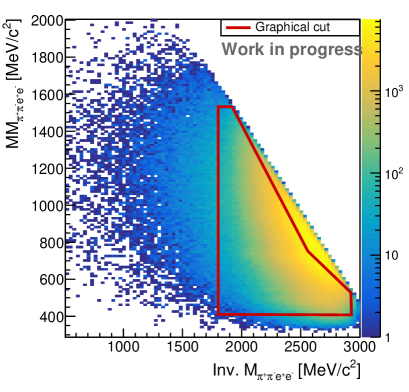
This analysis utilizes data from the HADES detector to search for Axion-Like Particles (ALPs) in the η→π+π−e+e− decay channel, improving sensitivity and establishing upper limits on ALP coupling constants.
Beyond the Standard Model, several unexplained phenomena suggest the existence of new particles and interactions, motivating searches for physics beyond our current understanding. This paper details an analysis, ‘Search for the Axion-Like-Particles in the $η\toπ^{+}π^{-}e^{+}e^{-}$ decay with HADES detector’, employing data from the HADES detector to investigate the potential production and decay of Axion-Like Particles (ALPs) in the rare decay of the η meson. By focusing on the η\toπ^{+}π^{-}e^{+}e^{-} channel, we aim to establish upper limits on ALP coupling strengths and masses. Could a resonant signal in the dilepton invariant mass spectrum reveal the elusive presence of these weakly interacting particles and provide insight into the hidden sectors of the universe?
The Incompleteness of Current Models
Despite its extraordinary predictive power and consistent validation through decades of experimentation, the Standard Model of particle physics remains incomplete. This remarkably successful theory, which describes the fundamental forces and particles of the universe, fails to account for several key observations, including the existence of dark matter and dark energy, the observed mass of neutrinos, and the matter-antimatter asymmetry in the cosmos. Furthermore, the Standard Model offers no explanation for gravity, remaining incompatible with general relativity. These unresolved puzzles strongly suggest that the current understanding of the universe is merely an effective theory, a stepping stone towards a more comprehensive framework-a Beyond the Standard Model (BSM) physics-capable of addressing these fundamental shortcomings and revealing the true nature of reality.
The foundations of established particle physics are facing intriguing challenges, most notably through observations made by the ATOMKI Collaboration in Hungary. These researchers have reported evidence for a potential new particle, dubbed X17, with a mass around 17 megaelectronvolts. If confirmed, the X17 particle doesn’t fit within the Standard Model – the prevailing theory describing fundamental forces and particles – because its existence would suggest forces or interactions not currently accounted for. The initial findings indicate a possible decay of X17 into a pair of photons, a behavior not predicted by known particles. While further experiments are crucial to validate these observations and rule out alternative explanations, the anomaly has ignited considerable theoretical activity, prompting physicists to explore extensions to the Standard Model that could accommodate such a surprising discovery and potentially unlock deeper insights into the universe’s fundamental building blocks.
The persistent mysteries beyond the Standard Model are driving a surge in investigations targeting light, weakly interacting particles – potential messengers within ‘Dark Sectors’. These hypothetical sectors represent a parallel universe of particles that interact primarily amongst themselves, and only very weakly with the familiar matter comprising the visible universe. Researchers posit that anomalies, like unexplained excesses of certain particle decays, could arise from interactions between the Standard Model and these Dark Sectors, mediated by these light particles. Experiments are now being designed and deployed to specifically search for these fleeting interactions, employing techniques ranging from high-precision measurements of particle properties to dedicated searches for exotic decay signatures. The discovery of such a particle wouldn’t merely fill a gap in the Standard Model; it would open a window onto a hidden realm of physics, fundamentally reshaping understanding of the universe’s composition and forces.
Eta Decays as Probes of the Unseen
Eta meson decays provide a viable search method for Axion-Like Particles (ALPs) and other light, weakly interacting mediators due to their relatively large branching ratios into final states sensitive to these hypothetical particles. ALPs are predicted by extensions to the Standard Model and can manifest as resonant enhancements or distortions in the observed decay spectra of the η meson. Specifically, decays involving photons or leptons are particularly sensitive probes, as the ALP would couple to these particles, altering the expected decay rates and angular distributions. The search leverages the principle that observation of anomalies in these decay channels – deviations from Standard Model predictions – could indicate the presence and properties of these new particles, providing insights into physics beyond the current established framework.
The HADES experiment, located at the GSI Helmholtz Centre for Heavy Ion Research, is particularly well-suited for the study of eta meson decays due to its high data acquisition rate and precise tracking capabilities. The experiment has accumulated an integrated luminosity of 5.5 pb-1, providing a substantial dataset for analyzing rare decay channels such as η → π^+π^-e^+e^-. This luminosity, combined with HADES’s detector suite, enables the reconstruction and analysis of a statistically significant sample of eta decays, facilitating searches for physics beyond the Standard Model, specifically focusing on potential signatures of Axion-Like Particles and other light mediators through detailed measurements of decay branching ratios and invariant mass distributions.
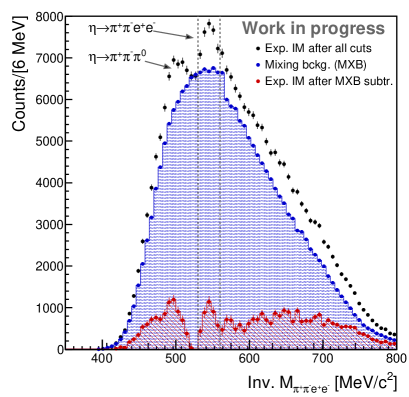
The identification of potential Axion-Like Particle (ALP) signals within eta meson decay data necessitates the application of several advanced analytical techniques. Particle Selection Criteria are implemented to define and isolate events of interest, reducing contamination from unrelated processes. Data from the Ring Imaging Cherenkov (RICH) detector is crucial for precise particle identification, specifically for distinguishing between electrons and pions. Furthermore, Monte Carlo Simulation is extensively used to model background processes and predict signal characteristics, enabling a statistically robust separation of ALP signals from the inherent background noise. This combined approach facilitated the reconstruction of approximately 2750 η → π^+π^-e^+e^- events within the HADES experiment, providing a substantial dataset for ALP searches.
Theoretical Foundations of Axion-Like Particle Interactions
The Peccei-Quinn (PQ) theory postulates the existence of axion-like particles (ALPs) as a dynamic solution to the strong CP problem in quantum chromodynamics (QCD). The strong CP problem arises from the absence of observed time-reversal (T) and parity (P) violation in strong interactions, despite the allowance of a θ term in the QCD Lagrangian. The PQ mechanism introduces a new global U(1) symmetry, spontaneously broken by a scalar field, resulting in the prediction of a neutral, spin-zero boson – the axion or, more generally, an ALP. This symmetry breaking dynamically relaxes the θ parameter to zero, effectively resolving the strong CP problem without requiring fine-tuning of parameters. The mass of the predicted ALP is inversely proportional to the symmetry breaking scale, f_a , making ALPs compelling candidates for dark matter and motivating numerous experimental searches.
Resonance Chiral Theory (RCT) provides a method for calculating the interactions between axion-like particles (ALPs) and hadrons by effectively modeling the low-energy dynamics of quantum chromodynamics (QCD). RCT achieves this by representing hadrons as resonances arising from the interactions of quarks and gluons, and utilizing chiral symmetry to constrain the possible interaction terms. This approach allows for the prediction of ALP decay constants and coupling strengths to various hadrons, considering contributions from both direct couplings and loop-induced processes. The complex dynamics of QCD, which are computationally challenging to address directly, are thus parameterized through the resonance structure and chiral Lagrangian, enabling quantitative predictions for ALP production and detection rates in experiments.
Hadronic couplings quantify the interaction strength between axion-like particles (ALPs) and hadrons, directly influencing the predicted rate of ALP production in various experimental settings. Accurate determination of these couplings is therefore essential for both theoretical predictions and the optimization of search strategies designed to detect ALPs. Specifically, precise knowledge of hadronic couplings allows for the reconstruction of decay events, such as the η→π+π−π0(e+e−γ) decay, with an anticipated yield of approximately 5000 events under specific model assumptions. This reconstruction relies on accurately modeling the interaction probabilities governed by these coupling constants, allowing for statistical analysis and potential ALP signal identification.
The Broader Implications for Cosmology and Beyond
The compelling nature of QCD axions as dark matter candidates stems from their theoretical origins within the Peccei-Quinn mechanism, a proposed solution to the strong CP problem in quantum chromodynamics. This mechanism predicts the existence of a new, neutral particle – the axion – which interacts extremely weakly with ordinary matter, making it difficult to detect but also a suitable constituent of dark matter. Crucially, axions possess properties that suggest cosmological stability; they wouldn’t decay over the age of the universe, and their production in the early universe avoids overabundance – problems that plague many other dark matter hypotheses. The predicted mass range for these axions, though uncertain, falls within a window that is increasingly accessible to current and future experimental searches, fueling ongoing efforts to definitively identify or rule out their role in the universe’s missing mass.
Beyond the simplest explanations for dark matter, alternative models featuring axion-like particles (ALPs) propose more complex interactions and potential connections to undiscovered forces. Specifically, the existence of the X17 particle – initially proposed as a protophobic gauge boson and subsequently considered a piophobic particle – suggests a hidden sector with its own dynamics. This particle, if confirmed to be an ALP, could mediate interactions that deviate from the standard predictions of minimal dark matter scenarios, opening the possibility of dark matter self-interactions or couplings to ordinary matter beyond those expected from gravity. Investigating these alternative ALP models, therefore, extends the search for dark matter beyond a single particle type and offers a window into potentially richer, more nuanced physics at the frontier of particle cosmology.
The search for dark matter and exploration of hidden sectors necessitates a dual approach of increasingly precise experimentation and sophisticated theoretical frameworks. Current investigations aren’t solely focused on confirming or denying specific particle candidates, but also on systematically mapping the parameter space for axion-like particles (ALPs) – hypothetical particles that could constitute dark matter or mediate interactions within these hidden sectors. These efforts demand pushing the boundaries of detector sensitivity, particularly within the challenging 0-200 MeV mass range, while concurrently refining theoretical models to accurately predict ALP behavior and potential signals. By combining high-precision measurements-looking for subtle interactions or decay products-with advanced simulations and calculations, scientists aim to either definitively identify these elusive particles or establish increasingly stringent upper limits on their properties, narrowing the scope of future investigations and ultimately illuminating the fundamental nature of the universe.
The pursuit detailed within this analysis, focused on identifying Axion-Like Particles through the HADES detector and the rare η→π+π−e+e− decay, embodies a rigorous demand for verifiable truth. It mirrors the sentiment expressed by Richard Feynman: “The first principle is that you must not fool yourself – and you are the easiest person to fool.” Establishing upper limits on ALP properties isn’t merely about finding a signal; it’s about eliminating self-deception through meticulous data analysis and a commitment to a demonstrably correct understanding of the pseudoscalar sector, rejecting any conjecture lacking robust evidence. The emphasis on improving the signal-to-background ratio is, at its core, a rejection of ambiguity.
Where the Search Leads
The pursuit of Axion-Like Particles, as exemplified by this analysis of η decays, highlights a persistent tension. The Standard Model, while remarkably successful, remains incomplete – a collection of empirically verified rules rather than a logically necessary truth. This search isn’t simply about finding a new particle, but about exposing the underlying mathematical structure that should have predicted it. To refine signal extraction from rare decays requires acknowledging that statistical significance, however compelling, is a proxy for understanding, not its equivalent.
Future investigations will undoubtedly demand increased luminosity and detector resolution. However, these are merely engineering improvements. The true advancement will lie in a more rigorous theoretical framework. Resonance Chiral Theory offers a path, but its inherent approximations must be confronted. The reliance on effective field theories, while pragmatic, obscures the fundamental question: what symmetries, if any, dictate the existence and properties of these hypothetical particles?
Ultimately, this line of inquiry forces a reckoning. Are these searches revealing genuine new physics, or simply mapping the contours of our systematic uncertainties? The elegance of a solution isn’t measured by its ability to fit data, but by its internal consistency and its ability to predict previously unknown phenomena. Until that standard is met, the search continues, driven by hope and constrained by the demands of mathematical rigor.
Original article: https://arxiv.org/pdf/2601.15887.pdf
Contact the author: https://www.linkedin.com/in/avetisyan/
See also:
- Gold Rate Forecast
- Looks Like SEGA Is Reheating PS5, PS4 Fan Favourite Sonic Frontiers in Definitive Edition
- Pluribus Star Rhea Seehorn Weighs In On That First Kiss
- Dune 3 Gets the Huge Update Fans Have Been Waiting For
- Arknights: Endfield – Everything You Need to Know Before You Jump In
- Antiferromagnetic Oscillators: Unlocking Stable Spin Dynamics
- 22 actors who were almost James Bond – and why they missed out on playing 007
- Kelly Osbourne Slams “Disgusting” Comments on Her Appearance
- 10 Steamiest Erotic Thriller Movies of the 21st Century
- 5 Weakest Akatsuki Members in Naruto, Ranked
2026-01-23 23:34