Author: Denis Avetisyan
A new analysis of the B meson’s decay into a K₀*(1430) and pairs of leptons offers a sensitive probe for deviations from the Standard Model and potential evidence for leptoquarks.
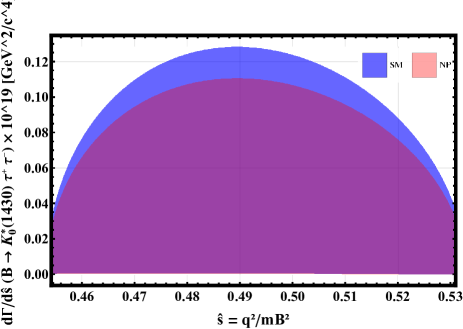
This study investigates the B→K₀*(1430)ℓ⁺ℓ⁻ decay to constrain scalar leptoquark models by examining branching fractions, lepton flavor universality, and longitudinal polarization.
Rare decays of B mesons offer a compelling window into potential physics beyond the Standard Model, yet definitive signals remain elusive. This study, ‘Study of B \to K_0^*(1430)\,\ell^+ \ell^- Decay in the Standard Model and Scalar Leptoquark Scenario’, investigates this decay channel as a sensitive probe for new phenomena, specifically scalar leptoquarks. By analyzing observables such as branching fractions, lepton universality ratios, and longitudinal polarization, we demonstrate the potential to distinguish leptoquark contributions from Standard Model predictions, particularly in regions minimally affected by background effects. Could precise measurements of this decay at facilities like Belle II and LHCb reveal the first conclusive evidence for leptoquark interactions?
The Standard Model: Approaching the Limits of Description
The Standard Model of particle physics, despite its decades of success in describing fundamental forces and particles, isn’t a complete picture of reality. Numerous observations suggest physics beyond its framework – phenomena it simply cannot explain. These include the existence of dark matter and dark energy, the observed mass of neutrinos, and the matter-antimatter asymmetry in the universe. While incredibly precise in its predictions within its defined scope, the Standard Model leaves significant gaps in \Lambda CDM cosmology and fails to account for gravitational interactions at the quantum level. Consequently, physicists are actively pursuing extensions to the Standard Model, exploring new particles and forces that might resolve these inconsistencies and offer a more comprehensive understanding of the universe, indicating that the current model is likely an effective theory-a highly accurate approximation of a more fundamental, yet undiscovered, underlying reality.
Certain rare decays of B mesons, specifically those resulting in a K^{<i>0}(1430) meson and a pair of leptons – electrons or muons – offer a unique window into physics beyond the Standard Model. These decays are exceedingly uncommon under Standard Model predictions, meaning even subtle deviations from those predictions can be magnified, revealing the presence of new particles or interactions. The sensitivity arises because these decays proceed via quantum loops, accumulating contributions from virtual particles; thus, any new particle that interacts with the b-quark or leptons can significantly alter the decay rate or the distribution of the decay products. By meticulously measuring the properties of these B \rightarrow K^{</i>0}(1430)\ell^{+}\ell^{-} decays, physicists can search for discrepancies that would signal the existence of previously unknown forces or particles, effectively testing the boundaries of established physics and hinting at a more complete understanding of the universe.
The search for physics beyond the Standard Model relies heavily on meticulously analyzing the subtle characteristics of particle decays. This study centers on rare B meson decays – specifically, those yielding a K^*_0 meson and a pair of leptons – as a sensitive means of detecting deviations from established theoretical predictions. By precisely measuring properties such as the angular distribution and rate of these decays, researchers can search for indirect evidence of new particles, with a particular focus on scalar leptoquarks. These hypothetical particles would couple quarks and leptons, offering a potential explanation for anomalies observed in B meson behavior and potentially revolutionizing the understanding of fundamental forces and particle interactions.
Constructing an Effective Framework for New Physics
The Effective Hamiltonian approach allows physicists to systematically investigate potential new physics contributions to B meson decays without needing to specify the exact details of the underlying high-energy theory. This is achieved by constructing an effective Lagrangian containing all possible operators consistent with the Standard Model symmetries, plus any new operators arising from beyond-the-Standard-Model physics. The strengths of these new interactions are encoded in Wilson Coefficients, which serve as parameters to be constrained by experimental data. By analyzing decay rates and angular distributions, and comparing them to Standard Model predictions, these Wilson Coefficients can be determined, providing evidence for, or limits on, the presence of new physics. This method is particularly useful when the energy scale of the new physics is significantly higher than the energies probed in B meson decays, rendering a direct calculation of the underlying process impractical.
Wilson coefficients within the effective Hamiltonian quantify the strength of new physics interactions affecting B meson decays. These coefficients function as parameters that modify the Standard Model contributions to decay amplitudes, effectively representing the scale and coupling constants of hypothetical new particles or interactions. Each Wilson coefficient corresponds to a specific operator in the effective Lagrangian, and its value directly impacts the predicted branching ratios and angular distributions of B meson decays. Precise determination of these coefficients, through experimental measurements and global fits, is therefore essential for probing potential deviations from the Standard Model and constraining new physics models. The coefficients are typically determined at a specific energy scale and require renormalization group evolution to account for scale dependencies.
Accurate predictions in B meson decay analyses utilizing the Effective Hamiltonian require careful consideration of both short-distance and long-distance effects. Short-distance contributions are encapsulated within the Wilson Coefficients, which parametrize the strength of new physics interactions at the electroweak scale. However, B meson decays also receive significant contributions from long-distance effects, primarily arising from intermediate charm resonances ψ and \chi_c states. These charm resonances contribute to the decay amplitude through processes not directly factored into the Wilson Coefficients. Failing to properly account for the interference between these two contributions – the perturbative Wilson Coefficients and the non-perturbative charm resonances – can lead to substantial inaccuracies in the predicted decay rates and angular distributions, obscuring potential signals of new physics.
Deciphering Hadronic Transitions: The Role of Form Factors
Form factors represent the probability amplitudes for a hadronic decay or transition and are crucial components of the Effective Hamiltonian used in calculations of weak decays and other hadronic processes. The Effective Hamiltonian, derived from the Standard Model, requires these non-perturbative quantities to connect the weak interaction to observable hadronic states; without accurate form factor values, predictions for decay rates and angular distributions are incomplete. Specifically, form factors parameterize our ignorance of the strong interaction dynamics occurring at the scale of the weak decay. They encapsulate the momentum transfer dependence of the transition between the initial and final hadronic states, effectively mapping the underlying quark-level interaction onto the observable hadronic level. \Gamma = |V_{q_1 q_2}|^2 \in t d^4x \, \langle f(x) | H_{eff}(x) | i(x) \rangle , where the integral includes form factor contributions.
QCD Sum Rules provide a method for estimating non-perturbative quantities like hadronic form factors by relating them to vacuum condensates and perturbative QCD calculations. This approach exploits the operator product expansion (OPE) to express hadronic properties in terms of a series of local operators with increasing dimension. By imposing Cauchy theorems and performing analytic continuation between different representations – typically, at large momentum transfer and in the operator product expansion – one can isolate the contributions from the ground state hadron and extract the desired form factor. The reliability of this method hinges on the convergence of the OPE and accurate knowledge of the vacuum condensates, such as \langle \bar{q}q \rangle and \langle g_s G^a_{\mu\nu} G^a_{\mu\nu} \rangle, which represent quark and gluon condensates, respectively.
The accurate determination of hadronic form factors presents a substantial challenge due to the non-perturbative nature of Quantum Chromodynamics (QCD). Calculating these quantities analytically is generally impossible, necessitating the use of approximation methods like QCD sum rules, lattice QCD, or chiral effective theories. Each method introduces specific theoretical uncertainties stemming from approximations made in the calculation, such as the choice of renormalization scale, the truncation of operator product expansion, or the limited size of lattice simulations. Quantifying and controlling these uncertainties is crucial for reliable predictions of hadronic transitions and for precise tests of the Standard Model. Furthermore, different calculation methods often yield form factor values that disagree, requiring careful comparison and assessment of their respective limitations and assumptions to arrive at a consistent and reliable result.
Precision Measurements: Constraining the Boundaries of Physics
The rate at which a particle decays – its differential decay rate – isn’t simply a single value, but rather a detailed distribution shaped by various kinematic variables like particle energies and angles. This complex landscape offers a sensitive probe for physics beyond the Standard Model. Deviations from predicted distributions, even subtle shifts in the shape of the decay rate as a function of these variables, can signal the presence of new particles or interactions. Researchers analyze these distributions to identify anomalies that cannot be explained by known physics, effectively using particle decay as a ‘fingerprint’ to search for evidence of previously unknown phenomena. The precision with which these rates are measured, combined with detailed theoretical calculations, allows scientists to constrain or even discover new physics signatures hidden within these seemingly complex decay patterns.
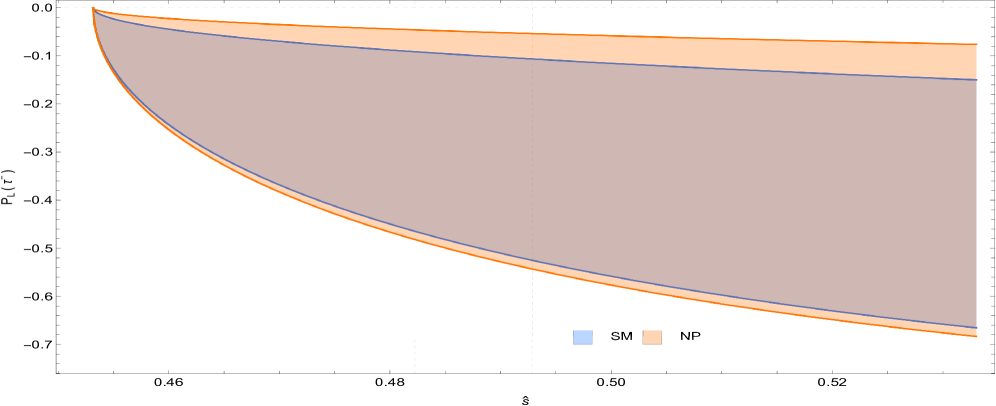
Certain measurable quantities – including branching ratios, longitudinal lepton polarization, and forward-backward asymmetry – serve as sensitive probes for physics beyond the established Standard Model. These observables detail how frequently a particle decays into specific products, the preferred spin orientation of emitted leptons, and the imbalance in particle distribution relative to a decay axis, respectively. Subtle deviations in these measurements, even those seemingly minor, can signal the presence of undiscovered particles or interactions not accounted for within the current theoretical framework. Consequently, high-precision experiments dedicated to characterizing these observables offer a powerful means of identifying new physics and refining existing models, potentially revealing the underlying mechanisms governing fundamental particle behavior.
The search for physics beyond the Standard Model hinges on the precision with which observable quantities are measured, and these measurements effectively map out the allowable parameters of proposed new models. For instance, considering decays of B \rightarrow K^<i>_0(1430)e^+e^- and B \rightarrow K^</i>_0(1430)\mu^+\mu^-, the Standard Model predicts branching fractions in the ranges of 1.4-11.8 x 10⁻⁸ and 1.4-11.5 x 10⁻⁸, respectively. However, a scenario involving leptoquarks suggests values between 0.6-10.1 x 10⁻⁸ and 0.6-9.8 x 10⁻⁸. Similarly, the ratio R_{K^*_0}, a measure comparing the rates of these decays with different leptons, is predicted to be 0.9673 – 0.9721 within the Standard Model, but shifts to 0.9659 – 0.9723 if leptoquarks are present; these subtle discrepancies, when precisely quantified, provide crucial constraints on the possible properties and existence of such new particles.
The pursuit of precision in flavor physics, as demonstrated by the study of $B \to K_0^*(1430)\,\ell^+ \ell^-$ decay, demands a rigorous approach to understanding fundamental interactions. One seeks not merely to observe a phenomenon, but to dissect it into its invariant components. As Ludwig Wittgenstein observed, “The limits of my language mean the limits of my world.” This resonates with the challenges inherent in probing beyond the Standard Model; the current theoretical language may be insufficient to fully describe potential new physics like scalar leptoquarks. The analysis of branching fractions and longitudinal polarization fractions, crucial to detecting deviations, requires a language precise enough to capture subtle signals and define the boundaries of what is observable, ensuring any observed variance isn’t simply a limitation of the descriptive framework.
Future Directions
The pursuit of physics beyond the Standard Model, as exemplified by this investigation of $B \to K_0^*(1430)\,\ell^+ \ell^-$ decay, continually reveals the precariousness of empirical validation. While deviations from current predictions would be… compelling, the absence of such deviations is not, strictly speaking, a confirmation. It merely establishes a lower bound on the mass scale of potential leptoquarks, a constraint that, while mathematically precise, feels… unsatisfying. The continued refinement of effective Hamiltonian calculations, and the relentless pursuit of higher-order corrections, remain necessary, though one suspects they are ultimately chasing a vanishing point of perfect agreement with a fundamentally incomplete model.
A crucial, yet often understated, limitation resides in the assumptions inherent in the factorization schemes employed. The true structure of the $K_0^*(1430)$ resonance-its internal composition and decay dynamics-remains a source of systematic uncertainty. More sophisticated theoretical frameworks, grounded in first principles rather than phenomenological approximations, are required to address this. Simply put, matching observable decay patterns to mathematically elegant equations is not, in itself, a demonstration of understanding.
The next logical step necessitates a broadening of scope. Investigations into related decay channels, and the exploration of alternative new physics scenarios – those not conveniently parameterized by scalar leptoquarks – are paramount. The field must resist the temptation to cling to favored models, and instead embrace the possibility that nature’s solution is… unexpected. Rigor, after all, demands an openness to being proven incorrect.
Original article: https://arxiv.org/pdf/2602.06892.pdf
Contact the author: https://www.linkedin.com/in/avetisyan/
See also:
- The Super Mario Galaxy Movie: 50 Easter Eggs, References & Major Cameos Explained
- Surprise Isekai Anime Confirms Season 2 With New Crunchyroll Streaming Release
- 10 Best Free Games on Steam in 2026, Ranked
- ‘Project Hail Mary’: The Biggest Differences From the Book, Explained
- Preview: Sword Art Online Returns to PS5 as a Darker Open World Action RPG This Summer
- Starfield (PS5) Review – A Successful Cross-Console Voyage
- Skate 4 – Manny Go Round Goals Guide | All of the Above Sequence
- Silver Rate Forecast
- All 7 New Supes In The Boys Season 5 & Their Powers Explained
- Sydney Sweeney’s The Housemaid 2 Sets Streaming Release Date
2026-02-09 14:41