Author: Denis Avetisyan
The XENONnT experiment pushes the boundaries of dark matter detection with a novel analysis of ionization signals, refining the search for weakly interacting particles.
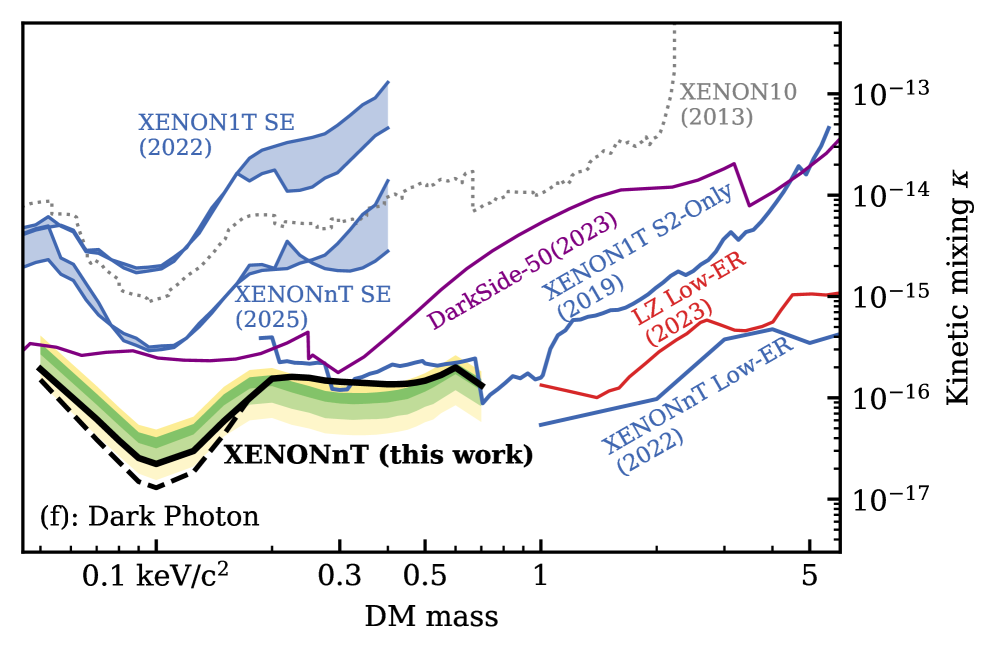
This study presents the first search for light dark matter using only S2-only signals from a 7.8 tonne-year exposure of the XENONnT liquid xenon time projection chamber, setting new constraints on dark matter interactions with both nucleons and electrons.
Despite comprising approximately 85% of the matter in the universe, the nature of dark matter remains elusive, prompting increasingly sensitive direct detection experiments. This paper, ‘Light Dark Matter Search with 7.8 Tonne-Year of Ionization-Only Data in XENONnT’, reports on a search for low-mass dark matter utilizing ionization-only signals from the XENONnT liquid xenon time projection chamber, achieving an exposure of 7.8 tonne-year. By implementing dedicated background suppression techniques and a complete S2-only background model, the analysis sets new 90% confidence level upper limits on spin-independent and spin-dependent dark matter-nucleon scattering, as well as dark matter-electron interactions, for masses between 3 and 8 \mathrm{GeV}/c^2. As XENONnT’s sensitivity improves, will coherent elastic neutrino-nucleus scattering ultimately define the floor for light dark matter searches?
The Universe’s Hidden Mass: An Emerging Mystery
Modern physics is presently engaged in a quest to understand dark matter, a mysterious substance that, despite being invisible to current detection methods, constitutes approximately 85% of the universe’s total mass. This isn’t simply a matter of filling a gap in cosmological models; evidence for dark matter arises from a variety of astronomical observations, including galactic rotation curves, gravitational lensing, and the cosmic microwave background. These phenomena cannot be adequately explained by the visible matter alone, suggesting the presence of an unseen component exerting gravitational influence. Identifying the nature of dark matter – whether it consists of weakly interacting massive particles (WIMPs), axions, or something else entirely – represents one of the most significant challenges facing physicists today, with profound implications for understanding the structure, evolution, and ultimate fate of the cosmos.
The quest to unveil dark matter hinges on the premise that, despite its elusive nature, it occasionally interacts with the ordinary matter composing everything around us. Experiments such as XENONnT are specifically designed to capture these fleeting interactions, employing ultra-sensitive detectors shielded deep underground to minimize interference from cosmic rays and other background radiation. These detectors, often filled with noble gases like xenon, meticulously monitor for the tiny energy deposits-recoil events-that would signal a dark matter particle colliding with an atomic nucleus. The extreme rarity of these potential interactions necessitates detectors with exceptional purity and incredibly low thresholds, pushing the boundaries of current technological capabilities in the pursuit of confirming the existence of this mysterious substance and characterizing its fundamental properties.
The pursuit of dark matter faces a significant hurdle: isolating a true signal from the constant ‘noise’ of other interactions within detectors. These experiments, often situated deep underground to shield against cosmic radiation, are still susceptible to background events stemming from residual radioactivity in materials and unavoidable interactions with neutrons and other particles. Distinguishing a genuine dark matter interaction – predicted to be incredibly rare and possessing a unique energy signature – requires sophisticated analysis techniques and precise calibration. Furthermore, even if a signal is detected, characterizing the nature of the interaction – determining the mass and properties of the dark matter particle – proves exceedingly difficult, as multiple particle types could theoretically produce similar signals. This ambiguity necessitates the development of diverse detection strategies and innovative data analysis methods to confidently unveil the elusive nature of dark matter.
A Chamber for the Invisible: Observing Interactions
The XENONnT experiment employs a Dual-Phase Time Projection Chamber (TPC) where liquid xenon functions as both the primary target for dark matter particle interactions and the medium for detecting those interactions via scintillation and ionization. Approximately 6 tonnes of xenon are utilized, with the bulk maintained in a liquid phase at -95°C and 3 bar. Scintillation photons, produced directly from particle interactions within the xenon, provide the initial event trigger and timing information. Simultaneously, incident particles ionize the xenon, releasing electrons which are then drifted upwards through the liquid xenon volume under the influence of an applied electric field. This dual-phase approach, utilizing both liquid and gaseous xenon, allows for precise tracking and 3D reconstruction of interaction events.
The XENONnT detector employs an electric field to direct ionization electrons generated by particle interactions within the liquid xenon. This field, applied across the detector volume, causes electrons to drift upwards through the liquid phase. Upon reaching the liquid-gas interface, these electrons are extracted into the gaseous xenon region via a carefully controlled process. This extraction is critical for signal amplification and allows for precise measurement of the initial ionization event’s properties, including energy deposition and spatial location, facilitating event reconstruction.
The dual-phase design of the XENONnT detector enables three-dimensional event reconstruction by precisely measuring both the initial interaction point in the liquid xenon and the subsequent drift of ionization electrons into the gaseous xenon phase. The z-coordinate is determined by the drift time of these electrons, proportional to the time elapsed between the primary scintillation signal and the detection of the ionization electrons in the gas phase. The x and y coordinates are determined from the pattern of detected light and ionization signals, providing a complete spatial reconstruction of the interaction. This capability is critical for background discrimination and accurate measurement of particle energies and directions, ultimately enhancing the sensitivity of the experiment to rare event signatures.
Decoding the Signal: Light and Recoil
The XENONnT detector utilizes liquid xenon as its target medium, leveraging the phenomenon of scintillation to detect particle interactions. When a particle interacts within the liquid xenon, it produces both primary scintillation light (S1) and a secondary, proportional scintillation signal (S2). S1 is emitted promptly at the interaction vertex, while S2 arises from the ionization electrons drifting within the electric field and subsequently scintillating at the liquid xenon-gas phase boundary. The amount of S2 produced is proportional to the number of ionization electrons created in the initial interaction, providing information about the event’s energy and particle type. Detecting both S1 and S2 signals in coincidence is crucial for background discrimination and the identification of potential dark matter interactions.
S1-S2 discrimination leverages the differing scintillation mechanisms produced by Nuclear Recoils (NR) and Electronic Recoils (ER) in liquid xenon. ER events, caused by gamma or beta particles, primarily deposit energy locally, creating both S1 and S2 signals with a relatively high S2/S1 ratio. NR events, resulting from interactions with potential dark matter particles or neutron backgrounds, involve the entire xenon nucleus recoiling, spreading ionization over a larger volume. This results in a lower S2/S1 ratio due to the reduced ionization density. By analyzing the ratio of these two signals, the XENONnT detector can effectively differentiate between the ER background and the NR signal expected from weakly interacting massive particles (WIMPs), enhancing the sensitivity of the dark matter search.
Photomultiplier Tubes (PMTs) are the primary sensors used to detect the extremely weak scintillation light produced in the liquid xenon of the XENONnT detector. These devices operate on the principle of secondary electron emission; incident photons strike a photosensitive cathode, releasing a small number of electrons. These initial electrons are then accelerated towards a series of dynodes, each held at a progressively higher voltage, causing the emission of multiple secondary electrons at each stage. This cascading effect results in a substantial amplification of the original signal, ultimately producing a measurable pulse of Photoelectrons (PE). The number of PEs detected is directly proportional to the energy of the initial photon, allowing for precise measurement of the scintillation signal and subsequent event reconstruction.
Refining the Search: Untangling Noise from Signal
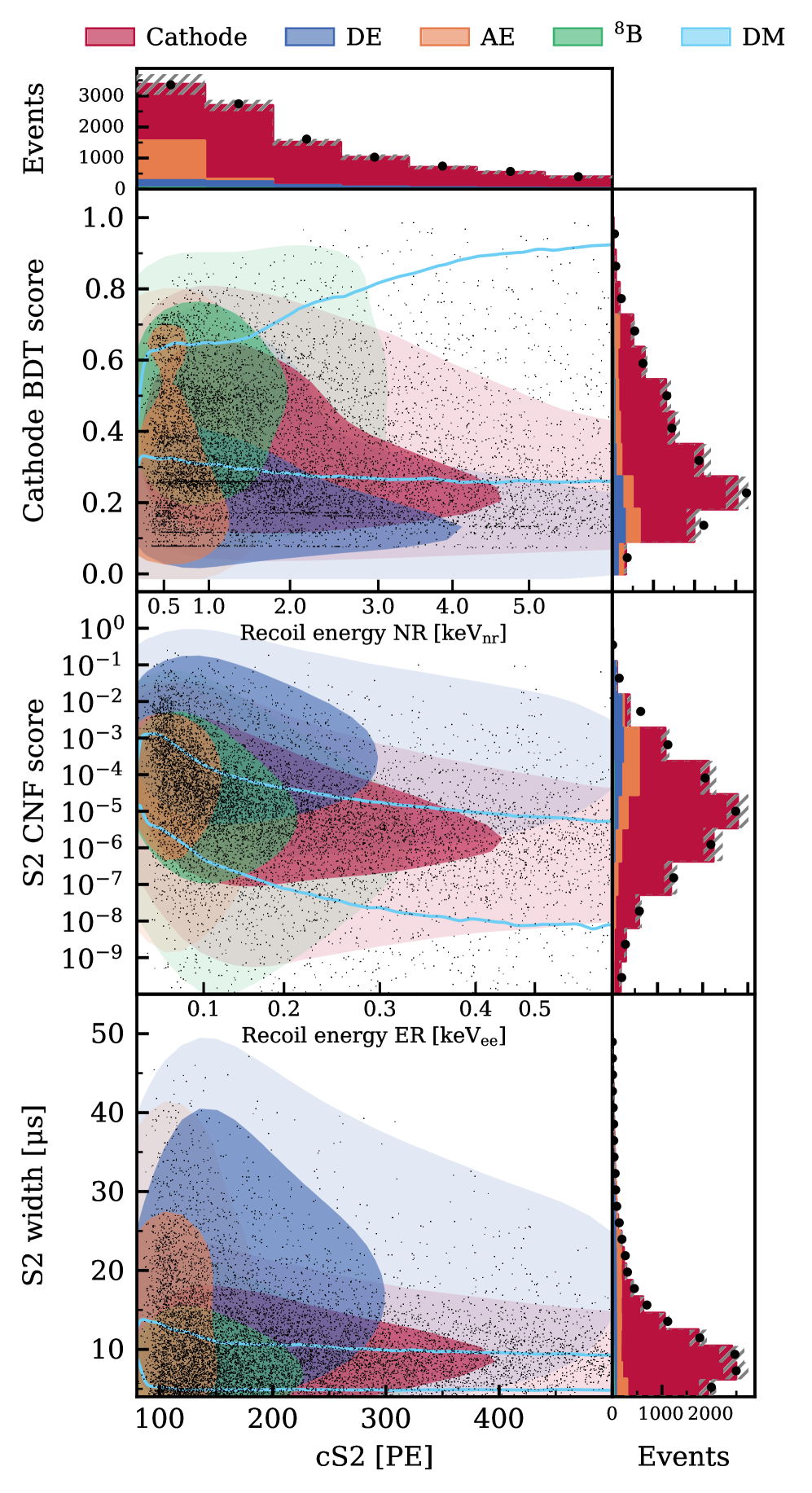
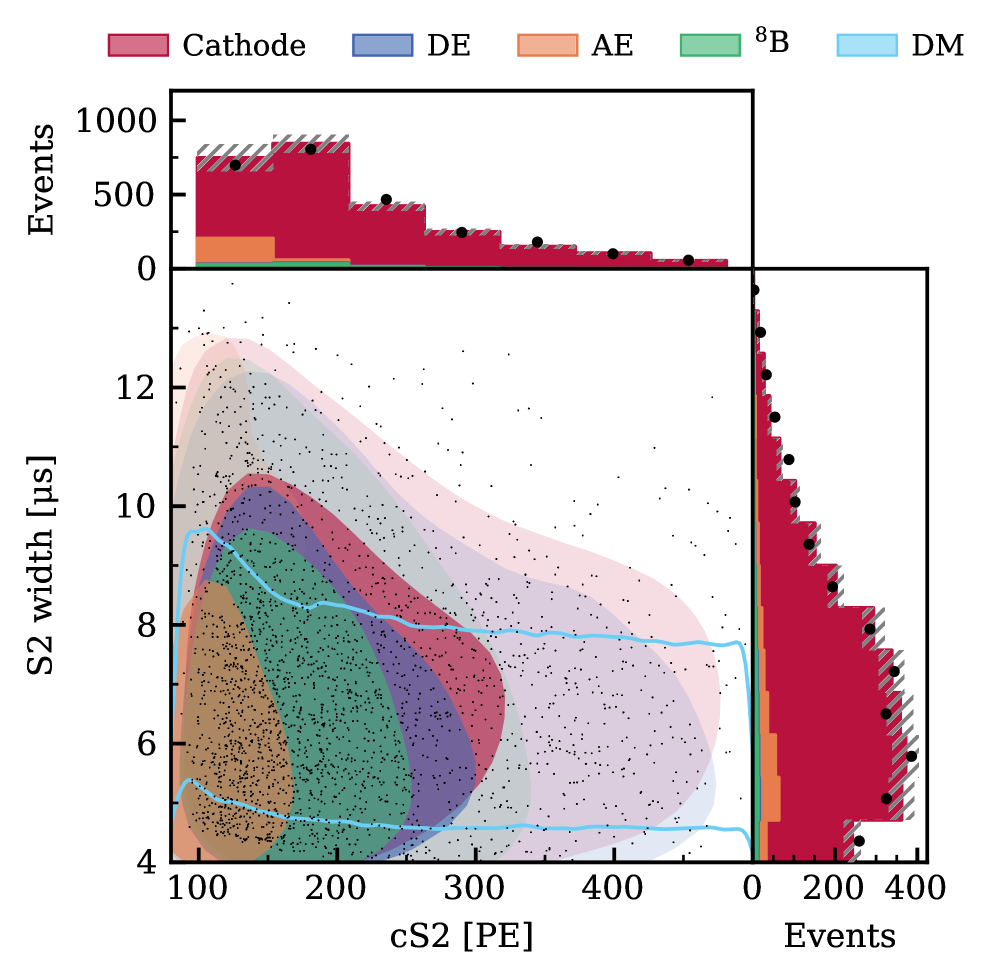
The identification of faint dark matter signals requires meticulous separation from unwanted background events. To achieve this, researchers employ sophisticated data analysis techniques, notably Gradient-Boosted Decision Tree (BDT) algorithms. These algorithms function by creating a complex decision boundary, effectively learning to distinguish between genuine interaction events and those originating from known sources of noise, such as the Cathode Background – a consequence of the detector’s internal materials and electronic processes. By training on simulated and observed background events, the BDTs can accurately predict the likelihood of an event being background, allowing for its rejection and increasing the sensitivity of the dark matter search. This precise background mitigation is crucial for extracting any potential dark matter signal from the data and establishing meaningful limits on the interaction strength between dark matter and ordinary matter.
Understanding and mitigating electron-induced backgrounds is paramount in the search for rare interactions. Specifically, models were developed to characterize and subtract contributions from Delayed Electrons (DE) – those occurring after the primary interaction – and Accidental Electrons (AE), which arise from unrelated events falsely registering as signals. These models meticulously account for the temporal and spatial distribution of these background events, allowing researchers to precisely predict their influence on the detector’s response. By effectively subtracting these backgrounds, the experiment significantly enhances its sensitivity to potential dark matter signals, improving the ability to discern faint interactions from the inherent noise and ultimately enabling more stringent limits on the properties of dark matter candidates.
The precision of the S2-Only analysis hinges on a comprehensive understanding of background noise, necessitating the development of a Full Background Model. This model allows researchers to accurately subtract spurious signals arising from various sources, ultimately enhancing the sensitivity of the dark matter search. Through an accumulated livetime of 579.5 days – compiled from three science runs totaling 110.2, 177.8, and 291.5 days respectively – the experiment achieved the ability to set 90% confidence level upper limits on the DM-nucleon scattering cross section, reaching a value of 6.0 \times 10^{-{45}} \text{ cm}^2 at a dark matter mass of 5 GeV/c2. This stringent limit represents a significant step forward in the ongoing effort to detect and characterize the elusive nature of dark matter.
Towards Deeper Understanding: Expanding the Search
The XENONnT experiment, currently operational, represents a significant leap in the search for dark matter, utilizing a substantially larger target mass of liquid xenon than its predecessors. This increased scale directly translates to heightened sensitivity, allowing the detector to probe a wider range of potential dark matter particle interactions with unprecedented precision. By continuously acquiring data, the experiment is not only expanding the search space for weakly interacting massive particles (WIMPs) but also opening avenues to explore alternative dark matter candidates, such as axions and sterile neutrinos. Each additional day of operation refines the limits on dark matter interaction cross-sections, either bringing the elusive particles closer to detection or establishing even more stringent constraints on their properties, ultimately deepening the understanding of the universe’s hidden mass.
The challenge of detecting rare dark matter interactions within the XENONnT experiment necessitates sophisticated methods for discerning signal from background noise. To address this, researchers are implementing techniques like Conditional Normalizing Flow (CNF), a machine learning approach capable of modeling the highly complex patterns that constitute background events. Unlike traditional methods that rely on simplified assumptions, CNF learns the full probability distribution of background, allowing for a more accurate prediction of expected events and, crucially, improved event reconstruction. By precisely characterizing the background, scientists can better identify potential dark matter signals that might otherwise be obscured, effectively lowering the detection threshold and enhancing the experiment’s sensitivity. This advanced modeling not only refines data analysis but also provides a more nuanced understanding of the detector’s response, contributing to the overall robustness of the dark matter search.
Refining the search for weakly interacting dark matter requires increasingly precise discrimination between genuine signals and background events. The S2 Pattern Likelihood method represents a significant advancement in this area, meticulously analyzing the patterns of secondary scintillation signals to distinguish between different interaction types within the XENONnT detector. Recent measurements demonstrate the effectiveness of this technique, revealing background rates of 318±50, 271±28, and 310±23 events per year per tonne in the detector’s search regions SR0, SR1, and SR2, respectively. Importantly, the method also allowed for the precise measurement of coherent elastic neutrino-nucleus scattering from 8B neutrinos, with rates of 14±3, 12±3, and 8.3±2.1 events t-1 y-1 in the same runs – validating the detector’s response and providing a crucial benchmark for future dark matter searches. This enhanced background rejection capability not only improves the sensitivity of the experiment but also lays the groundwork for either the definitive detection of dark matter interactions or the establishment of unprecedented limits on their properties.
The XENONnT experiment, detailed in this study, embodies a fascinating approach to unveiling the universe’s hidden components. It prioritizes emergent order – detecting faint ionization signals rather than imposing strict, top-down detection criteria. This mirrors the principle that global patterns arise from local rules, as evidenced by the sophisticated background modeling required to isolate potential dark matter interactions. As Jean-Paul Sartre noted, “Existence precedes essence,” suggesting that understanding arises from observing what is, rather than predefining what should be. Similarly, the search for light dark matter doesn’t begin with a preconceived notion of its properties, but with the careful observation of the signals emerging from the liquid xenon time projection chamber.
Beyond the Signal
The pursuit of dark matter, as evidenced by this work, increasingly resembles a refinement of null results rather than a triumphant detection. The XENONnT experiment, skillfully isolating the faintest whispers of interaction, demonstrates the power of meticulous subtraction – removing known backgrounds to reveal… less. This is not failure, but a sharpening of the question. Order manifests through interaction, not control, and the absence of a signal is itself information. The search for light dark matter via ionization-only channels, while constrained, highlights the necessity of exploring complementary detection strategies.
The ‘neutrino fog’ presents a persistent, though not insurmountable, challenge. Future iterations will undoubtedly focus on further discrimination between nuclear recoils and the irreducible electron recoil background. However, the limitations inherent in large-mass detectors – the sheer volume demanding ever-more-stringent control – should prompt consideration of alternative approaches. Perhaps the most profound advances will stem not from building larger instruments, but from embracing different principles.
Sometimes inaction is the best tool. The field might benefit from a period of consolidation – a deep theoretical re-evaluation of favored models – before committing to yet another scale jump in detector size. The universe does not offer its secrets easily. It reveals them through subtle shifts in perspective, not brute force.
Original article: https://arxiv.org/pdf/2601.11296.pdf
Contact the author: https://www.linkedin.com/in/avetisyan/
See also:
- Gold Rate Forecast
- Dune 3 Gets the Huge Update Fans Have Been Waiting For
- Every Creepy Clown in American Horror Story Ranked
- 22 actors who were almost James Bond – and why they missed out on playing 007
- Jack Osbourne Shares Heartbreaking Tribute to Late Dad Ozzy Osbourne
- Hazbin Hotel Secretly Suggests Vox Helped Create One of the Most Infamous Cults in History
- As Dougal and friends turn 60, Radio Times explores the magic behind The Magic Roundabout
- Arknights: Endfield – Everything You Need to Know Before You Jump In
- Everything We Know About Gen V Season 3 (& Why It’ll Be a Very Different Show)
- Jason Statham’s Hit Creature Feature Is Heading to Streaming for Free
2026-01-20 14:59