Author: Denis Avetisyan
Researchers are harnessing the unique properties of Rydberg atoms to explore novel nonlinear optical phenomena and their potential for advanced quantum sensing applications.
This review details the generation and interpretation of nonlinear optical spectra arising from Rydberg-mediated photon-photon interactions, highlighting both opportunities and challenges for precision measurements.
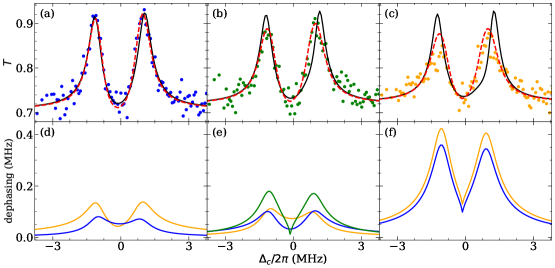
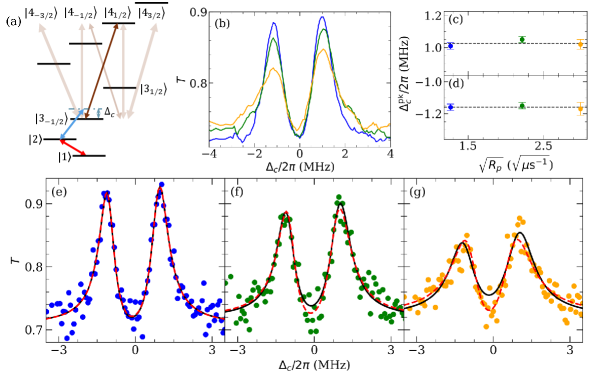
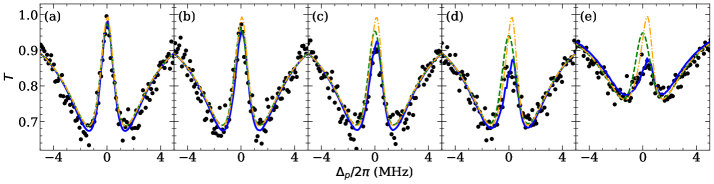
While strong atomic interactions are crucial for advancing quantum technologies, their impact on precision measurements in Rydberg atom-based sensors remains poorly understood. This research, detailed in ‘Nonlinear optical spectra from Rydberg-mediated photon-photon interactions’, experimentally investigates how Rydberg-Rydberg interactions manifest in the nonlinear optical spectra of cold atoms using electromagnetically induced transparency. We find that increasing photon-photon interactions lead to spectral broadening and shifts, explained by a conditional superatom model in three-level systems, and surprisingly, by a simple dephasing model in four-level systems. Do these findings pave the way for novel, robust atomic sensors operating in the nonlinear regime, and what further insights can be gained from refining models of many-body interactions in Rydberg EIT spectroscopy?
The Inherent Limits of Precision: Doppler Broadening and Spectral Resolution
Traditional sensing methods, notably those utilizing vapor cells to detect minute changes in magnetic fields or other physical quantities, are inherently limited by a phenomenon known as Doppler broadening. This effect arises from the random thermal motion of the atoms within the vapor cell; as atoms move, the wavelengths of light they absorb or emit are shifted slightly due to the Doppler effect, effectively smearing out the spectral lines. This broadening introduces uncertainty into measurements, reducing the precision with which these sensors can operate, and creating noise that obscures subtle signals. Consequently, applications demanding high spectral resolution, such as precision spectroscopy or sensitive magnetic field detection, are significantly hampered by these limitations inherent to vapor cell technology.
Doppler broadening fundamentally limits the sensitivity of vapor cell-based sensing techniques. This phenomenon arises from the random thermal motion of atoms within the vapor, causing a distribution of frequencies around the resonant transition. Consequently, a signal that should appear as a sharp peak is instead spread out, introducing noise and obscuring subtle spectral features. This is particularly detrimental in applications demanding high spectral resolution, such as precision magnetometry or the detection of weak molecular signatures. The broadened linewidth effectively reduces the signal-to-noise ratio, hindering the ability to discern fine details and ultimately compromising the accuracy of the measurement. \Delta\nu \approx \sqrt{\frac{2kT}{m}} represents the approximate magnitude of Doppler broadening, where k is Boltzmann’s constant, T is temperature, and m is the atomic mass, highlighting the direct relationship between thermal motion and spectral uncertainty.
The persistent demand for increasingly precise measurements across fields like medical diagnostics, environmental monitoring, and fundamental physics necessitates a departure from conventional vapor cell sensing techniques. While historically valuable, these methods are intrinsically limited by spectral broadening effects that obscure subtle signals and introduce measurement uncertainty. Consequently, researchers are actively investigating and developing alternative sensing platforms – including microfabricated devices, chip-scale atomic clocks, and novel optical techniques – designed to bypass these fundamental limitations and achieve superior sensitivity and resolution. These innovative approaches aim to unlock new capabilities in detecting trace amounts of substances, characterizing complex materials, and probing the universe with unprecedented accuracy, pushing the boundaries of what is currently measurable.
Rydberg Atoms: Amplifying Interaction, Reshaping Possibility
Rydberg atoms provide a distinct means of controlling interatomic interactions due to their exaggerated size and resulting dipole moments. Unlike ground-state atoms where interactions are short-ranged and weak, Rydberg atoms exhibit dipole-dipole interactions scaling with n^4, where n is the principal quantum number. This strong dependence allows for significant interaction strengths even with relatively large interatomic distances. Traditional methods for enhancing atomic interactions, such as Feshbach resonances, are often species-specific and limited in their tunability; Rydberg interactions, however, are broadly applicable across many atomic species and can be precisely tuned by adjusting the excitation laser wavelength and intensity, offering a versatile platform for quantum control and simulation.
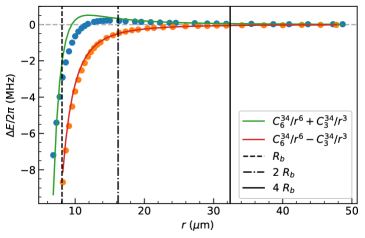
Rydberg atoms exhibit strong interactions due to their large electric dipole moments, resulting in long-range dipole-dipole forces that scale with the inverse third power of the interatomic distance \propto 1/r^3 . This distance dependence facilitates controllable manipulation of atomic states; specifically, the interaction strength can be tuned by adjusting the excitation wavelength and polarization of laser fields used to prepare the Rydberg states. These dipole-dipole interactions cause shifts in the energy levels of the atoms, known as the van der Waals (vdW) interaction, and can lead to phenomena like Förster resonance energy transfer (FRET) or dipole blockade, allowing for precise control over individual atomic states and collective atomic behavior.
Rydberg atom interactions are being utilized in the development of highly sensitive sensors capable of detecting weak electric and magnetic fields, with applications ranging from materials science to biomolecular detection. The strong, long-range dipole-dipole interactions between Rydberg atoms facilitate the creation of entanglement across macroscopic distances, enabling investigations into fundamental quantum phenomena such as many-body physics and quantum simulation. Specifically, researchers are exploiting these interactions to build quantum sensors with enhanced precision, surpassing the limitations of classical devices, and to probe correlated many-body states that are otherwise inaccessible through conventional methods. These platforms also allow for the exploration of non-classical light-matter interactions and the creation of novel quantum devices.
Modeling the Complex Dance: Rydberg Interactions and Theoretical Approaches
Accurate modeling of Rydberg-Rydberg interactions is essential for reliable performance of Rydberg-based sensors due to the strong, long-range interactions between Rydberg states. These interactions, resulting from electron-electron repulsion, significantly influence the energy levels and dynamics of the atomic ensemble. Precise prediction of these effects is needed to interpret sensor signals correctly and to optimize sensor design parameters, such as atomic spacing and excitation protocols. Failure to accurately account for these interactions leads to systematic errors in measurements of quantities like electric fields or microwave frequencies, and limits the achievable sensor sensitivity and resolution. The strength of the interaction scales as 1/R^3, where R is the interatomic distance, necessitating careful consideration of atomic positioning and spatial distribution within the sensor.
Modeling of Rydberg atom interactions utilizes a spectrum of theoretical approaches, varying in complexity and computational cost. Simplified mean-field theory treats the collective atomic interaction as an average effect, neglecting individual atom fluctuations. More advanced models incorporate stochastic conditioning, which accounts for the probabilistic nature of excitation and the influence of neighboring atoms’ states. These models also address unconditional effects, referring to interactions not dependent on specific excitation pathways, and dephasing, which describes the loss of coherence due to environmental noise and atomic motion. The selection of an appropriate model depends on the desired accuracy and the specific experimental conditions, with increasingly sophisticated methods necessary to capture the full range of observed behaviors.
Experimental results from this study indicate a measurable impact of Rydberg-Rydberg interactions on atomic transition (AT) frequencies. Specifically, a 0.07 MHz discrepancy was observed between the extracted AT splitting-determined through analysis of the atomic ensemble’s response-and the fitted microwave Rabi frequency, which represents the expected transition rate under ideal, non-interacting conditions. This difference provides quantitative evidence that Rydberg interactions introduce a frequency shift, influencing the observed spectroscopic properties of the system and necessitating the use of models beyond simple, single-atom approximations to accurately characterize and predict sensor behavior.
Beyond Control: Harnessing Rydberg Interactions for Quantum Frontiers
The unique properties of Rydberg atoms are now being harnessed to build the foundational elements of future quantum technologies. Interactions between these highly excited atoms provide a pathway to generate single photons on demand – discrete packets of light essential for secure quantum communication – and to create deterministic photonic entangling gates. These gates, which link the quantum states of photons, are vital for performing complex calculations in a quantum computer. Unlike probabilistic methods that rely on chance, Rydberg-mediated entanglement ensures a reliable connection between photons, significantly improving the efficiency and scalability of quantum systems. This deterministic control over light promises to overcome limitations in existing quantum technologies, paving the way for faster, more secure, and more powerful information processing.
Rydberg atom interactions are proving instrumental in crafting exotic states of light beyond those found in everyday experience. These interactions don’t simply manipulate photons; they allow for the creation of non-classical photonic states – squeezed light, for example, which exhibits noise properties fundamentally different from conventional light – and, crucially, open a pathway to directly exploring the long-sought-after realm of photon-photon interactions. Traditionally, photons have been considered largely non-interacting, but leveraging the strong, controlled interactions mediated by Rydberg atoms allows researchers to effectively create a medium where photons can ‘feel’ each other, potentially enabling all-optical logic gates and novel quantum simulations. This capability represents a significant leap forward, expanding the horizons of quantum optics and promising new avenues for manipulating and harnessing light at the single-photon level.
Recent investigations into Rydberg atom interactions reveal a pronounced sensitivity of spectral features to external probing. The study demonstrates that increasing the rate at which these atoms are probed leads to a measurable broadening of their spectral linewidth – observed up to 1.6 MHz – and a corresponding increase in the rate of Rydberg state decoherence, reaching as high as 2.5 MHz. This phenomenon underscores the significant impact Rydberg interactions have on the atoms’ response to external stimuli and provides valuable insight into the dynamics of these highly excited states. These observed changes are not merely quantitative shifts; they directly reflect the complex interplay between interacting Rydberg atoms, influencing both their spectral characteristics and the longevity of their excited state, thereby impacting potential applications in quantum technologies.
The Van der Waals Connection: Unveiling the Origins of Rydberg Interactions
The seemingly exotic interactions between Rydberg atoms, where electrons are excited to very high energy levels, surprisingly originate from the familiar Van der Waals forces that govern interactions between all atoms. These forces, arising from temporary fluctuations in electron distribution creating transient dipoles, are typically weak but become dramatically enhanced with Rydberg atoms due to their diffuse electron clouds. This heightened sensitivity means even slight distortions in the electron density of one Rydberg atom by a nearby atom significantly alter the overall interaction. Consequently, the long-range interactions between Rydberg atoms, crucial for applications in quantum computing and quantum simulation, aren’t a fundamentally new phenomenon, but rather a magnification of the ubiquitous forces that underpin much of chemistry and physics. The strength of this connection highlights how understanding basic atomic interactions can unlock powerful new technologies.
The magnitude of interactions between Rydberg atoms is not simply a qualitative observation, but a precisely quantifiable phenomenon described by the C_6 coefficient. This coefficient represents the dominant term in the long-range van der Waals potential, effectively dictating the strength of the attractive force between two atoms as they approach each other. A larger C_6 value indicates a stronger interaction, stemming from a greater degree of polarizability within the atoms’ electron clouds and, consequently, a more substantial induced dipole-dipole attraction. Determining the C_6 coefficient for specific Rydberg states is therefore crucial for accurately modeling and predicting the behavior of these atoms in experiments and for tailoring their interactions in applications like quantum simulation and information processing; it allows researchers to move beyond general descriptions and implement precise control over atomic interactions.
The precise manipulation of Van der Waals interactions between Rydberg atoms promises substantial advancements across several quantum technologies. Researchers are actively investigating methods to engineer these forces, tailoring the long-range interactions to optimize performance in areas like quantum simulation and computation. By controlling the C_6 coefficient – a key parameter defining interaction strength – scientists can enhance the fidelity of quantum gates and create highly entangled states. This level of control extends beyond computation, potentially enabling the development of novel quantum sensors with unprecedented sensitivity and the exploration of complex many-body physics previously inaccessible to experimental investigation. Ultimately, a deeper understanding of these fundamental forces unlocks pathways to more robust, scalable, and versatile quantum systems.
The study of Rydberg-mediated photon-photon interactions illuminates the inherent complexities within even carefully constructed quantum systems. It’s a demonstration of how interactions, while potentially unlocking new sensing capabilities, also introduce decay mechanisms that must be understood and accounted for. As Ernest Rutherford observed, “If you can’t explain it, then you’re not reaching people.” This research, by detailing the nuanced interplay of atomic interactions and nonlinear optical spectra, acknowledges that improvements – in this case, enhanced sensing – age faster than full comprehension. The work carefully maps the boundaries of these interactions, revealing the delicate balance between exploiting collective effects and mitigating the limitations imposed by atomic decay and spectral broadening – a natural progression within any system, however meticulously designed.
The Horizon Recedes
Each iteration of Rydberg spectroscopy, as documented in this work and the annals preceding it, reveals not so much a path forward as a more detailed map of the obstructions. The observed sensitivity to collective effects – the subtle but insistent drag of atom-atom interaction – is not a bug to be eradicated, but a fundamental tax on ambition. Delaying acknowledgement of these interactions only accrues technical debt, complicating future refinements. The pursuit of ever-more-nonlinear regimes demands a reckoning with the inherent limitations of maintaining atomic isolation, or, conversely, a deliberate embrace of these correlations as a resource.
The current emphasis on photon-photon interactions, while demonstrating impressive control, skirts the larger question of scalability. Every commit to this research is a record, and every version a chapter in a story that must ultimately confront the practicalities of many-body systems. The field now stands at a juncture: refine existing techniques to squeeze ever-smaller signals from single atoms, or redirect efforts toward harnessing collective phenomena-accepting a degree of inherent noise in exchange for increased signal strength and, potentially, entirely new sensing modalities.
The longevity of this approach, like any physical system, is not guaranteed. Time is not a metric here, merely the medium in which decay occurs. The true test will not be achieving a single, exquisitely precise measurement, but rather the development of robust, repeatable protocols that gracefully accommodate the inevitable imperfections of the physical world. The horizon recedes with every step taken, revealing not a destination, but more horizon.
Original article: https://arxiv.org/pdf/2602.11563.pdf
Contact the author: https://www.linkedin.com/in/avetisyan/
See also:
- Gold Rate Forecast
- Dune 3 Gets the Huge Update Fans Have Been Waiting For
- Looks Like SEGA Is Reheating PS5, PS4 Fan Favourite Sonic Frontiers in Definitive Edition
- Pluribus Star Rhea Seehorn Weighs In On That First Kiss
- Kelly Osbourne Slams “Disgusting” Comments on Her Appearance
- Action Comics #1096 is Fun Jumping-On Point for Superman Fans (Review)
- Tomodachi Life: Living the Dream ‘Welcome Version’ demo now available
- Antiferromagnetic Oscillators: Unlocking Stable Spin Dynamics
- 10 Steamiest Erotic Thriller Movies of the 21st Century
- Arknights: Endfield – Everything You Need to Know Before You Jump In
2026-02-15 12:03