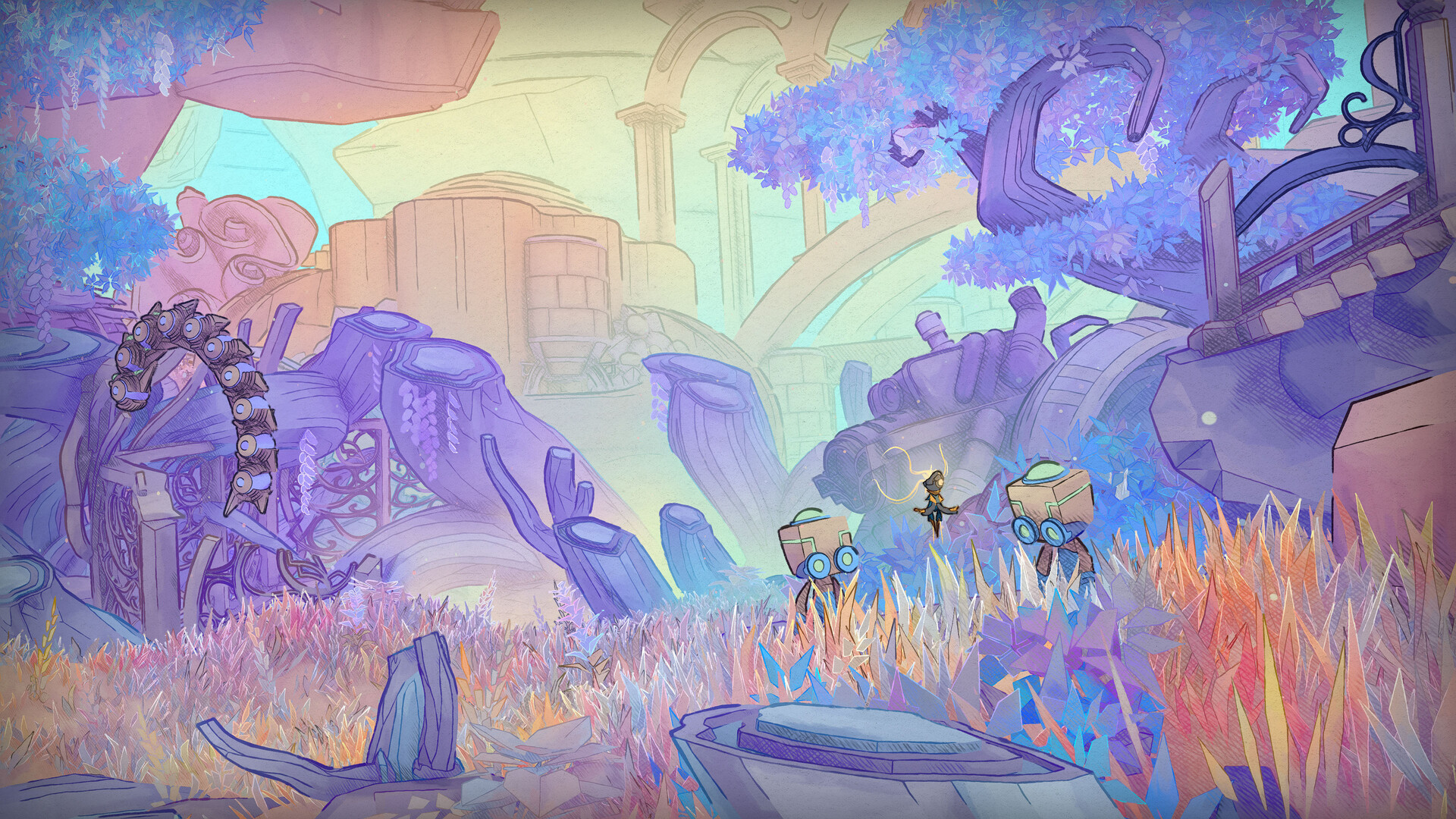
MIO: Memories in Orbit shares a lot with the highly anticipated Hollow Knight: Silksong, and unfortunately, it doesn’t quite reach the same level of quality. While that might discourage fans of the genre, it’s important to remember that Silksong sets a very high standard. MIO is still a solid and enjoyable side-scrolling action platformer. The games have clear similarities – both feature grappling, aerial combat, a dark atmosphere, a beautiful but decaying world to explore, and a system of learning new abilities. MIO even includes a downward dash for quick descents, though it’s more practical than a stylish move like Hornet’s.
If you’re looking for a beautiful game with interesting boss battles and a fantastic soundtrack, Memories in Orbit could be a good fit, even with a few minor flaws. On its own, it’s a well-made game, but some of its design choices aren’t ideal.
The story takes place aboard a giant spaceship called The Vessel, populated by robots with minds of their own. The ship is governed by a central intelligence, the Heart, and five supporting entities known as the Voices: The Breath, The Spine, The Hand, The Blood, and The Eye. When Mio wakes up, she discovers The Vessel is falling apart and the Voices aren’t responding. She soon learns that by finding and reconnecting with the Keepers, she might be able to save the ship by restoring the Heart – and the only way to do that is to gather the Voices.
Fortunately, the game’s core gameplay is solid. Players familiar with action games will quickly understand it: you’ll be using quick attacks, double jumps (available right away), gliding, and grappling. Everything feels good to control, and Mio learns new skills at a nice pace.
The game has a good foundation, though the characters could be more fleshed out. This is especially true for the ‘Voices,’ which is surprising since they’re fully voiced. The main character, Mio, also suffers from this – her inner thoughts appear during challenging sections when you’re focused on learning new skills, and these moments feel infrequent and poorly timed. The story actually feels more compelling through Tomo’s investigation of the Vessel, revealed through collectible datapads.
The game’s environments are full of subtle stories, often hinting at a past beauty now lost to some event. You’ll also find broken robots, and it’s a shame we don’t learn more about them. A little extra information – perhaps through collectible logs – could have really enriched the game’s world and given those robots a voice.
As you explore The Vessel, you’ll meet various bots who share their opinions on what’s happening, including updates on each Voice. Some of these bots will ask for your help, which is usually pretty straightforward. You’ll also encounter Ati, Mio’s sister, who tries to stop you from collecting all the Voices, but she doesn’t appear often enough to make a big impact. While the story isn’t terrible, and there are a few good moments and discoveries, most of the Voice storylines feel unsatisfying in the end. The Hand is an exception, as its story is the most developed, though it’s still a bit of a stretch to call it a full arc.
Fortunately, the core gameplay is solid. Players familiar with action games will quickly understand the mechanics: fast attacks, double jumps (available immediately), gliding, and grappling all feel good to use. Mio learns new skills at a good pace, including some unique abilities like a spider-like movement that lets you climb walls and even run on ceilings. The combat is especially fun in the air – hitting enemies gives you an extra jump, allowing you to stay airborne and create long, flowing attack combos.
While combat feels good with satisfying impacts, your options are limited. You won’t find extra weapons or power-ups during battles. The only way to improve your damage is by customizing Mio’s abilities with Modules.
While not necessarily flaws, some game mechanics take time to adjust to and can limit how freely you explore. The energy system governs abilities like gliding and grappling – it functions like stamina, preventing you from using these moves when depleted. You can regain energy by bouncing off enemies or landing on the ground, but hitting specific objects in the environment fully refills it, letting you seamlessly chain abilities together. The game, Memories in Orbit, uses this to create challenging platforming sections that require a precise sequence of actions – bouncing, grappling, jumping, and hitting objects – to maintain momentum and progress.
The frustrating thing is that even a small error can send you back quite a distance. For example, you might successfully get through a dangerous section like the Blightwater, avoid a deadly wall, and reach a platform, only to have to repeat it all because you missed a single grapple point. It turns into a test of perfect execution and memorization of every item and movement needed to maintain momentum. When you’re already on edge, things like a grapple that doesn’t quite reach or a weak bounce after an attack can feel especially irritating.
The quick movement ability, often called a ‘dash,’ isn’t quite a dash at all. It’s similar to dodging, but doesn’t offer the usual perks like slowed time or the ability to strike back. It feels more like a perfect dodge without those benefits. Because of its lengthy cooldown after a mistake, and the difficulty of stringing multiple dodges together, it can feel a bit clunky and unreliable.
While combat feels satisfying when you land attacks, it doesn’t offer a lot of strategic depth. You won’t find extra weapons or items to help you out. The only way to improve your damage is by customizing Mio’s internal systems with Modules. You can also tweak the on-screen display, removing things like enemy health bars or your own status indicators to make room for things like increased damage at low health, or a more powerful final hit in your combos. However, these are essentially the only ways to change up how you fight.
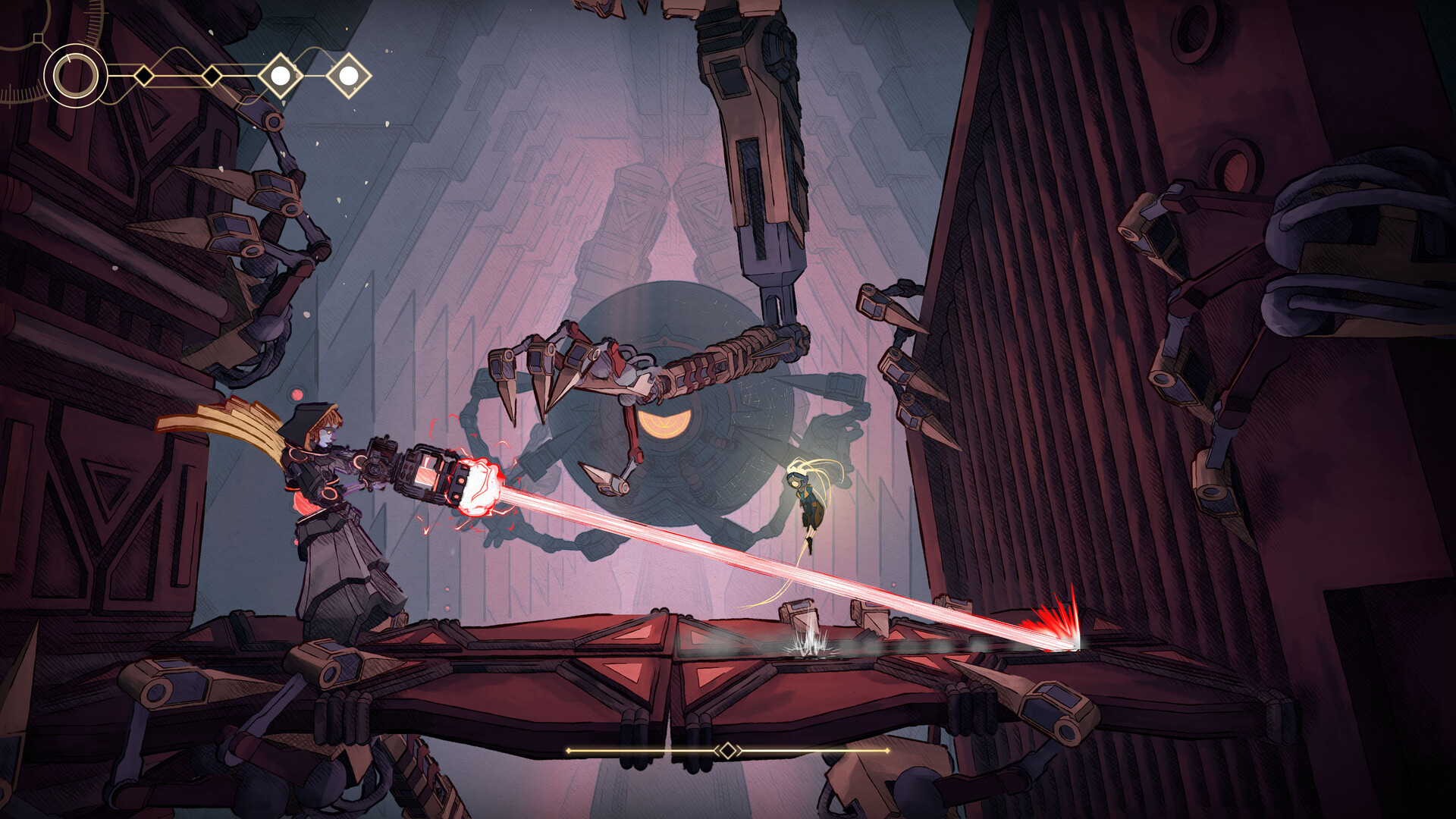
While the game offers a good experience with a unique, though sometimes uneven, set of features, a decent story, and polished presentation, it ultimately feels like it could have been even better, especially considering the price.
The game has some unusual design choices, like not including any way to heal during the main story. Getting around also isn’t straightforward – you need to find special creatures called Overseers to fast travel, otherwise you’ll be doing a lot of walking back and forth. While the map is a good size and generally well-designed, some areas require frustratingly long return trips. On the bright side, the boss battles are excellent, each presenting a unique challenge that feels appropriate for its setting.
The game’s beautiful art style really stands out, with detailed shading and a vibrant color palette. It skillfully blends science fiction, natural environments, and industrial elements, creating a strong visual appeal that likely attracts many players. However, the music is arguably even more impressive. Some tracks evoke the feeling of Risk of Rain, while others have an electronic sound reminiscent of Daft Punk – and it works incredibly well.
While Memories in Orbit offers a good experience with a decent story and appealing presentation, especially for its price, I didn’t feel a strong urge to revisit it after finishing the main story and uncovering most of its secrets. It has some interesting gameplay mechanics, though not all of them work perfectly, and ultimately, I was hoping for something a little more impactful.
This game was reviewed on PC.
Read More
- Gold Rate Forecast
- Hazbin Hotel Secretly Suggests Vox Helped Create One of the Most Infamous Cults in History
- Every Creepy Clown in American Horror Story Ranked
- 22 actors who were almost James Bond – and why they missed out on playing 007
- Chill with You: Lo-Fi Story launches November 17
- Everything We Know About Gen V Season 3 (& Why It’ll Be a Very Different Show)
- Jack Osbourne Shares Heartbreaking Tribute to Late Dad Ozzy Osbourne
- Kingdom Come: Deliverance 2 – Legacy of the Forge DLC Review – Cozy Crafting
- Jason Statham’s Hit Creature Feature Is Heading to Streaming for Free
- Best X-Men Movies (September 2025)
2026-01-20 16:12