Author: Denis Avetisyan
New research reveals subtle differences in the quadrupole transitions of carbon-10 and beryllium-10, challenging expectations of perfect isospin symmetry in these exotic nuclei.
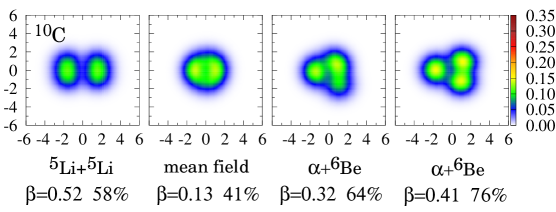
Advanced nuclear modeling using Antisymmetrized Molecular Dynamics demonstrates an anomaly in the electric quadrupole transitions of $^{10}$C and $^{10}$Be, linked to differing proton and neutron deformations.
Despite established expectations of isospin symmetry in mirror nuclei, subtle discrepancies can emerge in their electromagnetic properties due to nuanced structural effects. This work, ‘Quadrupole transitions of $^{10}$C and their isospin symmetry with $^{10}$Be’, investigates the quadrupole transitions of the exotic carbon isotope $^{10}$C and compares them to its mirror nucleus, $^{10}$Be, utilizing an advanced antisymmetrized molecular dynamics approach. Results reveal an anomalous relationship in their electric quadrupole transitions, stemming from differing proton and neutron deformations-specifically, a suppressed proton deformation in $^{10}$C and enhanced clustering in $^{10}$Be-while largely maintaining isospin symmetry. Could further experimental investigation of these transitions provide deeper insights into the interplay between nuclear structure and symmetry in these exotic systems?
Deconstructing the Nucleus: A Map of Instability
The atomic nucleus, though incredibly small, dictates the properties of matter and fuels stellar processes; therefore, a complete understanding of its structure is a central goal of nuclear physics. Predicting the shape – or deformation – of a nucleus is surprisingly complex, extending far beyond a simple sphere. While certain stable nuclei exhibit predictable forms, moving towards nuclei with extreme proton or neutron numbers introduces exotic configurations and weakens the forces holding them together. These ‘unstable’ nuclei can adopt bizarre, often fleeting, shapes driven by the interplay of the strong and weak nuclear forces, presenting a formidable theoretical challenge. Accurately mapping these deformations is crucial not only for validating fundamental nuclear models but also for understanding the creation of heavy elements in astrophysical environments and informing applications like medical isotope production.
As nuclei deviate further from the established ‘valley of stability’ – meaning they possess increasingly extreme proton-to-neutron ratios or excessive numbers of either – conventional nuclear models begin to falter. These models, frequently reliant on simplifying assumptions about nuclear forces and structure, struggle to account for the emergent behaviors of these exotic systems. Instead of the smooth, predictable shapes predicted by simpler theories, nuclei far from stability exhibit complex configurations, where nucleons don’t simply occupy single-particle orbits but coalesce into clusters. These clusters – often resembling familiar structures like alpha particles ^4He – significantly alter the nucleus’s overall shape and properties, leading to deformation and making accurate prediction of their behavior a substantial challenge for theorists. The prominence of these clustering effects, combined with increased quantum correlations between all constituent nucleons, necessitates the development of more sophisticated theoretical frameworks capable of capturing the intricate interplay of forces within these unstable nuclei.
Describing the structure of exotic, unstable nuclei demands computational approaches that go beyond simplified assumptions. These nuclei, lying far from the line of stability, exhibit complex behavior stemming from the strong correlations between all constituent nucleons – protons and neutrons. Traditional nuclear models often treat these interactions in an average way, which proves insufficient for accurately predicting the properties of these systems. Instead, methods like ab initio calculations, which attempt to solve the many-body Schrödinger equation directly from the fundamental forces between nucleons, are crucial. These approaches, however, face immense computational challenges, scaling factorially with the number of nucleons, necessitating the development of advanced algorithms and high-performance computing resources to capture the subtle interplay of correlations that define the structure of these fascinating nuclear species. The ability to model these correlations is paramount for understanding nuclear stability, reaction rates in astrophysical environments, and the limits of nuclear existence.
Simulating the Quantum Dance: AMD in Action
Antisymmetrized Molecular Dynamics (AMD) models the nuclear structure by representing nucleons not as point particles, but as localized Gaussian wave packets, typically with a width of approximately 2 fermi. This approach allows for a description of the spatial distribution of nucleons within the nucleus and facilitates the calculation of nuclear properties based on the collective behavior of these wave packets. The use of Gaussian wave packets simplifies the mathematical treatment while still capturing essential features of the nuclear wave function. Crucially, the antisymmetrization requirement-ensuring the total wave function is antisymmetric under nucleon exchange-is enforced to accurately reflect the fermionic nature of nucleons and is central to the AMD method.
AMD’s time-dependent framework simulates nuclear behavior by propagating localized Gaussian wave packets representing nucleons according to the time-dependent Schrödinger equation. This allows for the observation of dynamic processes such as nuclear fission, fusion, and heavy-ion collisions. Crucially, the method inherently incorporates many-body correlations arising from the interactions between nucleons, going beyond mean-field approximations. By evolving these wave packets, AMD enables the exploration of various nuclear configurations and the associated potential energy surfaces, providing insight into the nucleus’s response to external stimuli and its intrinsic structural properties. This contrasts with static approaches that offer only a snapshot of the nuclear state at a given moment.
AMD utilizes effective nuclear interactions to represent the complex many-body forces acting between nucleons. These interactions, typically derived from realistic nucleon-nucleon potentials such as those based on chiral effective field theory or Paris potentials, are modified to be suitable for use with Gaussian wave packets. The effective interaction incorporates both two-body and three-body components, accounting for short-range correlations and medium-range effects. By employing a finite range, these interactions reduce computational cost while maintaining accuracy in describing nuclear saturation, binding energies, and excitation spectra. The specific form of the effective interaction directly impacts the predicted properties of the nucleus, necessitating careful calibration against experimental data and benchmark calculations.
Refining the Simulation: Multicool and Empirical Validation
The Multicool method represents an advancement over the Antisymmetrized Molecular Dynamics (AMD) approach by concurrently optimizing a greater number of AMD configurations during calculations. This parallel optimization process significantly improves both the accuracy and convergence rate of AMD for complex nuclei, which traditionally present computational challenges. By exploring a wider configuration space simultaneously, Multicool reduces the likelihood of becoming trapped in local minima, leading to more reliable results and a more efficient determination of the nuclear wavefunction. The method’s efficacy stems from its ability to better approximate the many-body problem inherent in nuclear structure calculations, particularly for nuclei exhibiting complex shapes or cluster structures.
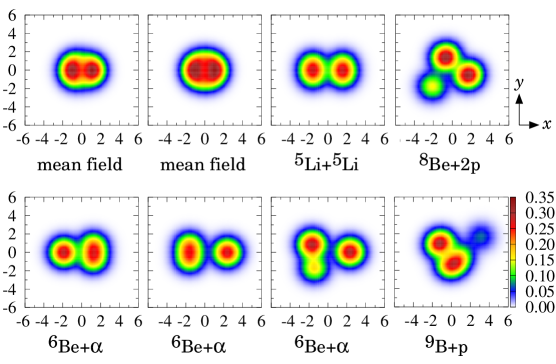
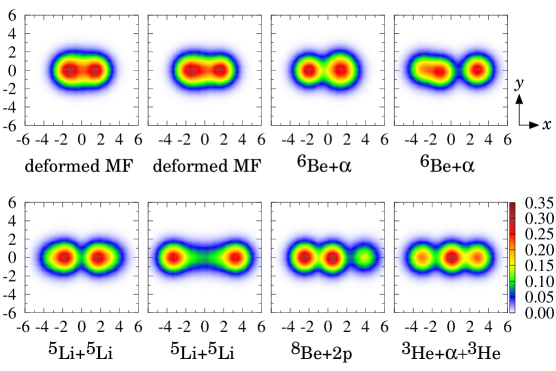
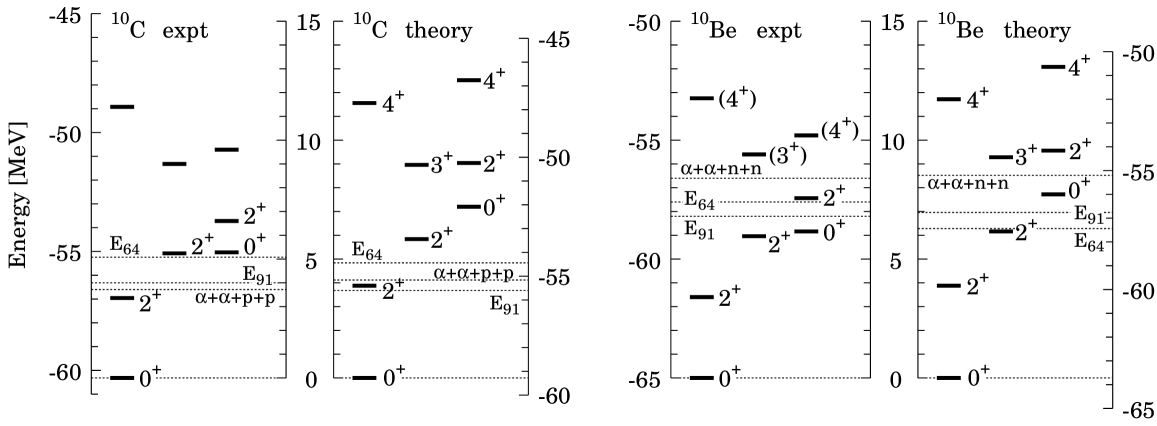
Application of the Antisymmetrized Molecular Dynamics (AMD) and Multicool methods to the nuclei 10C and 10Be successfully reproduces experimentally observed properties. Specifically, calculations accurately predict both the quadrupole moments, which characterize the charge distribution, and the cluster structures present within these nuclei. Furthermore, the model quantitatively matches the experimentally determined ground state energy of 10Be (01+), validating its predictive capability and confirming the accuracy of the underlying many-body interactions used in the calculations.
Calculations utilizing the AMD and Multicool methods demonstrate that accurately modeling the structure of nuclei like 10C and 10Be requires accounting for triaxiality – a deviation from purely prolate or oblate shapes. Specifically, the calculations estimate a deformation parameter γ of approximately 21 degrees for both nuclei, indicating a significant triaxial component to their shape. This triaxiality is not an isolated feature but is intrinsically linked to the interplay between nuclear clustering – the tendency of nucleons to group together – and overall nuclear deformation. The observed correlation suggests that both clustering phenomena and the specific triaxial shape contribute significantly to defining the key properties of these light nuclei.
Isospin Symmetry and the Fingerprint of Nuclear Forces
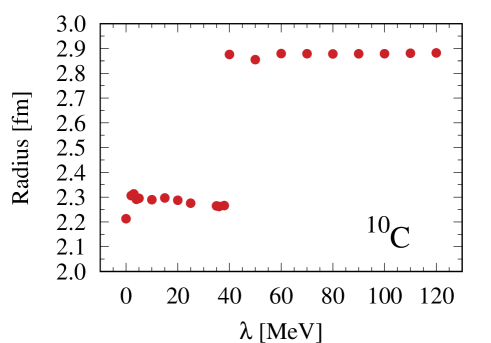
Ab initio many-body calculations, specifically the Antisymmetrized Molecular Dynamics (AMD) approach, are illuminating how isospin symmetry-the approximate symmetry between protons and neutrons-shapes the structure of mirror nuclei such as ^{10}C and ^{10}Be. These nuclei, differing only in their proton/neutron count, serve as ideal testing grounds for nuclear theories. AMD calculations model the many-body wavefunction of the nucleus directly, providing a detailed picture of the correlations between nucleons. By systematically varying parameters within the AMD framework, researchers can explore how subtle deviations from perfect isospin symmetry manifest in observable nuclear properties, like energy levels, electromagnetic moments, and transition strengths. This allows for a deeper understanding of the underlying nuclear forces and their impact on nuclear structure, and ultimately validates the theoretical models used to predict the behavior of exotic nuclei.
The accurate prediction of nuclear properties relies heavily on the selection of appropriate effective interactions within theoretical models. Calculations demonstrate that the choice between different potentials, such as the Volkov No.2 potential and the G3RS spin-orbit force, can substantially alter the predicted energy levels, shapes, and electromagnetic properties of nuclei. These interactions attempt to represent the complex, residual strong force acting between nucleons, and their subtle differences reflect varying approximations of this force. For instance, the inclusion of a spin-orbit component, like that provided by the G3RS force, is crucial for reproducing the observed spin and parity splittings in many nuclei. Therefore, careful consideration and validation of these effective interactions are paramount for achieving reliable theoretical descriptions of nuclear structure and behavior; even minor adjustments can lead to noticeable changes in predicted observables.
Calculations focusing on the exotic nuclei 10C and 10Be demonstrate a subtle yet significant difference in their nuclear shapes, revealed through the measurement of their quadrupole moments. Specifically, 10C exhibits a smaller quadrupole moment compared to 10Be, suggesting that the protons within 10C are less deformed. This arises from the near-completion-or “sub-closed” nature-of the p3/2 orbital, influencing the overall distribution of protons within the nucleus. Importantly, these calculations accurately reproduce the observed B(E2) transition strength for 10C, a property that deviates from expectations based on standard nuclear models and underscores the anomalous, yet well-predicted, behavior of this particularly unstable carbon isotope, providing further evidence of the nuanced interplay between isospin symmetry and nuclear forces.
Beyond Stability: Charting the Unknown and the Origins of Matter
The exploration of nuclei possessing extreme neutron-to-proton ratios – those far removed from stable isotopes – demands theoretical approaches capable of handling their unique structural properties. Antisymmetrized Molecular Dynamics (AMD) and its extension, Multicool, offer precisely such a framework. These methods treat nuclei as quantum systems of interacting nucleons, allowing for the description of complex correlations and clustering phenomena crucial in exotic nuclei. By simulating the dynamics of these systems, researchers can predict nuclear shapes, excitation energies, and decay modes, providing valuable insights into the limits of nuclear stability. The robustness of AMD and Multicool stems from their ability to incorporate many-body correlations, going beyond simplified mean-field descriptions, and their capacity to model both bound and unbound states, essential for understanding the decay of unstable nuclei into lighter elements and free nucleons.
The accuracy of nuclear structure models, such as AMD and Multicool, is intimately linked to the quality of the effective interactions used to describe the forces between nucleons. Current calculations often rely on approximations to simplify the complex many-body problem, but incorporating more sophisticated treatments of these effects-including three-nucleon forces and beyond-promises significant improvements in predictive capability. Refinements to these interactions aren’t merely about increasing precision; they are crucial for accurately describing nuclei far from stability, where exotic decay modes and unusual shapes challenge existing theoretical frameworks. By systematically addressing these many-body complexities, researchers aim to develop a unified understanding of nuclear structure across the entire chart of the nuclides, ultimately enabling more reliable predictions of nuclear properties and reactions in astrophysical settings.
The study of nuclear structure, particularly with approaches like AMD and Multicool, extends far beyond academic curiosity, offering crucial insights into the very genesis of elements. Astrophysical events – supernovae, neutron star mergers, and the extreme conditions within aging stars – are responsible for creating most of the elements heavier than iron. Understanding how nuclei behave under the intense temperatures and densities of these environments requires accurate models of their structure and decay pathways. This research provides a more refined toolkit for simulating these events, allowing scientists to trace the origins of elements found on Earth and throughout the universe. Consequently, a deeper comprehension of exotic nuclei isn’t simply about charting the limits of nuclear existence, but about reconstructing the cosmic narrative of matter’s evolution and the processes that have shaped the universe we observe.
The study of $^{10}$C and $^{10}$Be, as presented, isn’t merely about confirming established symmetries; it’s about actively probing the boundaries of nuclear structure understanding. The observed anomaly in electric quadrupole transitions, stemming from differing proton and neutron deformations, exemplifies this perfectly. As Georg Wilhelm Friedrich Hegel noted, “The truth is the whole.” This research doesn’t settle on a single ‘truth’ of isospin symmetry, but rather reveals a more complete picture-one where subtle deviations from perfect symmetry unveil the complex interplay of forces shaping these exotic nuclei. The meticulous modeling, particularly with Antisymmetrized Molecular Dynamics, serves as a deliberate dismantling of prior assumptions, a necessary step in achieving a more nuanced comprehension of the nuclear landscape.
Beyond the Symmetry
The observed discrepancy in electric quadrupole transitions between $^{10}$C and $^{10}$Be isn’t a failure of the model-quite the opposite. It’s an exploit of comprehension, revealing the limitations inherent in assuming perfect isospin symmetry as a simplifying principle. The current work successfully maps the static deformations, but the true challenge lies in extending this to a dynamic picture. How do these nuclei respond to excitation? A full, time-dependent treatment is required to probe the interplay between collective and single-particle modes, potentially uncovering subtle couplings missed in this static analysis.
Further refinement of the effective interactions within the Antisymmetrized Molecular Dynamics framework is also critical. The model’s predictive power remains tethered to the accuracy of these interactions; a more robust, data-driven calibration – one that systematically addresses known shortcomings – could illuminate the origin of the observed asymmetry. Simply put, the system is telling the theorists where the rules are being bent.
Ultimately, the investigation of light nuclei like $^{10}$C and $^{10}$Be serves as a proving ground for more complex systems. The same techniques, when scaled appropriately, will be essential for understanding the exotic shapes and structures predicted in neutron-rich nuclei at the limits of nuclear stability. The anomaly isn’t the destination; it’s the vector pointing toward a deeper understanding of the nuclear landscape.
Original article: https://arxiv.org/pdf/2601.10172.pdf
Contact the author: https://www.linkedin.com/in/avetisyan/
See also:
- The Super Mario Galaxy Movie: 50 Easter Eggs, References & Major Cameos Explained
- Surprise Isekai Anime Confirms Season 2 With New Crunchyroll Streaming Release
- 10 Best Free Games on Steam in 2026, Ranked
- ‘Project Hail Mary’: The Biggest Differences From the Book, Explained
- Frieren: Beyond Journey’s End Gets a New Release After Season 2 Finale
- Why is Tech Jacket gender-swapped in Invincible season 4 and who voices her?
- Sydney Sweeney’s The Housemaid 2 Sets Streaming Release Date
- Welcome to Demon School! Iruma-kun season 4 release schedule: When are new episodes on Crunchyroll?
- Skate 4 – Manny Go Round Goals Guide | All of the Above Sequence
- Starfield (PS5) Review – A Successful Cross-Console Voyage
2026-01-19 03:20