Author: Denis Avetisyan
A decade of advances in muon physics is pushing the boundaries of the Standard Model and opening new avenues in the search for physics beyond it.
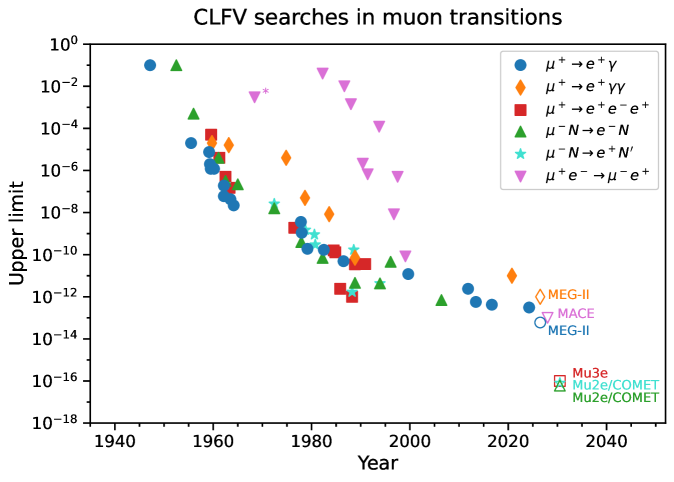
This review details recent experimental and theoretical progress in precision muon measurements, focusing on the anomalous magnetic moment, lepton flavor violation, and tests of fundamental symmetries.
Despite the remarkable success of the Standard Model, fundamental questions regarding the nature of dark matter, neutrino masses, and the matter-antimatter asymmetry remain unanswered. This review, ‘Precision Physics with Muons : A Decade of Theoretical and Experimental Advances’, surveys the current landscape of muon-based experiments designed to probe beyond the Standard Model, focusing on sensitive searches for lepton flavor violation and precise measurements of the muon’s magnetic moment. Recent progress promises unprecedented sensitivity to new physics through investigations of both muon decay processes and searches for charged lepton flavor violating transitions, potentially revealing indirect evidence of particles like axions or hidden sector bosons. Will the next generation of muon facilities and innovative experimental designs finally unveil definitive cracks in the Standard Model and illuminate the path toward a more complete understanding of the universe?
The Muon’s Whisper: Probing Beyond the Established Order
Despite its extraordinary predictive power, the Standard Model of particle physics remains incomplete. Phenomena such as the existence of dark matter and dark energy, the observed matter-antimatter asymmetry in the universe, and the origin of neutrino masses all lie outside its explanatory reach. These unresolved puzzles strongly suggest the existence of undiscovered particles and interactions, prompting physicists to seek extensions to the current framework. While the Standard Model accurately describes the fundamental forces and particles observed thus far, its inability to account for these critical observations implies the presence of a more comprehensive theory waiting to be unveiled, driving ongoing research into the realm of “new physics” beyond our current understanding of the universe.
The muon, a fundamental particle resembling the electron but roughly 200 times more massive, presents a unique opportunity for physicists seeking to unravel mysteries beyond the Standard Model. This increased mass amplifies the muon’s sensitivity to subtle interactions and the potential influence of undiscovered particles, acting as a magnifying glass for effects too weak to be observed with lighter particles. Unlike the electron, which largely feels only the forces described by the Standard Model, the muon’s heft allows it to ‘feel’ the presence of virtual particles popping in and out of existence, potentially revealing hints of new forces or dimensions. Because of this heightened responsiveness, precise measurements of the muon’s magnetic moment and decay rates offer an indirect, yet powerful, method for detecting deviations from established physics and probing the realm of the unknown.
The muon, a fundamental particle resembling the electron but roughly 200 times heavier, presents a unique opportunity to explore physics beyond the Standard Model through exceptionally precise measurements of its magnetic moment. This property, dictating how the muon interacts with magnetic fields, isn’t merely a calculated value; quantum fluctuations and interactions with virtual particles constantly nudge it. Discrepancies between theoretical predictions and experimental observations of this ‘anomalous magnetic moment’ suggest the influence of undiscovered particles or forces. Current experiments, like those at Fermilab, meticulously measure the muon’s wobble in a strong magnetic field, seeking to refine these measurements and potentially reveal statistically significant deviations. Such findings wouldn’t directly detect new particles, but rather their indirect influence on the muon’s behavior, offering a crucial window into a realm of physics currently hidden from direct observation and promising to reshape our understanding of the universe’s fundamental building blocks.
Evidence of Instability: Precision Tests and Anomalies
The muon anomalous magnetic moment, often denoted as a_μ, deviates from predictions based on the Standard Model of particle physics. Theoretical calculations, incorporating quantum electrodynamics (QED) and contributions from the strong and weak interactions, predict a specific value for a_μ. However, experimental measurements, most notably from the Muon g-2 experiment at Fermilab, consistently yield values differing from the Standard Model prediction. As of recent analyses, this discrepancy reaches a statistical significance of 2.5σ, meaning there is approximately a 0.62% probability of observing such a deviation if the Standard Model were accurate. This level of deviation suggests the potential influence of physics beyond the Standard Model, prompting continued research and refined calculations to either confirm or refute the anomaly.
Lattice Quantum Chromodynamics (QCD) calculations represent a primary theoretical approach to precisely determine the Standard Model prediction for the muon’s anomalous magnetic moment. These calculations discretize spacetime onto a four-dimensional lattice, allowing for non-perturbative evaluation of strong interaction effects which contribute significantly to g-2. Despite substantial progress, uncertainties in Lattice QCD remain, stemming from limitations in handling the continuum limit, chiral extrapolation, and the inclusion of all higher-order perturbative contributions. Current uncertainties are at the level of approximately 0.02 x 10^{-{10}}, and while ongoing efforts aim to reduce these, the persistence of these uncertainties leaves open the possibility that the observed discrepancy between theory and experiment could be a signal of physics beyond the Standard Model, rather than an error in the theoretical calculation.
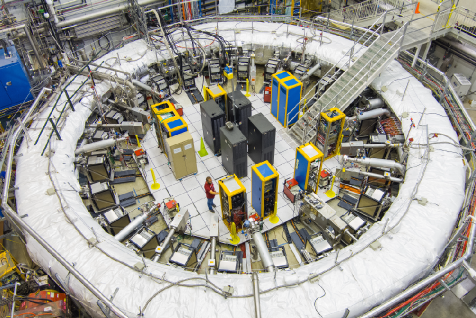
The Muon g-2 experiment at Fermilab is currently undertaking a program to measure the anomalous magnetic moment of muons with unprecedented precision. This involves circulating polarized muons in a 14-meter diameter storage ring, observing the frequency of their precession in a strong magnetic field, and comparing the experimental result to the Standard Model prediction. The experiment aims to reduce uncertainties to a level where a 5σ deviation from the Standard Model would constitute discovery, thereby confirming or refuting the previously observed 2.5σ anomaly reported by earlier experiments at Brookhaven National Laboratory. Data collection is ongoing, with analysis expected to provide a definitive answer regarding the existence of new physics contributing to the muon’s magnetic moment.
Fragile Symmetry: Lepton Flavor Violation as a Beacon
Within the Standard Model of particle physics, lepton flavor violation (LFV) – any process where a lepton of one flavor transforms into a lepton of another flavor – is rigorously prohibited. This constraint arises from the model’s requirement that lepton flavor is a conserved quantity, meaning each lepton type – electron, muon, and tau – remains distinct and does not interconvert. The absence of observed LFV in current experiments provides strong support for the Standard Model; however, many extensions to the model, such as those incorporating supersymmetry or extra dimensions, predict observable rates for LFV processes. Therefore, the search for LFV represents a key avenue for exploring physics beyond the Standard Model and identifying potential new interactions.
Muon conversion, the hypothetical transformation of a muon bound to a nucleus into an electron, and the decay of muonium – a hydrogen-like atom consisting of a muon and an electron – are both highly sensitive indicators of Lepton Flavor Violation (LFV). These processes are considered sensitive because the Standard Model strictly prohibits lepton flavor changing interactions; therefore, observation of either would unequivocally demonstrate physics beyond the Standard Model. The sensitivity arises from the relatively large branching fraction predicted for these LFV processes in many beyond-Standard-Model scenarios, coupled with the ability to precisely control and monitor the initial states in experimental setups like the Muon Conversion Experiment (MACE) and experiments searching for muonium decay.
Current searches for muon-to-electron conversion, a process violating lepton flavor, are conducted by experiments like MACS, which have established an upper limit of 8.3 x 10⁻¹¹ for the branching ratio. The planned Muon Conversion Experiment (MACE) is designed to improve sensitivity by two orders of magnitude, targeting a projected sensitivity of 10-13. This enhancement will be achieved through increased data collection and improvements in detector technology, enabling a more precise search for this rare decay and potentially revealing physics beyond the Standard Model.
Echoes of the Unseen: Theoretical Frameworks and Interpretation
Effective Field Theory (EFT) offers a powerful approach to exploring physics beyond the Standard Model, even without knowing the precise details of new, high-energy phenomena. Instead of directly searching for undiscovered particles, EFT focuses on characterizing the effects of this unknown physics at accessible energy scales. It achieves this by introducing a series of effective interactions, parameterized by coefficients, which describe how Standard Model particles interact in ways not predicted by the established theory. These coefficients encapsulate the influence of heavier, yet-unobserved particles and interactions at higher energies – effectively ‘integrating out’ the complexities of the unknown realm. By precisely measuring these coefficients through experiments, physicists can indirectly probe the properties of this new physics and build a comprehensive understanding of the universe, even before directly detecting the particles responsible.
The persistent anomalies observed in muon behavior and lepton flavor violation (LFV) suggest the potential influence of particles beyond the Standard Model. Specifically, hypothetical entities such as axion-like particles and those originating from hidden sectors are theorized to act as mediators, facilitating transitions between different lepton flavors-a hallmark of LFV. These particles, interacting weakly with Standard Model fermions, could also contribute to the muon’s anomalous magnetic moment-a deviation from the value predicted by established physics. The strength of these interactions, and thus the magnitude of the observed anomalies, is intrinsically linked to the mass and coupling constants of these beyond-the-Standard-Model particles, making precision measurements of both LFV rates and the muon’s magnetic moment crucial for unraveling the nature of this potential new physics. g-2 measurements and LFV searches, therefore, represent complementary avenues for probing these hidden sectors and identifying the particles responsible for these intriguing discrepancies.
The pursuit of Lepton Flavor Violation (LFV) and the meticulous measurement of the muon’s magnetic moment, while seemingly disparate, are deeply interwoven investigations into the fundamental laws of physics. Observations hinting at deviations from the Standard Model in either arena can provide crucial cross-validation for the other. Should LFV be detected, precision measurements of the muon’s properties could help pinpoint the characteristics of the new particles mediating this violation, such as their mass and coupling strength. Conversely, anomalies in the muon’s magnetic moment – its interaction with magnetic fields – could signal the existence of particles also responsible for LFV, offering an independent confirmation of new physics beyond established models. This synergistic approach, combining searches for rare decays indicative of LFV with high-precision measurements, maximizes the potential for uncovering and characterizing the subtle effects of physics at higher energy scales, ultimately providing a more complete understanding of the universe’s building blocks and forces.
The Unfolding Narrative: Future Directions and Prospects
The pursuit of Lepton Flavor Violation (LFV) remains a central strategy in the search for physics beyond the Standard Model. Experiments designed to detect processes where leptons – such as muons and electrons – transform into one another, despite being forbidden by established theory, are continually being refined and expanded. Current investigations employ increasingly sensitive detectors and innovative techniques, ranging from high-intensity muon beams to searches within atomic spectra. These efforts aim to either directly observe LFV, which would signal the existence of new particles and interactions, or to establish even tighter constraints on the parameters of theoretical models predicting such violations. Each null result, while not a discovery, effectively narrows the landscape of possible new physics, guiding future experimental designs and theoretical development toward more promising avenues of exploration.
The muon, often described as a ‘heavy electron’, presents a unique opportunity to rigorously test the Standard Model of particle physics through precise measurements of its decay characteristics. These decays, governed by parameters known as Michel parameters, aren’t simply random events; their subtle variations hold clues about potential new physics. By meticulously analyzing the energy and angular distribution of particles emitted during muon decay, scientists can constrain the contributions of hypothetical particles and interactions not accounted for in the Standard Model. Deviations from predicted values of the Michel parameters would signal the presence of new forces or particles influencing the muon’s behavior, offering a pathway to refine theoretical models and potentially uncover the building blocks of a more complete understanding of the universe. This approach complements searches for rare muon decays, providing an independent and powerful means of probing beyond-the-Standard-Model phenomena.
The search for physics beyond the Standard Model receives compelling impetus from increasingly precise measurements of rare muon decays; current experimental bounds place the branching ratio for the decay μ+ → e+e−e+ at less than 1.0 x 10⁻⁹, a level demanding exceptional experimental sensitivity. This pursuit isn’t isolated, however, as researchers are actively investigating potential links between these muon anomalies and seemingly disparate phenomena, such as neutrinoless double beta decay – a hypothesized process violating lepton number conservation. Establishing a connection between these observations could signify a unified underlying mechanism, potentially resolving several outstanding puzzles and illuminating the nature of new particles or interactions beyond our current understanding of fundamental physics. This interconnected approach promises a more holistic view, moving beyond individual anomalies towards a comprehensive model capable of explaining a wider range of experimental results.
The pursuit of precision in muon physics, as detailed in the review, echoes a fundamental tenet of understanding any system-its eventual decay and the need to map its evolution with increasing accuracy. Each experiment, striving to refine measurements of the muon anomalous magnetic moment or searching for lepton flavor violation, isn’t simply about confirming or denying existing models, but about understanding the inherent fragility within the Standard Model. As Simone de Beauvoir observed, “One is not born, but rather becomes, a woman.” Similarly, physical models aren’t static entities but are constantly ‘becoming’ more refined-or revealed as incomplete-through rigorous testing and observation. The value lies not in achieving a final, immutable truth, but in the continual process of refinement, acknowledging that even the most robust structures are subject to the passage of time and the revealing power of precise measurement.
The Horizon Recedes
The pursuit of precision in muon physics, as detailed within, is not merely a refinement of measurement, but an exercise in acknowledging the inherent transience of models. Every discrepancy, every anomaly-particularly those hinting at lepton flavor violation-is not a failure of experiment, but a signal from time, indicating the limitations of the current framework. The Standard Model, while remarkably resilient, is demonstrably incomplete; the question is not if it will yield, but where and how. The continued refinement of the muon anomalous magnetic moment offers a delicate probe-a search for whispers of virtual particles beyond the established zoo.
Future progress hinges on a willingness to embrace the inherent ambiguity of indirect searches. Direct observation of new particles remains the gold standard, yet the universe often prefers to communicate in subtleties. Refactoring established theories, confronting them with ever-more-precise data, is a dialogue with the past-a necessary, if sometimes frustrating, process of iterative refinement. The coming decade promises not necessarily definitive answers, but a sharper delineation of the questions themselves.
Ultimately, the significance of this work lies not in confirming or refuting specific predictions, but in the sustained, rigorous effort to map the boundaries of knowledge. The horizon recedes with every step forward, revealing not an end, but an ever-expanding vista of the unknown. The pursuit of precision, therefore, is not a quest for certainty, but an acceptance of perpetual refinement.
Original article: https://arxiv.org/pdf/2602.12442.pdf
Contact the author: https://www.linkedin.com/in/avetisyan/
See also:
- Gold Rate Forecast
- Dune 3 Gets the Huge Update Fans Have Been Waiting For
- Looks Like SEGA Is Reheating PS5, PS4 Fan Favourite Sonic Frontiers in Definitive Edition
- Pluribus Star Rhea Seehorn Weighs In On That First Kiss
- Kelly Osbourne Slams “Disgusting” Comments on Her Appearance
- Arknights: Endfield – Everything You Need to Know Before You Jump In
- Antiferromagnetic Oscillators: Unlocking Stable Spin Dynamics
- Tomodachi Life: Living the Dream ‘Welcome Version’ demo now available
- Disney Promotes Thomas Mazloum To Lead Parks and Experiences Division As Josh D’Amaro Prepares To Become CEO
- Xbox 360 and PS3 Series Not Seen Since 2013 Reportedly Returning With New Game
2026-02-16 06:37