Author: Denis Avetisyan
A new analysis demonstrates how quantum information tools can unlock the full potential of upcoming long-baseline neutrino experiments.
This review explores the application of Quantum Fisher Information to optimize parameter estimation and sensitivity in searches for CP violation and the neutrino mass hierarchy.
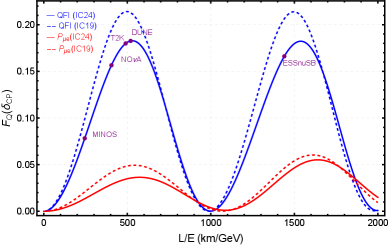
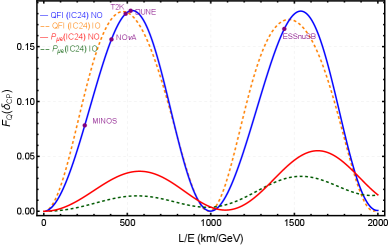
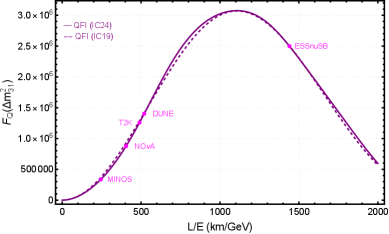
Establishing fundamental limits on our ability to precisely determine neutrino properties remains a central challenge in particle physics. This is addressed in ‘Quantum Fisher Information Revealing Parameter Sensitivity in Long-Baseline Neutrino Experiments’, which employs the Quantum Fisher Information (QFI) to rigorously assess the precision with which key oscillation parameters – the leptonic CP-violating phase \delta_{\mathrm{CP}}, the atmospheric mixing angle \theta_{23}, and the mass-squared difference \Delta m_{31}^{2} – can be estimated in long-baseline experiments. The analysis reveals distinct sensitivities and non-trivial dependencies on the baseline-to-energy ratio L/E, with peak sensitivities for \delta_{\mathrm{CP}} and \theta_{23} occurring at oscillation maxima, while \Delta m_{31}^{2} is most sensitive at intermediate energies. Can these findings guide the optimization of future experimental designs to maximize the discovery potential of long-baseline neutrino programs?
The Elusive Nature of Neutrino Mass
For decades, neutrinos were theorized to be massless particles, traveling at the speed of light. However, experiments beginning in the late 20th century revealed a surprising phenomenon: neutrinos change, or ‘oscillate’, between three distinct ‘flavors’ – electron, muon, and tau. This isn’t a simple transformation; it implies that each neutrino is actually a quantum mixture of all three flavors, and that as it travels, the probabilities of being each flavor change. Such oscillation is only possible if neutrinos possess mass, albeit incredibly small. The observation fundamentally challenged the Standard Model of particle physics, which originally predicted neutrinos to be massless, and opened a new avenue of research focused on understanding the nature of neutrino mass and the implications for our understanding of the universe.
The observed phenomenon of neutrino oscillation fundamentally challenges the long-held tenets of the Standard Model of particle physics, which originally predicted neutrinos to be massless. This oscillation-the spontaneous change of one neutrino flavor into another-directly implies that neutrinos do possess mass, however small. More surprisingly, it suggests that the neutrino mass states are not the same as the flavor states, necessitating a ‘mixing’ mechanism where each flavor is a quantum superposition of mass eigenstates. Determining the precise nature of this mixing, and the absolute scale of neutrino masses, represents a significant frontier in particle physics, requiring investigations beyond the Standard Model to account for this unexpected mass structure and potentially reveal connections to dark matter or other undiscovered particles.
A primary pursuit within neutrino physics centers on precisely quantifying the parameters that dictate neutrino oscillation-the process by which these elusive particles shift between three distinct ‘flavors’: electron, muon, and tau. This isn’t merely an academic exercise; accurately determining the mass-squared differences – \Delta m^2_{ij} – which reveal the differences in the squares of the neutrino masses, and the Pontecorvo-Maki-Nakagawa-Sakata (PMNS) mixing angles – \theta_{12}, \theta_{23}, and \theta_{13} – which govern the probabilities of these transformations, is crucial for testing the Standard Model of particle physics. Current experiments utilize intense neutrino beams and sophisticated detectors to statistically analyze oscillation patterns, striving to refine these parameters and potentially uncover physics beyond the established framework, including the possibility of CP violation in the lepton sector – a key asymmetry between matter and antimatter that could explain the observed baryon asymmetry in the universe.
Long-Baseline Experiments: A Precision Approach
Long-baseline neutrino experiments, including T2K in Japan, NOvA in the United States, and the future Deep Underground Neutrino Experiment (DUNE) also in the US, utilize intense neutrino beams and detectors placed hundreds of kilometers apart to observe neutrino oscillations. These experiments function by producing a beam of neutrinos, typically at a particle accelerator, and then monitoring the composition of that beam at a distant detector. The probability of observing a specific neutrino flavor – electron, muon, or tau – changes as the neutrinos travel due to the phenomenon of neutrino oscillation. The large distances involved maximize the effect of these oscillations, allowing precise measurements of the oscillation parameters, specifically the mixing angles and mass-squared differences that govern the process.
Neutrino oscillation experiments determine the probabilities of neutrino flavor transitions – specifically, the likelihood of a neutrino produced as one flavor (electron, muon, or tau) appearing as a different flavor upon detection. This probability is not constant but oscillates as a function of the neutrino’s energy and the distance traveled, governed by parameters including the mass-squared differences between the neutrino flavors and the mixing angles described in the Pontecorvo-Maki-Nakagawa-Sakata (PMNS) matrix. Precise measurement of these oscillation probabilities, therefore, directly constrains the values of these oscillation parameters, providing insights into fundamental neutrino properties and testing the Standard Model of particle physics. The oscillation probability for a neutrino of energy E traveling a distance L is dependent on the mixing angle θ and the mass-squared difference \Delta m^2, as expressed in the standard two-flavor oscillation formula: P(\nu_{\alpha} \rightarrow \nu_{\beta}) = sin^2(\theta)sin^2(\frac{1.27\Delta m^2 L}{E}).
The precision of long-baseline neutrino oscillation experiments is fundamentally constrained by statistical uncertainty in the measured event rates. Determining the values of oscillation parameters – such as the mixing angle \theta_{23}, the mass ordering, and the CP-violating phase \delta_{CP} – requires accurately quantifying these rates and their associated errors. Consequently, significant effort is directed towards both increasing the number of detected neutrino interactions – achieved through larger detectors and increased beam intensity – and developing sophisticated statistical analysis techniques. These techniques include improved event reconstruction algorithms, refined background estimation procedures, and advanced methods for incorporating systematic uncertainties into the parameter estimation process, all aimed at maximizing the sensitivity to subtle effects and reducing the impact of statistical fluctuations.
Quantum Limits and the Precision Frontier
The Quantum Fisher Information (QFI) represents a theoretical upper bound on the precision achievable when estimating parameters governing neutrino oscillations. This limit is derived from the Cramer-Liao bound, which states that the variance of any unbiased estimator is fundamentally limited by the inverse of the QFI. Calculating the QFI involves analyzing the sensitivity of the probability distribution of oscillation events to small changes in the parameters of interest – specifically, utilizing the Symmetric Logarithmic Derivative. Therefore, the QFI isn’t a statement about any particular experimental technique, but rather a constraint imposed by the laws of quantum mechanics on the ultimate precision attainable, regardless of measurement strategy. \text{Variance} \ge \frac{1}{\text{QFI}}
The Quantum Fisher Information (QFI) is a quantifiable metric used to determine the theoretical upper bound on the precision of parameter estimation in quantum experiments. Calculated via the Symmetric Logarithmic Derivative (SLD), the process involves deriving the SLD \hat{S} with respect to the parameter of interest, and then computing the QFI as the expectation value of the square of the SLD: QFI = \langle \hat{S}^2 \rangle . This calculation provides a benchmark for evaluating the ultimate sensitivity achievable by any experimental setup designed to measure that parameter, independent of specific measurement strategies or statistical analyses. Researchers utilize the QFI to assess the potential for improving experimental designs and to identify the parameters most readily determined with a given quantum state and measurement process.
Analysis of the Quantum Fisher Information (QFI) reveals a substantial hierarchy in the achievable precision for estimating neutrino oscillation parameters. The QFI for \Delta m_{31}^2 is approximately 3 x 10⁶, indicating a significantly higher sensitivity for measuring this parameter compared to \theta_{23} and \delta_{CP}. Specifically, the QFI for \theta_{23} is measured at approximately 15, representing a decrease of over four orders of magnitude from the QFI for \Delta m_{31}^2. The precision limit for the CP-violating phase, \delta_{CP}, is even lower, with a QFI of approximately 0.15, demonstrating a reduction of over five orders of magnitude compared to the sensitivity achievable for \Delta m_{31}^2. These values directly quantify the differing levels of precision attainable in experimental determination of these fundamental neutrino properties.
Quantitative analysis of the Quantum Fisher Information (QFI) reveals substantial differences in achievable precision for neutrino oscillation parameters. The QFI for the mixing angle \theta_{23} is approximately 15, indicating a relatively higher sensitivity for its estimation. Conversely, the QFI for the CP-violating phase \delta_{CP} is significantly lower, at approximately 0.15. This represents over a factor of ten difference, demonstrating a markedly reduced capacity to precisely determine \delta_{CP} compared to \theta_{23} within the experimental setup and theoretical framework used for these calculations.
Unveiling the Neutrino Landscape and Beyond
Neutrinos, elusive particles with tiny masses, come in three flavors-electron, muon, and tau-and oscillate between these forms as they travel. Determining the precise ordering of their masses-whether the lightest neutrino is associated with the electron flavor (normal hierarchy) or the muon/tau flavors (inverted hierarchy)-remains a central challenge in particle physics. Current and forthcoming experiments, such as the Deep Underground Neutrino Experiment (DUNE) and Hyper-Kamiokande, are designed to detect these oscillations with unprecedented precision. By meticulously analyzing the rates at which neutrinos transform between flavors over vast distances, these endeavors seek to resolve the mass ordering. Success in this pursuit won’t just complete the Standard Model’s picture of these fundamental particles, but could also offer crucial clues about the asymmetry between matter and antimatter in the universe and open avenues to physics beyond current understanding.
The perplexing behavior of neutrinos – elusive particles with incredibly small mass – is deeply intertwined with their interactions with matter, a phenomenon described by the Mikheyev-Smirnov-Wolfenstein (MSW) effect. As neutrinos traverse dense environments like the Earth’s core or the Sun, their oscillation probabilities – the likelihood of changing “flavor” between electron, muon, and tau neutrinos – are dramatically altered. This isn’t simply a matter of absorption; instead, the effective mass of the neutrino shifts due to its interaction with the surrounding electrons, resonantly enhancing the probability of certain flavor transitions. Crucially, the precise pattern of these oscillations is sensitive to the ordering of the neutrino masses – whether the lightest neutrino is the electron neutrino (normal hierarchy) or the muon neutrino (inverted hierarchy). Current and future experiments, particularly those utilizing atmospheric and solar neutrinos, are leveraging the MSW effect as a key tool to disentangle these possibilities and finally reveal the true ordering of these fundamental particles, offering a window into physics beyond the Standard Model.
The pursuit of understanding neutrino behavior extends far beyond simply establishing their mass ordering. Current research focuses intensely on measuring the CP-violating phase within the Pontecorvo-Maki-Nakagawa-Sakata (PMNS) matrix, the neutrino equivalent of the quark mixing matrix. A non-zero value for this phase would indicate CP violation in the lepton sector – a critical asymmetry between matter and antimatter. Such a discovery would be profoundly significant, as it is not adequately explained by the Standard Model of particle physics and could offer vital clues to explain the observed matter-antimatter asymmetry in the universe. Precise measurements of this phase, therefore, represent a powerful probe for new physics, potentially revealing the existence of sterile neutrinos, extra dimensions, or other exotic phenomena that lie beyond our current understanding of the fundamental laws governing the cosmos.
The pursuit of precision, as demonstrated in this study of neutrino oscillation parameters, mirrors a fundamental drive for structural honesty. This work, focusing on the limits defined by Quantum Fisher Information, strips away extraneous variables to reveal the core sensitivities governing long-baseline experiments. It acknowledges that true understanding isn’t achieved through accumulation, but through discerning what is essential. As Leonardo da Vinci observed, “Simplicity is the ultimate sophistication.” The analysis of δCP, θ23, and Δm312 isn’t about exhaustive data collection; it’s about identifying the minimal configuration necessary to achieve maximal clarity regarding the universe’s asymmetries.
The Road Ahead
The pursuit of precision in neutrino oscillation parameters, as illuminated by this work, invariably encounters the stark reality of diminishing returns. Quantum Fisher Information provides a necessary, if theoretical, lower bound, but the translation of that bound into practical experimental design is where simplification becomes paramount. The exercise isn’t merely about squeezing more data from existing configurations; it demands a rigorous reassessment of what constitutes ‘information’ in the presence of overwhelming background and irreducible detector limitations.
Future long-baseline endeavors will likely not be defined by revolutionary technologies, but by austere design. The true challenge isn’t building larger detectors, but building smaller ones, optimized to measure only the truly essential observables. A critical next step involves a detailed examination of systematic uncertainties-those persistent shadows that obscure the subtle signals this analysis seeks to reveal-and a willingness to discard parameters that contribute little to the overarching goal of establishing CP violation and the neutrino mass ordering.
The field may find itself moving beyond the relentless pursuit of parameter estimation, toward a more holistic understanding of neutrino interactions. Establishing a definitive connection between oscillation phenomena and broader physics-sterile neutrinos, non-standard interactions-demands a shift in perspective. The question isn’t simply ‘what do neutrinos oscillate into?’, but ‘what does their oscillation tell us?’. The answer, one suspects, will not be found in increased complexity, but in a refined and ruthless clarity.
Original article: https://arxiv.org/pdf/2602.05221.pdf
Contact the author: https://www.linkedin.com/in/avetisyan/
See also:
- The Super Mario Galaxy Movie: 50 Easter Eggs, References & Major Cameos Explained
- 10 Best Free Games on Steam in 2026, Ranked
- Sydney Sweeney’s The Housemaid 2 Sets Streaming Release Date
- Skate 4 – Manny Go Round Goals Guide | All of the Above Sequence
- Welcome to Demon School! Iruma-kun season 4 release schedule: When are new episodes on Crunchyroll?
- Why is Tech Jacket gender-swapped in Invincible season 4 and who voices her?
- Overwatch 2 G.I. Joe Crossover Launches July 1: Join the Battle Between Heroes and Villains
- Best coins for today
- Forza Horizon 6 ‘Prologue’ gameplay
- 10 Best Supporting Actress Oscar Wins That Are Indisputable
2026-02-07 18:40