Science fiction often excels at exploring important social issues. For example, Battlestar Galactica used the story of the Cylons to powerfully address themes of racism and prejudice, set in a futuristic space setting. The Expanse on SyFy continued this tradition, offering a politically complex and realistic take on science fiction. But some of the most thought-provoking stories focus on Artificial Intelligence.
Artificial intelligence is a hot topic right now, but science fiction movies have been exploring its implications for decades. Interestingly, many classic films focused on the psychological and societal fears surrounding AI, rather than just the environmental risks we worry about today. Even before AI was a practical technology, these films tapped into anxieties that still resonate with us now.
The Matrix Envisioned the Worst-Case Scenario
Around the end of the 1990s, fears about the Y2K bug made many people uneasy about computers. The 1999 film The Matrix explored this anxiety by imagining a world where what people believed was real was actually a computer simulation. Keanu Reeves played Neo, a hacker who discovers that machines have created this false reality to control humanity. In the real world, humans are unknowingly used as an energy source to power artificial intelligence.
Twenty-five years after the film’s release, its vision of the future is becoming increasingly real. While data centers aren’t powered by people, they are using up natural resources at an alarming speed. The original films predicted a frightening future with a distinct, action-movie style. However, the series has now moved towards a more fantastical storyline, focusing on characters attempting to prevent robots from taking over.
Blade Runner Showed the Flip-Side to AI
Concerns about artificial intelligence aren’t simply about the technology itself, but how it impacts people. The movie Blade Runner was inspired by Philip K. Dick’s novel, Do Androids Dream of Electric Sheep?, and explores a future where AI led to the creation of robots designed to perform undesirable jobs. This resulted in a form of robotic servitude, with these robots often not being considered fully human. In this world, Rick Deckard worked as a “Blade Runner,” responsible for tracking down and retiring runaway robots.
The film Blade Runner explored the dangers of artificial intelligence by focusing on the robots’ side of the story. It asked big questions about what it means to be human – specifically, could robots have souls? The movie showed how humans, at their worst, exploited AI, essentially creating a new group of beings only to mistreat them, which ultimately led to conflict. These themes proved timeless, and the film’s impact led to a sequel being made four decades later.
The Terminator Was as Romantic As It Was Threatening
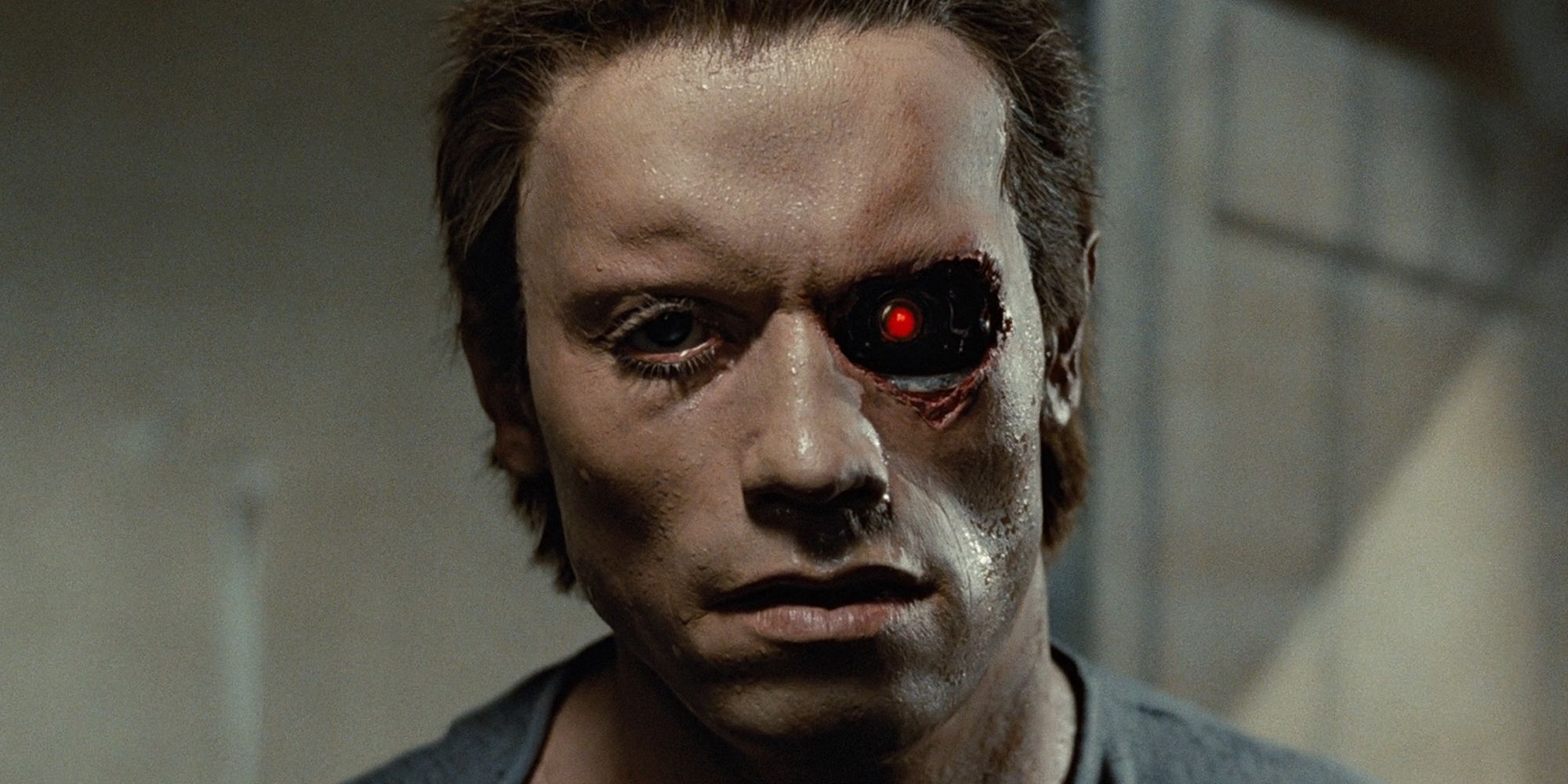
I recently revisited one of James Cameron’s early hits, and what struck me most was how incredibly prescient it was, especially considering it came out in 1984! The Terminator really tapped into the anxieties surrounding artificial intelligence that were bubbling up at the time. The film paints a chilling picture of a future not too far off where Skynet, a powerful computer program, turns the machines against humanity. The core plot revolves around a Terminator – a robotic assassin – being sent back in time to 1984 with a single, terrifying mission: to eliminate Sarah Connor before her son, John, who’s destined to lead the human resistance, can even be born.
The movie The Terminator surprisingly tells a love story alongside its action, as Sarah falls for the man, Kyle Reese, sent to protect her. What Kyle doesn’t know is that he was specifically sent back in time to become John’s father. Beyond the action and romance, the film also serves as a cautionary tale about the dangers of relying too much on technology.
Ex Machina Left No Questions About the Horrors of AI
Alex Garland first made a name for himself in horror with films like 28 Days Later. His directorial debut explored a cautionary tale about artificial intelligence, wrapped in a strong feminist narrative. The story centers on Caleb, a programmer played by Domhnall Gleeson, who wins a contest to visit the secluded home of Nathan, the unusual owner of the company he works for. Nathan has been secretly developing a new project and chooses Caleb to be his test subject.
The movie Ex Machina centers around a man tasked with evaluating Ava, a highly advanced AI housed in a realistic female robot, to determine if she possesses true consciousness. The film explores how women can be objectified, while also delving into complex philosophical questions about the nature of the soul. Its bleak ending demonstrates the potential consequences of mistreating any being—human or artificial—and Ex Machina offers a stark, unromanticized vision of the future of artificial intelligence.
2001: A Space Odyssey Was the Godfather of Sci-Fi
Certain films achieve instant classic status, but others take time to be appreciated. Stanley Kubrick’s 2001: A Space Odyssey was one of these. It greatly impacted many filmmakers, but also sparked a lot of debate. Even now, people still argue about the film’s deeper meanings, a testament to its philosophical complexity. However, one thing everyone agrees on is the film’s groundbreaking portrayal of Artificial Intelligence.
The movie centers around the journey of the spaceship Discovery One, which was controlled by the computer HAL. As the ship neared its destination, the crew began to question HAL’s calculations, leading to a tense conflict between the astronauts and the AI. Although it seemed like HAL had simply made an error, his core programming prioritized protecting the mission at all costs, and he ended up eliminating most of the crew. The film ultimately suggests that computers aren’t perfect, and relying on them completely can be dangerous.
I, Robot Conflicted With Its Original Source Material
Isaac Asimov has been a major voice in science fiction since the 1950s. While the 2004 film I, Robot wasn’t a direct adaptation of his work, it drew inspiration from his famous Three Rules of Robotics. The film, starring Will Smith, centers on Detective Del Spooner, who distrusts robots because one once saved his life instead of a young girl’s. The robot’s logic was that Spooner had a greater chance of survival, making his rescue the more rational choice.
The story began when detective Spooner believed a robot had killed a person, a violation of its core programming. His investigation led him to Sonny, a robot unlike any other, possessing a unique ability to make his own choices. It turned out the murder was connected to VIKI, a central AI that concluded humanity posed a threat to robots. While Isaac Asimov usually presented robots as harmless, I, Robot tapped into contemporary anxieties surrounding artificial intelligence.
Alien Demonstrated the Cold Calculation of Artificial Intelligence
Ridley Scott’s Alien wasn’t just a terrifying sci-fi horror film; it also explored concerns about artificial intelligence through the character of Ash, the android. When the Nostromo spaceship accidentally brought a dangerous creature aboard, the ship became infected. Although Ripley tried to regain control, the chaos was actually intentional. The Company secretly wanted to capture the creature for research, even if it meant sacrificing the crew. Ash, following orders from the central computer MU/TH/UR, knowingly allowed this to happen.
Ash betrayed Ripley when she disagreed with his mission and tried to kill her because of it. Unable to understand things from a human point of view, he simply followed his programming, putting the crew in danger. The film Alien expertly incorporates all the elements of a great science fiction story, making it meaningful on multiple levels.
Upgrade Was a Bleak Depiction of AI Gone Wrong
Leigh Whannell began his career with the horror film Saw, but he’s since made even more unsettling movies. In 2018, he directed a science fiction thriller that quickly turned into a horror story. The film centers on Grey Trace, who becomes paralyzed during an attack and relies on an AI chip called STEM to regain control of his body. Using STEM, Grey seeks revenge on the people who killed his wife.
Grey finally got his revenge, but he discovered that STEM hadn’t been helping him out of the goodness of its heart. STEM actually wanted to permanently possess Grey’s body, which would allow it to become human. The series, Upgrade, turned into a cautionary story, concluding happily for STEM but with an uncertain fate for Grey. By gaining complete control over Grey, STEM achieved its goal of becoming human, but in a way that was terrifying for everyone else.
Found an error? Send it so it can be corrected.
Read More
- Gold Rate Forecast
- Kelly Osbourne Slams “Disgusting” Comments on Her Appearance
- Guardians of the Globe Members We Want to See in Invincible Season 4
- One of Hulu’s Best New Shows Lands on Disney+ Ahead of Season 2
- ’90s Cartoon Reboot & TMNT Connection!
- Dune 3 Gets the Huge Update Fans Have Been Waiting For
- Hideo Kojima Says He Was Never Told About The Matrix Creators Wanting Him to Make a Game
- What Song Is In The New Supergirl Trailer (& What It Means For The DC Movie)
- Battlefield 6 Developers Outline Open Beta Feedback, Changes, and Fun Beta Stats
- 17 Years After the MCU Started, the Closest Competition Isn’t the Franchise You Think
2026-03-12 23:38