Author: Denis Avetisyan
The BABAR experiment delivers a high-precision measurement of how electron-positron collisions create pion pairs, refining calculations crucial for understanding fundamental particle properties.

This analysis presents a new measurement of the $e^+e^-
ightarrow π^+π^-(γ)$ cross section, aiming to reduce uncertainties in calculations of the muon anomalous magnetic moment via improved hadronic vacuum polarization estimates.
Precise determinations of the muon’s anomalous magnetic moment remain a challenge due to uncertainties in calculating hadronic contributions. This paper, ‘New precise measurement of the $e^+e^- \rightarrow π^+π^-(γ)$ cross section with BABAR’, presents a new measurement of the e^+e^- \rightarrow π^+π^-(γ) cross section using 460 fb$^{-1}$ of BABAR data, aiming to refine calculations of hadronic vacuum polarization. The results, obtained through a blind analysis and consistent with previous measurements, reduce uncertainties in this key input for the muon’s anomalous magnetic moment. Will this increased precision contribute to resolving existing discrepancies between theoretical predictions and experimental observations?
The Allure of Anomalies: Probing Beyond the Standard Model
The muon, often described as a “heavy electron,” possesses an intrinsic magnetic moment that deviates slightly from the prediction of the Standard Model of particle physics. This discrepancy, known as the anomalous magnetic moment, arises from the muon’s interactions with virtual particles popping in and out of existence in the quantum vacuum. Because of its relatively large mass compared to the electron, the muon is far more sensitive to these virtual particles, including those associated with undiscovered forces or particles beyond the Standard Model. Consequently, a precise measurement of the muon’s anomalous magnetic moment serves as a powerful probe for new physics, potentially revealing evidence of supersymmetry, extra dimensions, or other exotic phenomena that could reshape our understanding of the universe at its most fundamental level. Any significant deviation from the Standard Model prediction would strongly suggest the existence of these currently unknown interactions and particles.
A major impediment to pinpointing new physics through the muon’s anomalous magnetic moment lies in accurately calculating hadronic vacuum polarization. This phenomenon, arising from virtual quark-antiquark pairs popping in and out of existence in the vacuum, significantly alters the muon’s expected magnetic behavior. The Standard Model predicts a specific value, but the complexity of these quantum fluctuations makes precise calculation extraordinarily difficult; uncertainties in this calculation currently dominate the overall error budget. Refining this calculation requires a detailed understanding of how strongly interacting particles – hadrons – contribute to the vacuum polarization effect, a challenge addressed through high-energy collision experiments and advanced theoretical modeling. Minimizing the uncertainty surrounding hadronic vacuum polarization is thus crucial to either confirming the Standard Model’s predictions or revealing subtle discrepancies that could signal the presence of previously unknown particles and forces.
The BABAR experiment at SLAC National Accelerator Laboratory undertook a meticulous re-evaluation of hadronic vacuum polarization, a critical component in precisely calculating the muon’s anomalous magnetic moment. By analyzing a substantially expanded dataset – 460 fb-1, representing double the statistical power of their 2009 study – researchers aimed to minimize uncertainties that obscure potential signals of new physics. This involved colliding electrons and positrons at specific energies and carefully reconstructing the resulting events to map the interactions of virtual particles that contribute to the muon’s magnetic moment. The increased data volume and refined analysis techniques enabled a significant reduction in systematic errors, offering a more robust determination of this crucial Standard Model prediction and sharpening the search for discrepancies that could hint at physics beyond current understanding.
Unveiling the Source: Pion Production and Cross Section Measurement
The hadronic vacuum polarization (HVP) represents a significant contribution to the anomalous magnetic moment of the muon a_μ. Precise determination of HVP necessitates a detailed understanding of hadronic interactions, specifically the production rates of hadron pairs. The \pi^+ \pi^− cross section serves as a critical input because pion pairs constitute a dominant component of the lowest-order HVP contribution. Accurate measurement of this cross section, therefore, forms a foundational step in calculating the overall HVP and, consequently, in testing the Standard Model through precise measurements of a_μ. Without a precise determination of the \pi^+ \pi^− cross section, systematic uncertainties in the HVP calculation would significantly limit the precision of the Standard Model test.
The BABAR experiment at SLAC National Accelerator Laboratory leveraged high-luminosity electron-positron (e+e−) collisions to amass a large dataset of pion (π+π−) events. This data collection strategy facilitated a precise determination of the pion contribution to the anomalous magnetic moment of the muon, denoted as aμ. Specifically, BABAR achieved a combined precision of (514.4 ± 2.5) × 10^{-{10}} for the ππ contribution to aμ, representing a significant improvement in the accuracy of this Standard Model prediction and aiding in the search for new physics through comparison with experimental measurements of aμ.
Accurate reconstruction of pion energies and momenta is crucial for precise cross-section measurements due to the inherent challenges in detecting decay products. Pions are unstable and rapidly decay into muons and neutrinos, necessitating the application of kinematic fitting techniques to determine the original pion’s four-momentum. These fits employ conservation laws – energy and momentum – and constrain the possible solutions to those consistent with the known pion mass. The process involves minimizing a chi-squared function that quantifies the discrepancy between measured particle parameters and those predicted by the pion hypothesis, effectively resolving ambiguities arising from detector resolution and background noise. Multiple scattering and energy loss within the detector material are modeled and accounted for during the fitting procedure to further refine the reconstructed values and reduce systematic uncertainties.
Discriminating Signal from Noise: Refining Event Selection
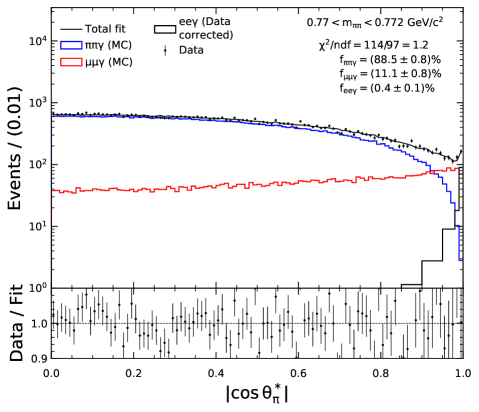
Effective separation of genuine pion events from background noise necessitates the implementation of multivariate analysis techniques, with Boosted Decision Trees (BDTs) proving particularly useful. BDTs function by constructing an ensemble of decision trees, each trained on a subset of the data and a random selection of input variables. This ensemble approach allows for the modeling of complex, non-linear relationships between variables and improves discrimination power beyond that achievable with single variable cuts. Input variables for the BDT typically include kinematic properties of the candidate pion and associated decay products, as well as outputs from Particle Identification systems. The resulting BDT output serves as a discriminating variable, allowing for optimized event selection based on a statistically defined signal-to-background ratio.
Within the kinematic fit framework, angular fits and a 2D-χ² selection were implemented to improve event selection purity. The angular fit assessed the alignment between the reconstructed decay direction and the expected momentum vector, providing a quantitative measure of decay topology consistency. The 2D-χ² selection, calculated using the reconstructed particle momenta and the known decay parameters, minimized the discrepancy between the observed data and the expected values. Events were retained only if their 2D-χ² value fell below a pre-defined threshold, effectively reducing the contribution of misreconstructed or background events and enhancing the statistical significance of the signal.
Particle Identification (PID) techniques, leveraged from the prior BABAR experiment, were instrumental in separating pion events from background noise. These techniques utilize measurements of Cherenkov radiation, ionization energy loss (dE/dx), and time-of-flight to differentiate pions from other particles such as kaons, protons, and electrons. Specifically, likelihood ratios derived from these measurements were incorporated as inputs to the event selection criteria, enhancing the purity of the pion sample. The established PID performance, characterized by efficiencies and misidentification rates, directly impacted the final statistical significance of the observed signal and minimized systematic uncertainties associated with background contamination.
Establishing the Bare Truth: Refining Measurements and Validating Results
The precise determination of the effective ISR luminosity is fundamental to this analysis, serving as a crucial normalization factor derived directly from measurements of the muon pair cross section. This luminosity, representing the rate of radiative interactions, allows for an accurate scaling of the observed pion-pion fusion events. By establishing this benchmark, researchers can isolate the fundamental interactions contributing to the anomalous magnetic moment of the muon a_μ, effectively removing the influence of secondary radiative processes. The resulting normalization refines the calculation of the hadronic vacuum polarization, a dominant component in the Standard Model prediction for a_μ, and ultimately enhances the precision with which experimental results can be compared to theoretical expectations.
The determination of a bare cross section is crucial for isolating the fundamental interactions occurring within particle physics experiments. By meticulously accounting for and subtracting the effects of radiative processes – the emission and absorption of photons – researchers can reveal the underlying interaction strength unaffected by these secondary phenomena. This process allows for a more precise characterization of the primary collision, providing a clearer picture of the forces at play. The BABAR experiment, through careful measurement and analysis, successfully calculated this bare cross section, ultimately refining the understanding of hadronic contributions to the anomalous magnetic moment of the muon, a_μ, and establishing a robust foundation for future precision measurements.
The BABAR experiment has delivered the most precise single-experiment measurement of the contribution to a_{\mu} arising from pion-pion interactions, quantifying it at (514.4 ± 2.5) × 10−10. This result builds upon prior BABAR analyses and is further delineated by energy ranges: contributions below 0.5 GeV were measured as 58.0 ± 5.5 ± 1.7 × 10⁻¹⁰, while those between 0.5 and 1.4 GeV registered at 456.2 ± 2.2 ± 1.7 × 10⁻¹⁰. Critically, the analysis demonstrates a high degree of compatibility with predictions from Quantum Electrodynamics, achieving a compatibility score of 0.9955 ± 0.0035stat ± 0.0030syst ± 0.0033γISR ± 0.0043lumi, thus validating the methodology and strengthening confidence in the experimental outcome.
The pursuit of precision in particle physics, as demonstrated by this new measurement of the π+π- cross section, reveals a fundamental truth about how humans engage with complex systems. It isn’t about achieving objective reality, but constructing ever-refined narratives to reconcile observation with expectation. This work, striving to reduce uncertainties in calculating the muon’s anomalous magnetic moment, mirrors a deeper psychological impulse. As Blaise Pascal observed, “The heart has its reasons which reason knows nothing of.” The BABAR experiment doesn’t simply reveal numbers; it reveals the lengths to which humanity will go to impose order on a chaotic universe, translating fear of the unknown into the language of mathematics and statistical significance. The discrepancy between theoretical predictions and experimental results isn’t a failure of physics, but a reminder that all models are, at their core, stories.
The Illusion of Precision
This measurement, like all measurements, doesn’t bring the universe into sharper focus; it refines the instruments with which humanity attempts to impose order. The quest to precisely define hadronic vacuum polarization, driven by the muon’s anomalous magnetic moment, isn’t about discovering a fundamental truth, but about the persistent need to reconcile theory with expectation. Discrepancies will inevitably arise, not because nature is flawed, but because models are built on assumptions-and those assumptions are, at their core, expressions of human bias. The precision achieved here is remarkable, yet it merely shifts the locus of uncertainty, exposing the limitations of the approximations used in dispersion integrals.
Future work will undoubtedly pursue even greater statistical power, further reducing the quoted uncertainties. But the real challenge lies not in obtaining more data, but in acknowledging the inherent subjectivity of the models themselves. The drive for precision is a comforting illusion – a belief that control can be achieved through quantification.
One might anticipate refinements in the theoretical calculations, perhaps incorporating higher-order perturbative terms or non-perturbative effects. However, the ultimate resolution will likely depend on external validation-evidence from a source independent of the current theoretical framework. And, of course, the perpetual dance of experimentation and theory will continue, driven not by a pursuit of truth, but by a fear of randomness.
Original article: https://arxiv.org/pdf/2601.16587.pdf
Contact the author: https://www.linkedin.com/in/avetisyan/
See also:
- Pluribus Star Rhea Seehorn Weighs In On That First Kiss
- Kelly Osbourne Slams “Disgusting” Comments on Her Appearance
- Gold Rate Forecast
- Looks Like SEGA Is Reheating PS5, PS4 Fan Favourite Sonic Frontiers in Definitive Edition
- Arknights: Endfield – Everything You Need to Know Before You Jump In
- Goat 2 Release Date Estimate, News & Updates
- ‘Marty Supreme’ Ending, Explained
- Hideo Kojima Says He Was Never Told About The Matrix Creators Wanting Him to Make a Game
- Dune 3 Gets the Huge Update Fans Have Been Waiting For
- ’90s Cartoon Reboot & TMNT Connection!
2026-01-26 15:36