Author: Denis Avetisyan
A new aluminum-manganese transition-edge sensor achieves energy resolution below 0.1%, offering a promising alternative to existing technologies.
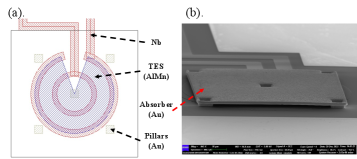
This study details the fabrication and performance of an AlMn TES detector demonstrating 12.1 eV energy resolution at 17.48 keV.
Achieving sub-percent energy resolution remains a significant challenge in X-ray spectroscopy, hindering detailed material analysis and precise spectral measurements. This work, titled ‘Beyond One-Thousandth Energy Resolution with an AlMn TES Detector’, details the development and characterization of an aluminum-manganese (AlMn) Transition-Edge Sensor (TES) demonstrating an energy resolution of 12.1 \pm 0.3 eV at 17.48 keV. This represents the first demonstration of an AlMn TES achieving below 0.1% resolution, positioning it as a viable alternative to traditional bilayer TES detectors. Could this advancement pave the way for more accessible and higher-resolution X-ray detection systems across diverse scientific disciplines?
The Illusion of Precision: Seeking Clarity in X-ray Spectra
Many contemporary X-ray detectors, while capable of registering the presence of X-rays, struggle to precisely differentiate between X-rays of slightly different energies. This limitation poses a significant obstacle in fields demanding detailed spectral analysis; discerning subtle energy shifts within an X-ray spectrum can reveal crucial information about the material’s composition or the physical conditions of its source. For instance, in material science, the exact energy of emitted X-rays can identify the elements present and their chemical states, while in astrophysics, spectral features provide insights into the temperature, density, and velocity of distant celestial objects. Current detector technology often blends these subtle energy differences, obscuring vital data and hindering accurate interpretation – effectively diminishing the information content captured from X-ray interactions.
The inability of current X-ray detectors to discern fine spectral details significantly impedes advancements across diverse scientific disciplines. In material science, the precise identification of elemental composition and chemical states relies on analyzing the minute shifts in X-ray energies emitted or absorbed by a substance; a blurred spectrum obscures these crucial indicators of material properties. Similarly, astrophysics depends heavily on spectral analysis of celestial X-rays to understand the temperature, density, and composition of distant stars, galaxies, and black holes – faint spectral lines reveal the processes occurring in these extreme environments, yet are easily lost with insufficient detector resolution. Consequently, progress in both fields is often limited by the inability to fully decode the wealth of information encoded within these subtle spectral features, highlighting the critical need for detectors capable of higher energy resolution.
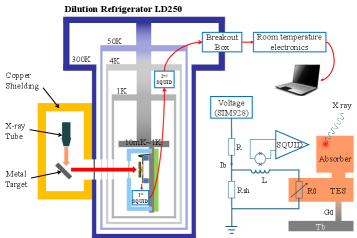
Transition-Edge Sensors (TES) represent a promising avenue for significantly enhancing X-ray detection capabilities, particularly in applications demanding high energy resolution. These devices operate at extremely low temperatures, exploiting the sharp transition in resistance of superconducting materials to precisely measure incoming photon energies. However, realizing the full potential of TES technology is not without considerable hurdles. Fabrication requires meticulous control at the nanoscale to create the delicate superconducting films and wiring. Furthermore, maintaining the sensors at cryogenic temperatures – typically just a few Kelvin – necessitates complex and expensive cooling systems, often relying on dilution refrigerators. Achieving stable, reliable performance also demands careful shielding from external magnetic fields and cosmic rays, alongside sophisticated noise reduction techniques to preserve the faint signals indicative of individual X-ray events. Overcoming these challenges is crucial to unlock the advanced spectral analysis capabilities needed in diverse fields like materials science and astrophysics.
Simplicity from Complexity: The AlMn TES Approach
Transition Edge Sensors (TES) employing aluminum-manganese (AlMn) alloy films represent a departure from conventional bilayer TES fabrication. Traditional TES devices typically require the deposition and careful layering of two distinct metallic films – a superconducting film and a normal metal layer – to achieve the desired resistive transition. AlMn alloys, however, exhibit a superconducting transition directly within a single material, eliminating the need for bilayer deposition. This simplification reduces fabrication complexity, minimizes potential interfacial issues that can affect device performance and yield, and allows for more precise control over the film’s superconducting properties through alloy composition tuning. The single-material approach streamlines the manufacturing process and potentially lowers production costs compared to bilayer TES designs.
The critical temperature (Tc) of Aluminum-Manganese Transition Edge Sensors (AlMn TES) is directly influenced by the alloy’s manganese concentration, enabling precise control over detector sensitivity. By adjusting the Mn content during film deposition, the Tc can be tailored to match the energy spectrum of incoming X-ray photons, maximizing the detector’s responsivity. This tunability is a significant advantage for applications requiring optimized performance across a broad range of X-ray energies, as it avoids the need for complex cryogenic filters or limitations imposed by fixed-Tc devices. Specifically, a higher Mn concentration results in a lower Tc, and vice-versa, allowing for calibration of the detector to the desired energy band.
The AlMn TES devices employ an annular geometry – a circular film with a central void – specifically designed to modify current flow characteristics. This configuration alters the current distribution within the superconducting film, reducing current crowding effects typically observed in conventional TES designs. By engineering the annulus dimensions – inner and outer diameter, and film thickness – the device’s kinetic inductance can be tuned. This manipulation of kinetic inductance has the potential to broaden the width of the superconducting transition, offering improved detector stability and performance, and potentially increasing the overall device sensitivity by affecting the response time to incident radiation.
The fabrication of AlMn TES devices necessitates the use of precise thin film deposition techniques, with DC Magnetron Sputtering being a primary method. This physical vapor deposition process involves the bombardment of a target material – in this case, an aluminum-manganese alloy – with ionized gas, ejecting atoms that then deposit onto a substrate. Controlling parameters such as sputtering power, gas pressure, substrate temperature, and deposition rate is critical to achieving uniform, stoichiometric films with minimal defects. Film quality, as assessed through techniques like X-ray reflectivity and scanning electron microscopy, directly impacts the superconducting properties and overall detector performance. Precise control over film thickness, typically on the order of tens to hundreds of nanometers, is also essential for tuning the device’s thermal characteristics and critical temperature.
Shielding the Signal: Isolating the Universe’s Whispers
Transition Edge Sensor (TES) and Superconducting Quantum Interference Device (SQUID) amplifiers exhibit extreme sensitivity to magnetic fields, necessitating robust shielding to maintain functionality. External magnetic fields induce spurious signals, reducing the signal-to-noise ratio and potentially saturating the detector. This is due to the superconducting nature of both TES and SQUID devices; magnetic flux penetration alters their resistance and output, respectively. Consequently, effective magnetic shielding is not merely a performance enhancement, but a fundamental requirement for reliable operation and accurate data acquisition in applications such as bolometry and low-field magnetometry. Shielding materials and configurations must therefore be carefully selected and implemented to minimize external field penetration and ensure stable detector performance.
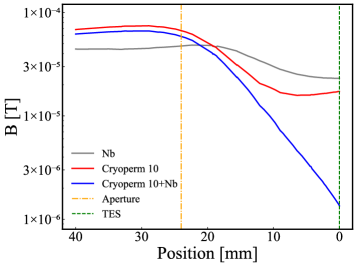
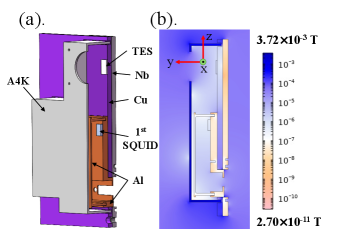
The magnetic shielding system utilizes a composite structure of Cryoperm 10 and Niobium to minimize external magnetic field interference. Finite element analysis, performed using COMSOL Multiphysics, demonstrates that this configuration reduces the magnetic field reaching the Transition Edge Sensor (TES) and Superconducting Quantum Interference Device (SQUID) amplifier to 2.7% of the ambient field strength. This level of attenuation is critical for maintaining detector stability and minimizing noise contributions that could otherwise degrade signal quality. The composite material selection balances high permeability with effective eddy current suppression, optimizing shielding performance across a broad frequency range.
The implemented magnetic shielding configuration directly contributes to stable detector operation by suppressing fluctuations in the external magnetic field that would otherwise impact the superconducting transition edge sensor (TES) and SQUID amplifier. Minimizing magnetic interference is critical because these devices exhibit extreme sensitivity to magnetic flux. Reductions in external field variations translate directly into decreased noise contributions within the measured signal, improving the signal-to-noise ratio and enhancing the precision of the scientific measurements. The achieved field reduction of 2.7% of the ambient value, as verified by COMSOL Multiphysics simulations, represents a significant mitigation of potential noise sources and ensures reliable data acquisition.
Bilayer Transition Edge Sensor (TES) devices commonly employ materials such as Mo/Au, Ti/Au, and Mo/Cu films to precisely tune the critical temperature at which the superconducting transition occurs. While these materials are effective, Aluminum-Manganese (AlMn) presents advantages during fabrication. AlMn films can be deposited with greater ease and control over film stress, leading to improved film uniformity and reduced risk of delamination compared to some traditional bilayer materials. This simplifies the manufacturing process and contributes to increased device yield and reliability, particularly in large-format detector arrays.
Looking Beyond the Horizon: The Promise of Polarized X-rays
A crucial element in the design of the proposed Wide-band X-ray Polarization Telescope is the Aluminum-Manganese Transition Edge Sensor (AlMn TES). This highly sensitive detector is engineered to measure the polarization of X-rays emitted from extreme astrophysical environments, such as those surrounding black holes and neutron stars. The AlMn TES operates on the principle of detecting minute changes in temperature as X-rays are absorbed, and its development represents a significant advancement in X-ray detection technology. By precisely characterizing the polarization of these high-energy photons, the telescope – and its core AlMn TES component – aims to unlock new insights into the fundamental physics governing these enigmatic cosmic objects, offering a detailed view of magnetic fields and particle acceleration mechanisms previously obscured.
The proposed Wide-band X-ray Polarization Telescope is designed to investigate the most energetic phenomena in the universe – the extreme physics surrounding black holes and neutron stars. By measuring the polarization of X-rays emitted from these objects, scientists can gain unprecedented insights into the behavior of matter under intense gravitational and magnetic fields. X-ray polarization reveals information about the geometry and strength of magnetic fields near these compact objects, as well as the processes by which particles are accelerated to incredibly high energies. This technique allows researchers to differentiate between various theoretical models describing the emission mechanisms and to test the predictions of general relativity in strong-field regimes, ultimately deepening understanding of these cosmic engines and the fundamental laws governing them.
The development of the AlMn Transition Edge Sensor (TES) is yielding significant gains in energy resolution, a critical factor for the proposed Wide-band X-ray Polarization Telescope. Recent measurements demonstrate resolution levels of 8.1 eV at 5.9 keV, improving to 11.4 eV at 8.0 keV, and reaching 12.1 eV at 17.48 keV – representing a fractional energy resolution of just 0.069%. This enhanced capability allows for exceptionally precise spectral analysis of X-ray emissions, effectively distinguishing between subtle energy shifts and enabling the detection of remarkably faint signals from distant astrophysical sources. Consequently, the telescope will be better equipped to unravel the complex physics surrounding black holes and neutron stars, probing their extreme environments with unprecedented detail and sensitivity.
Achieving exceptional energy resolution in X-ray telescopes hinges on the meticulous suppression of intrinsic noise sources. Johnson Noise, arising from the random motion of electrons in conductive materials, and Thermal Fluctuation Noise, linked to the thermal energy within the detector, both contribute to signal uncertainty and obscure faint astronomical signals. Researchers are actively developing strategies to minimize these disturbances; this includes optimizing detector materials and operating temperatures to reduce thermal energy, as well as employing sophisticated filtering techniques to isolate the desired X-ray signal from the background noise. Successfully mitigating these noise factors is paramount, as even minor improvements in energy resolution translate directly into a significantly enhanced ability to detect and characterize the polarized X-ray emissions from distant and energetic phenomena like black holes and neutron stars.
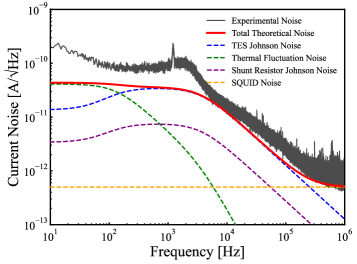
The pursuit of increasingly refined energy resolution, as demonstrated by this AlMn TES detector, echoes a humbling truth about modeling the universe. The detector’s achievement of below 0.1% resolution-a near-limit for current technology-is not merely a technical feat, but a testament to the constant refinement needed to approach reality. As James Maxwell observed, “Science is as much about questioning as it is about answering.” This detector, pushing the boundaries of X-ray detection, embodies that spirit. The article details how meticulous magnetic shielding and film deposition are crucial to suppressing noise-a constant battle against imperfections that, much like the event horizon of a black hole, threaten to obscure the signal. The work suggests that even the most sophisticated models-in this case, the detector’s response function-are always approximations, forever subject to the limitations of measurement and the inherent complexity of the phenomena they attempt to capture.
What Lies Beyond?
The pursuit of increasingly refined energy resolution in transition-edge sensors continues, and this demonstration of AlMn film viability is, predictably, not an arrival. It is merely a sharpening of the question. Models exist until they collide with data, and each incremental gain reveals a new constellation of limitations. The magnetic shielding, while effective, remains a practical constraint; the dance between detector performance and cryogenic complexity is far from resolved. Each reduction in spectral width exposes subtle imperfections in calibration, and the ever-present noise floor – the ultimate horizon – recedes only slightly.
The true challenge isn’t simply to achieve better numbers, but to understand what those numbers mean. The detector doesn’t reveal truth; it offers a translation, one subject to its own biases and imperfections. Future work will undoubtedly focus on material science-exploring alternative alloys, refining deposition techniques. But a parallel path must consider the analysis of the noise itself. What information is lost in the pursuit of precision? What previously hidden phenomena might emerge from a fuller accounting of the detector’s limitations?
Every theory is just light that hasn’t yet vanished. The AlMn film offers a new path, a different form of illumination. But the darkness beyond the event horizon remains, a constant reminder that even the most elegant model is, ultimately, provisional. The next step isn’t necessarily a better detector, but a more honest accounting of the shadows it casts.
Original article: https://arxiv.org/pdf/2602.11728.pdf
Contact the author: https://www.linkedin.com/in/avetisyan/
See also:
- Looks Like SEGA Is Reheating PS5, PS4 Fan Favourite Sonic Frontiers in Definitive Edition
- Dune 3 Gets the Huge Update Fans Have Been Waiting For
- Gold Rate Forecast
- Pluribus Star Rhea Seehorn Weighs In On That First Kiss
- Kelly Osbourne Slams “Disgusting” Comments on Her Appearance
- Arknights: Endfield – Everything You Need to Know Before You Jump In
- Tomodachi Life: Living the Dream ‘Welcome Version’ demo now available
- Antiferromagnetic Oscillators: Unlocking Stable Spin Dynamics
- 10 Steamiest Erotic Thriller Movies of the 21st Century
- Action Comics #1096 is Fun Jumping-On Point for Superman Fans (Review)
2026-02-15 17:02