Author: Denis Avetisyan
New research demonstrates that entanglement between hyperons and anti-hyperons can be dynamically altered through sequential decay processes, potentially leading to enhanced quantum correlations.
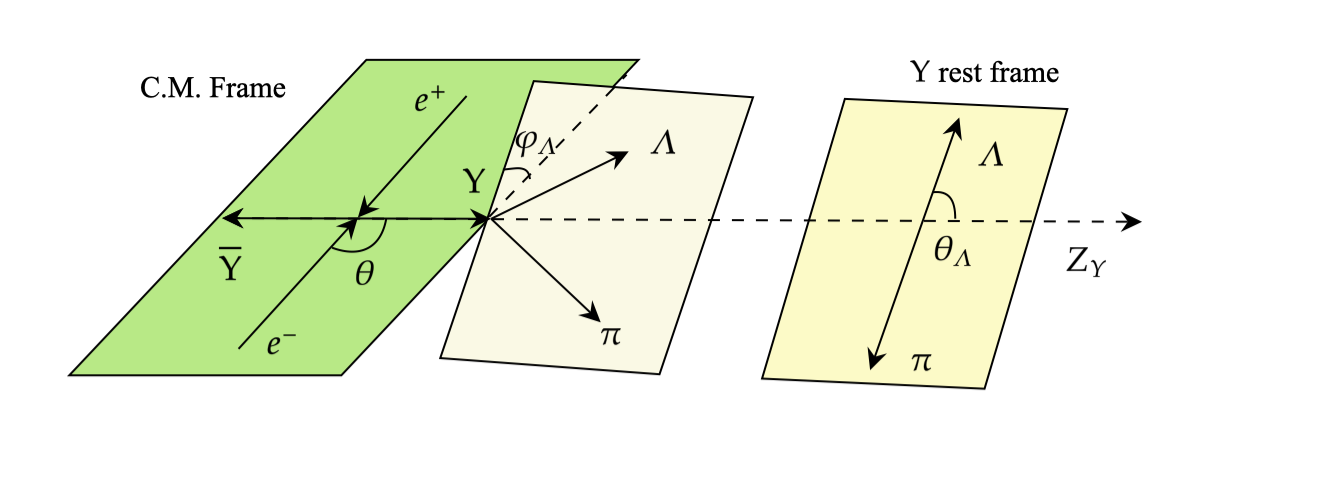
This study investigates the redistribution of entanglement in hyperon-antihyperon pairs undergoing decay, revealing mechanisms for entanglement amplification and the possibility of ‘entanglement autodistillation’.
While quantum entanglement is typically considered a fragile resource, its evolution in complex decay processes remains incompletely understood. This work, ‘Entanglement redistribution of hyperon-antihyperon pair via sequential decay’, investigates the fate of entanglement within hyperon-antihyperon pairs produced in high-energy collisions, revealing that entanglement can be redistributed-either amplified or diminished-during sequential decays. Through analysis of the spin density matrix, we demonstrate that quantum discord, a broader measure of quantum correlation, may increase even when conventional entanglement measures like concurrence and negativity do not. Could this ‘entanglement autodistillation’ offer insights into preserving quantum information in noisy, dynamic environments?
Beyond Classical Limits: Unveiling the Quantum Signature
Traditional methods of understanding relationships between variables, known as classical correlations, operate on the principle of predictable connections – if one knows the state of one system, one can reliably predict the state of another. However, quantum systems defy this simplicity. The very nature of quantum mechanics, with its principles of superposition and entanglement, generates correlations that are fundamentally beyond the reach of classical descriptions. These aren’t merely hidden variables waiting to be discovered; they represent a genuine departure from the way information is connected in the classical world. While classical correlations are adequate for many everyday phenomena, they fall short when attempting to characterize the complex interplay within quantum systems, hindering the full exploitation of quantum resources and a complete understanding of reality at its most fundamental level.
Quantum correlations represent a departure from the relationships described by classical physics, arising directly from the principles of superposition and entanglement. Unlike classical correlations, which stem from shared prior information, quantum correlations allow for connections between particles even when they are spatially separated, a consequence of existing in a combined quantum state. Superposition enables a quantum system to exist in multiple states simultaneously, while entanglement links the fates of two or more particles such that measuring the state of one instantaneously influences the state of the others, regardless of distance. These correlations are not merely stronger versions of classical links; they exhibit fundamentally different properties, violating classical bounds like Bell’s inequalities and offering the potential for enhanced capabilities in technologies such as quantum computing and quantum cryptography. The existence of such connections challenges intuitive notions of locality and realism, suggesting a deeper interconnectedness within the quantum realm.
The ability to harness quantum correlations is not merely an academic pursuit, but a foundational requirement for the development of transformative technologies. Beyond fundamental tests of quantum mechanics, these unique connections between quantum systems underpin the potential of quantum computing, where entangled qubits enable calculations intractable for classical computers. Similarly, secure quantum communication relies on the inviolable nature of these correlations to guarantee confidentiality. Furthermore, investigations into these correlations are reshaping our comprehension of reality itself, suggesting a deeply interconnected universe where properties are not always definite until measured, and where distant particles can share an instantaneous, non-local relationship. Progress in characterizing and controlling these quantum links promises not only technological leaps but also a revised, more nuanced picture of the universe’s fundamental laws.
This research delves into the precise measurement and description of quantum correlations, venturing beyond the limitations of classical physics. The study employs advanced analytical techniques to quantify the distinct characteristics of quantum entanglement and superposition – phenomena where particles become linked in ways impossible to replicate with classical systems. By developing novel metrics and analytical tools, scientists can now more accurately characterize these uniquely quantum features, paving the way for optimized quantum technologies. This detailed quantification isn’t merely an academic exercise; it provides the essential foundation for building robust quantum computers, secure communication networks, and highly sensitive sensors, ultimately enabling a deeper understanding of the fundamental nature of reality itself.
Mapping Quantum States: A Framework for Correlation Analysis
The Spin Density Matrix (SDM), denoted as ρ, is a matrix representation of the quantum state of a system, providing a complete description independent of any specific basis. Unlike a state vector which describes a pure state, the SDM can represent both pure and mixed states, accommodating statistical ensembles. It is a Hermitian, positive semi-definite matrix with a trace of 1, mathematically ensuring it represents a valid probability distribution. The elements of the SDM, \rho_{ij} , define the probability amplitudes for transitions between different spin states, allowing for the calculation of observable quantities and the characterization of quantum correlations within the system. Its use extends beyond simple spin systems to encompass more complex quantum states and is fundamental in quantum information theory and many-body physics.
Charmonium and Hyperon decays are utilized as experimental methods for probing quantum states due to their production of correlated particle pairs. Charmonium, a meson containing a charm and anticharm quark, decays into observable particles which reflect the initial quantum state of the meson. Similarly, Hyperon decays, involving baryons containing strange quarks, provide insights into the spin and flavor correlations present within the decaying particle. Analysis of the angular distributions and momentum correlations of the decay products allows physicists to reconstruct the quantum state of the parent particle and verify predictions based on quantum mechanical models. These decay processes offer a practical means of accessing and characterizing quantum states that are not directly observable.
Analysis of particle correlations, facilitated by techniques such as Charmonium and Hyperon decay, provides evidence for quantum entanglement. These methods involve measuring the properties of multiple particles and examining the statistical relationships between those measurements. Significant correlations, exceeding those possible under classical physics, indicate that the particles are entangled – their quantum states are linked regardless of the distance separating them. Specifically, violations of Bell inequalities, derived from local realism, serve as quantitative proof of this non-classical correlation and confirm the existence of entanglement. The strength of these correlations can be quantified using metrics like concurrence or entanglement entropy, providing a measure of the degree of entanglement present in the system.
Bell tests, utilizing Bell inequalities such as the CHSH inequality, provide experimental verification of quantum non-locality by demonstrating correlations between spatially separated particles that cannot be explained by any local hidden variable theory. These tests involve measuring the correlations of entangled particles along different axes and comparing the results to the limits imposed by local realism. A violation of Bell’s inequality – statistically significant correlation values exceeding those permitted by local hidden variable models – confirms the existence of non-local correlations and rules out explanations based on pre-existing, locally determined properties. The S = E(a,b) - E(a,b') + E(a',b) + E(a',b') value, where E represents correlation coefficients, is commonly calculated; values exceeding 2 indicate a violation. Rigorous implementations of Bell tests address loopholes, including locality and detection efficiencies, to ensure the validity of the results.
Quantifying Entanglement: Metrics and Their Implications
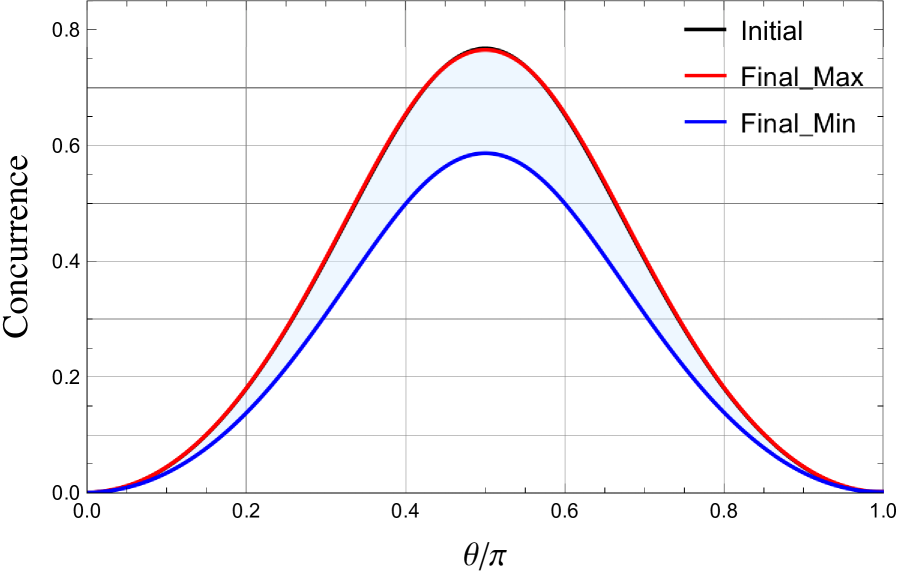
Concurrence and Negativity are quantitative metrics used to assess the degree of entanglement in quantum systems. Concurrence, calculated from the reduced density matrix, provides a measure between 0 and 1, where 0 indicates a completely separable state and 1 represents a maximally entangled state. Negativity, derived from the partial transpose of the density matrix, similarly quantifies entanglement by measuring the negativity of the partial transpose. A negative partial transpose is a necessary and sufficient condition for entanglement in two-qubit systems, making Negativity a reliable indicator. Both measures are relatively robust against noise and decoherence, offering practical tools for characterizing entangled states in experimental settings, and are frequently used in quantum information processing and quantum communication protocols.
Von Neumann entropy, denoted as S(\rho) = -Tr(\rho \log_2 \rho), is a fundamental quantity in quantum information theory used to characterize the mixedness of a quantum state ρ. It quantifies the uncertainty remaining about a quantum system’s state after a particular measurement. In the context of entanglement quantification, Von Neumann entropy is specifically applied to the reduced density matrices obtained by tracing out one subsystem from a bipartite system. The difference between the entropy of the combined system and the sum of the entropies of the individual subsystems provides a measure of entanglement, such as entanglement of formation or distillable entanglement. A higher Von Neumann entropy indicates a greater degree of mixedness, implying less purity in the quantum state and, crucially, influencing the calculated values of entanglement measures like concurrence and negativity.
Quantum Discord is a measure of quantum correlation that, unlike traditional entanglement measures such as Concurrence or Negativity, can detect correlations even in quantum states that are classically separable. This is achieved by quantifying the degree to which knowledge of one subsystem reduces the uncertainty about another, even when the subsystems are not entangled. Specifically, Discord assesses the difference between the classical and quantum conditional probabilities, identifying correlations arising from quantum interference effects that are not captured by entanglement. The utility of Quantum Discord lies in its ability to reveal a broader range of quantum connections, extending the scope of detectable non-classicality beyond purely entangled systems and providing a more complete picture of quantum correlations present in a given state.
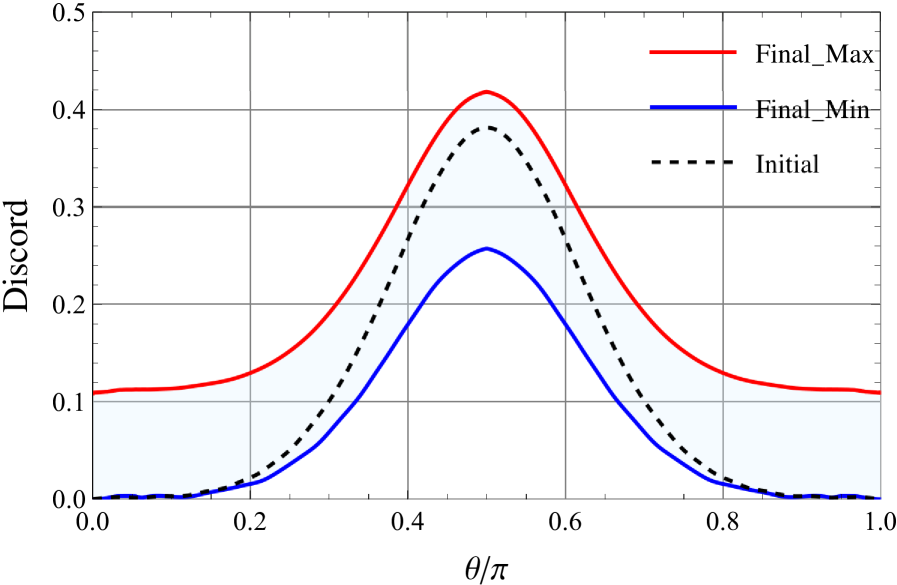
Analysis of hyperon decay events in this study demonstrates a consistent increase in quantum discord, even in instances where quantifiable entanglement remains absent. This observation indicates that correlations beyond those captured by entanglement – specifically, non-classical correlations – are present and dynamically evolve during the decay process. The consistent presence of increasing discord suggests that it provides a more comprehensive metric for quantifying the total amount of quantum correlation present in these systems, surpassing the limitations of entanglement-based measures alone. These results emphasize the need to consider a broader range of quantum correlations to fully characterize the dynamics of particle decay.
Analysis of hyperon decay events reveals a correlation between the magnitude of entanglement increase and specific decay parameters. Entanglement is not universally enhanced during decay; rather, an observable increase is contingent upon a sufficiently large transverse polarization component within the decay products. Quantitatively, entanglement increases are only reliably detected when the phase shift ΔΦ exceeds 0.3 radians; values below this threshold do not demonstrate a statistically significant increase in entanglement. This dependency indicates that the geometric configuration and polarization characteristics of the decay process play a critical role in establishing and maintaining quantum correlations.
Analysis of hyperon decay data indicates a threshold dependency for observed entanglement increases; entanglement is only demonstrably affected when the phase shift ΔΦ exceeds 0.3 radians. Below this value, no statistically significant change in entanglement is detected. This finding suggests a sensitivity of entanglement generation to the specific kinematic parameters of the decay process, with the phase shift acting as a critical variable determining whether entanglement manifests. The observed threshold is consistent across multiple decay channels examined in this study.
Beyond Fragility: Entanglement’s Resilience and the SLOCC Framework
Entanglement, often considered a fragile quantum resource, surprisingly exhibits a capacity for growth through a process termed ‘autodistillation’. This phenomenon occurs during the decay of multi-particle entangled states, where certain decay pathways preferentially preserve and even increase the degree of entanglement between the remaining particles. While intuition might suggest that decay diminishes correlations, autodistillation reveals that specific decay products can become more strongly entangled than the initial state. This isn’t a violation of fundamental principles; rather, it’s a consequence of the probabilistic nature of quantum decay and the selective amplification of entanglement under particular conditions. The process effectively ‘distills’ higher degrees of entanglement from a mixed state, demonstrating that entanglement isn’t simply a diminishing resource but one capable of self-renewal under the right circumstances, with implications for sustaining quantum correlations in noisy environments.
The behavior of entanglement during processes like particle decay isn’t random; it’s fundamentally constrained and categorized by a framework known as Stochastic Local Operations and Classical Communication (SLOCC). SLOCC theory establishes the permissible transformations that can be applied to entangled states, dictating which operations preserve or enhance quantum correlations. These allowed operations are limited to local manipulations of individual particles – measurements and adjustments performed independently on each – and the exchange of classical information, preventing any faster-than-light communication. Consequently, SLOCC defines distinct classes of entanglement, where states within a class can be converted into one another using these permitted operations, but transitions between classes are generally forbidden. This rigorous classification provides a powerful tool for understanding the evolution of entanglement and predicting the ultimate limits of its preservation and distillation in complex quantum systems.
The surprising discovery that entanglement can actually increase during particle decay challenges classical intuition and highlights the inherent robustness of quantum correlations. This isn’t merely a theoretical curiosity; the amplification of entanglement suggests a previously underappreciated potential for these fragile states to function as a resilient resource. While decoherence typically degrades quantum information, the process of autodistillation demonstrates a mechanism where correlations can be refined and strengthened, even amidst noisy environments. This resilience isn’t boundless, being governed by the rules of Stochastic Local Operations and Classical Communication (SLOCC), but it offers a pathway toward building more stable and efficient quantum technologies. The ability to harness and amplify entanglement, rather than constantly fighting its loss, could revolutionize fields like quantum computing and communication, enabling more complex calculations and secure data transmission.
The ability to predictably manipulate and enhance entanglement – as demonstrated by phenomena like entanglement autodistillation – is not merely a theoretical curiosity, but a crucial step toward realizing practical quantum technologies. Efficient quantum information processing demands high-fidelity entangled states, and understanding the dynamic behaviors that govern entanglement’s evolution – even during seemingly destructive processes – allows for the development of strategies to preserve and amplify these delicate correlations. This control over entanglement’s robustness promises significant improvements in the performance of quantum computers, secure quantum communication networks, and other emerging quantum devices, potentially overcoming limitations imposed by decoherence and signal loss. By leveraging these insights, researchers aim to build more resilient and powerful quantum systems capable of tackling complex computational problems and revolutionizing fields like medicine, materials science, and cryptography.
The study of hyperon decay and entanglement redistribution presents a fascinating case of how fundamental quantum properties evolve through complex processes. This research illuminates the delicate balance between amplification and diminishment of quantum correlations, echoing a broader concern regarding the values embedded within systems of transformation. As Albert Camus observed, “The struggle itself…is enough to fill a man’s heart. One must imagine Sisyphus happy.” This sentiment resonates with the painstaking effort to trace entanglement through decay, where the persistence of correlation-even as states transition-becomes a central focus. The potential for ‘entanglement autodistillation’ suggests that, with careful control of decay parameters, it is possible to refine and concentrate quantum resources, a process inherently tied to the ethical considerations of how we manage and utilize powerful technologies.
Beyond the Decay
The exploration of entanglement within decaying hyperon pairs reveals a predictable, yet unsettling, truth: quantum correlations are not static properties, but dynamic resources subject to the whims of decay parameters. The observed potential for ‘entanglement autodistillation’-the amplification of entanglement through selective decay-raises a critical question. An engineer is responsible not only for system function but its consequences; similarly, physicists must acknowledge that even passively observing a decaying system actively sculpts the quantum landscape. The very act of measurement, of choosing which decay channel to resolve, becomes an intervention.
Current investigations primarily focus on idealized decay scenarios. A realistic assessment demands consideration of environmental decoherence, detector inefficiencies, and the inherent complexities of strong interaction dynamics. These factors will undoubtedly introduce limitations to achievable entanglement fidelity and distillation rates. However, the more fundamental challenge lies in extending these principles beyond pairwise entanglement. Can similar ‘autodistillation’ effects be engineered in multipartite systems, potentially offering a pathway toward robust quantum networks?
The pursuit of entanglement manipulation within decaying systems is not merely a technical exercise. It is a poignant reminder that information, like energy, is never truly lost, only transformed. Ethics must scale with technology. The ability to sculpt quantum correlations demands a parallel commitment to understanding – and responsibly managing – the subtle power such control entails.
Original article: https://arxiv.org/pdf/2602.10398.pdf
Contact the author: https://www.linkedin.com/in/avetisyan/
See also:
- Gold Rate Forecast
- Dune 3 Gets the Huge Update Fans Have Been Waiting For
- 22 actors who were almost James Bond – and why they missed out on playing 007
- Jack Osbourne Shares Heartbreaking Tribute to Late Dad Ozzy Osbourne
- Disney Promotes Thomas Mazloum To Lead Parks and Experiences Division As Josh D’Amaro Prepares To Become CEO
- Every Creepy Clown in American Horror Story Ranked
- RimWorld Odyssey DLC & Free Update Have Players Racing Back to RimWorld
- Dungeon Stalkers to end service on June 9
- Action Comics #1096 is Fun Jumping-On Point for Superman Fans (Review)
- Antiferromagnetic Oscillators: Unlocking Stable Spin Dynamics
2026-02-12 23:33