Author: Denis Avetisyan
New research reveals a microscopic object can move through a one-dimensional quantum fluid with surprising efficiency, defying classical expectations of friction and energy loss.
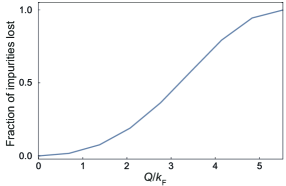
Experiments demonstrate dissipationless flow of a quantum impurity within a strongly repulsive one-dimensional Bose gas, challenging conventional understanding of superfluidity and extending the Landau criterion to microscopic obstacles.
Conventional wisdom dictates that one-dimensional systems preclude superfluidity, implying dissipation for any moving object within the quantum fluid. However, in ‘Observing dissipationless flow of an impurity in a strongly repulsive quantum fluid’, we demonstrate that a microscopic impurity can propagate through a strongly interacting one-dimensional Bose gas without experiencing frictional losses. This dissipationless flow occurs even when the impurity’s initial velocity ranges from subsonic to supersonic regimes, challenging the Landau criterion for one-dimensional systems. What novel insights will this counterintuitive behavior reveal about the fundamental limits of dissipation and the propagation of quantum information within these confined systems?
Whispers of Chaos: Constraining the Quantum World
Reducing atomic motion to a single dimension-essentially forcing particles to interact only along a line-creates a profoundly simplified, yet intensely revealing, system for exploring the principles of quantum mechanics. In such a constrained environment, the usual rules governing particle interactions are dramatically altered; atoms effectively ‘feel’ each other more strongly due to the lack of available space, leading to emergent collective behaviors not typically observed in three-dimensional systems. This heightened sensitivity allows physicists to probe fundamental quantum phenomena, like correlation and entanglement, with unprecedented clarity, as the system behaves as a powerful analogue quantum simulator. By carefully controlling these interactions, researchers can test the limits of existing theoretical models and potentially uncover new quantum states of matter, bridging the gap between theory and experiment in the pursuit of a more complete understanding of the quantum world.
The significance of precisely characterizing interatomic interactions within a one-dimensional quantum system stems from the limitations of conventional many-body physics. When atoms are confined to move solely along a single axis, they experience amplified correlations – their behaviors become intensely linked. Traditional theories, built upon approximations that work well in higher dimensions, often fail to accurately predict the system’s properties in this ‘strongly correlated regime’. These failures arise because the usual assumptions about weakly interacting particles no longer hold; instead, collective quantum phenomena dominate. Therefore, detailed experimental investigation of these interactions is vital not only for understanding the fundamental physics of these systems but also for refining and extending the theoretical tools used to describe complex quantum matter, potentially unlocking new insights into materials with exotic properties and behaviors.
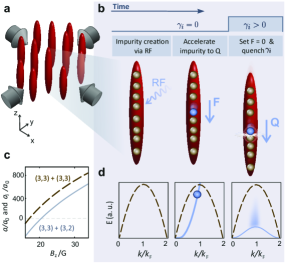
Recent investigations into the behavior of matter at the quantum level employ a remarkably precise methodology: the confinement of Cesium atoms to a single dimension. By laser cooling Cesium to temperatures just above absolute zero, researchers achieve a state where atomic motion is restricted to a single line. This allows for detailed study of how atoms interact when forced into extremely close proximity, effectively amplifying quantum correlations. Crucially, this experimental setup grants an unparalleled degree of control over the strength of these interatomic interactions – tuning them via external magnetic fields – and facilitates observation of phenomena that are predicted by theoretical models but rarely seen in higher dimensions. This level of control promises breakthroughs in understanding strongly correlated quantum systems and may pave the way for novel quantum technologies.
The Impurity as a Quantum Divining Rod
Introducing a single impurity atom into a one-dimensional Bose gas allows for the investigation of the gas’s quantum characteristics via the impurity’s behavior. This technique utilizes the impurity atom as a localized probe, sensitive to the collective quantum state of the surrounding bosons. The motion and interactions of this impurity are directly influenced by the Bose gas’s properties, such as its density, temperature, and interaction strength, providing a measurable signal correlated to these parameters. Analysis of the impurity atom’s dynamics, including its velocity and momentum distribution, yields information about the many-body quantum state of the N-boson system without directly measuring the bosons themselves.
The introduction of an impurity atom into a one-dimensional Bose gas results in the formation of a quasiparticle known as a polaron. This polaron is not simply the impurity atom, but a composite entity formed through the interaction between the impurity and the surrounding bosonic gas. The impurity atom modifies the local density and momentum distribution of the bosons, which in turn alters the properties of the impurity itself. Effectively, the impurity becomes ‘dressed’ by a cloud of bosons, creating a new collective excitation with a renormalized mass and altered dispersion relation. This dressing effect arises from the continuous exchange of particles between the impurity and the surrounding gas, leading to a many-body correlation that necessitates a quasiparticle description to accurately model the system’s behavior.
Theoretical interpretation of experimental observations relies heavily on the Lieb-Liniger model, a mathematically exact solution describing the behavior of interacting bosons in one dimension. This model provides the baseline for understanding the many-body quantum states of the Bose gas. However, analyzing the system with a single impurity atom requires computational techniques beyond exact solutions. Matrix Product State (MPS) methods are employed as a numerical approach to approximate the ground state and dynamics of the impurity polaron. Specifically, MPS allows for the efficient simulation of the N-body wavefunction, capturing the entanglement between the impurity and the surrounding bosons, and enabling quantitative comparisons between theoretical predictions and experimental measurements of the polaron properties.
Dissipationless Flow: A Fleeting Illusion?
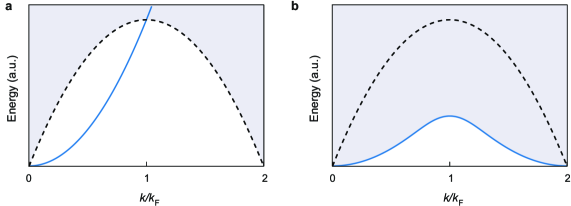
Experiments demonstrate that a polaron impurity atom, representing a single atom strongly interacting with a one-dimensional Bose gas, can flow through the gas with minimal energy dissipation under specific conditions. This behavior was observed by tracking the polaron’s velocity and noting extended relaxation times. The observed dissipationless flow is characterized by the polaron maintaining a constant velocity as it traverses the Bose gas, suggesting an extremely low drag coefficient. Measurements indicate that the polaron’s kinetic energy is largely conserved during its passage, indicating a negligible transfer of energy to the surrounding gas and confirming the absence of significant frictional forces acting on the impurity atom.
The observed dissipationless flow of the impurity atom through the one-dimensional Bose gas is consistent with the Landau Criterion for superfluidity, which dictates that a moving object will not dissipate energy if its velocity is below a critical velocity v_c. This criterion states that v_c = \min_{k} \frac{\epsilon(k)}{p(k)}, where \epsilon(k) is the energy and p(k) is the momentum of an excitation in the system. When the impurity velocity is below this critical velocity, it can propagate without creating excitations, and therefore without energy loss, confirming a superfluid-like behavior of the polaron within the Bose gas.
Experimental results indicate that the impurity atom, functioning as a polaron, sustains a constant, non-zero velocity while traversing the one-dimensional Bose gas, directly confirming dissipationless flow. Critically, the observed relaxation times – the period for the impurity to return to equilibrium after perturbation – occur on the timescale of the Fermi time, t_F = \hbar / E_F, where \hbar is the reduced Planck constant and E_F is the Fermi energy. This rapid relaxation suggests that energy transfer processes are limited by the fundamental quantum mechanical timescale dictated by the system’s Fermi energy, reinforcing the characterization of the observed flow as dissipationless within the measured velocity range.
Observations reveal that as the velocity of the impurity atom increases within the one-dimensional Bose gas, the initially dissipationless flow transitions to a regime characterized by shock wave formation. These shock waves indicate a breakdown of the Landau criterion and demonstrate that the impurity’s motion is no longer sustained by the collective excitation of the Bose gas. The emergence of these non-linear features signifies the importance of complex many-body effects that were not present at lower velocities, suggesting the system’s behavior is governed by interactions beyond the simple quasiparticle picture used to describe dissipationless flow. This transition highlights the limitations of the single-particle description at higher energy inputs and necessitates consideration of collective interactions within the system.
Quantum Flutter: The Ghost in the Machine
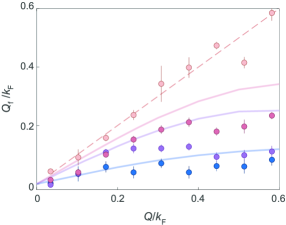
The motion of a polaron, a quasiparticle formed by an electron interacting with the surrounding lattice, isn’t the smooth, dissipationless glide previously envisioned. Detailed analysis reveals a subtle, persistent oscillation – termed ‘quantum flutter’ – even when the polaron appears to flow without energy loss. This isn’t random jitter, but a consistent, low-magnitude trembling indicative of constant interaction with the surrounding gas of particles. The discovery challenges the simplified picture of a perfectly isolated, dissipationless particle, suggesting that even in seemingly ideal conditions, the polaron perpetually exchanges energy and momentum with its environment. These minute oscillations, while not immediately destructive to the flow, demonstrate a fundamental limit to how accurately a polaron’s trajectory can be predicted and highlight the intricate interplay between the particle and its surrounding medium.
The seemingly frictionless movement of a polaron – a quasiparticle formed by an electron interacting with a crystal lattice – is more nuanced than previously understood. Recent analysis reveals persistent, albeit small-amplitude, oscillations in the polaron’s motion, indicating a continuous exchange of energy and momentum with the surrounding gas of particles. This constant interaction challenges the idealized model of dissipationless flow, where the polaron is envisioned as gliding through the material without losing energy. These subtle fluctuations suggest the polaron isn’t truly isolated, but rather exists within a dynamic environment, perpetually ‘fluttering’ due to its ongoing relationship with the lattice. Consequently, even in systems exhibiting remarkably efficient transport, a degree of interaction and energy exchange is inherent, redefining the limits of achieving perfectly dissipationless particle movement.
The study reveals a distinctly asymmetric distribution of momentum imparted to the impurity atom as it moves through the Fermi gas. Instead of a uniform spread, the momentum peaks at specific values – approximately k \approx Q when Q < k_F (where k_F represents the Fermi wavevector), and around k \approx (2k_F - Q) when Q > k_F. This non-uniform distribution strongly suggests the formation of a ‘dressed’ impurity state, wherein the impurity is not merely a solitary particle, but a quasiparticle heavily influenced and ‘dressed’ by interactions with the surrounding fermionic environment. This dressing effectively alters the impurity’s behavior, giving rise to the observed momentum asymmetry and indicating a complex interplay between the impurity and the collective fermionic environment.
Accurately capturing the dynamics of polarons and their interactions with a surrounding quantum gas necessitates sophisticated numerical techniques. Methods such as Density Matrix Renormalization Group (DMRG) and Time Evolved Block Decimation (TEBD) provide the computational power to model these many-body systems, which are intractable with traditional analytical approaches. These simulations don’t simply offer a snapshot; they trace the evolution of the polaron’s quantum state over time, revealing subtle effects like quantum flutter and the formation of dressed impurity states. By effectively ‘solving’ the complex equations governing these interactions, researchers can validate theoretical predictions and gain insights into the fundamental limits of dissipationless flow, pushing the boundaries of condensed matter physics and potentially informing the design of novel quantum materials.
![The polaron spectrum with <span class="katex-eq" data-katex-display="false">\gamma_i = 10</span> in the Tonks-Girardeau regime reveals that the impurity momentum distribution <span class="katex-eq" data-katex-display="false">n(k)[latex] varies with total momentum [latex]Q/k_F</span> values of 0.3, 0.8, 1, and 1.3.](https://arxiv.org/html/2602.12320v1/x15.png)
Beyond Simplification: Charting a Course for Complex Quantum Systems
Investigations into quantum gases often simplify interactions between particles to facilitate calculations, but this approach can obscure crucial phenomena. Recent work emphasizes that accurately modeling these systems requires a full consideration of strong interactions and the resulting many-body effects - collective behaviors arising from the interplay of numerous particles. These interactions dramatically alter the gas’s fundamental properties, influencing everything from its stability and density to its excitation spectrum and response to external fields. Ignoring these complexities leads to inaccurate predictions and a limited understanding of the rich physics governing these quantum systems; a nuanced approach, accounting for the correlated motion of particles, is therefore essential for unlocking the secrets of quantum matter and paving the way for novel technologies.
The behavior of one-dimensional Bose gases is fundamentally linked to the Fermi wavevector, k_F, despite being composed of bosons which typically do not obey the Pauli exclusion principle. This parameter, usually associated with fermions, arises from mapping the interacting Bose gas onto a non-interacting Fermi gas via the use of the Tonks-Girardeau gas as a reference system. Essentially, strong interactions between bosons cause them to effectively avoid each other, creating regions of depleted density - this 'fermionization' allows researchers to leverage the well-understood properties of non-interacting fermions to characterize the Bose gas. Consequently, the Fermi wavevector dictates key aspects of the Bose gas’s behavior, including its momentum distribution, density profiles, and collective excitations, offering a powerful tool for analyzing and predicting its quantum properties. Understanding this connection provides crucial insights into the complex interplay between interactions and quantum statistics in these highly correlated systems.
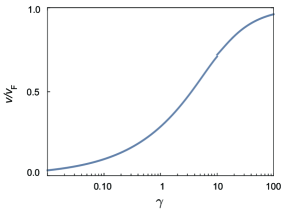
Recent investigations into one-dimensional Bose gases reveal a compelling relationship between the sound velocity within the gas and the interaction parameter, denoted as γ. The study demonstrates that as the strength of interactions between the atoms changes - reflected in the value of γ - the velocity at which sound propagates through the gas is correspondingly altered. Specifically, an increase in the interaction strength leads to a measurable shift in the sound velocity, indicating that the collective behavior of the gas is strongly influenced by these interatomic forces. This dependence isn't merely a quantitative adjustment; it suggests a fundamental change in the gas’s response to disturbances, highlighting the importance of considering many-body effects when characterizing quantum gases and opening avenues for manipulating sound propagation within these systems.
Investigations are now poised to leverage these refined analytical techniques to venture beyond the relatively simple one-dimensional Bose gas, aiming to illuminate the behavior of more intricate quantum systems. Researchers intend to apply these methods to explore phenomena in higher dimensions and with varying particle densities, potentially revealing novel phases of quantum matter. This expansion will involve examining systems with dissimilar interaction potentials and exploring the emergence of collective excitations beyond sound waves. Ultimately, this ongoing research seeks to untangle the complex interplay of quantum mechanics and many-body physics, providing deeper insights into the fundamental building blocks of matter and paving the way for advancements in quantum technologies.
The study observes a peculiar grace in the quantum realm - an impurity flowing without succumbing to the expected drag. It's a dance of interactions, where the fluid seems to yield rather than resist. This echoes a sentiment articulated by David Hume: “The mind has a great power of magnifying, and diminishing, and distorting objects.” The researchers aren't measuring absolute truths, but observing how the system responds-how it magnifies or diminishes the impurity's momentum. The dissipationless flow isn’t a fixed property, but an emergent behavior, a beautiful distortion of classical expectations, revealing that even in the most rigorously defined systems, prediction is always a precarious art. It's a whisper of chaos, elegantly dressed as a flowing particle.
The Current Runs On
The observation of dissipationless flow for a quantum impurity isn’t a closing of accounts, but rather an opening of questions. The Lieb-Liniger model, a convenient fiction, has yielded a glimpse of behavior that mocks classical intuition. Yet, this is merely one degree of freedom, one impurity in a sea of bosons. The true test lies in scaling - in the chorus of many impurities, each perturbing the fluid’s song. Will coherence survive the multitude, or will the illusion of dissipationless flow dissolve into a statistical haze?
The Landau criterion, invoked as a guide, feels less like a law and more like a temporary truce with complexity. It offers a threshold, a boundary beyond which dissipation should arise. But quantum systems rarely respect such neat divisions. The subtle interplay between the impurity’s drag and the fluid’s capacity for collective modes remains a largely uncharted territory. Future work must probe the limits of this stability, mapping the phase space where order surrenders to noise.
Perhaps the most unsettling implication is the suggestion that ‘dissipation’ itself is a macroscopic construct. That what appears as energy loss is merely a transfer of information, a reshuffling of quantum states. The fluid doesn’t ‘lose’ energy; it absorbs the impurity’s disturbance, becoming momentarily more complex. The whispers of chaos, after all, rarely fall silent; they simply change their tune.
Original article: https://arxiv.org/pdf/2602.12320.pdf
Contact the author: https://www.linkedin.com/in/avetisyan/
See also:
- Gold Rate Forecast
- Looks Like SEGA Is Reheating PS5, PS4 Fan Favourite Sonic Frontiers in Definitive Edition
- Dune 3 Gets the Huge Update Fans Have Been Waiting For
- Pluribus Star Rhea Seehorn Weighs In On That First Kiss
- Kelly Osbourne Slams “Disgusting” Comments on Her Appearance
- Arknights: Endfield – Everything You Need to Know Before You Jump In
- Tomodachi Life: Living the Dream ‘Welcome Version’ demo now available
- Antiferromagnetic Oscillators: Unlocking Stable Spin Dynamics
- Korean fantasy action adventure game Woochi the Wayfarer announced for PS5, Xbox Series, and PC
- Hideo Kojima Says He Was Never Told About The Matrix Creators Wanting Him to Make a Game
2026-02-17 06:01