Opinion

Ah, the sublime ballet of progress! A whitepaper, freshly birthed from the wombs of Google Quantum AI, reveals that a fast-clock quantum computer-a mechanical spider spinning its cryptographic web-could pluck a private key from its public twin in a mere nine minutes. Bitcoin, that lumbering behemoth, settles a block in ten. A single minute, my dear reader, separates the sanctity of digital wealth from the abyss of quantum larceny. One minute! A multi-trillion-dollar minute, during which Satoshi’s coins-nay, the entire Bitcoin cosmos-dangle like ripe fruit before the ravenous beak of the quantum phoenix.
For years, the crypto cognoscenti have whispered, “We shall cross that qubit when we come to it.” Even the most vigilant among them believed the quantum wolf was a decade away, content to nibble on dormant assets. But oh, how the tables have turned! This paper, a harbinger of doom wrapped in the velvet glove of scientific progress, renders such complacency as quaint as a Victorian corset. The timeline, once a leisurely stroll, has become a sprint through a minefield of qubits and algorithms.
The Quicksilver Pace of Change
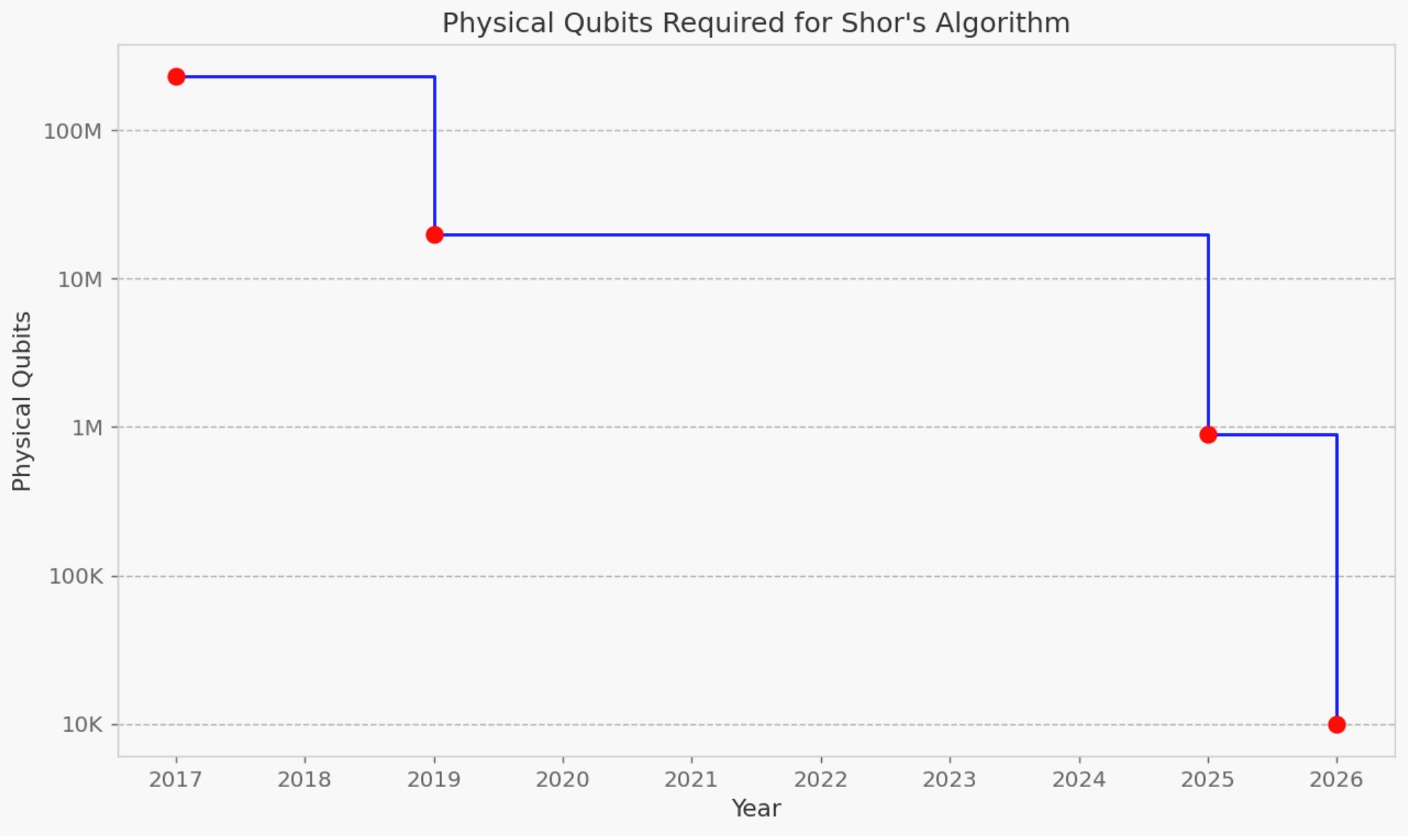
Recall, if you will, the old estimates: tens of millions of qubits, a trillion error-corrected operations-a veritable Mount Everest of computational requirements. Yet these were but phantoms, projections based on the antiquated RSA-2048 algorithm, a relic of a bygone era. Google’s whitepaper, with the precision of a surgeon’s scalpel, slices through these estimates, revealing a path to breaking Bitcoin’s 256-bit Elliptic Curve Discrete Logarithm Problem (ECDLP) with fewer than half a million qubits. A mere 1,200 logical qubits, at an error rate of 0.1%, suffice to bring this cryptographic Goliath to its knees. Google, ever the optimist, has penciled in 2029 as its quantum rendezvous.
But it is not merely the dormant coins that tremble in fear. Every active Bitcoin transaction, frolicking in the mempool like lambs in a field, is now fair game for the quantum wolf. The superconducting architecture, with its blistering clock speeds, ensures that no transaction is safe, no wealth secure.
And Google is not alone in this quantum waltz. Oratomic, those mischievous alchemists of the atomic realm, have conjured a parallel breakthrough. With neutral-atom hardware and quantum low-density parity check (qLDPC) codes, they have compressed Shor’s algorithm into a mere 10,000 to 22,000 reconfigurable atomic qubits. What once demanded millions now requires but a fraction, a testament to the relentless march of human ingenuity-or folly, depending on your perspective.
A Symphony of Technological Convergence
How, you may ask, has quantum computing leapt from the realm of science fiction to the precipice of reality? The answer lies in the subtle interplay of incremental improvements-a feedback loop of physical fidelity, error correction, control architectures, and algorithmic wizardry. Each advance begets the next, accelerating progress at a pace that defies linear comprehension. Faster machines enable better error correction, which in turn lowers the bar for the next generation, ad infinitum.
Yet, the most perilous misconception is that quantum supremacy hinges on a single, miraculous breakthrough. Superconducting, photonic, neutral-atom, and ion-trap architectures are not rivals but comrades-in-arms, each marching to the beat of its own quantum drum. Only one need succeed, and the cryptographic fortress crumbles. To bet against them all is to wager trillions on a coin toss-a gamble even the most reckless of speculators would hesitate to make.
The Clock Strikes Migration
The temptation to delay, to wait until the quantum wolf is at the door, is a siren song of complacency. Migrating a decentralized network like Bitcoin is no trivial affair; it is a logistical ballet, a hard fork of monumental proportions. Trillions of dollars hang in the balance, and the introduction of Post-Quantum Cryptography (PQC) brings with it a host of new challenges: larger digital signatures, increased bandwidth, storage, and compute requirements. Consensus, that elusive chimera, must be forged in the crucible of political intrigue.
Even with consensus achieved, the logistics are staggering. At Bitcoin’s current transaction rate, migrating the network to post-quantum addresses would take several months-assuming the network processes nothing else and every block is full. To wait until Q-Day, when the quantum wolf bares its teeth, is to invite catastrophe. Digital signatures, once the bedrock of trust, will be rendered null, and the ensuing financial volatility will make the tulip mania look like a tea party. Competing forks, shattered trust, and a crisis of provenance await those who dawdle.
Urgency, Not Hysteria
This is not a call to panic, but to clarity. The quantum threat is no longer a theoretical specter; it is an engineering reality, galloping toward us with the speed of a thousand qubits. Executives, institutions, stablecoin issuers, and protocol teams must awaken from their cryptographic slumber. The risk profile has shifted, and with it, the imperative to act. Proactive migration strategies, tools to register post-quantum ownership, and an industry-wide mandate to upgrade are not luxuries but necessities.
The quantum adversary is coming, silent and unseen. But we are not powerless. We can prepare, we can coordinate, we can ensure that the foundation of digital trust endures into the quantum era. The clock is ticking. Will we answer its call, or shall we be found wanting when the nine-minute heist begins?
Read More
- Pluribus Star Rhea Seehorn Weighs In On That First Kiss
- Kelly Osbourne Slams “Disgusting” Comments on Her Appearance
- Looks Like SEGA Is Reheating PS5, PS4 Fan Favourite Sonic Frontiers in Definitive Edition
- Arknights: Endfield – Everything You Need to Know Before You Jump In
- Dune 3 Gets the Huge Update Fans Have Been Waiting For
- ’90s Cartoon Reboot & TMNT Connection!
- ‘Marty Supreme’ Ending, Explained
- Gold Rate Forecast
- Hideo Kojima Says He Was Never Told About The Matrix Creators Wanting Him to Make a Game
- Goat 2 Release Date Estimate, News & Updates
2026-03-31 21:09