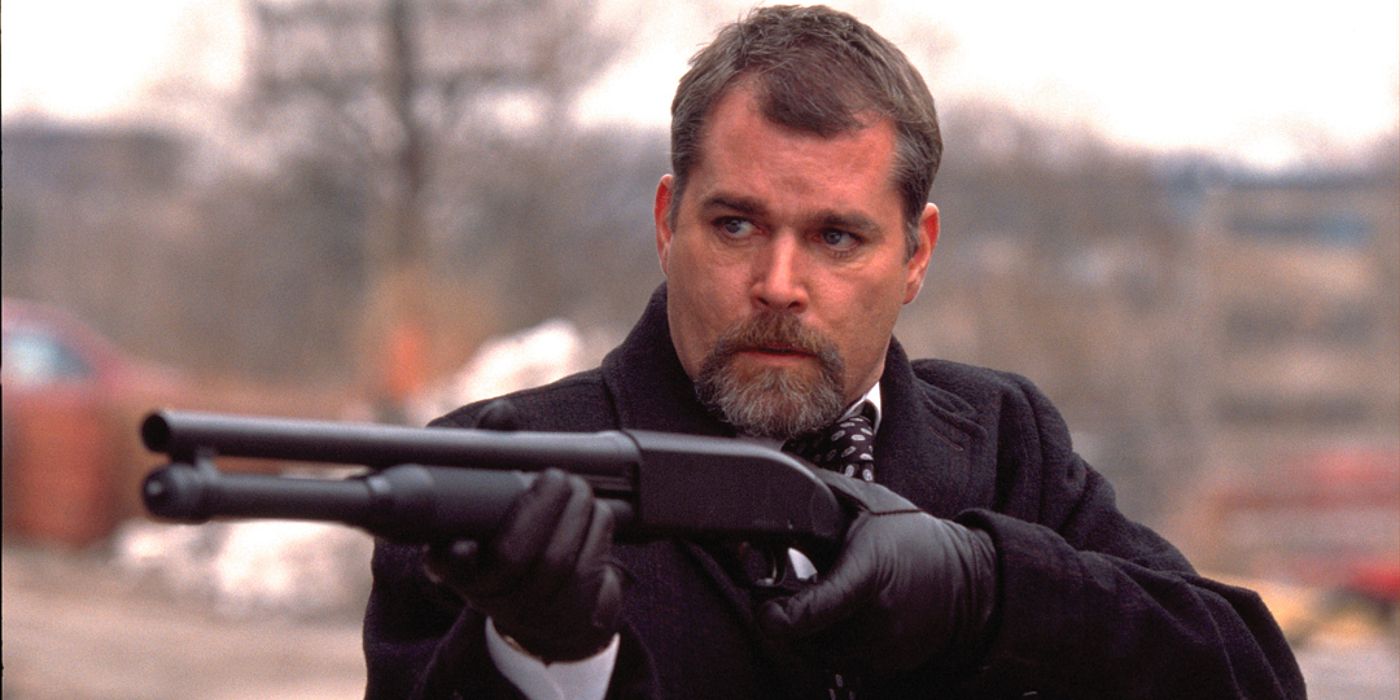
The death of Ray Liotta in 2022 was a loss for Hollywood. Though a remarkably talented actor who excelled in many different types of films, he never quite reached the level of superstardom many believed he deserved. Despite giving memorable performances – like his roles as Shoeless Joe Jackson in Field of Dreams and Henry Hill – he was never nominated for an Academy Award and often appeared in lower-budget action movies.
Many fans still consider it a major oversight that James Liotta wasn’t nominated for an Oscar for his role in Martin Scorsese’s Goodfellas, a film that received six nominations, including two for his co-stars, Joe Pesci and Lorraine Bracco. Years later, Liotta starred in another gritty crime film where he played an even more imposing character than his Goodfellas role. Ironically, this character, also named Henry, was meant to be a ‘good guy,’ but Liotta’s intense performance made him seem truly frightening. That raw energy is what continues to make the film so powerful, even 23 years after it came out.
Ray Liotta’s Detective Henry Oak Is a Force of Nature in Narc
I first heard about Narc back in the late 90s. By then, director Joe Carnahan had made this incredibly low-budget film called Blood Guts Bullets and Octane – a fantastic title, honestly – but he was really struggling to get anyone in Hollywood to take a chance on his next project.
The film Narc was intended as a gritty, realistic police thriller, similar to iconic 1970s movies like The French Connection and Serpico. It followed two disillusioned detectives investigating the murder of an undercover narcotics officer, with questions surrounding whether he’d become compromised during the investigation. However, the director was told at the time that Hollywood wasn’t interested in that type of story, as it had become more common on television.
Eventually, the script reached Ray Liotta, and he was immediately impressed. While his career wasn’t failing, he hadn’t had a major hit recently. Films like Forever Mine, A Rumor of Angels, and Pilgrim hadn’t attracted much attention. Hoping to boost his career, Liotta met with director Joe Carnahan and quickly agreed to star in and produce Narc.
Even after that, it took two more years of setbacks, funding problems, and a last-minute push – with help from Tom Cruise – to finally get Narc into theaters. But as soon as critics and viewers saw the film and the powerful performance of Ray Liotta as the strong, graying, and always-angry Detective Henry Oak, they realized it was truly something unique.
I have to say, even though Narc is really realistically and powerfully directed by Carnahan – it’s got some seriously intense chases and shootouts – and Jason Patric gives an amazing, emotional performance as the troubled Detective Nick Tellis, it just feels like it could have been a truly great film if a few things had landed differently.
Tellis and Oak are complete opposites. While Tellis is a thoughtful investigator who carefully considers every possibility, Oak is a forceful, direct character who acts first and asks questions later. Watching Oak is exciting and surprising, and actor Ray Liotta plays him with such power that he’s both fascinating and unsettling.
Narc Is Far From a Clichéd Corrupt Cop Movie
James Liotta is fantastic when his character, Oak, is at his most intense – whether he’s yelling at Tellis or violently interrogating suspects in the frigid Detroit warehouses. But what truly makes his performance stand out is the subtle depth he brings to the role. The director skillfully builds the film around the complex relationship between Tellis and Oak, even when they’re supposedly on the same side.
Using Tellis as the main perspective immediately lets the audience see things from his side, not Oak’s. Before Tellis even meets Oak, he learns that his superiors at the Detroit Police Department view him as unstable, and some suspect he might have been involved in Calvess’s fate. This immediately shapes how the audience feels about Oak.
As the story of Narc unfolds, the pieces of the puzzle start falling into place, and it really looks like Oak was the one who killed Calvess. It’s especially disturbing because Oak was Calvess’s mentor, and he’s still close to Calvess’s wife. I keep wondering, did Oak kill him after discovering Calvess had become a drug addict while working undercover in the city’s dangerous criminal world?
The film strongly suggests a cover-up, as whenever Tellis gets close to discovering what really happened to Calvess, Oak desperately tries to stop him. This tension finally explodes at the end when Tellis directly accuses Oak of murder, leading to a shootout between the two.
As Oak lay dying on the cold ground, Carnahan revealed the final piece of the puzzle, making the audience see everything in a new light. With his last breaths, Oak confessed what truly happened the night Calvess died. He explained that he’d found Calvess desperately trying to get drugs from two dealers, and even shot at them when they tried to escape.
Oak had finally reached his limit and told his friend he was going to report him. Realizing this would likely cost him his job, the friend shot himself, deeply traumatizing Oak. In that moment, Tellis realized Oak hadn’t been motivated by protecting his own reputation, but by ensuring the friend’s family – his wife and child – would have the financial support they needed.
He’s really crossed the line and broken the law, but now Tellis understands his motives and can determine how to proceed.
Ray Liotta Should Have Been Oscar-Nominated For Narc
It’s in Oak’s final moments that his character truly comes to life. The haunted look in his eyes as he finally reveals a long-held secret is deeply unsettling, and it confirms him as a complex and fully developed character.
This wasn’t a case of a righteous officer eliminating a friend lost to addiction and crime, nor was it a corrupt act to preserve a reputation. It was a man who genuinely tried to help a friend, but ultimately did what he believed was right when that help wasn’t enough. Calvess’s death deeply affected Oak, and the burden of trying to provide for Calvess’s family consumed him.
When Narc came out in theaters during awards season, it was clear Paramount thought it had a strong awards contender. Rob Friedman, the studio’s Vice Chairman, even told The New York Times that they believed Narc would be seriously considered for many Academy Awards.
Surprisingly, even William Friedkin, the director of The French Connection, strongly supported the film, declaring it the best police movie of all time. Considering that Carnahan had often mentioned Friedkin’s work as a major inspiration for Narc, this praise must have been both incredibly rewarding and a bit unbelievable.
Unfortunately, the Academy completely overlooked the movie, and Ray Liotta’s excellent performance as Henry didn’t receive any recognition. While the lack of attention to the film itself was disappointing, many felt it was even more of a shame that voters didn’t acknowledge his powerful performance in Narc.
Although Goodfellas and Narc are quite different movies, Narc delivered a powerfully emotional and intense experience, much like a gut punch. Ray Liotta’s performance was essential to achieving that impact; the film wouldn’t have been nearly as effective without him.
Read More
- Gold Rate Forecast
- Dune 3 Gets the Huge Update Fans Have Been Waiting For
- Jack Osbourne Shares Heartbreaking Tribute to Late Dad Ozzy Osbourne
- 22 actors who were almost James Bond – and why they missed out on playing 007
- Every Creepy Clown in American Horror Story Ranked
- Hazbin Hotel Secretly Suggests Vox Helped Create One of the Most Infamous Cults in History
- Everything We Know About Gen V Season 3 (& Why It’ll Be a Very Different Show)
- Jason Statham’s Hit Creature Feature Is Heading to Streaming for Free
- As Dougal and friends turn 60, Radio Times explores the magic behind The Magic Roundabout
- Antiferromagnetic Oscillators: Unlocking Stable Spin Dynamics
2025-12-10 17:12