Author: Denis Avetisyan
Researchers have successfully demonstrated a quantum voting protocol using entangled photons, offering a new path toward truly private and verifiable elections.

This work presents an experimental quantum voting system achieving 87% success, relying on GHZ states and bypassing the need for quantum memories or trusted state sources.
Traditional election systems face inherent challenges in guaranteeing both voter privacy and verifiable legitimacy. This is addressed in ‘Experimental quantum voting using photonic GHZ states’, which demonstrates a functional quantum electronic voting protocol leveraging entanglement to protect individual voter preferences. The experiment achieves an 87% success rate in recording voter intentions using four-party GHZ states, without relying on trusted authorities or quantum memories. Could this approach pave the way for truly secure and transparent elections in the future?
Securing the Ballot: Quantum Privacy as a Democratic Imperative
Contemporary electronic voting systems, while offering convenience, present significant vulnerabilities that threaten the integrity of democratic processes. Existing technologies often rely on centralized databases and encrypted communications, which, despite appearing secure, remain susceptible to various forms of attack, including hacking, malware, and insider threats. Moreover, verifying that a vote was accurately recorded and tallied-ensuring true voter privacy-is frequently impossible, fostering distrust and raising legitimate concerns about manipulation. This lack of transparency and verifiable privacy erodes public confidence in election outcomes, potentially leading to decreased civic participation and the destabilization of democratic institutions. The inherent limitations of classical computing security necessitate exploration of fundamentally new approaches to protect the sanctity of the vote.
Quantum communication proposes an unprecedented level of security for voting systems by harnessing the principles of quantum mechanics. Unlike classical communication, which relies on mathematical complexity for encryption, quantum methods leverage the very laws of physics to safeguard information. A core concept is that any attempt to intercept or copy a quantum signal inevitably disturbs it, immediately alerting parties to potential tampering. This is achieved through the use of qubits, which, unlike bits, can exist in a superposition of states, and phenomena like quantum entanglement, where two particles become linked and share the same fate, no matter the distance separating them. By encoding votes in these quantum states, and utilizing protocols like quantum key distribution, it becomes fundamentally impossible for malicious actors to eavesdrop on or manipulate ballots without detection, ensuring both voter anonymity and the integrity of the election results. This approach doesn’t rely on the computational power of adversaries, but rather on the immutable laws of the universe, offering a pathway towards truly secure and trustworthy democratic processes.
The realization of a truly secure quantum voting system hinges not simply on the theoretical promise of quantum mechanics, but on overcoming significant practical hurdles in quantum state preparation and validation. Unlike classical bits, quantum information is fragile and susceptible to errors introduced by environmental noise. Consequently, generating consistently high-fidelity entangled states – essential for protocols ensuring voter privacy – is paramount. Furthermore, verifying the integrity of these quantum states before and during the voting process is crucial; any tampering or degradation could compromise the entire system. Researchers are actively exploring various techniques, including quantum error correction and advanced state tomography, to build robust and reliable quantum components capable of meeting the stringent demands of a secure and verifiable election. The development of standardized benchmarks and validation protocols will be essential to ensure that any deployed quantum voting system inspires public confidence and truly safeguards the democratic process.
The proposed voting protocol centers on the unique properties of quantum entanglement, where two or more particles become linked and share the same fate, no matter how far apart they are. In this system, each voter receives a pair of entangled quantum states – often photons – with one particle held by the voter and the other sent to a central tallying server. A voter’s choice is encoded by manipulating their particle’s quantum state; due to entanglement, this manipulation instantaneously affects the corresponding particle at the server. Critically, any attempt to intercept or measure the quantum states during transmission would disturb them, immediately alerting both the voter and the server to potential tampering. This inherent disturbance, a consequence of the laws of quantum mechanics, provides an unbreakable layer of security, guaranteeing ballot privacy and preventing manipulation, as the server only receives altered states if no eavesdropping occurred. The protocol then uses these altered states to verify the vote’s integrity without revealing the voter’s preference, effectively creating a secure and private voting process reliant on fundamental physical principles.

Generating the Quantum Resource: A Foundation of Entangled Photons
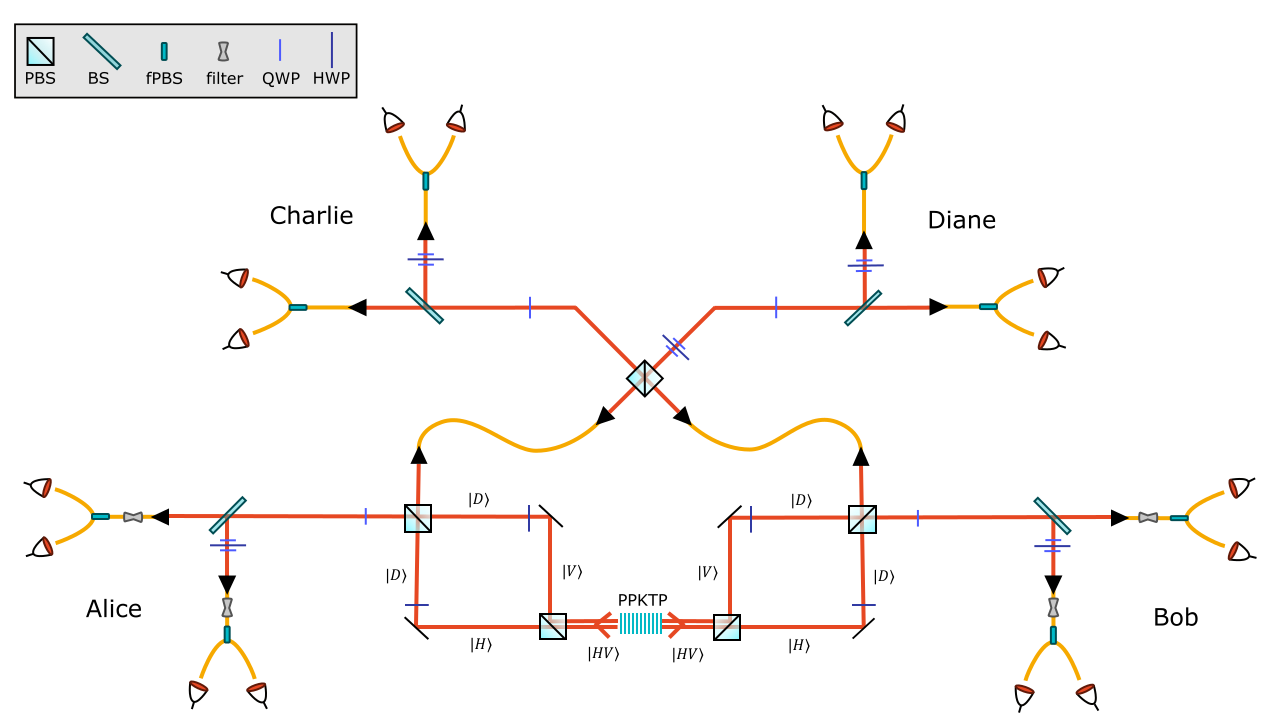
A high-fidelity four-photon polarization-entangled state serves as the central quantum resource for this protocol. This state exhibits correlations between the polarization of all four photons, meaning the measurement outcome of one photon instantaneously influences the possible outcomes of the others, regardless of distance. Generating such a state requires precise control over the quantum properties of the photons and their interactions. The quality of entanglement, often quantified by metrics such as fidelity and concurrence, directly impacts the performance of any subsequent quantum information processing task. A higher fidelity state minimizes errors and maximizes the potential for successful operations, such as quantum key distribution or quantum computation.
Spontaneous Parametric Down-Conversion (SPDC) is a nonlinear optical process utilized to generate entangled photon pairs. In this process, a pump photon incident on a nonlinear crystal, such as beta-barium borate (BBO), is annihilated, creating two lower-energy photons – the signal and idler – which are entangled. Energy and momentum are conserved in the process, dictating the wavelengths and emission angles of the entangled pairs. The efficiency of SPDC is relatively low, typically on the order of $10^{-6}$ to $10^{-8}$ per pump photon, necessitating high pump laser power and long interaction times to achieve measurable rates of entangled pair generation.
Achieving a high-fidelity four-photon entangled state necessitates precise alignment and calibration of optical components, particularly beamsplitters. Beamsplitters with carefully engineered reflectivity and transmissivity are used to superimpose the paths of photons generated via Spontaneous Parametric Down-Conversion (SPDC). The specific arrangement of these components determines the resulting entanglement properties, influencing the correlation between photon polarizations. Deviations from optimal alignment introduce phase errors and reduce the entanglement fidelity, directly impacting the performance of quantum communication protocols. Maintaining sub-wavelength precision in the positioning and orientation of these optical elements is therefore crucial for consistently generating the desired entangled state and minimizing signal loss.
Reliable detection of the entangled photons necessitates the use of Superconducting Nanowire Single-Photon Detectors (SNSPDs) due to their high sensitivity and efficiency. These detectors must achieve a minimum photon detection efficiency of ≥ 80% to ensure a significant portion of the generated photons are registered. Equally crucial is maintaining a low dark count rate, specified as ≤ 300 counts s-1, to minimize false positive detections that would compromise the fidelity of the entanglement measurements. These performance parameters are critical for distinguishing genuine signal photons from noise and are essential for the successful implementation of quantum key distribution protocols relying on four-photon entanglement.
Verifying Quantum Integrity: State Tomography and Reconstruction
Quantum State Tomography (QST) is a process used to determine the quantum state of a system. This is achieved by performing a complete set of measurements on identically prepared quantum systems. Specifically, multiple measurements are performed across various, non-commuting bases to obtain statistically significant data. This data is then used to reconstruct the system’s density matrix, $ \rho $, which completely describes the quantum state. The fidelity of the reconstructed state is then assessed to verify its suitability for the intended application, such as secure voting protocols, by ensuring it meets pre-defined criteria for accuracy and purity.
Quantum State Tomography relies on a complete set of measurements to characterize an unknown quantum state. This is achieved through the application of Pauli measurements – specifically, measurements along the $X$, $Y$, and $Z$ axes – which project the quantum state onto a basis. By performing these measurements multiple times and collecting statistical data, we obtain a set of expectation values. These expectation values are then used to estimate the elements of the quantum state’s density matrix, $\rho$, which fully describes the quantum state. The density matrix is a $N \times N$ matrix, where $N$ is the dimension of the Hilbert space, and its reconstruction is crucial for verifying the integrity of the quantum state.
Quantum State Reconstruction utilizes a Neural Network approach to improve both the accuracy and computational efficiency of determining the density matrix representing a quantum state. This method surpasses traditional techniques by leveraging a trained neural network to map measurement data obtained from Pauli measurements to the state’s density matrix elements. Evaluations demonstrate that the Neural Network Reconstruction achieves a fidelity of 89% when reconstructing the target quantum state, indicating a high degree of accuracy in representing the original state and ensuring reliable results for downstream applications such as secure voting protocols. This fidelity score represents the overlap between the reconstructed state and the ideal target state, quantified by the trace of their matrix product.
State Verification is a critical post-reconstruction process that quantitatively assesses the similarity between the generated quantum state and the pre-defined target state. This is achieved by calculating a fidelity metric, which represents the maximum overlap between the generated state’s density matrix, $ \rho $, and the target state’s density matrix, $ \rho_{target} $. A fidelity score of 1 indicates a perfect match, while lower values indicate deviations. In this system, State Verification confirms that the generated quantum state achieves a fidelity of 89% to the target state, establishing the quantum system’s reliability for secure voting by confirming the integrity of the quantum information prior to its use in the election process.
Encoding and Protecting the Vote: Protocol Mechanics
The voting protocol leverages Greenberger-Horne-Zeilinger (GHZ) states, a specific form of multi-particle entanglement, to represent voter preferences. While initial entanglement involves four photons, the protocol extends this to accommodate $n$ voters by creating an $n$-photon GHZ state. Each photon within the GHZ state corresponds to a single voter, and the quantum state of that photon encodes their selection. Manipulation of the collective entangled state, rather than individual photons, ensures that no single voter’s preference is directly revealed, maintaining privacy. The use of a multi-photon GHZ state allows for a collective decision to be encoded within the quantum system, with the final measurement revealing the aggregated voting outcome.
Random bit generation (RBG) is a critical component of the secure communication framework, utilized to create and distribute secret keys for encryption and decryption processes. The system employs a quantum random number generator (QRNG) to produce truly random bits, avoiding the predictability inherent in pseudorandom number generators. These generated bits are then used as input for key derivation functions, such as HMAC-SHA256, to create symmetric keys. These keys are subsequently exchanged between voting nodes using a key exchange protocol, ensuring confidentiality during vote transmission. The length of the generated keys is configurable, allowing for adjustments to the security level based on the specific requirements of the election.
Voter preferences are encoded as parity-even bitstrings to maintain data privacy. A parity-even bitstring ensures that the total number of ‘1’ bits within the string is always even. This method does not encrypt the vote itself, but rather obscures the direct correlation between the voter and their choice. If an eavesdropper intercepts a bitstring, they cannot determine the original vote without knowing the length of the string and thus cannot ascertain the voter’s preference. The use of parity-even bitstrings adds a layer of obfuscation, preventing straightforward analysis of the intercepted data and increasing the difficulty of voter identification. The security relies on the computational effort required to deduce the original bitstring from the parity information, particularly as string length increases.
The voting logic within the protocol is implemented through the precise manipulation of quantum states using specific quantum gates. The Hadarmard gate, a single-qubit gate, creates a superposition, enabling a qubit to represent both 0 and 1 simultaneously, which is crucial for encoding choices. Phase gates, also single-qubit gates, modify the phase of the quantum state, allowing for differentiation between encoded options without direct measurement. These gates are applied in a defined sequence to qubits representing voter preferences; the resulting quantum state then reflects the aggregated vote. The application of these gates is deterministic and reversible, ensuring the integrity and verifiability of the voting process, and their combined effect dictates how voter intent is translated into the final tallied result. $H = \frac{1}{\sqrt{2}} \begin{bmatrix} 1 & 1 \\ 1 & -1 \end{bmatrix}$ represents the Hadarmard gate in matrix form.
Towards a Secure Future: Implications and Outlook
The bedrock of this quantum-secured voting system’s security lies in the fidelity of the entangled quantum states it generates. Entanglement, a peculiar phenomenon where two particles become linked regardless of distance, forms the basis for secure key distribution, ensuring that votes remain confidential and tamper-proof. A protocol achieving a success rate of 87±3% in generating these high-fidelity entangled states demonstrates a substantial leap towards practical implementation; this high success rate minimizes the possibility of eavesdropping or manipulation during the voting process. Lower fidelity would introduce errors, potentially compromising the encryption and allowing malicious actors to intercept or alter voting information. Therefore, maintaining and improving this fidelity is paramount, as it directly correlates to the system’s robustness and ability to guarantee the integrity of democratic elections.
The integrity of democratic elections relies heavily on secure and verifiable voting systems, a challenge increasingly vulnerable to modern cyber threats. Recent research establishes the feasibility of a quantum-secured electronic voting system, offering a potential solution by leveraging the principles of quantum mechanics to protect ballot confidentiality and prevent manipulation. This system utilizes entangled photons to create a secure communication channel between voters and a central tallying authority, ensuring that each vote remains private and tamper-proof. By fundamentally shifting the security paradigm from computational complexity – which is susceptible to advancements in computing power – to the laws of physics, this innovation addresses a critical need for robust and future-proof electoral infrastructure. The successful demonstration of such a system represents a significant step towards restoring public trust in democratic processes and safeguarding the cornerstone of modern governance.
Continued advancements in both quantum state generation and detection are pivotal to realizing a fully functional and widely applicable quantum-secured voting system. Current research focuses on refining the efficiency of entangled photon pair creation, exploring novel nonlinear optical materials and cavity designs to maximize the rate of high-fidelity state production. Simultaneously, improvements to single-photon detectors – including superconducting nanowire detectors and transition-edge sensors – are aimed at minimizing dark counts and maximizing detection efficiency, thereby reducing error rates and bolstering the system’s overall security. These combined efforts aren’t merely about incremental gains; they represent a pathway toward scalability, allowing for the transmission of entangled states over longer distances and supporting a larger number of voters, ultimately transforming the theoretical promise of quantum voting into a practical reality for safeguarding democratic processes.
The potential implementation of quantum voting systems represents a significant step towards rebuilding public confidence in democratic processes. Current electronic voting methods, while offering convenience, remain vulnerable to manipulation and fraud, fostering skepticism among citizens. Quantum mechanics, with its fundamental laws governing information security, offers a pathway to create inherently tamper-proof voting infrastructure. By leveraging the principles of quantum entanglement and the no-cloning theorem, a quantum voting system could ensure that each vote remains confidential, unchangeable, and verifiably authentic. This isn’t merely a technological advancement; it’s a potential restoration of faith in the integrity of elections, offering a future where democratic institutions are fortified against malicious interference and the will of the people is truly and securely represented.
The pursuit of secure communication, as demonstrated in this exploration of quantum voting, echoes a fundamental principle of elegant design: minimizing complexity while maximizing integrity. This research achieves a remarkable 87% success rate in a functional voting protocol, sidestepping the need for complex quantum memory infrastructure. As Albert Einstein once stated, “Everything should be made as simple as possible, but no simpler.” The protocol’s reliance on entanglement verification and avoidance of trusted sources isn’t merely a technical achievement; it’s a testament to the power of a system where each element-each quantum state-harmonizes to create a robust and trustworthy whole. The interface, in this case the protocol itself, ‘sings’ when such delicate balance is achieved, ensuring privacy without sacrificing functionality.
Where Do We Go From Here?
The demonstration of an 87% successful quantum voting protocol, divorced from the tyranny of trusted sources and the impracticality of quantum memories, is not a destination, but rather a subtle redirection. It speaks to a fundamental principle: elegance isn’t about achieving perfection, but about minimizing complication. The current success rate, while encouraging, is a stark reminder that the path to widespread adoption demands a rigorous assessment of error sources. The protocol’s dependence on high-fidelity entanglement verification, in particular, presents a clear bottleneck; a delicate balance between security and practicality.
Future work must address the limits of current state fidelity measurements. A system that demands near-perfect quantum states to function is, in a sense, shouting its limitations. The true test will not be to achieve ever-higher fidelity, but to design protocols resilient enough to function despite imperfections. Consideration should be given to exploring alternative entanglement metrics that better reflect the practical constraints of real-world implementations.
Ultimately, this research hints at a broader question: can the inherent fragility of quantum states be transformed from a liability into a feature? Perhaps a voting system that intentionally introduces a degree of quantum uncertainty – a controlled “noise” – could offer a unique form of security, one predicated not on absolute prevention of interference, but on its predictable incorporation. Such a design would be a true testament to the power of harmonious form and function.
Original article: https://arxiv.org/pdf/2512.03659.pdf
Contact the author: https://www.linkedin.com/in/avetisyan/
See also:
- What Song Is In The New Supergirl Trailer (& What It Means For The DC Movie)
- Why is Tech Jacket gender-swapped in Invincible season 4 and who voices her?
- TV legend Carol Kirkwood reveals the reasons why she decided to retire after 28 years with BBC
- Dune 3 Gets the Huge Update Fans Have Been Waiting For
- Highly Anticipated Strategy RPG Finally Sets Release Date (And It’s Soon)
- Grab These Resident Evil PSN Avatars for Free This Month
- Gold’s March Madness: Plumbing, Panic, and Polish Central Banks
- Whales, Channels, and the Inevitable Dance of Folly
- The War Film Harrison Ford Completely Disowned Finally Returns to Streaming – “A Terrible Experience”
- Steam Giving Away Two PC Games for Free for Next 72 Hours
2025-12-05 01:06