Author: Denis Avetisyan
A new method leverages existing collider instrumentation to determine photon polarization, opening doors to enhanced nuclear and particle physics research.
This review details a technique for measuring photon polarization using azimuthal asymmetries in pair production with general-purpose spectrometers and validated through Geant4 simulation.
While photon polarization is a crucial observable for unraveling the spin and parity structure of particle interactions, its measurement has remained largely unexplored in collider experiments due to limitations in conventional spectrometer capabilities. This paper, ‘A novel approach to determine photon polarization at collider experiments’, introduces a technique to integrate photon polarimetry into general-purpose spectrometers without compromising their existing performance, relying on the calibration of azimuthal asymmetries produced via pair production. This successful implementation-the first of its kind-opens a new dimension for analysis by concurrently measuring spin polarization and four-momentum, promising deeper insights into fundamental physics. Will this approach become standard for future collider experiments seeking a more complete understanding of particle and nuclear interactions?
Unveiling the Signature of Light: Photon Polarization as a Window into Fundamental Interactions
Photon polarization serves as a powerful diagnostic tool across numerous areas of physics, revealing critical information about fundamental particle interactions. The polarization, which describes the orientation of a photon’s electric field, isn’t merely a property of the photon, but a signature of the process that created it and the forces at play. For instance, examining the polarization of photons emitted during particle collisions can reveal the spin of the interacting particles, confirm the existence of predicted particles, and even test the validity of theoretical models like the Standard Model. Moreover, polarized photons are essential in studying the strong force, enabling investigations into the internal structure of hadrons, and are increasingly important in quantum information science, where polarization states represent qubits. By meticulously analyzing photon polarization, physicists gain invaluable insights into the very fabric of reality, pushing the boundaries of knowledge regarding how particles interact and behave at the most fundamental levels.
Determining the polarization of a photon, while fundamentally important in various areas of physics, presents significant experimental hurdles. Background noise, stemming from stray light and electronic interference, often obscures the faint signal carrying polarization information. Furthermore, detector limitations – including imperfect sensitivity and resolution – introduce systematic errors that complicate accurate measurement. These detectors aren’t capable of registering every photon, and those they do detect may be inaccurately characterized, creating a distorted representation of the true polarization state. Overcoming these challenges requires sophisticated techniques like advanced filtering algorithms, highly sensitive detectors cooled to cryogenic temperatures, and meticulous calibration procedures to minimize the influence of these inherent limitations and extract reliable data.
Determining the polarization state of a single photon, while fundamentally simple in theory, presents significant practical difficulties for conventional measurement techniques. Existing methods frequently grapple with limitations stemming from imperfect optical components, detector inefficiencies, and the pervasive influence of environmental noise. These factors introduce systematic errors and statistical uncertainties that obscure the true polarization, hindering precise characterization. Consequently, researchers are actively pursuing novel approaches, including advanced quantum state tomography and the development of polarization-sensitive detectors with enhanced resolution and signal-to-noise ratios. These innovations aim to overcome the constraints of traditional methods and unlock the potential for more accurate and reliable polarization measurements, essential for pushing the boundaries of quantum optics and fundamental physics.
The pursuit of increasingly accurate photon polarization measurements isn’t merely a technical refinement, but a cornerstone for advancing the frontiers of physics. Subtle discrepancies between experimental results and theoretical predictions often reside within the precision of these fundamental measurements, demanding relentless improvements in methodology. Enhanced accuracy allows physicists to rigorously test the Standard Model of particle physics, potentially revealing deviations that hint at new particles or interactions beyond current understanding. Moreover, precise polarization measurements are crucial for probing quantum phenomena like entanglement and exploring the intricacies of quantum field theory, opening doors to potential breakthroughs in quantum computing and materials science. Consequently, investing in advanced polarization measurement techniques isn’t simply about building better instruments; it’s about sharpening the tools needed to unravel the deepest mysteries of the universe and validate or redefine the very laws governing reality.
Decoding Polarization: A Pathway Through Pair Production
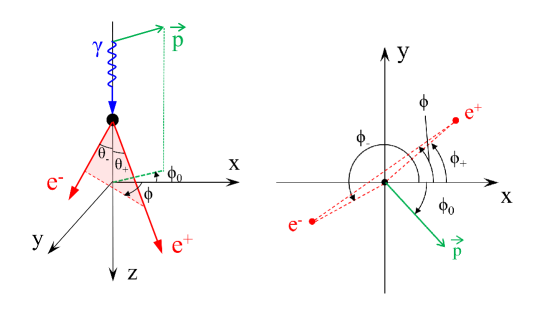
Pair production, the creation of an electron-positron pair from a high-energy photon, forms the basis of this polarization measurement technique. When a photon interacts with a material, such as a carbon foil, it can deposit its energy to create these particle-antiparticle pairs. The probability and characteristics of this process are dependent on the photon’s energy and, crucially, its polarization state. By analyzing the resulting electron-positron pairs – specifically their angular distribution – we can infer properties of the original photon, including the direction and degree of polarization. This method relies on the well-established principles of quantum electrodynamics governing the interaction between photons and matter, providing a direct link between observed particle behavior and the initial photon polarization.
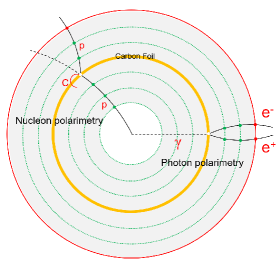
A carbon foil functions as the radiation length material within the experimental setup, facilitating the photoelectric effect and subsequent pair production when high-energy photons interact with its atomic nuclei. This process converts photons into electron-positron pairs, providing a measurable particle signature for analysis. The relatively low atomic number of carbon minimizes multiple scattering effects, preserving the angular correlation information crucial for polarization reconstruction. Foil thickness is carefully calibrated to optimize pair production yields while minimizing unwanted secondary interactions and ensuring the resulting electron-positron pairs retain sufficient energy for detection by the downstream spectrometer.
The General-Purpose Spectrometer (GPS) is a crucial component in the polarization measurement process, functioning to detect and characterize the electron-positron pairs created through pair production. This device utilizes tracking detectors to reconstruct the trajectories of the charged particles, allowing for precise determination of their momenta and angles. Specifically, the GPS measures the scattering angles of the electron and positron, and utilizes these measurements to calculate the pair’s emission angle with respect to the incident photon beam. These angular measurements are essential, as the distribution of pair emission angles is directly correlated to the original photon’s polarization state; the GPS provides the high-resolution, high-acceptance detection necessary to resolve these subtle angular dependencies.
The azimuthal angle, φ, of the produced electron-positron pairs provides a direct correlation to the original photon’s polarization. Pair production within the carbon foil is not isotropic; the angular distribution of the emitted electrons and positrons is influenced by the polarization state of the incident photon. Specifically, the asymmetry observed in the φ distribution – measured relative to the polarization direction – allows for quantitative determination of the Stokes parameters, which fully describe the photon’s polarization. The general-purpose spectrometer facilitates precise measurement of this angular distribution, enabling reconstruction of the original photon polarization with high accuracy. Systematic errors in φ measurement, including spectrometer alignment and pair production kinematics, require careful calibration and modeling to maintain precision.
Precision Through Reconstruction: Enhancing Angular Resolution
Accurate primary vertex reconstruction is a fundamental requirement for electron-positron pair identification, directly impacting the reduction of background noise and enhancement of signal clarity. This process determines the precise point of interaction for the created particles, allowing for effective separation from unrelated events. Current detector systems, utilizing modern vertex detector technology, achieve a primary vertex resolution of 50 μm. This level of precision is crucial for maintaining data quality and maximizing the sensitivity of the detector to the physics process under investigation.
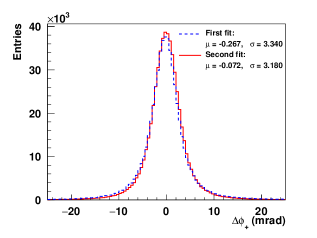
Precise determination of particle trajectories, quantified by angular resolution, is fundamental to accurate polarization measurement. The detector achieves an angular resolution of 2-3 milliradians (mrad) in both the theta and phi directions. This level of precision directly influences the ability to reconstruct the azimuthal angle of particle tracks, which is a key parameter in determining particle polarization. Improved angular resolution minimizes uncertainties in track reconstruction, leading to more reliable polarization measurements and a reduction in systematic errors in the overall analysis.
The implementation of a Silicon Pixel Detector is central to achieving high angular resolution within the H-NS Detector. These detectors utilize an array of small, individual silicon sensors – pixels – to precisely determine the trajectory of charged particles. This fine granularity, significantly exceeding that of earlier detector technologies, allows for more accurate reconstruction of particle paths and, consequently, a more precise determination of their angles. The pixelated design minimizes the ambiguity in track reconstruction, reducing the uncertainty in measured angles and improving the overall angular resolution to 2-3 mrad in both theta and phi directions. This precise tracking is critical for accurate polarization measurements and background rejection.
The performance and accuracy of the H-NS detector, and specifically the primary vertex reconstruction and angular resolution measurements, are rigorously validated through detailed simulations using the Geant4 toolkit. These simulations model particle interactions within the detector materials, allowing for a comprehensive analysis of detector response and the identification of potential systematic uncertainties. By comparing simulated data with expected results, the detector design and reconstruction algorithms can be optimized to maximize precision and minimize biases. The Geant4 simulations also facilitate the estimation of background contributions and the development of effective data selection criteria, ensuring the reliability of the final physics measurements.
Towards Definitive Measurements: Refining Accuracy and Validating the Approach
A precise determination of any physical quantity necessitates a thorough evaluation of potential uncertainties. This study carefully addresses both statistical and systematic uncertainties inherent in the measurement process. Statistical uncertainty arises from the finite number of observed events; a larger dataset naturally reduces this effect. However, even with abundant data, systematic uncertainties – those stemming from imperfections in the experimental apparatus and data analysis – remain crucial considerations. These systematic effects are meticulously identified and quantified, encompassing factors like detector calibration, background estimation, and the modeling of physical processes. Rigorous control and accurate assessment of these uncertainties are paramount to establishing the reliability and precision of the final result, ensuring that the observed signal genuinely reflects the underlying physics and isn’t merely an artifact of the experimental procedure.
Accurate interpretation of experimental data hinges on a thorough understanding of the underlying physics, and the Bethe-Heitler generator plays a vital role in establishing this foundation. This sophisticated computational tool simulates the process of pair production – where a high-energy photon transforms into an electron-positron pair – with remarkable precision. By generating a vast number of simulated events, researchers can meticulously model the expected signal and background contributions. These simulations serve as a crucial benchmark against which experimental measurements are compared, allowing for rigorous validation of the detector response and data analysis techniques. Discrepancies between simulation and experiment can pinpoint systematic uncertainties or reveal unexpected physics, ultimately ensuring the reliability and accuracy of the final results. The generator’s detailed modeling of electromagnetic interactions is therefore indispensable for extracting meaningful insights from high-energy physics experiments.
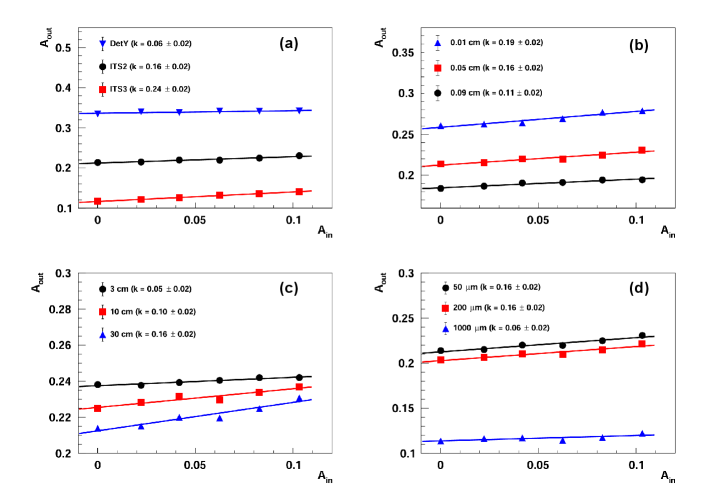
To achieve precise polarization measurements, a calibration table was implemented to correlate observed readings with true polarization values, effectively mitigating limitations inherent in the detection apparatus. This process accounts for inefficiencies and biases within the detector, ensuring the final results accurately reflect the underlying physics. Specifically, the relationship between observed and true polarization was found to have a slope of 0.15 for a detector characterized by an angular resolution of 2-3 milliradians; this calibration factor is critical for translating raw data into meaningful physical quantities and minimizing systematic errors in the overall analysis.
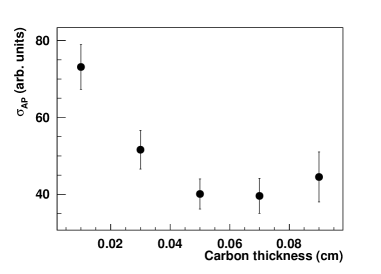
Current measurements of the true asymmetry, derived from BESIII data, are subject to a statistical uncertainty of 1.4%. However, projections for future high-luminosity experiments, notably the Super Tau-Charm Facility (STCF), indicate a substantial reduction in this uncertainty – down to approximately 0.14%. This improvement stems from the anticipated increase in event statistics at STCF, allowing for more precise determinations. Optimization studies reveal that employing a carbon foil with a thickness between 0.5 and 0.7 mm minimizes contributions to this statistical uncertainty, representing a critical parameter for maximizing the sensitivity of future measurements and refining the understanding of fundamental particle interactions.
The pursuit of photon polarization, as detailed in this study, echoes a fundamental principle of understanding any system: discerning signal from noise. This research cleverly utilizes existing detector infrastructure-general-purpose spectrometers-to calibrate azimuthal asymmetries, effectively turning a limitation into an advantage. It’s a process akin to embracing the unexpected, recognizing that deviations from the norm-in this case, asymmetries arising from detector resolution and carbon conversion-are not errors, but opportunities to uncover hidden dependencies. As Albert Camus observed, “In the midst of winter, I found there was, within me, an invincible summer.” Similarly, this work finds a path to precise measurement within the complex landscape of collider experiments, transforming challenges into illuminating insights into nuclear and particle physics.
Looking Ahead
The presented methodology, while leveraging existing detector infrastructure, does not circumvent the inherent challenge of disentangling signal from background. Every azimuthal asymmetry is, after all, a composite portrait-a superposition of genuine polarization effects and the specter of systematic uncertainties. Future work must, therefore, concentrate on refining the calibration procedures, particularly the accurate modeling of carbon conversion processes within the detector volume. Geant4 simulations, while powerful, are still approximations of a stubbornly complex reality.
A particularly intriguing avenue lies in extending this approach to explore photon polarization in more complex nuclear environments. The subtle interplay between polarization and nuclear structure remains largely uncharted territory, and this technique offers a potentially accessible pathway for investigation. However, the limitations imposed by detector resolution must be carefully considered; a finer-grained understanding of detector response will be crucial to unlock the full potential of this method.
Ultimately, the value of this work resides not in providing definitive answers, but in framing the right questions. It suggests that information about photon polarization, often considered the domain of specialized instrumentation, is already present within the data streams of general-purpose experiments-waiting to be revealed through careful observation and a healthy dose of skepticism.
Original article: https://arxiv.org/pdf/2601.21325.pdf
Contact the author: https://www.linkedin.com/in/avetisyan/
See also:
- What Song Is In The New Supergirl Trailer (& What It Means For The DC Movie)
- TV legend Carol Kirkwood reveals the reasons why she decided to retire after 28 years with BBC
- Dune 3 Gets the Huge Update Fans Have Been Waiting For
- Robinhood’s Tokenized Stock Fiasco: A Tale of Tokens and Tussles
- After 13 Years, Someone Earned One of the Hardest Achievement Trophies in Gaming
- 5 Best Superman-Centric Crossover Events
- New Open-World “AAAA” Game Coming From Tomb Raider Developer
- Crimson Desert is a “Cynical Amalgamation of Borrowed Mechanics,” Says Larian’s Publishing Director
- Jaleco Sports: Bases Loaded II announced for PS5, Switch; now available
- Digimon Is Getting a New RPG in 2026 (And You Probably Missed It)
2026-02-02 04:05