Author: Denis Avetisyan
Researchers have demonstrated a new technique for measuring incredibly small vibrations at the nanometer scale using the principles of quantum entanglement and two-photon interference.
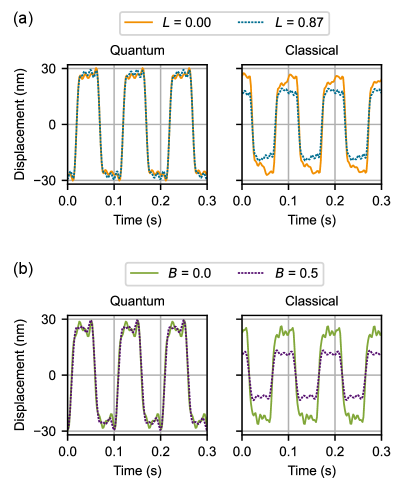
This work showcases entanglement-enhanced quantum nano-vibrometry with improved resolution, bandwidth, and robustness against noise, leveraging coincidence detection and Fisher information analysis.
Measuring dynamic processes at the nanoscale is fundamentally challenged by limitations in resolution and sensitivity, particularly when contending with signal loss and noise. Here, we present ‘Entanglement-Enhanced Quantum Nano-Vibrometry’, a technique leveraging extreme energy entanglement between photons to dramatically improve nanometer-scale vibration sensing. This approach enables the recovery of vibrational signals with frequencies up to 21 kHz, demonstrating both nanometric precision and a clear quantum advantage in lossy environments. Could this entanglement-enhanced method pave the way for real-time, high-resolution imaging of nanoscale dynamics in diverse fields?
The Inevitable Limits of Classical Perception
Conventional sensing modalities, such as Time-of-Flight and Frequency-Modulated Continuous-Wave Lidar, face inherent limitations when deployed in real-world scenarios. These techniques, while widely used for distance and object detection, are fundamentally constrained by the signal-to-noise ratio and susceptibility to environmental interference. Complex environments – those with high reflectivity, atmospheric turbulence, or significant background noise – dramatically reduce the precision of these measurements. Specifically, inaccuracies arise from the difficulty in discerning the true signal from spurious reflections and the broadening of signals due to the wave nature of light. This leads to reduced sensitivity and difficulty in resolving fine details, hindering applications that demand high-resolution imaging or precise distance measurements, particularly at smaller scales.
Classical sensing methods, while widely employed, are fundamentally constrained by inherent noise and the probabilistic nature of measurement itself. This uncertainty, dictated by the Heisenberg principle and other quantum limits, manifests as a barrier to achieving the nanometer-scale resolution demanded by increasingly sophisticated applications. Traditional techniques rely on measuring macroscopic properties – like the time it takes for light to travel or the frequency of reflected waves – which are susceptible to environmental disturbances and the limitations of detector precision. Consequently, discerning features smaller than the wavelength of light, or differentiating subtle changes in a complex environment, becomes exceedingly difficult. This intrinsic limitation hinders progress in fields like materials science, biomedical imaging, and precision manufacturing, where the ability to resolve structures and processes at the nanoscale is crucial for innovation and discovery.
The pursuit of increasingly precise measurement has driven the development of quantum sensing, a field poised to surpass the limitations of classical techniques. Traditional sensors, constrained by the fundamental laws of classical physics, encounter inherent noise that obscures subtle changes in the environment. Quantum sensors, however, exploit phenomena like superposition and entanglement to dramatically reduce this noise, enabling resolutions previously thought unattainable. This allows for the detection of incredibly weak signals and minute changes in physical quantities – with demonstrated capabilities reaching down to $1.26$ nanometers. Such sensitivity unlocks transformative potential across diverse fields, from medical diagnostics and materials science to environmental monitoring and fundamental physics research, promising a new era of precision and insight.

The Ghostly Dance of Indistinguishable Photons
Quantum two-photon interference occurs because photons, as bosons, are fundamentally indistinguishable. When two photons simultaneously impinge upon a balanced beamsplitter, the system evolves into a superposition of possible paths, effectively treating the photons as a single quantum entity. This means the probabilities of detection are determined by the interference of these combined pathways, not by treating each photon as following a definite, independent trajectory. The beamsplitter doesn’t “split” each photon individually; instead, it mediates a correlation between the two photons, resulting in interference patterns that deviate from classical predictions. The probability of coincident detection is dependent on the precise phase relationship between the photons’ wavefunctions at the beamsplitter, dictating constructive or destructive interference.
Quantum measurements exceeding classical limits are enabled by exploiting the correlations present in quantum entanglement. In scenarios involving indistinguishable photons, the probability of detection is determined by the interference of quantum states, a phenomenon not predicted by classical physics. This interference arises from the entangled nature of the photons, where their properties are intrinsically linked; measuring the state of one instantaneously defines the possible states of the other, regardless of the distance separating them. This correlation allows for the cancellation of noise and the enhancement of signal detection, leading to increased precision in measurements such as those performed with balanced beam splitters. The degree to which these measurements surpass classical bounds is directly related to the strength of the quantum entanglement and the ability to maintain the indistinguishability of the photons involved.
Measurements utilizing quantum indistinguishability benefit from the implementation of both energy and non-degenerate polarization entanglement to achieve increased sensitivity and precision. Specifically, experiments have demonstrated enhanced performance through an energy detuning of 177 THz between entangled photons. This detuning introduces a frequency difference that, when combined with polarization entanglement, allows for refined control and manipulation of the quantum state, effectively reducing noise and improving the signal-to-noise ratio in interference-based measurements. The magnitude of this energy detuning represents a critical parameter in optimizing the quantum system for specific applications requiring high precision, such as quantum metrology and sensing.

Decoding the Whispers of Quantum Coincidence
Coincidence detection is a fundamental technique in quantum optics used to identify photon pairs that are correlated, meaning they originate from the same quantum event. This is achieved by measuring the arrival times of photons at two detectors and registering only those events where photons are detected within a very short time window – typically a few picoseconds. The resulting coincidence counts represent the rate of correlated photon pairs. A prominent manifestation of this correlation is the Hong-Ou-Mandel (HOM) dip, observed when two photons impinge on a beamsplitter. The HOM dip arises from the quantum interference between the two possible paths each photon can take, resulting in a reduction in coincidence counts at specific delays. The depth and shape of the HOM dip serve as a direct signature of two-photon interference and are critically dependent on the indistinguishability of the photons and the precision of the timing resolution of the coincidence detection system.
The Flux Probing Technique improves both bandwidth and temporal resolution in quantum signal detection by leveraging the statistical properties of a Poisson Process, which models the random arrival of photons. This technique analyzes the fluctuations in photon arrival times to extract more precise timing information. Further refinement is achieved through the application of a Hann Window – a mathematical function that reduces spectral leakage and improves the accuracy of time-domain measurements. The Hann Window effectively shapes the signal, minimizing artifacts and allowing for the identification of closely spaced events, ultimately leading to enhanced resolution in quantum experiments.
Fisher-Information Analysis serves as the foundational mathematical tool for quantifying the precision limits in parameter estimation, directly enabling nanometer-scale resolution in quantum imaging. This analysis determines the minimum achievable variance in measurements, constrained by the quantum Cramér-Rao bound, which represents the theoretical lower limit for precision. Experimental results demonstrate 88% saturation of this bound, indicating a highly efficient measurement strategy. Specifically, a resolution of 1.26 nm was achieved utilizing 59,000 detected photon pairs, validating the efficacy of the Fisher-Information approach in achieving resolutions at the nanometer scale and approaching the fundamental quantum limit.
The Inevitable Expansion of Quantum Perception
Quantum two-photon interference is rapidly advancing the field of biological and materials imaging through enhancements to both quantum microscopy and quantum optical coherence tomography. Traditional microscopy is limited by the diffraction limit, restricting achievable resolution; however, by exploiting the subtle correlations between entangled photons, these quantum techniques circumvent this barrier, achieving resolutions far beyond classical limits. This is accomplished by creating interference patterns with photons that have interacted with a sample, revealing details at the nanometer scale and enabling true three-dimensional reconstructions. Unlike conventional methods that rely on detecting single photons, two-photon interference effectively ‘zooms in’ on the sample’s features by leveraging the combined quantum information, promising sharper images with reduced noise and minimal invasiveness – a significant advantage for observing delicate biological structures or sensitive materials without causing damage.
Quantum two-photon interference presents a pathway toward dramatically improved clock synchronization and the development of revolutionary quantum positioning systems. Recent demonstrations have showcased the technique’s capacity to detect vibrational frequencies as high as 21 kHz, a sensitivity that surpasses the limits of human hearing and conventional measurement tools. This heightened sensitivity isn’t merely an incremental improvement; it allows for the precise timing and location determination crucial for applications ranging from advanced sensor networks to enhanced geological surveying and potentially, entirely new methods of navigation independent of traditional satellite systems. The ability to resolve such subtle frequency shifts opens possibilities for characterizing dynamic processes at the nanoscale with unprecedented accuracy and stability, promising significant advancements in fields reliant on precise temporal and spatial information.
Realizing the full capabilities of two-photon interference techniques hinges on overcoming inherent limitations in optical systems. Optical background noise, stemming from stray light and detector dark counts, obscures the delicate quantum signal, while imbalanced path loss – differing efficiencies in the two-photon paths – diminishes interference visibility. Mitigation strategies, including advanced filtering, optimized optical designs, and sophisticated data processing algorithms, are therefore paramount. Successfully addressing these challenges promises to unlock nanometer-scale precision in imaging and position sensing, alongside frequency uncertainty reaching the centi-hertz level – a level of sensitivity vital for applications ranging from materials science and biomedical diagnostics to fundamental tests of quantum mechanics and the development of next-generation quantum technologies.
The pursuit of nanometer-scale vibration sensing, as detailed in this work, reveals a profound truth about complex systems. It isn’t about imposing control, but about nurturing sensitivity. The researchers demonstrate how entanglement enhances measurement beyond classical limits, achieving resolution previously unattainable. This resonates with the understanding that a system isn’t a machine, it’s a garden – delicate interdependencies yielding emergent properties. As Albert Einstein once observed, “The only thing that you must learn is how to use the imagination.” This study doesn’t build a sensor; it cultivates a state of interconnectedness, allowing the subtle vibrations to reveal themselves through the forgiveness between entangled photons, much like a garden revealing its bounty with careful tending.
The Inevitable Drift
This demonstration of nanometer-scale vibration sensing, predicated on the delicate choreography of two-photon interference, feels less like a culmination and more like the seeding of future failures. The achieved robustness against loss and noise is, of course, temporary. Every deployed sensor becomes a monument to environmental decoherence, a shrinking island of quantum coherence in a rising sea of thermal agitation. The question isn’t whether these systems will fail, but when, and what unanticipated modes of degradation will manifest.
The reliance on coincidence detection, while currently effective, suggests a looming architectural constraint. Scaling these systems beyond a modest number of sensors will necessitate a re-evaluation of data acquisition and processing – a bottleneck always destined to appear. Further refinement of Fisher information metrics, while valuable, merely delays the inevitable confrontation with the fundamental limits of precision imposed by the quantum realm.
One anticipates a shift from maximizing sensitivity to accepting-even embracing-controlled decoherence. Perhaps the true innovation will not lie in building better sensors, but in designing systems that gracefully degrade, revealing information through their imperfections. The ecosystem will evolve, not according to design, but through the relentless pressure of entropy.
Original article: https://arxiv.org/pdf/2512.05961.pdf
Contact the author: https://www.linkedin.com/in/avetisyan/
See also:
- Gold Rate Forecast
- Arknights: Endfield – Everything You Need to Know Before You Jump In
- 10 Best Buffy the Vampire Slayer Characters Ranked
- Every Creepy Clown in American Horror Story Ranked
- Best X-Men Movies (September 2025)
- Chill with You: Lo-Fi Story launches November 17
- Hazbin Hotel Secretly Suggests Vox Helped Create One of the Most Infamous Cults in History
- 22 actors who were almost James Bond – and why they missed out on playing 007
- Spider-Man: Brand New Day’s Trailer Release Date Officially Confirmed & The MCU’s Strategy Is Perfect
- As Dougal and friends turn 60, Radio Times explores the magic behind The Magic Roundabout
2025-12-08 06:29