Author: Denis Avetisyan
The LUXE experiment and future collider designs are pushing the boundaries of strong-field QED, opening new avenues for exploring fundamental physics.
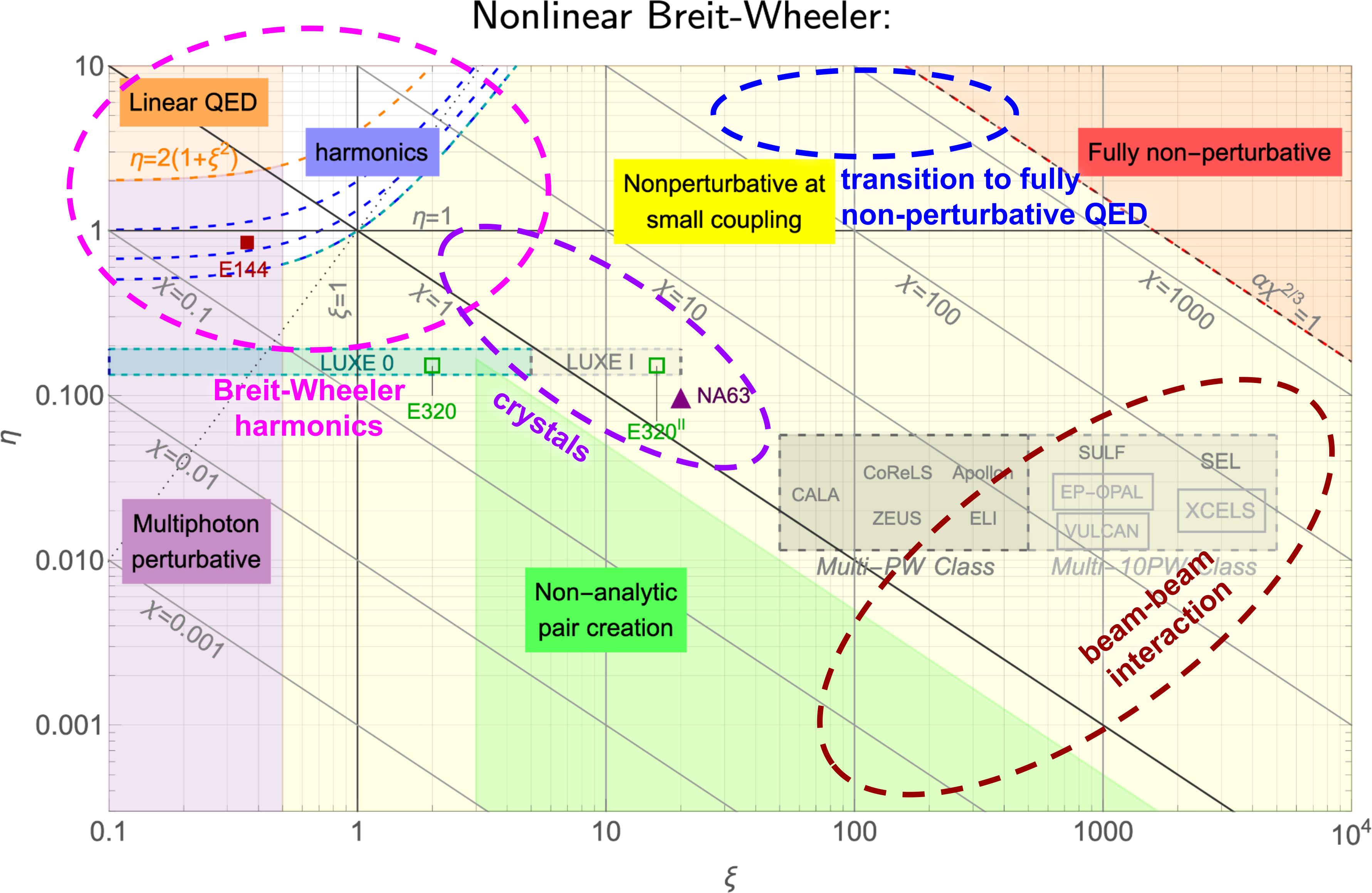
This review details the LUXE experiment’s potential for studying non-linear Compton scattering, Breit-Wheeler pair production, and searches for axion-like particles and beyond-the-Standard-Model phenomena via high-energy photon beam-dump experiments.
Despite the established success of quantum electrodynamics, probing its non-perturbative regime-where vacuum pair production becomes significant-remains a considerable challenge. This is addressed in ‘From LUXE to Future Colliders: Probing Strong-Field QED and Beyond’, which details the potential of current and future experiments to investigate strong-field QED through high-intensity laser-electron beam collisions, exemplified by the LUXE experiment at DESY. The study highlights not only the feasibility of observing phenomena like non-linear Compton scattering and Breit-Wheeler pair production, but also the opportunity to leverage energetic photons in beam-dump searches for new physics, including potential axion-like particles. Could these innovative approaches unlock a deeper understanding of fundamental interactions and reveal physics beyond the Standard Model?
The Quantum Vacuum: A Playground for Uncertainty
Quantum Electrodynamics, the remarkably successful theory describing the interaction of light and matter, posits a counterintuitive reality: what appears as empty space is, in fact, far from void. This isn’t merely a philosophical notion, but a prediction stemming from the quantization of the electromagnetic field. Virtual photons, fleeting electromagnetic fluctuations, constantly pop into and out of existence, briefly violating energy conservation thanks to the Heisenberg uncertainty principle. These aren’t detectable as conventional particles, but manifest as measurable effects, such as the Casimir force-an attractive pressure between closely spaced, uncharged conducting plates-and the spontaneous emission of photons from excited atoms. This dynamic, fluctuating vacuum isn’t a passive backdrop to physical phenomena; it actively participates, influencing the behavior of particles and light, and represents a fundamental aspect of the quantum universe.
Investigating the ephemeral electromagnetic fluctuations predicted to exist within the quantum vacuum demands experimental setups capable of generating electromagnetic field strengths far exceeding those currently achievable. These fleeting fluctuations, a consequence of QED, are incredibly subtle, necessitating fields orders of magnitude stronger than those produced by even the most powerful lasers. Pushing the boundaries of current experimental technology involves innovative approaches, such as utilizing highly focused, ultra-intense laser pulses or exploring advanced cavity designs to amplify these vacuum effects. Successfully probing these extreme regimes promises not only a validation of QED in previously inaccessible energy scales, but also a potential window into novel phenomena and physics beyond the Standard Model, where the vacuum itself may exhibit unexpected properties.
Investigations into the behavior of the quantum vacuum under extreme electromagnetic fields offer a pathway to fundamentally reshape understandings of reality. Current theoretical frameworks, while remarkably successful, begin to break down when confronted with field strengths approaching the Schwinger limit, a threshold where the vacuum itself becomes non-perturbative. At these intensities, virtual particle-antiparticle pairs predicted by Quantum Electrodynamics are no longer fleeting disturbances but can become observable, real particles, altering the vacuum’s permittivity and potentially leading to phenomena like spontaneous pair production. This transition isn’t merely a refinement of existing models; it suggests the possibility of novel interactions and forces, potentially revealing connections to unanswered questions in cosmology, such as the nature of dark energy, or hinting at physics beyond the Standard Model. Exploring these strong-field regimes, therefore, represents a unique opportunity to not only test the limits of current theory but also to glimpse the underlying structure of spacetime itself.
LUXE: Shining Light on the Quantum Vacuum
The LUXE experiment, located at the European XFEL facility, generates intense electromagnetic fields through the collision of a 16.5 GeV electron beam with high-intensity laser photons. This configuration utilizes the electron beam provided by the XFEL and focuses it onto the laser focal point, maximizing the interaction probability and resulting field strength. The electron beam energy is a critical parameter, enabling the production of measurable non-linear quantum electrodynamic (QED) effects despite the relatively low collision energy compared to traditional collider experiments. Precise control of the electron beam parameters, including beam size and energy spread, is essential for optimizing the experiment’s sensitivity to these phenomena.
The LUXE experiment facilitates the observation of non-linear Quantum Electrodynamic (QED) effects by colliding a 16.5 GeV electron beam with laser photons reaching peak powers of several hundred terawatts (TW). At these intensities, the electromagnetic field strength approaches and exceeds the Schwinger limit E_{crit} = 1.32 \times 10^{18} \text{ V/m}, enabling processes forbidden in conventional QED. Specifically, non-linear Compton scattering, where an electron scatters multiple laser photons, and vacuum pair production, where a strong field spontaneously creates electron-positron pairs, become measurable phenomena. These processes exhibit interaction rates proportional to higher orders of the electromagnetic field strength, necessitating the high laser intensities achieved at the European XFEL to generate sufficient event rates for detection and analysis.
The LUXE experiment’s laser-electron collision approach offers a distinct pathway to investigate strong-field quantum electrodynamics (QED) compared to conventional high-energy collider experiments. Traditional colliders typically probe QED in regimes of high virtuality, examining interactions through the exchange of virtual particles. LUXE, however, generates extreme electromagnetic fields – approaching 10^{24} V/m – enabling the direct observation of non-perturbative QED processes like multiphoton Compton scattering and vacuum pair production, where the creation of real particle-antiparticle pairs from the vacuum becomes significant. This complementary approach allows for testing QED predictions in a regime inaccessible to collider experiments, focusing on the behavior of particles in the presence of intense fields rather than high center-of-mass energies.
![Projections of axion-like particle sensitivity for various accelerator facilities, assuming one year of background-free operation, demonstrate the scaling of search potential with photon energy and flux, as detailed in Ref.[Schulthess:2025tct].](https://arxiv.org/html/2601.21891v1/phaseSpaceCoverage.png)
LUXE-NPOD: Repurposing Infrastructure for New Physics
The LUXE-NPOD (LUXE – New Physics and Optical Detectors) concept leverages the existing infrastructure of the LUXE experiment to facilitate photon beam-dump searches for new physics. Specifically, strong-field interactions within LUXE generate high-flux photon beams which, rather than being discarded, are repurposed as the primary beam for a dedicated search. This approach avoids the need for a dedicated electron accelerator and photon source, substantially reducing the cost and complexity of such an experiment. By utilizing these existing photon fluxes, LUXE-NPOD effectively transforms a high-energy physics detector into a versatile platform for probing beyond the Standard Model through photon-initiated processes.
Axion-like particles (ALPs) are hypothetical elementary particles proposed as potential solutions to several unresolved astrophysical observations. These include anomalies in stellar cooling rates, transparency of the universe to very-high-energy gamma rays, and the observed dark matter content of the universe. ALPs are predicted to interact very weakly with standard model particles, primarily through interactions with photons and gluons, making their direct detection extremely challenging. The precise mass and coupling strength of ALPs remain unknown, necessitating broad search strategies across a wide range of possible parameter space. Current searches utilize various methods, including searches for ALP-induced photon splitting, resonant production in magnetic fields, and their potential contribution to electromagnetic signals from astrophysical sources.
Axion-like particles (ALPs) are predicted to be produced via the Primakoff effect, a process involving the creation of ALPs from virtual photons in strong electromagnetic fields; this mechanism provides a distinct search avenue unavailable in conventional experiments relying on other production methods. The LUXE-NPOD experiment leverages this by utilizing the high-flux photon environment created by strong-field interactions. The experimental setup includes a 2-meter beam dump followed by a 10-meter decay volume, allowing for sufficient separation of production and decay points. An anticipated operational period of approximately 107 seconds will provide the necessary integrated luminosity to achieve the desired sensitivity for detecting ALPs produced through this channel.
The Future of Strong-Field Physics: Colliders and Beyond
Next-generation particle colliders are poised to dramatically extend the frontiers of strong-field quantum electrodynamics (QED) through innovative photon generation techniques. Traditional methods of producing high-energy photons often limit experimental reach, but designs now frequently incorporate inverse Compton sources. These sources utilize high-energy electron or positron beams colliding with a laser or infrared photon beam, effectively upconverting the energy and creating γ rays with unprecedented intensities. This allows physicists to probe the quantum vacuum with increasingly powerful electromagnetic fields, searching for phenomena like nonlinear effects, vacuum polarization, and even potential signatures of new particles predicted by theories beyond the Standard Model. The enhanced photon flux and energy achievable with these advancements promise to unveil previously inaccessible regimes of strong-field QED, providing a unique window into the fundamental nature of light and matter.
The collision of particle beams within future colliders isn’t solely about the immediate interaction point; the process itself generates powerful electromagnetic fields through a phenomenon known as beamstrahlung. As charged particles circulate at nearly the speed of light, their interaction creates intense, localized radiation. This isn’t simply a loss of energy; it effectively concentrates electromagnetic energy into a small volume, creating conditions akin to a strong external field. While demanding precise beam control to mitigate unwanted effects, this beamstrahlung-induced field enhancement offers a novel pathway to explore strong-field quantum electrodynamics (QED) at energies potentially beyond those achievable with conventional methods. The resulting fields can then be leveraged to study vacuum polarization, nonlinear effects, and potentially reveal subtle deviations from the Standard Model, offering a unique opportunity to probe the fundamental nature of reality.
The pursuit of future collider technologies isn’t simply about achieving higher energies; it’s a quest to directly probe the quantum vacuum, a realm where particles spontaneously appear and disappear. This seemingly empty space is, in fact, teeming with potential, and intense electromagnetic fields – generated through innovative techniques like inverse Compton sources and beamstrahlung – can reveal its hidden structure. By meticulously studying particle-antiparticle creation and annihilation in these extreme conditions, physicists hope to test the limits of Quantum Electrodynamics (QED), the most successful theory in physics. Deviations from QED’s predictions could signal the existence of new particles or forces, potentially illuminating phenomena like dark matter or offering insights into the very nature of spacetime. These advancements therefore represent a crucial step towards answering fundamental questions about the universe and potentially rewriting the standard model of particle physics.
The pursuit of strong-field QED, as detailed in this work concerning the LUXE experiment, feels predictably ambitious. One builds elaborate setups to probe the boundaries of known physics, always aware that what appears elegant on paper will inevitably meet the messy reality of deployment. As Marcus Aurelius observed, “The impediment to action advances action. What stands in the way becomes the way.” LUXE’s investigation into non-linear Compton scattering and Breit-Wheeler pair production is a testament to this – each challenge encountered during construction and operation will, ironically, refine the understanding and perhaps reveal unforeseen limitations, becoming integral to the next iteration. It’s an expensive way to complicate everything, naturally, but also the only way forward.
What’s Next?
The pursuit of strong-field QED, as elegantly laid out, inevitably bumps against the limitations of, well, everything. The beam-dump approach – a gloriously brute-force method – will undoubtedly uncover more challenges in data reconstruction than actual physics. They’ll call it AI and raise funding for a better Kalman filter, guaranteed. The real question isn’t whether these experiments can probe the quantum vacuum, but whether anyone will remember what a simple bash script used to accomplish before the distributed computing framework was deployed.
The search for axion-like particles, while tantalizing, feels suspiciously like shifting the goalposts. Each null result merely refines the parameter space, creating a more intricate and ultimately more fragile theoretical structure. It’s a beautiful edifice built on assumptions, and the documentation, predictably, will lie again. The future likely holds increasingly complex detectors, ever-demanding data analysis pipelines, and the slow realization that ‘new physics’ is often just systematic error hiding in plain sight.
One anticipates a proliferation of ‘next-generation’ beam-dump experiments, each promising higher luminosity and greater sensitivity. They will, of course, require exponentially more power and a dedicated team to maintain the cooling system. The fundamental problem remains: tech debt is just emotional debt with commits. And the universe, it turns out, isn’t particularly interested in paying it down.
Original article: https://arxiv.org/pdf/2601.21891.pdf
Contact the author: https://www.linkedin.com/in/avetisyan/
See also:
- Gold Rate Forecast
- Kelly Osbourne Slams “Disgusting” Comments on Her Appearance
- What Song Is In The New Supergirl Trailer (& What It Means For The DC Movie)
- One of Hulu’s Best New Shows Lands on Disney+ Ahead of Season 2
- ’90s Cartoon Reboot & TMNT Connection!
- Dune 3 Gets the Huge Update Fans Have Been Waiting For
- Hideo Kojima Says He Was Never Told About The Matrix Creators Wanting Him to Make a Game
- Guardians of the Globe Members We Want to See in Invincible Season 4
- Why Gideon Emerges as Resident Evil Requiem’s Most Compelling Character
- 7 Great Justice League Villains Nobody Talks About
2026-01-30 17:09