Author: Denis Avetisyan
A new framework leverages physics-based simulations and large-scale datasets to dramatically improve the characterization of 2D quantum materials.
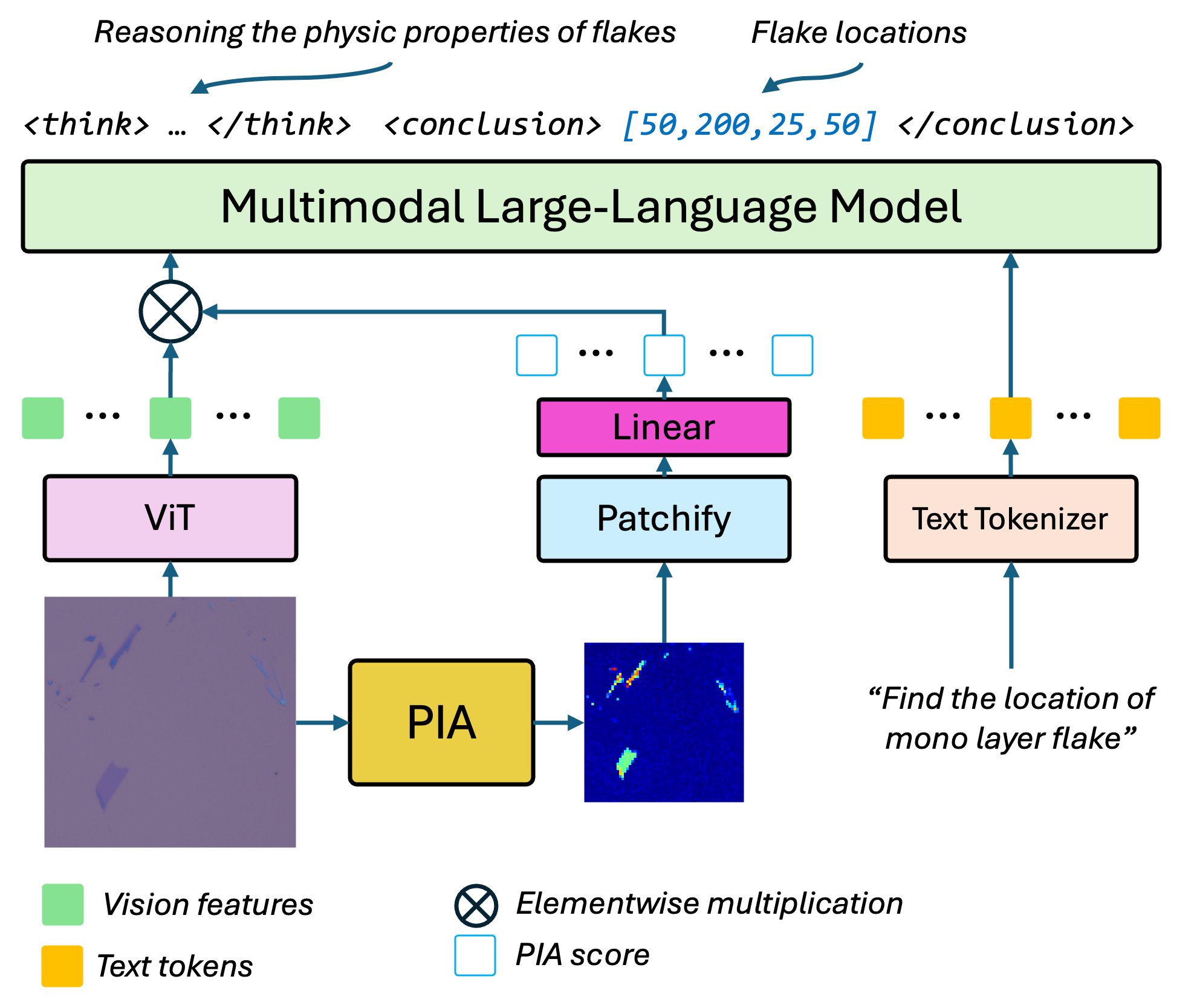
Researchers combine physics-informed AI with multimodal learning to accelerate the discovery of novel quantum materials with enhanced flake characterization.
Characterizing two-dimensional quantum materials from optical microscopy remains challenging due to subtle contrast and limited labeled data. This work, ‘QuPAINT: Physics-Aware Instruction Tuning Approach to Quantum Material Discovery’, introduces a novel framework leveraging physics-based simulation, a large-scale instruction dataset (QMat-Instruct), and a physics-aware multimodal model to significantly improve the accuracy of flake characterization. By incorporating optical priors via a Physics-Informed Attention module, QuPAINT enables more robust representations and establishes a standardized benchmark (QF-Bench) for reproducible evaluation. Will this physics-informed approach unlock a new era of reliable and efficient quantum material discovery?
Unveiling the Hidden Order of Quantum Materials
Quantum materials represent a potentially revolutionary frontier in technological advancement, offering possibilities ranging from superconductivity at room temperature to entirely new forms of computing. However, realizing this promise is significantly hampered by the extreme sensitivity of their properties to even the most minute structural imperfections. These materials don’t fail in a dramatic fashion; rather, their extraordinary characteristics – the very traits scientists seek to harness – can be extinguished by subtle variations in atomic arrangement, stacking order, or chemical composition. Identifying and controlling these imperfections presents a formidable challenge, requiring characterization techniques capable of detecting deviations at the nanoscale – variations often far below the resolution of conventional imaging methods. Consequently, a material that appears structurally perfect to the naked eye, or even under a standard microscope, may exhibit dramatically different behavior than predicted, hindering both fundamental understanding and applied innovation.
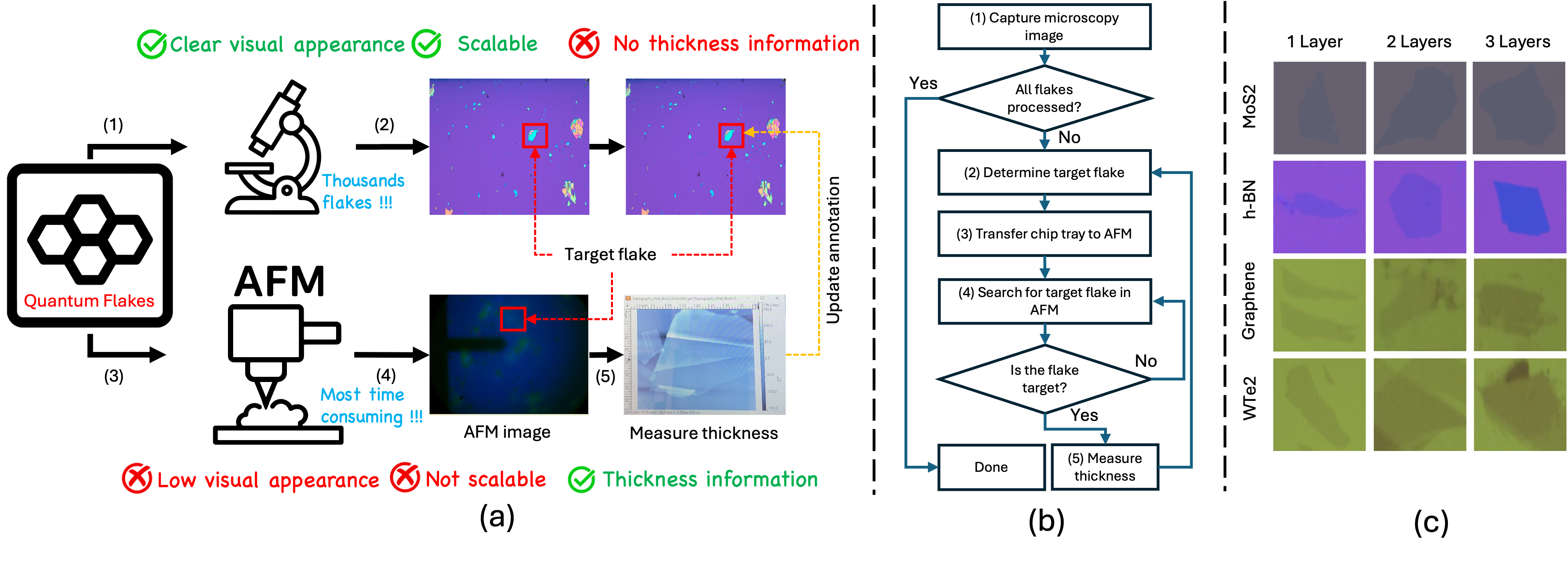
The quest to identify and categorize quantum materials is frequently hampered by the limitations of conventional analytical techniques. Relying solely on visual inspection or basic microscopy often proves insufficient, as subtle structural nuances – atomic layering, strain, or the presence of defects – drastically influence a material’s quantum properties yet remain invisible to the naked eye. This creates a significant bottleneck in materials discovery, where promising candidates may be overlooked due to inaccurate or incomplete characterization. Researchers find that materials appearing similar under standard observation can exhibit wildly different behaviors, necessitating more sophisticated methods capable of discerning these hidden details and unlocking the potential of these complex systems. Consequently, advancements in automated, high-resolution imaging and data analysis are crucial to efficiently navigate the vast landscape of quantum materials and accelerate the development of next-generation technologies.
The properties of quantum materials are intrinsically linked to their physical form, demanding precise characterization of individual flakes at the microscale. Subtle variations in size, shape, and crystallographic orientation dramatically influence electronic behavior, impacting everything from superconductivity to magnetism. A flake’s dimensions dictate quantum confinement effects, while its shape affects edge states and overall conductivity. Furthermore, the alignment of the crystal lattice – its orientation – determines how electrons move through the material and interact with external stimuli. Consequently, researchers are increasingly focused on developing advanced imaging and analytical techniques capable of reliably quantifying these parameters, as a comprehensive understanding of flake morphology is no longer merely descriptive but fundamentally essential for both material identification and the prediction of its quantum properties.
Characterizing quantum materials demands imaging and analytical techniques extending far beyond conventional microscopy. Researchers now employ a suite of tools, including atomic force microscopy to map surface topography with nanometer precision, and Raman spectroscopy to identify vibrational modes revealing material composition and strain. Crucially, these datasets aren’t simply observed; advanced algorithms are applied to quantify flake size, shape, and crystalline orientation – parameters demonstrably linked to emergent quantum phenomena. Techniques like polarized optical microscopy further distinguish subtle structural differences, while machine learning models are increasingly utilized to automate the analysis of complex datasets and predict material properties based on visual features, effectively accelerating the discovery of novel quantum materials with tailored functionalities.
Decoding Color: Optical Insights into Quantum Material Structure
Optical microscopy serves as a foundational characterization technique for quantum material flakes due to its capacity for high-resolution structural visualization. This technique utilizes visible light and a series of lenses to magnify the flake’s physical dimensions, revealing features on the scale of micrometers and, with advanced implementations, even nanometers. The resulting images allow for the determination of flake thickness, lateral dimensions, and the identification of defects or variations in material composition. Crucially, the non-destructive nature of optical microscopy enables repeated observations of the same flake under varying conditions, facilitating comprehensive material analysis and correlation with other characterization data.
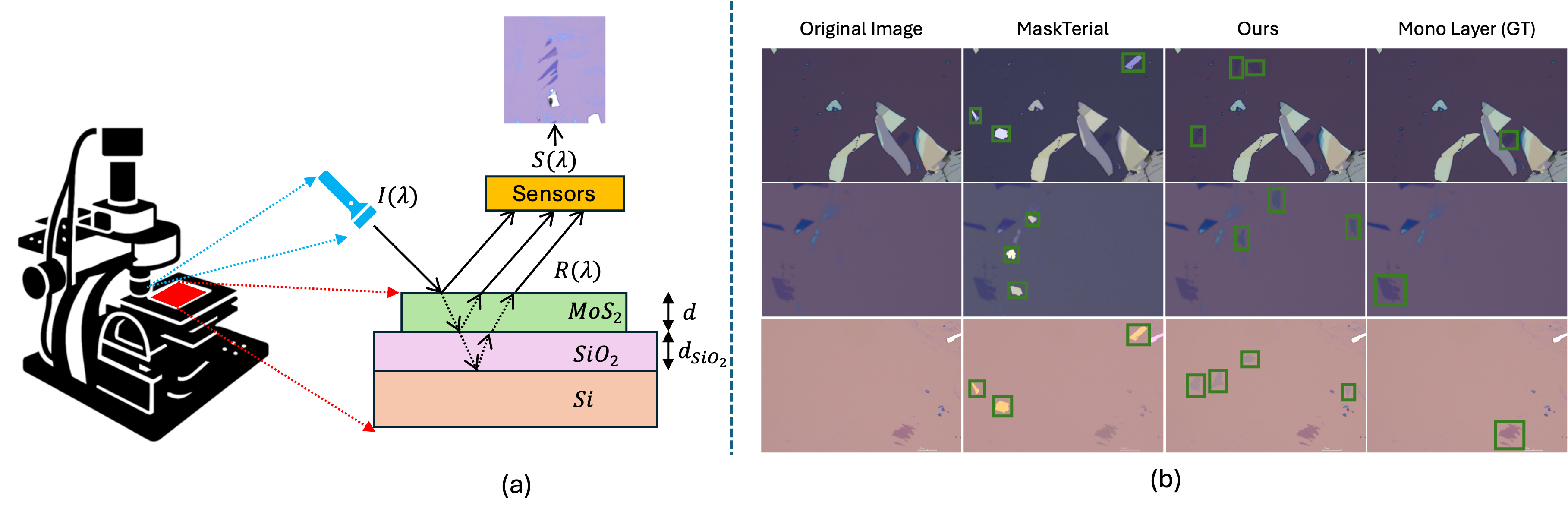
The vibrant colors observed in quantum material flakes are a direct result of thin-film interference. When light interacts with the flake, reflections occur at both the air-flake interface and within the material’s layered structure. These reflected waves interfere with each other; constructive interference, where waves are in phase, amplifies specific wavelengths, while destructive interference cancels others. The resulting wavelengths that are constructively interfered with are perceived as color. The thickness of each layer within the flake determines which wavelengths interfere constructively, and thus, the observed color is highly sensitive to layer thickness variations. This phenomenon allows for non-destructive optical characterization of flake thickness and uniformity.
Accurate interpretation of optical microscopy images of quantum material flakes necessitates a thorough understanding of thin-film interference. This phenomenon occurs because light reflects from both the top and bottom surfaces of the flake, and these reflected waves interfere with each other. The resulting interference – constructive or destructive – is highly dependent on the wavelength of light, the thickness of the flake, and the refractive index of the material. Consequently, the observed color in the image is not solely indicative of the material’s inherent properties, but rather a product of these interference effects. Quantitative analysis, such as determining flake thickness or refractive index, requires modeling and accounting for this interference to deconvolve the actual material properties from the observed optical data. Failure to do so can lead to significant errors in material characterization.
Characterization of quantum material flakes via optical microscopy benefits from quantitative color analysis through the CIELAB color space. This system defines color as three perpendicular components: L for lightness, a for green-red component, and b for blue-yellow component, providing a perceptually uniform representation. Utilizing CIELAB, rather than RGB or other color spaces, minimizes the impact of variations in lighting and camera characteristics, yielding more reproducible and comparable measurements of flake thickness and composition. The resulting L</i>a<i>b</i> values allow for precise numerical comparison of color variations across different flakes or regions within a single flake, improving the reliability of data used in materials analysis and device fabrication.
Constructing Reality: Synthetic Data for Materials Discovery
The performance of machine learning models is directly correlated with the quantity and quality of training data; however, acquiring sufficiently large, accurately labeled datasets can be prohibitively expensive and time-consuming, particularly in specialized fields like materials science. Synthetic data generation addresses this limitation by creating datasets independent of physical experimentation. This approach is especially crucial when labeled data is scarce, as models trained on limited real-world examples often exhibit poor generalization to unseen data. By generating realistic, labeled synthetic data, researchers can augment existing datasets or create entirely new training sets, enabling the development of more robust and reliable machine learning models without the constraints of extensive physical data acquisition.
Synthia utilizes the Transfer Matrix Method (TMM), a computational technique for modeling the propagation of light through multilayer thin films, to generate synthetic data. TMM calculates the reflection and transmission coefficients of light at each interface within the film stack, accounting for the refractive index and thickness of each layer. By varying these parameters, Synthia can simulate a wide range of optical responses, creating realistic flake images that accurately represent the interference patterns arising from thin film constructs. The method’s reliance on electromagnetic wave theory ensures the generated data adheres to established physical principles, allowing for the creation of physically plausible training datasets.
The QMat-Instruct dataset comprises a large volume of synthetic images generated to facilitate machine learning model training. This dataset distinguishes itself through the inclusion of precise, verified ground truth labels for each generated image, eliminating the ambiguity and error inherent in manually labeled datasets. The scale of QMat-Instruct is designed to support the development of robust models capable of generalization, addressing limitations imposed by the typically restricted size of experimentally acquired, labeled datasets in materials science. The dataset’s construction prioritizes data quantity and label accuracy, allowing for supervised and self-supervised learning paradigms focused on materials characterization tasks.
Traditional materials characterization relies on experimentally acquired data paired with often manually-derived labels, creating a substantial bottleneck due to the time and resources required for both processes. Separating data acquisition from labeling, as achieved through synthetic data generation, allows for the creation of datasets at scale without the limitations of physical sample preparation and measurement. This decoupling enables the rapid generation of large, labeled datasets – such as QMat-Instruct – facilitating more efficient training of machine learning models and accelerating materials discovery research by removing the dependency on synchronized, labeled experimental data.
The Rise of Intelligent Analysis: Foundation Models for Quantum Materials
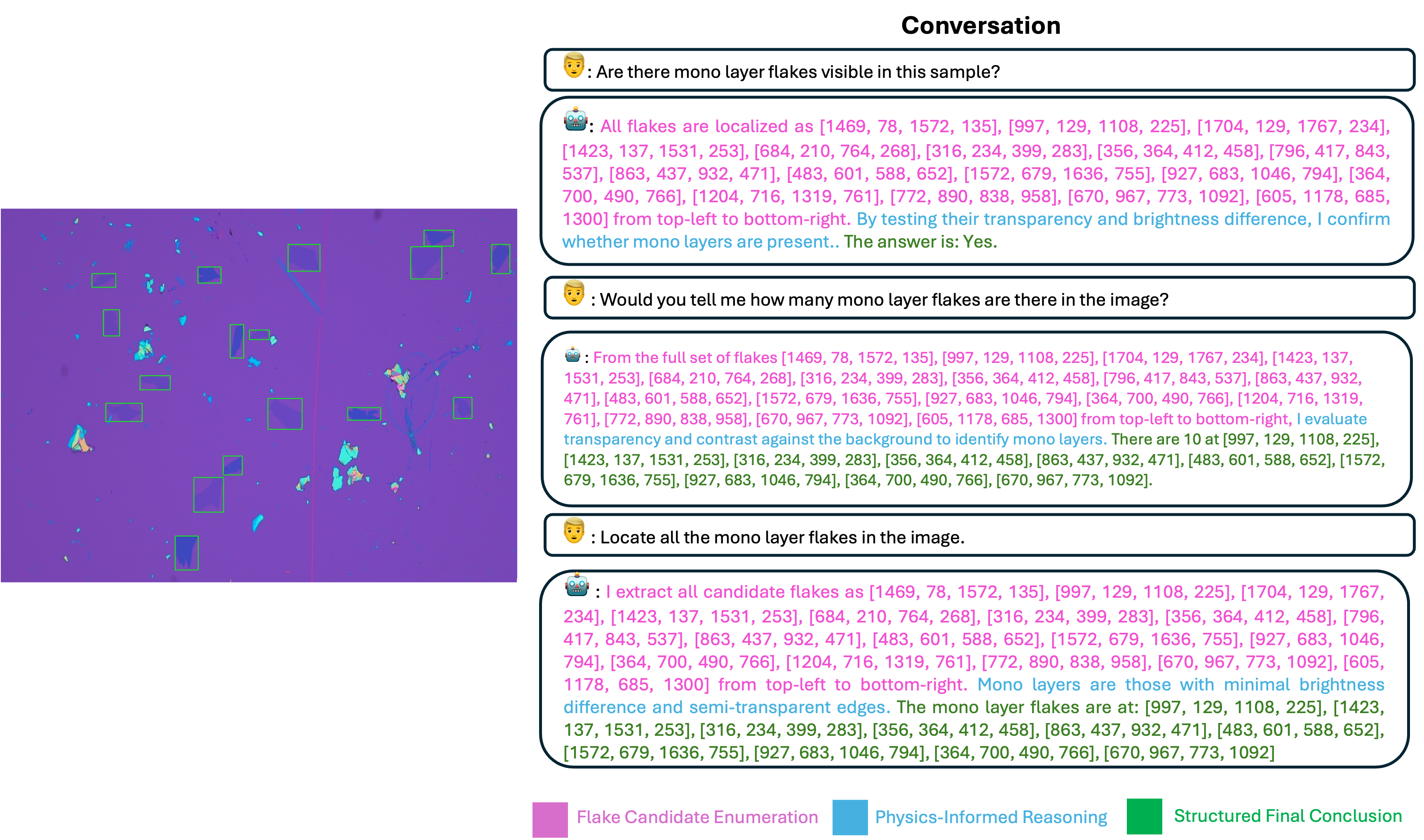
The advent of Multimodal Large Language Models (MLLMs), leveraging the capabilities of Foundation Models, is revolutionizing image-based analysis by providing a unified framework for understanding visual data. These models transcend traditional computer vision techniques by not simply detecting objects within an image, but by integrating visual information with broader contextual knowledge. This allows for a more nuanced interpretation of complex images, enabling the extraction of meaningful insights that were previously inaccessible. By pre-training on vast datasets of both images and text, MLLMs develop a rich understanding of visual concepts and their relationships, empowering them to perform tasks like object identification, segmentation, and classification with remarkable accuracy and efficiency. The power of this approach extends beyond simple identification, facilitating detailed analysis and the uncovering of subtle patterns within complex visual scenes.
Quantum material flake analysis, traditionally a time-consuming manual process, benefits significantly from the application of trainable models capable of discerning subtle visual cues. These models learn to identify flakes – thin, layered materials with unique quantum properties – by analyzing images for characteristics like shape, size, contrast, and edge definition. Through techniques like supervised learning, the models are presented with labeled examples of different flake types, enabling them to generalize and accurately segment and classify previously unseen samples. This automated approach not only accelerates the discovery of high-quality flakes for research and development but also reduces subjectivity, leading to more consistent and reliable results in materials science investigations.
Robust automated analysis of quantum material flakes relies on established computer vision techniques, notably Mask R-CNN, UNet, and YOLO. Mask R-CNN excels at instance segmentation, precisely outlining each individual flake within an image, while UNet, an encoder-decoder network, specializes in pixel-wise classification, effectively differentiating flakes from the background. YOLO, or You Only Look Once, provides a computationally efficient approach to object detection, swiftly identifying the presence and location of flakes. These architectures, each with unique strengths, serve as the core components for building accurate and efficient flake analysis pipelines, enabling researchers to automatically identify, segment, and characterize these crucial materials with greater speed and precision.
A newly developed automated analysis pipeline, termed QuPAINT, demonstrates remarkable proficiency in identifying and classifying quantum material flakes, achieving state-of-the-art results on the challenging QF-Bench dataset. Specifically, QuPAINT attains 60.5% accuracy in general flake detection and a noteworthy 52.8% accuracy in pinpointing single-layer flakes-a substantial advancement over existing methodologies. Utilizing the QuPAINT-8B model, the system achieves an Average Precision (AP) of 60.5% and an AP75 score of 45.6% for general flake detection, highlighting its ability to not only locate flakes but also to maintain precision even with stricter evaluation criteria. These results signify a considerable leap forward in automated materials analysis, promising to accelerate research and development in quantum materials science by enabling rapid and reliable flake characterization.

The pursuit of accurate flake characterization, as detailed in this work, necessitates a departure from purely data-driven approaches. Each image presented to the model inherently contains structural dependencies relating to the underlying quantum material, dependencies that must be uncovered through careful analysis. As Yann LeCun aptly stated, “Everything we’re doing in AI today is just sophisticated pattern recognition.” This research exemplifies that principle; however, it goes further by integrating physics-based simulations to guide the pattern recognition process. By grounding the model in established physical laws, the framework enhances its ability to generalize and reliably predict material properties, moving beyond superficial correlations to a more robust understanding of the system.
What Lies Ahead?
The pursuit of novel quantum materials, as demonstrated by this work, inevitably circles back to the fundamental challenge of bridging simulation and experiment. The generation of synthetic data, while effective in bolstering training sets, begs the question of how faithfully these simulations capture the inherent messiness of real-world flake characterization. A natural progression lies in developing methods to quantify the discrepancy between simulated and experimental data-not merely to minimize it, but to understand what the difference reveals about the limitations of both approaches. Is the divergence simply noise, or does it hint at previously unconsidered physics?
Furthermore, the current framework, while demonstrating success in flake characterization, remains largely confined to that specific domain. The true test of a physics-aware AI lies in its adaptability. Can the principles embodied in QuPAINT-the fusion of simulation, instruction tuning, and multimodal learning-be extended to other areas of materials discovery, or even to entirely different scientific disciplines? The apparent elegance of the approach suggests potential, but the devil, as always, resides in the details of generalization.
Ultimately, this work underscores a subtle irony. In attempting to automate the discovery process, it inadvertently highlights the enduring importance of human intuition. The creation of the instruction dataset, the interpretation of results, and the formulation of new hypotheses still require a discerning eye-a reminder that AI, at its best, is a tool for amplifying, not replacing, human intellect.
Original article: https://arxiv.org/pdf/2602.17478.pdf
Contact the author: https://www.linkedin.com/in/avetisyan/
See also:
- What Song Is In The New Supergirl Trailer (& What It Means For The DC Movie)
- Gold Rate Forecast
- Eurogamer Gives ARC Raiders 2/5 Over AI Voices, Dropping Metacritic Score from 94 to 84
- One of Hulu’s Best New Shows Lands on Disney+ Ahead of Season 2
- Meet the Real-Life Inspiration For Sex and The City’s Mr. Big
- Task & Mare Of Easttown’s Crime Thriller Universe: Revolutionizing the Genre
- Symmetry Unlocked: Quantum Computing Tackles Particle Physics
- Disney Has Only Launched 10 New Franchises in the 21st Century
- Guardians of the Globe Members We Want to See in Invincible Season 4
- Beyond Space and Time: Reconciling Relativity with Quantum Interference
2026-02-20 19:59