Author: Denis Avetisyan
A new framework leverages the principles of information theory to efficiently navigate complex materials spaces and accelerate the discovery of optimal compounds.

This review details an information-theoretic approach to multi-model fusion for target-oriented adaptive sampling in materials design, improving efficiency in high-dimensional, data-scarce environments.
Efficient exploration of high-dimensional materials design spaces is hampered by the costly nature of both experiment and high-fidelity simulation. This challenge is addressed in ‘Information-Theoretic Multi-Model Fusion for Target-Oriented Adaptive Sampling in Materials Design’, which introduces a novel framework that reframes optimization as trajectory discovery by concentrating search on target-relevant regions through information-theoretic principles. The approach leverages dimension-aware information budgeting and multi-model fusion to improve sample efficiency across diverse materials design tasks-reaching top-performing regions with as few as 100 evaluations-and demonstrates robustness even in rugged, multimodal landscapes. Could this adaptive sampling strategy unlock accelerated materials discovery across a wider range of complex design challenges?
The Exponential Barrier to Materials Innovation
The search for novel materials is increasingly hampered by a fundamental challenge: the rapid expansion of possible compositional and structural combinations. As researchers attempt to tailor materials with ever-finer precision – adjusting elements, atomic arrangements, and processing conditions – the design space grows not linearly, but exponentially. This phenomenon, often referred to as the ‘curse of dimensionality’, means that the volume of the search space increases so rapidly with each added variable that traditional materials discovery methods become impractical. Effectively, the number of materials to screen quickly exceeds available computational resources and experimental throughput, creating a critical bottleneck in the innovation process and necessitating the development of strategies to intelligently navigate these complex landscapes.
The search for novel materials is increasingly hampered by the sheer scale of possible compositions and structures, creating what is known as a high-dimensional search space. Conventional optimization techniques, while effective in simpler scenarios, falter when confronted with this complexity. These methods typically require an exponentially increasing amount of data – and consequently, computational power – to achieve reliable results as the number of variables grows. This demand for ‘impractically large datasets’ stems from the need to adequately sample the vast landscape of possibilities, ensuring that promising candidates aren’t overlooked due to insufficient exploration. The problem isn’t simply one of needing faster computers; it’s that the data requirements quickly outpace even the most advanced capabilities, effectively stalling materials discovery efforts.
Addressing the challenge of materials discovery in vast chemical spaces requires strategies that move beyond traditional optimization techniques. This framework introduces a novel approach to dimensionality reduction, enabling efficient exploration of complex material compositions and structures. By effectively lowering the ‘effective’ dimensionality-the number of variables critically influencing material properties-the system can successfully identify optimal candidates even within spaces possessing an intrinsic dimensionality exceeding 800 dimensions. This capability bypasses the limitations of conventional methods, which struggle with the exponentially growing computational demands of high-dimensional searches, and unlocks the potential for discovering materials with tailored properties from previously intractable design landscapes.
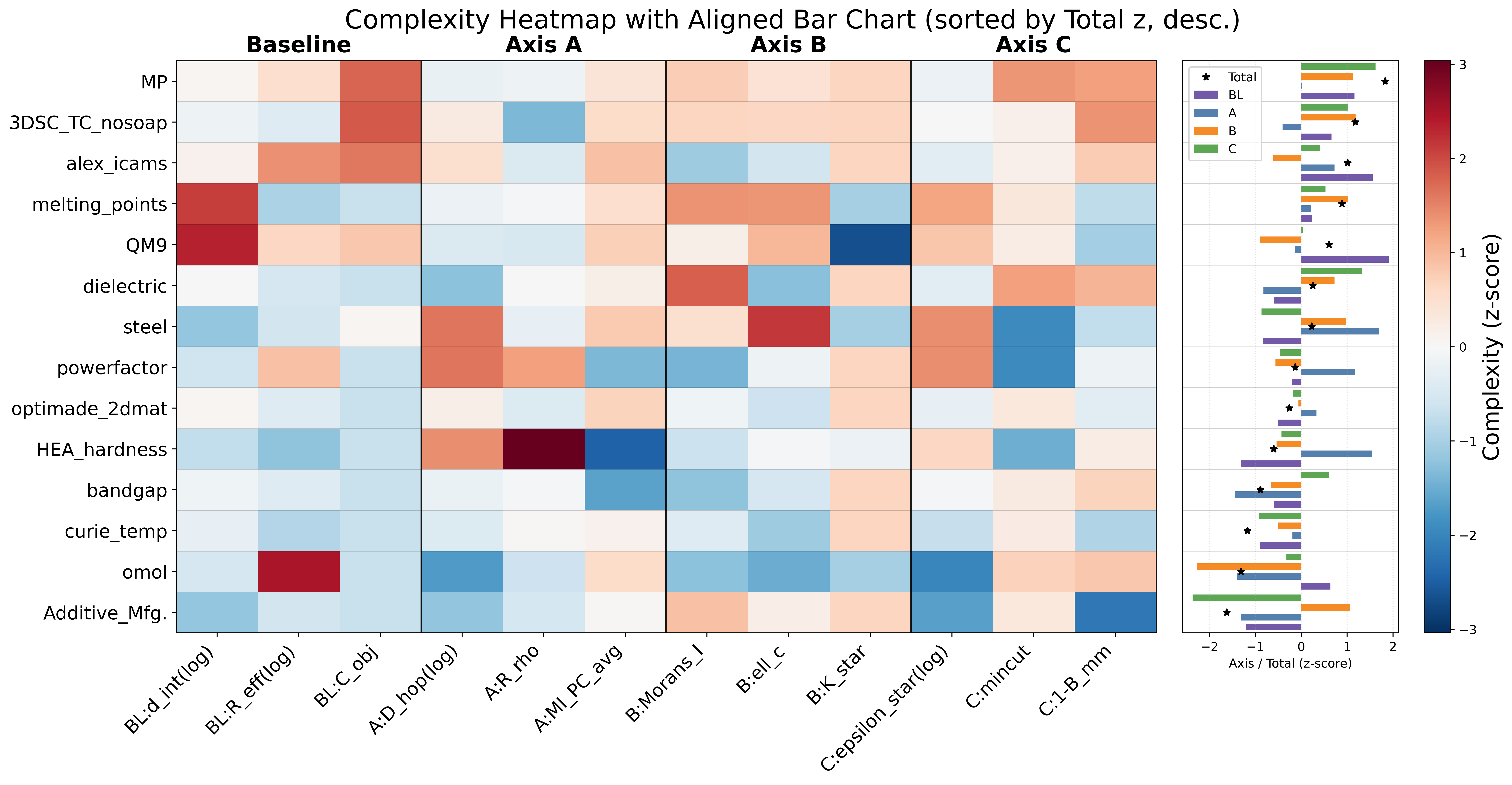
Unveiling the Intrinsic Manifold of Material Properties
Manifold learning techniques are employed to determine the intrinsic dimensionality of materials data, a value representing the minimal number of parameters needed to accurately describe the system. Analysis reveals that despite the potentially high number of compositional or structural variables defining a material, high-performing materials often reside on lower-dimensional manifolds within the full parameter space. This indicates significant redundancy in the descriptor space; a complex material can frequently be adequately characterized by a substantially smaller set of effective parameters than initially anticipated. Determining this intrinsic dimensionality is crucial, as it allows for focused exploration of relevant material compositions and structures, bypassing exhaustive searches across the entire descriptor space.
The identification of lower-dimensional candidate manifolds significantly streamlines materials optimization processes by reducing the computational burden associated with high-dimensional search spaces. Traditional optimization methods often require evaluating numerous combinations of parameters, becoming computationally intractable as the number of parameters increases. By constraining the search to these identified manifolds, which represent the space of likely high-performing materials, the number of necessary evaluations is drastically reduced. This dimensionality reduction enables efficient exploration of the materials space, allowing for the identification of optimal compositions and structures with significantly less computational cost and time.
The efficacy of this materials discovery framework rests on the principle that materials exhibiting desirable properties are not dispersed randomly within the full compositional space. Instead, these high-performing materials are concentrated within lower-dimensional manifolds embedded in the higher-dimensional feature space. This non-random distribution allows for focused exploration of only the relevant compositional subspace, significantly reducing computational cost. Validation of this approach has been performed across materials datasets varying in size from 600 to 4,000,000 samples, demonstrating consistent identification of these manifolds and subsequent improvements in materials optimization.
Bayesian Optimization: A Principled Approach to Materials Design
Bayesian Optimization is a sequential design strategy effective for optimizing functions that are expensive to evaluate or lack analytical forms, common characteristics of materials discovery processes. Unlike traditional optimization techniques requiring numerous function evaluations, Bayesian Optimization efficiently explores the search space by balancing exploration and exploitation, particularly when labeled data is limited – a condition known as data scarcity. This is achieved by constructing a probabilistic surrogate model – typically a Gaussian Process – to approximate the unknown objective function and an acquisition function to determine the next point to evaluate, thereby minimizing the number of experiments needed to identify optimal material compositions or processing conditions. The method’s efficiency stems from its ability to intelligently sample regions of the parameter space that offer the greatest potential for improvement or reduction of uncertainty, even with limited prior information.
Surrogate modeling is a core component of Bayesian optimization, employed to construct an approximation of the objective function – in this context, the relationship between material composition and properties. Due to the computational expense or time required to directly evaluate material properties through simulations or experiments, a surrogate model provides a computationally efficient substitute. \hat{y} = f(\mathbf{x}), where \mathbf{x} represents the input material composition and \hat{y} is the predicted material property. Gaussian Processes (GPs) are frequently used as surrogate models due to their ability to quantify uncertainty; GPs provide not only a prediction but also a variance associated with that prediction, which is crucial for guiding the exploration process. This allows Bayesian optimization to balance exploration of uncertain regions with exploitation of promising ones, ultimately minimizing the number of costly evaluations needed to locate optimal materials.
The exploration strategy within our Bayesian optimization framework is guided by principles of information theory, specifically prioritizing regions of the material space exhibiting the highest uncertainty. This is achieved by quantifying the expected improvement or probability of improvement, directing evaluations towards areas where reducing uncertainty will yield the greatest potential benefit in identifying optimal materials. Across fourteen benchmark datasets, this approach consistently achieved a 100% success rate in locating optimal or near-optimal solutions in thirteen cases, demonstrating its efficacy in efficient material discovery and optimization.
Ensemble Modeling and Adaptive Exploration: Amplifying Discovery Efficiency
Ensemble modeling represents a significant advancement over relying on single surrogate models for predicting material properties. Rather than accepting a single estimate, this technique leverages the combined wisdom of multiple predictive models – each potentially trained on different subsets of data or utilizing varied algorithms. By aggregating these individual predictions, often through methods like averaging or weighted combinations, the resulting estimate exhibits markedly improved robustness and accuracy. This approach effectively mitigates the risk of over-reliance on any single model’s biases or limitations, leading to more reliable assessments of material characteristics and a greater confidence in subsequent optimization processes. The resulting predictions are less sensitive to noise and better generalize to unseen data, offering a more stable foundation for materials discovery.
Optimization processes often struggle with efficiently navigating complex design spaces, particularly when faced with limited evaluations of material properties. To address this, the integration of Kalman Filter and Reverse Kalman Filter techniques offers a powerful approach to adaptive exploration. The Kalman Filter refines predictions of material performance by weighting observations against prior knowledge, effectively reducing uncertainty in well-explored regions. Crucially, the Reverse Kalman Filter operates conversely, identifying areas where predictions are most uncertain and strategically directing the optimization loop towards these promising, yet unexplored, zones. This dynamic interplay between prediction refinement and targeted exploration significantly amplifies the efficiency of the search, allowing for robust identification of optimal materials even with a constrained evaluation budget and fostering a more intelligent and adaptive optimization strategy.
Efficient exploration of the material landscape relies on algorithms capable of intelligently proposing and assessing candidate compositions. Differential Evolution and Sobol Sequence methods prove particularly effective at navigating the defined ‘Candidate Manifold’, allowing for rapid identification of optimal materials. Studies demonstrate a consistent ability to achieve successful optimization within a remarkably limited computational budget of 500 evaluations; furthermore, the median number of iterations required to reach a successful outcome remains impressively low, consistently below 50 across diverse datasets. This efficiency stems from the algorithms’ ability to balance exploration of uncertain regions with exploitation of promising areas, minimizing wasted evaluations and accelerating the discovery process.
The pursuit of efficient materials design, as detailed in this work, resonates with a fundamental principle of computational elegance. Tim Berners-Lee aptly stated, “Data is just stuff. Information is stuff with meaning.” This framework meticulously aligns data, models, and physical constraints, extracting meaningful information from high-dimensional spaces. The information-theoretic approach doesn’t merely seek a ‘working’ solution; it strives for provable optimization by minimizing uncertainty – a pursuit of correctness over convenience. This dedication to reducing uncertainty, even in data-scarce scenarios, exemplifies a mathematical purity akin to a provable algorithm, pushing beyond heuristic compromises.
What Lies Ahead?
The presented work, while a step toward principled materials design, merely illuminates the depth of challenges remaining. The pursuit of efficient exploration, framed through information theory, highlights a perennial truth: optimization without rigorous analysis is self-deception. Reducing uncertainty is not an end, but a prelude to confronting the inevitable approximations inherent in surrogate modeling. The fidelity of these models, and their ability to extrapolate beyond the training data, remains a critical, often overlooked, vulnerability.
Future research must address the limitations of current dimensionality reduction techniques. The elegant compression of high-dimensional spaces cannot entirely erase the loss of information, and the subsequent impact on the optimization landscape. Furthermore, a deeper investigation into the interplay between the information-theoretic acquisition function and the constraints imposed by physical realism is essential. A purely mathematical elegance, divorced from the realities of materials synthesis and characterization, will yield only theoretical optima, not practical materials.
Ultimately, the true test lies not in achieving faster convergence on known optima, but in the ability to discover genuinely novel materials with desired properties. This necessitates a shift from purely exploitative strategies to a more robust exploration of the vast, uncharted space of material possibilities. A provably correct algorithm for materials discovery remains, predictably, a distant, yet compelling, horizon.
Original article: https://arxiv.org/pdf/2602.03319.pdf
Contact the author: https://www.linkedin.com/in/avetisyan/
See also:
- The Super Mario Galaxy Movie: 50 Easter Eggs, References & Major Cameos Explained
- All 13 Smash Bros. Characters in the Super Mario Galaxy Movie
- Sydney Sweeney’s The Housemaid 2 Sets Streaming Release Date
- Why is Tech Jacket gender-swapped in Invincible season 4 and who voices her?
- TV legend Carol Kirkwood reveals the reasons why she decided to retire after 28 years with BBC
- Highly Anticipated Strategy RPG Finally Sets Release Date (And It’s Soon)
- Welcome to Demon School! Iruma-kun season 4 release schedule: When are new episodes on Crunchyroll?
- Dune 3 Gets the Huge Update Fans Have Been Waiting For
- Sesame Street Slams “Disgusting” Posts on Elmo’s Account After Hack
- Gold’s March Madness: Plumbing, Panic, and Polish Central Banks
2026-02-05 02:52