Author: Denis Avetisyan
New research explores the subtle interactions between hyperons and nucleons, shedding light on the strong force in exotic nuclear systems.
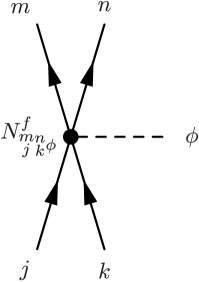
This study derives the ΞNN three-baryon force within SU(3) chiral effective field theory and assesses its impact on femtoscopic observables.
Understanding the strong nuclear force requires accurate modeling of three-baryon interactions, yet calculations of the ΞNN force-a crucial component in hypernuclear physics and dense matter-have remained largely unexplored. This work, titled ‘$ΞNN$ three-baryon force from SU(3) chiral effective field theory: A femtoscopic study’, derives the ΞNN interaction using SU(3) chiral effective field theory and investigates its impact on the correlation function of a deuteron-Ξ^- pair. The analysis reveals a limited effect-at most 4%-on this correlation function, stemming from the predominantly low-momentum, peripheral nature of the interaction. Given this limited sensitivity, what complementary experimental or theoretical approaches might be necessary to fully constrain the ΞNN three-body force?
The Fragile Symmetry: Unveiling the ΞNN Interaction
The exploration of the three-baryon force involving a hyperon – specifically the ΞNN 3BF – represents a critical frontier in nuclear physics, poised to connect established understandings of nucleon-nucleon interactions with the more enigmatic realm of exotic hadronic systems. Hypernuclei, nuclei where one or more nucleons are replaced by hyperons, offer a unique testing ground for strong interaction models beyond the well-studied nuclear landscape. Accurately characterizing the ΞNN 3BF is essential because it dictates how hyperons bind within nuclear matter, influencing the structure, stability, and decay properties of hypernuclei. This understanding isn’t merely an extension of conventional nuclear physics; it promises insights into the underlying quark structure of hadrons and the behavior of matter under extreme conditions, potentially illuminating the properties of neutron stars and other dense astrophysical objects. The ΞNN 3BF, therefore, serves as a vital link, bridging the familiar world of protons and neutrons with the less-charted territory of exotic hadronic matter.
Conventional many-body calculations, while successful in describing ordinary nuclei, encounter significant hurdles when applied to the ΞNN three-baryon force. The primary difficulty lies in the sheer complexity arising from the strong, short-range interactions between the hyperon and the nucleons, coupled with the need to accurately represent long-range contributions from meson exchange. Each interaction necessitates the introduction of numerous adjustable parameters-form factors, cutoff radii, and coupling constants-which must be carefully tuned to experimental data or other theoretical constraints. However, the limited availability of experimental data concerning Ξ-nuclear systems introduces substantial ambiguity, leading to a parameter space so vast that obtaining unique and reliable predictions becomes exceptionally challenging. This sensitivity to parameter choices introduces systematic uncertainties that can overshadow the physical insights derived from the calculations, hindering a comprehensive understanding of hypernuclear behavior.
A comprehensive understanding of the ΞNN three-baryon force necessitates a theoretical framework adept at simultaneously resolving both short-range and long-range interactions. The incredibly brief timescales governing interactions within the femtoscale realm demand models capable of accurately depicting strong force dynamics at distances comparable to the nucleon size. However, the Ξ hyperon also introduces longer-range contributions stemming from its strangeness, influencing the overall potential and necessitating the inclusion of effective field theories or sophisticated many-body techniques. Successful modeling must account for the delicate balance between these competing effects; ignoring either regime risks inaccurate predictions of hypernuclear binding energies and decay modes, hindering progress in understanding the equation of state of dense hadronic matter and the behavior of exotic systems found in astrophysical environments like neutron stars.
Symmetry as a Guiding Hand: The Chiral EFT Approach
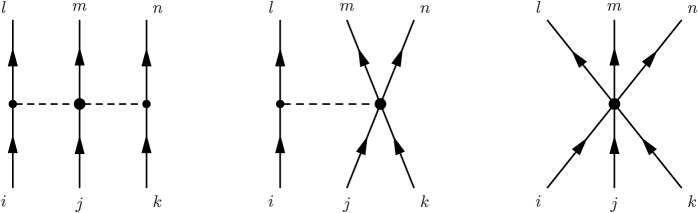
SU3 Chiral Effective Field Theory (Chiral EFT) offers a systematic method for calculating the ΞNN three-body force (3BF) by leveraging the symmetries inherent in Quantum Chromodynamics (QCD). This approach begins with the most general Lagrangian consistent with the symmetries of QCD, including chiral symmetry, and then expands it in terms of a momentum expansion. This expansion organizes calculations by the order of the momentum transfer, allowing for a controlled approximation scheme and the systematic improvement of results. By focusing on symmetry constraints, Chiral EFT reduces the number of free parameters needed to describe the strong interaction, making the calculation of the ΞNN 3BF a tractable problem. The resulting 3BF is then expressed as a series of operators with coefficients determined by low-energy constants, which can be fitted to experimental data or estimated from other theoretical constraints.
The application of approximate SU3 symmetry within Chiral Effective Field Theory (Chiral EFT) significantly simplifies calculations of the ΞNN three-body force (3BF) by leveraging relationships between particles in SU3 multiplets. This symmetry reduces the number of independent parameters needed to describe the strong interaction, as parameters associated with different members of the same multiplet are related. Without exploiting this symmetry, a complete calculation would require a significantly larger number of free parameters, rendering the problem computationally intractable. Specifically, the SU3 symmetry allows for the mapping of interactions between different baryon combinations, reducing the number of low-energy constants (LECs) that must be determined from experimental data or lattice QCD calculations, and thereby improving the predictive power of the EFT.
The SU3 Chiral Effective Field Theory utilizes a power counting scheme to systematically organize calculations based on the magnitude of momentum transfer, denoted as Q. This scheme assigns a natural size to each term in the expansion based on its dependence on Q, typically expressed as Q^n, where n is a non-negative integer. Terms with lower values of n are considered to be of lower order and contribute more significantly at low energies. By organizing calculations in this manner, the framework allows for controlled approximations; terms of a certain order can be systematically included or neglected, providing a means to estimate the theoretical uncertainty and improve the accuracy of the results as higher-order terms are included. This approach is crucial for managing the infinite number of terms inherent in a field theory by truncating the expansion at a chosen order.
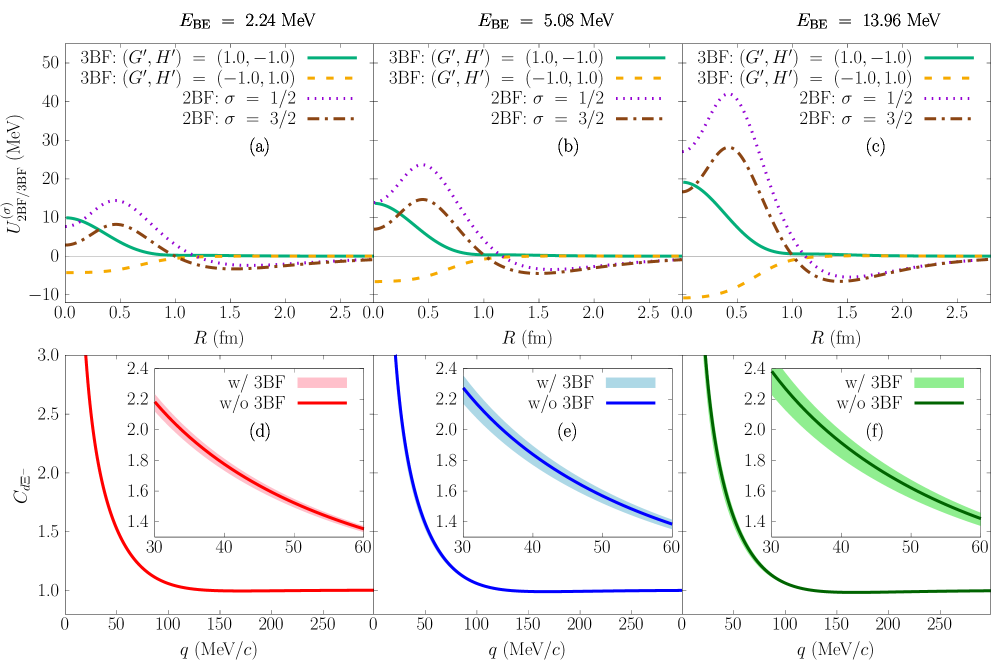
The numerical calculations for the ΞNN three-body force (3BF) were conducted with specific parameter choices within the SU3 Chiral EFT framework. Low-Energy Constants (LECs) governing the interaction were fixed at G’ = 1 and H’ = 1, values determined through fits to existing nucleon-nucleon scattering data and pion properties. A momentum cutoff of 1.0 fm was employed to regulate the high-momentum behavior of the loop integrals, ensuring the convergence and renormalizability of the chiral expansion and defining the range of validity for the calculated 3BF. These settings define a specific realization of the chiral EFT approach used to obtain quantitative results for the ΞNN interaction.
Dissecting the Interaction: Range and Components
The Decuplet Saturation Approximation streamlines the calculation of the ΞNN three-body force (3BF) by reducing the number of independent Low-Energy Constants (LECs) required for its determination. This reduction is achieved by leveraging the approximate decoupling of excited baryon states – specifically, higher-mass baryons belonging to the baryon decuplet – from the low-energy dynamics of the ΞNN system. Traditionally, calculations require parameterizing the influence of all possible intermediate states, leading to a large number of free LECs. The Decuplet Saturation Approximation effectively integrates the contributions from these excited states into a simplified framework, thereby decreasing the number of parameters that need to be independently determined from experimental data or theoretical constraints, and improving the computational feasibility of the 3BF calculation.
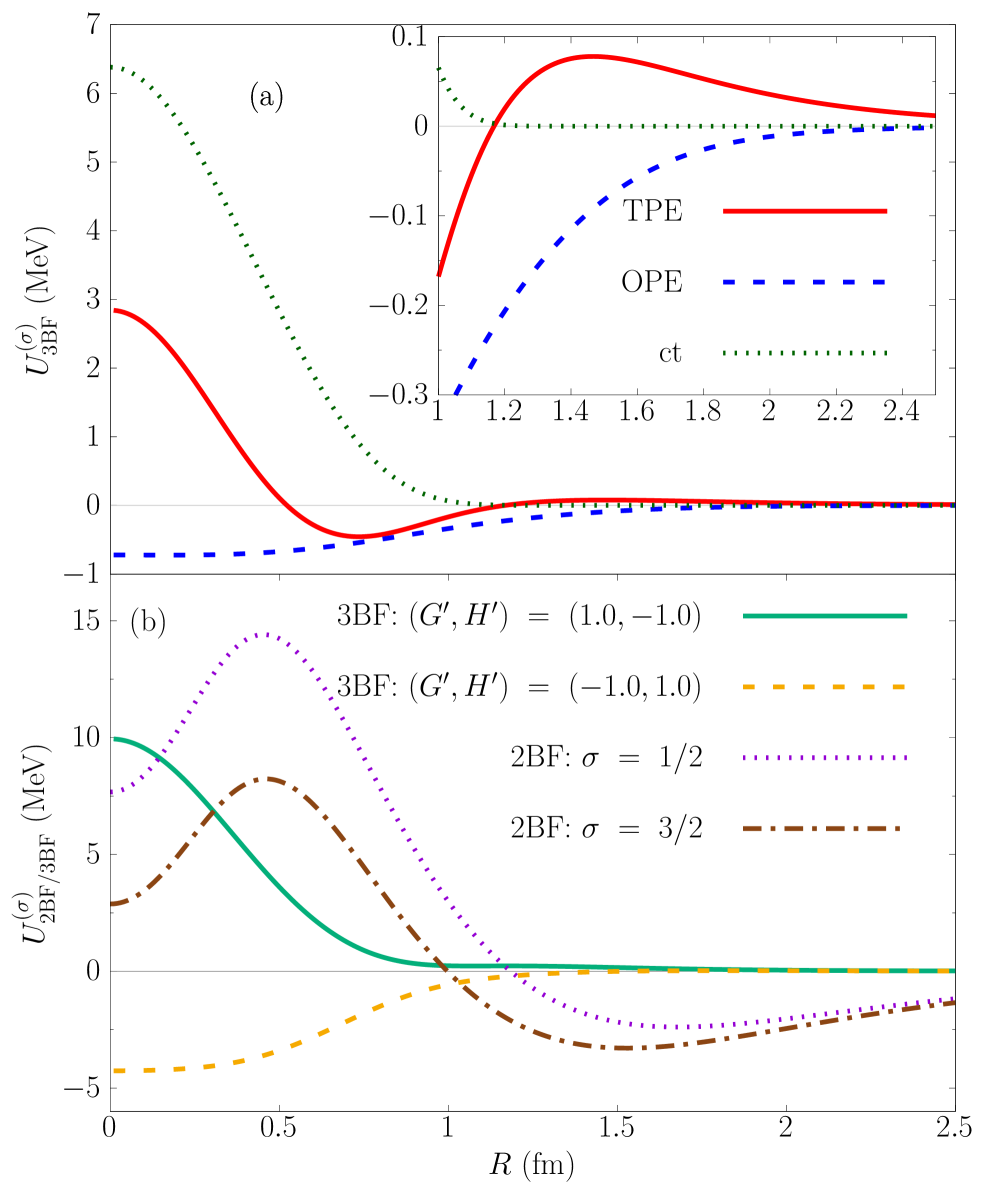
The ΞNN interaction, following the Decuplet Saturation Approximation, is structured by three primary potential components based on range. The short-range interaction is represented by the Contact Term, U_{ct}, which dominates at distances less than 1 fm. At intermediate ranges (approximately 1-3 fm), the potential U_{OPE} combines one-pion exchange with a contact term, accounting for both explicit pion exchange and short-range correlations. Finally, the long-range behavior, extending beyond 3 fm, is governed by the two-pion exchange potential, U_{TPE}, which contributes a weaker, attractive force due to the exchange of two pions between the baryons.
The ΞNN interaction potential is not monolithic; rather, it arises from the superposition of distinct contributions at different ranges. The short-range Contact Term U_{ct} dominates at inter-baryon separations below approximately 1 fm, representing the effect of unresolved, strong interactions. Between 1 and 5 fm, the one-pion exchange potential U_{OPE} combined with a contact term becomes significant, mediating interactions through the exchange of virtual pions. Finally, beyond 5 fm, the two-pion exchange potential U_{TPE} governs the long-range behavior, resulting in an attractive, albeit weaker, force. The relative strengths and range of each component directly influence the binding energy, scattering cross-sections, and overall dynamical properties of the ΞNN system.
Echoes of Interaction: Correlation and System Analysis
The correlation function serves as a vital bridge connecting the complex theoretical predictions of the ΞNN three-body force (3BF) to quantities directly measurable in experiments. This mathematical tool doesn’t simply predict a result; it details how the presence of a Ξ− baryon will statistically correlate with a deuteron, offering a precise signature for detection. By meticulously comparing this predicted correlation – a distribution revealing the probability of finding these particles at certain relative positions – with experimental data, physicists can rigorously validate or refine the ΞNN 3BF model. Essentially, the correlation function transforms abstract theoretical concepts into concrete, testable predictions, enabling a direct assessment of the force’s influence on the behavior of these exotic nuclear systems and providing critical constraints on the parameters used in the underlying calculations.
Investigation of the Deuteron-Ξ– system offers a unique pathway to characterize the underlying interaction between baryons. By meticulously analyzing the correlation-the statistical relationship-between a deuteron and a Ξ– baryon, researchers can indirectly probe the forces governing their behavior. This approach doesn’t involve directly observing the interaction itself, but rather deducing its properties from the observed spatial and momentum distributions of these particles. The strength and characteristics of the correlation function, a mathematical description of this relationship, provide valuable constraints on theoretical models aiming to describe the strong nuclear force and the complex interplay between these exotic hadrons. Essentially, the correlation acts as a fingerprint of the interaction, allowing physicists to validate and refine their understanding of the fundamental forces at play within the nucleus.
A detailed analysis of the deuteron-Ξ– system serves as a critical validation point for the ΞNN three-body force (3BF) theory. By meticulously comparing experimental data with theoretical predictions, researchers can rigorously assess the model’s accuracy and refine its parameters. This process isn’t simply about confirming a hypothesis; it establishes boundaries for the theoretical framework, defining the range of values for interaction strengths and other key variables that align with observed phenomena. Discrepancies between prediction and experiment, even seemingly minor ones, directly inform adjustments to the model, ultimately strengthening its predictive power and solidifying its foundation as a reliable description of baryon interactions. The precision gained through this correlation analysis is therefore fundamental to advancing understanding in nuclear physics.
Analysis of the deuteron-Ξ− correlation function revealed a subtle, yet measurable, impact from the ΞNN three-body force (3BF). The study determined that the inclusion of this force resulted in a maximum relative deviation of only 4% from calculations performed without it. While seemingly small, this deviation confirms the 3BF’s presence and influence on the interaction within the deuteron-Ξ− system. This limited magnitude suggests the 3BF doesn’t dramatically alter the overall correlation, but provides a crucial benchmark for refining theoretical models and understanding the nuances of hypernuclear interactions, demonstrating the sensitivity of the correlation function to these subtle effects.

The study meticulously constructs a three-baryon force, acknowledging the inherent limitations in detecting such subtle interactions. This endeavor resonates with a broader philosophical perspective on systems and time. As Søren Kierkegaard observed, “Life can only be understood backwards; but it must be lived forwards.” Similarly, this research builds upon established theoretical frameworks – living forwards – to better understand the complex interactions within hypernuclei, looking backwards to refine existing models. The limited impact of the ΞNN force on the deuteron-Ξ− correlation function suggests that while theoretical advancements are crucial, empirical verification remains a significant hurdle, and some understandings may only fully reveal themselves with the passage of time and further experimentation.
What Lies Ahead?
The calculation presented here, like all attempts to map the contours of the strong force, is but a snapshot-a single frame in a decaying film. The ΞNN interaction, while constrained by chiral symmetry, remains stubbornly difficult to isolate. The limited impact on the deuteron-Ξ− correlation function suggests that detection will require not merely increased luminosity, but a fundamental rethinking of experimental observables. Versioning the theory-refining the coefficients, incorporating higher-order terms-is inevitable, yet this is merely extending the lifespan, not defying entropy.
The Decuplet Saturation Approximation, a pragmatic simplification, serves as a reminder that every model is, at its core, an exercise in controlled approximation. The arrow of time always points toward refactoring-toward more complete, albeit perpetually asymptotic, descriptions. A compelling future direction lies in exploring the interplay between this three-body force and the internal structure of the Ξ− baryon itself. Does a more nuanced understanding of the Ξ−’s constituents offer leverage in predicting-and ultimately observing-its subtle influence?
Ultimately, the persistence of such calculations isn’t about ‘solving’ the strong force, but about patiently charting its inevitable decline. Each iteration refines the map, acknowledging that the territory itself is always shifting, always becoming something else. The true measure of progress isn’t the elimination of uncertainty, but the graceful acceptance of its permanence.
Original article: https://arxiv.org/pdf/2508.20498.pdf
Contact the author: https://www.linkedin.com/in/avetisyan/
See also:
- Gold Rate Forecast
- Looks Like SEGA Is Reheating PS5, PS4 Fan Favourite Sonic Frontiers in Definitive Edition
- Pluribus Star Rhea Seehorn Weighs In On That First Kiss
- Arknights: Endfield – Everything You Need to Know Before You Jump In
- Dune 3 Gets the Huge Update Fans Have Been Waiting For
- Kelly Osbourne Slams “Disgusting” Comments on Her Appearance
- 10 Steamiest Erotic Thriller Movies of the 21st Century
- Antiferromagnetic Oscillators: Unlocking Stable Spin Dynamics
- 5 Weakest Akatsuki Members in Naruto, Ranked
- Action Comics #1096 is Fun Jumping-On Point for Superman Fans (Review)
2026-01-25 12:41