Author: Denis Avetisyan
A new review highlights how accurately mapping our planet’s density is becoming essential for teasing out subtle patterns in neutrino behavior.
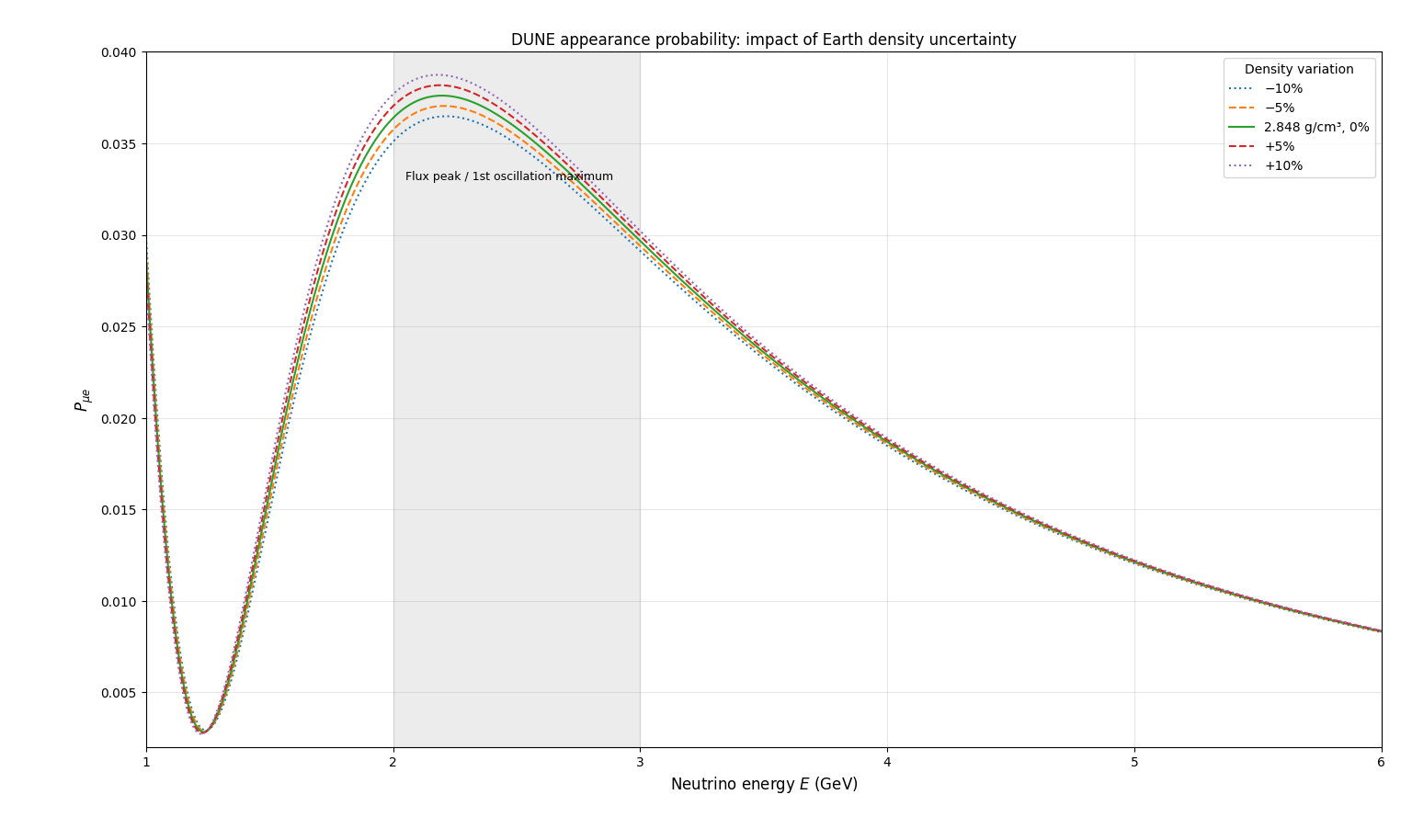
Precise modeling of Earth density profiles is critical for interpreting data from long-baseline neutrino experiments and resolving ambiguities in searches for CP violation.
Despite the successes of the Standard Model, precise determination of neutrino parameters remains challenging due to subtle effects within matter. This review, ‘Earth-Density Effects in LBL Experiments: A Comprehensive Review of Theory, Observations, and Future Directions’, details how uncertainties in Earth’s density profile significantly impact long-baseline neutrino oscillation probabilities, particularly for measurements sensitive to CP violation via the \nu_\mu \rightarrow \nu_e channel. We demonstrate that spatial variations in density introduce energy-dependent structures and potential degeneracies that cannot be adequately addressed by simplified, path-averaged approximations. Consequently, accurately modeling Earth’s density is crucial for next-generation experiments; can spatially resolved density profiles unlock the full potential of long-baseline neutrino oscillation studies and resolve the leptonic CP violation puzzle?
The Ghostly Dance: Neutrinos, Earth, and the Search for New Physics
Neutrinos, often called “ghost particles” due to their minimal interaction with matter, present a fascinating puzzle for physicists. These nearly massless particles come in three known ‘flavors’ – electron, muon, and tau – but remarkably, they aren’t fixed in these states. As neutrinos travel, they spontaneously transform between these flavors, a phenomenon known as neutrino oscillation. This isn’t merely a quirk of observation; it fundamentally challenges the Standard Model of particle physics, which originally predicted neutrinos to be massless and unchanging. The existence of neutrino oscillation definitively proves that neutrinos do possess mass, albeit incredibly small, and necessitates an extension of the Standard Model to accommodate this behavior. Understanding the mechanisms driving these oscillations is therefore paramount, offering a potential window into new physics and the deepest mysteries of the universe, including why matter dominates over antimatter.
The peculiar behavior of neutrino oscillation isn’t merely a quirk of particle physics; it represents a critical window into some of the universe’s deepest mysteries. These oscillations demonstrate that neutrinos possess mass – a fact not predicted by the original Standard Model – and, crucially, hint at symmetries that may have been violated in the early universe. Current cosmological models suggest that the Big Bang should have created equal amounts of matter and antimatter, but the observable universe is overwhelmingly dominated by matter. This imbalance, known as the matter-antimatter asymmetry, demands an explanation, and the subtle differences in behavior revealed by neutrino oscillations – governed by complex parameters like mixing angles and mass differences – may hold the key. Researchers theorize that new physics, potentially involving neutrinos, could account for the necessary conditions that favored matter creation, offering a pathway to understand why anything exists at all.
The Earth, seemingly a passive observer in the cosmos, actively participates in the enigmatic behavior of neutrinos. As these nearly massless particles journey towards us from distant sources – the sun, supernovae, or even the early universe – a significant number pass directly through our planet. The Earth’s core, with its unique density and composition, doesn’t stop these ghostly particles, but subtly alters their quantum mechanical properties. This interaction causes a measurable change in neutrino ‘flavor’ – the type of neutrino detected – an effect known as the Mikheyev-Smirnov-Wolfenstein (MSW) effect. Detecting these alterations provides a natural laboratory for studying neutrino oscillations and allows scientists to probe the Earth’s internal structure simultaneously, revealing information about our planet’s composition that would otherwise remain hidden. Essentially, the Earth acts as a giant, naturally occurring neutrino detector, influencing the very particles that stream through it.
Modeling Our World: From Simplified Density to Refined Earth Structures
The Constant Density Approximation, utilized in early neutrino oscillation studies, simplified calculations of Earth Matter Effects by assuming a uniform density throughout the Earth. This approach, while not fully representative of Earth’s actual composition, provided a foundational understanding of how electron neutrino interactions with Earth matter affect neutrino oscillation probabilities. By treating the Earth as a homogeneous medium, researchers could initially isolate and quantify the first-order effects of matter interactions on neutrino propagation, enabling the development of basic oscillation frameworks and providing a crucial starting point for more complex and accurate modeling. Although subsequent studies revealed the limitations of this simplification, the Constant Density Approximation served as a necessary first step in understanding the influence of Earth matter on neutrino behavior.
The Two-Layer Earth Model represents a significant improvement over the Constant Density Approximation by dividing Earth into two primary layers: the crust and the mantle. This model acknowledges the differing compositional and, consequently, density characteristics of these layers. Typically, the crust is assigned an average density of approximately 2.7 g/cm³, while the mantle is assigned a higher average density around 3.3 g/cm³. By assigning distinct densities to these layers, calculations of Earth matter effects – the modification of neutrino oscillation probabilities due to interactions with Earth’s material – become more realistic and accurate compared to assuming a uniform density throughout the planet. This approach allows for a better approximation of the neutrino propagation through Earth and provides a necessary foundation for more complex Earth models.
The Perturbed Preliminary Reference Earth Model (PREM) represents a significant advancement in modeling Earth’s density for neutrino oscillation studies. While PREM provides a foundational reference, it is inherently limited by its idealized uniformity. Perturbed PREM addresses this by incorporating realistic density variations derived from seismological data and geochemical constraints. These perturbations account for compositional heterogeneity within the mantle and crust, reflecting variations in mineralogy and temperature. By sampling a range of density profiles consistent with observational uncertainties, researchers can systematically assess the impact of Earth’s complex structure on neutrino propagation and quantify associated systematic errors in oscillation parameter measurements. This approach provides a more robust framework for interpreting neutrino oscillation data than models relying on simplified, constant-density assumptions.
Multi-Layer Earth Models represent a significant refinement in modeling Earth matter effects on neutrino oscillations by dividing Earth into numerous layers, each assigned a piecewise-constant density. Recent research demonstrates that utilizing simplified models with constant or averaged Earth densities introduces unacceptable biases in oscillation parameter estimations. This is because neutrino interaction rates are directly proportional to the intervening matter density; therefore, accurately representing spatial variations in density is crucial. These models improve accuracy by allowing for density variations with depth and, in some cases, lateral heterogeneity, moving beyond the limitations of the Constant Density Approximation and even the Two-Layer Earth Model. The increased computational complexity is justified by the necessity of minimizing systematic uncertainties in neutrino oscillation analyses.
Sensitivity analyses demonstrate that uncertainties in Earth density significantly impact neutrino oscillation calculations. Specifically, a variation of ±5% in the assumed Earth density results in an approximate 5 \times 10^{-3} change in the νμ→νe appearance probability near the first oscillation maximum. Increasing this density uncertainty to ±10% further amplifies the effect, yielding an equivalent absolute change in appearance probability. This highlights the necessity of accurate density modeling for precise neutrino oscillation parameter determination, as even relatively small density variations can introduce measurable biases in experimental results.
Seeking Symmetry’s Fracture: CP Violation and the Lepton Sector
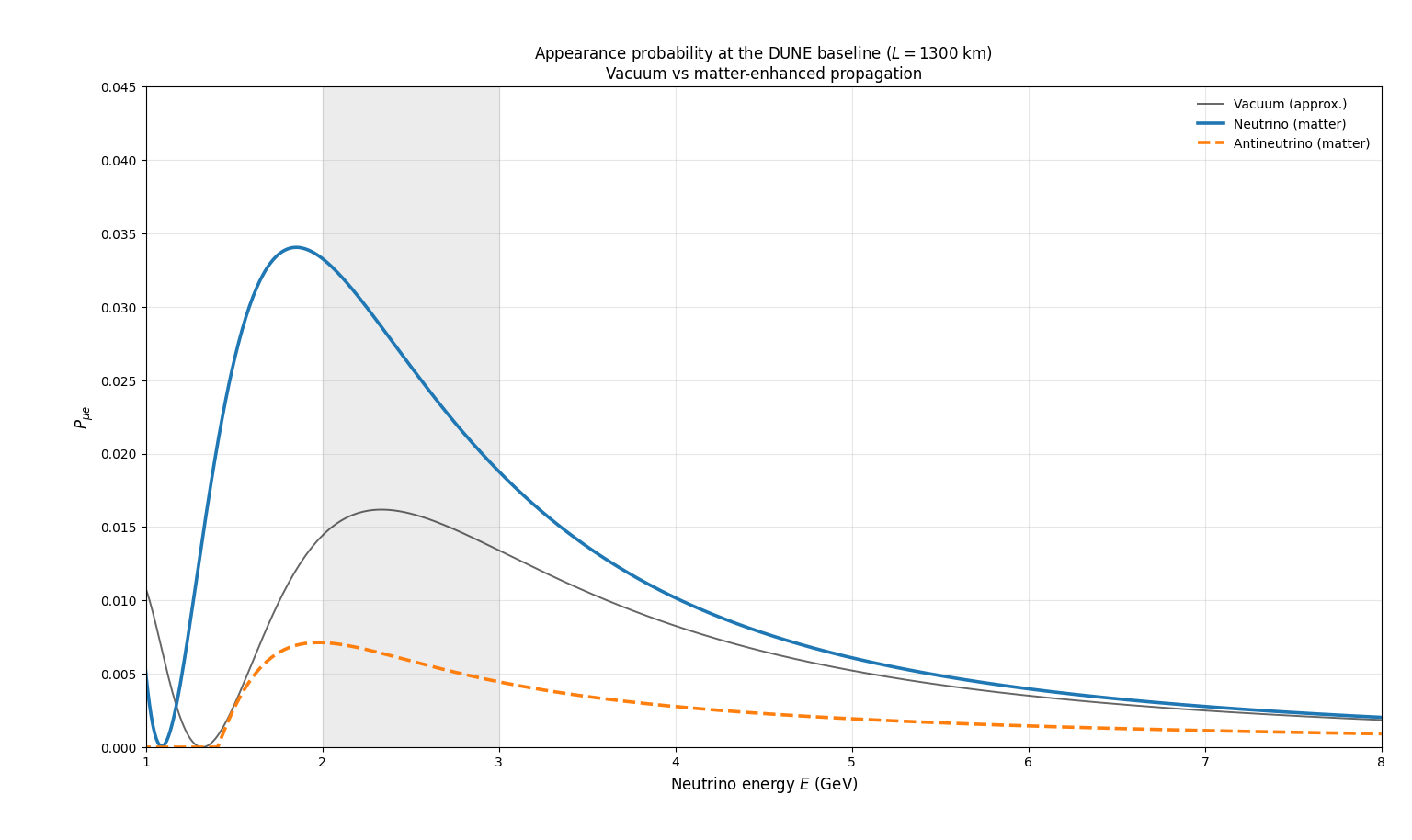
Neutrino oscillation, the process by which neutrinos change flavor during propagation, is significantly impacted by matter effects as neutrinos traverse the Earth. These effects arise from the coherent forward scattering of neutrinos off of electrons in the Earth’s core and mantle, altering the effective mass squared difference governing oscillation. This interaction is flavor-dependent and thus modifies oscillation probabilities for neutrinos versus antineutrinos. Consequently, precise measurements of neutrino oscillation parameters in conjunction with detailed Earth density models allow researchers to probe Charge-Parity (CP) violation – a fundamental asymmetry between matter and antimatter. The observed matter-antimatter asymmetry in the universe necessitates CP violation beyond that already established in the quark sector, and the leptonic sector, governed by neutrino interactions, provides a sensitive avenue for its investigation.
Constraining parameters governing CP violation relies on the precise determination of neutrino oscillation parameters – specifically, the mixing angles and mass-squared differences. These parameters are extracted from experiments observing neutrino flavor transitions, but their interpretation is complicated by the influence of matter effects as neutrinos traverse the Earth. Accurate modeling of Earth density profiles – accounting for variations in composition and layering within the crust and mantle – is therefore crucial. Uncertainties in these models directly impact the reconstructed oscillation parameters and introduce systematic errors in CP violation measurements; current limitations in Earth density knowledge can introduce up to a 10% relative modulation in observed signals, necessitating ongoing refinement of both experimental techniques and geophysical models to achieve definitive results.
The search for CP Violation in the leptonic sector involves a direct comparison of neutrino and antineutrino oscillation probabilities. CP Violation manifests as a difference in the rates at which these particles transition between different flavors (electron, muon, tau) as they propagate. Specifically, researchers analyze the probability of a neutrino transforming into a specific flavor and compare it to the probability of the corresponding antineutrino undergoing the same transformation. Any observed discrepancy between these probabilities would constitute evidence for CP Violation, indicating that the laws of physics are not identical for matter and antimatter in the lepton family. Experiments designed for this purpose require intense neutrino and antineutrino beams, along with sophisticated detectors capable of identifying the flavor of each particle.
Current investigations into neutrino oscillations represent an expansion of the search for Charge-Parity (CP) violation beyond the well-studied quark sector, offering the potential to uncover previously unknown sources of symmetry breaking in fundamental physics. Reliable measurement of CP violation in the leptonic sector requires extremely precise oscillation parameter determination, complicated by the significant influence of Earth matter effects on neutrino propagation. Uncertainties in Earth density models introduce a relative modulation of up to 10% in the observed neutrino signal, necessitating refined Earth models to minimize systematic errors and ensure accurate CP violation measurements.
The study meticulously details how seemingly minor variations in Earth’s density profile can propagate through long-baseline neutrino experiments, ultimately impacting the precision with which CP violation-a key component in understanding matter-antimatter asymmetry-can be measured. This echoes Ralph Waldo Emerson’s assertion: “The whole is greater than the sum of its parts.” Just as a complex system’s behavior arises from the interplay of its components, the accurate interpretation of neutrino oscillation data demands a holistic understanding of the experimental environment, including the subtle but significant influence of Earth’s material composition. Ignoring this interconnectedness risks obscuring the very phenomena the research seeks to reveal.
Beyond the Mantle
The precision demanded by current and future long-baseline neutrino experiments reveals a humbling truth: the system under investigation extends far beyond the detector itself. To treat neutrino oscillation analyses as solely a particle physics problem is to mistake a forest for a single tree. This work underscores that the Earth is not merely a passive observer, but an active element, subtly reshaping the very signals these experiments seek to decipher. If the system survives on duct tape-relying on simplified density models-it is probably overengineered, and almost certainly obscuring fundamental parameters.
The pursuit of CP violation, then, becomes an exercise in geophysics as much as particle physics. Improvements to Earth density models – incorporating regional variations, core-mantle boundary complexities, and even transient effects – will be essential. However, simply increasing resolution isn’t enough. Modularity without context is an illusion of control; a high-resolution map devoid of a robust understanding of formation processes and material properties offers little genuine insight.
The ultimate limit may not lie in detector technology, but in the inherent difficulty of fully characterizing a dynamic, heterogeneous planet. Perhaps the most fruitful path forward lies in embracing this complexity – developing analysis techniques that systematically account for density uncertainties, and designing experiments that are, if not immune to these effects, at least capable of quantifying them.
Original article: https://arxiv.org/pdf/2601.21256.pdf
Contact the author: https://www.linkedin.com/in/avetisyan/
See also:
- What Song Is In The New Supergirl Trailer (& What It Means For The DC Movie)
- Eurogamer Gives ARC Raiders 2/5 Over AI Voices, Dropping Metacritic Score from 94 to 84
- Gold Rate Forecast
- One of Hulu’s Best New Shows Lands on Disney+ Ahead of Season 2
- Invincible Season 4 Confirms a Major Atom Eve Change From the Comics
- OpenAI says GPT‑5 cuts political bias — but is 30% enough?
- Kylo Ren’s Darkest Moment: A Shocking Echo of Anakin’s Infamous Past
- Meet the Real-Life Inspiration For Sex and The City’s Mr. Big
- Task & Mare Of Easttown’s Crime Thriller Universe: Revolutionizing the Genre
- Dead Island 2 – Former Head of Communications Says Original Version Would Have Killed the Franchise
2026-01-30 23:53