In the labyrinthine corridors of the blockchain, where code is king and bugs reign supreme, a modern-day hero emerged-0xflorent, the white-hatted savior of lost Ether. With a flourish of his keyboard, he unlocked a treasure trove of 1,003.62 ETH, a sum so grand it could make even the Master and Margarita blush. Trapped since the dawn of the 2016 ICO era, these funds were as inaccessible as a conversation with Pontius Pilate.
-
Key Takeaways (or, as Bulgakov would say, “The Devil’s in the Details”):
- 0xflorent, the digital Behemoth, freed 1,003.62 ETH from the clutches of a 2016 Hongcoin ICO contract, a bug-ridden fortress that had stood unyielding for nearly nine years.
- The exploit? An integer overflow, a flaw as ancient as Azazello’s tricks, lurking in a multisig admin function. It required 41 signed transactions to unblock 48 investors, each more desperate than a Moscow apartment seeker.
- Two investors, quicker than a cat on a hot tin roof, claimed 96.5 ETH. The remaining 882 ETH awaits its rightful owners, as of June 1, 2026.
A 2016 ICO That Promised the Moon but Delivered a Bug
The funds, like a forgotten manuscript in a dusty attic, originated from Hongcoin, or “The HONG,” a 2016 Ethereum-based project. It was pitched as a community-run decentralized investment fund, a utopia as elusive as Koroviev’s violin tunes. The ICO failed to hit its funding target, which should have triggered an automatic refund. But, as in Bulgakov’s world, things rarely go as planned.
A bug in the refund logic, as stubborn as a Soviet bureaucrat, blocked most investors from reclaiming their ETH. The contract, in its infinite wisdom, compared each investor’s token balance against a global counter. Partial refunds over the years reduced this counter to 356, capping refunds at a paltry 3.56 ETH per holder. Most of the 48 remaining investors held far more, leaving their funds as locked as the doors to the Griboedov apartment.
The contract address, 0x9fa8fa61a10ff892e4ebceb7f4e0fc684c2ce0a9, remains verifiable on Etherscan, a digital monument to human folly.
The Exploit That Outsmarted the Bug
0xflorent, with the precision of a master surgeon, identified an integer-overflow vulnerability in an admin-only function tied to the Hongcoin team’s multisig wallet. This function, originally designed to mint bounty tokens, lacked overflow protections-a common weakness in pre-SafeMath Solidity code from 2016, as archaic as a horse-drawn carriage in Moscow traffic.
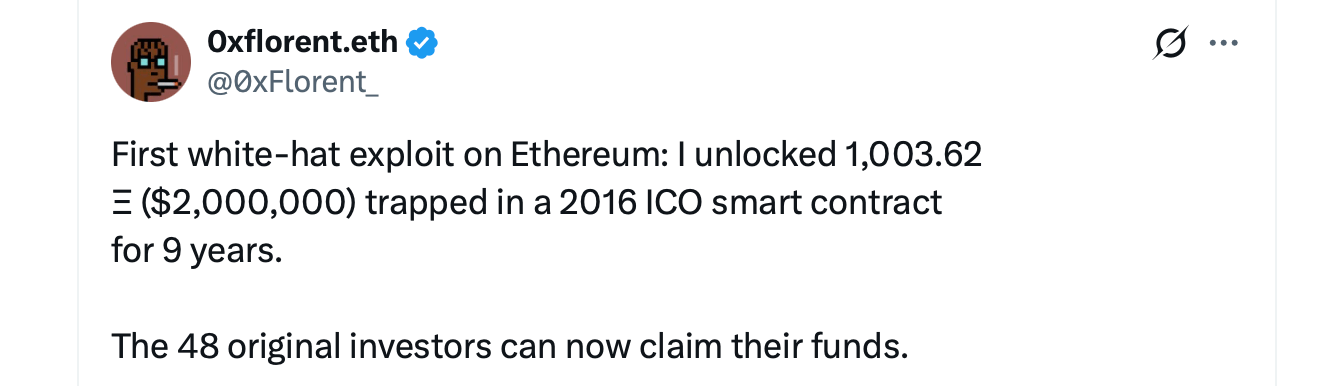
By passing a specific input value, the function reset an investor’s token balance to 1, bypassing the refund check and allowing the contract to release the corresponding ETH. Florent described it as the “first white-hat exploit on Ethereum,” a feat as rare as a kind word from Berlioz.
How the Recovery Unfolded (Or, “The Great Unlocking”)
Florent, with the discretion of a secret police agent, reached out privately to the dormant Hongcoin team by email. He validated the full unlock sequence on a local Foundry fork of Ethereum mainnet before touching anything on-chain. The team’s multisig then signed 41 transactions, one for each blocked holder requiring a balance reset. Seven holders with smaller balances could claim refunds directly, without the workaround. The entire process took about one week, faster than a Moscow metro ride during rush hour.
As of June 1, 2026, all 1,003.62 ETH had been unfrozen. Two investors, quicker than a cat on a hot tin roof, claimed a combined 96.5 ETH, worth roughly $193,000. They sent Florent a voluntary bounty, though he took no fees, no cut, and no commission-a true hero in a world of profiteers.
Roughly 882 ETH remains available for the other investors to claim, a treasure awaiting its rightful owners.
A Pattern of Whitehat Work (Or, “The Saint of Smart Contracts”)
This was Florent’s second publicized recovery in eight days. On May 24, he returned 19.329 ETH, about $40,590, from a 2018 ICO contract and expired atomic swaps tied to a now-defunct wallet. Florent uses custom scanning tools, including a self-hosted node, to locate contracts holding more than 100 ETH. He noted that many old contracts are forks of one another, meaning vulnerabilities often cluster-a digital echo of Bulgakov’s interconnected characters.
What This Means for Early Ethereum Holders (Or, “Hope Springs Eternal”)
Hundreds of Ethereum smart contracts from the 2016 and 2017 ICO boom era still hold locked funds. Most contributors wrote those balances off years ago, as one might forget a bad dream. Florent’s work is a reminder that some of those contracts still have a door, and someone with the right tools might find the key-a glimmer of hope in a world of digital despair.
Read More
- Gold Rate Forecast
- 10 Most Powerful Versions of Superman, Ranked
- GBP CNY PREDICTION
- 007 First Light: Release Date, Story, Gameplay, Cast, Editions, and Platforms
- Forza Horizon 6 Car List So Far: Confirmed Highlights, Cover Cars, DLC, and Rewards
- DOGE PREDICTION. DOGE cryptocurrency
- Superman’s 7 Best Power-Ups, Ranked
- 10 Greatest Wii U Games of All Time, Ranked
- What happened to Soldier Boy in The Boys?
- Kingdom Come Deliverance Update 1.002 Enables Trophies to Be Transferred
2026-06-01 19:27