Author: Denis Avetisyan
Researchers are leveraging meson decays to search for extremely light dark matter candidates, opening a novel window into the universe’s missing mass.

This study presents a search for sub-GeV dark matter particles using invisible decay products from η mesons observed by the BESIII experiment, setting new limits on their potential interactions with standard model quarks.
Despite compelling evidence for dark matter, its fundamental nature remains elusive, particularly for sub-GeV mass candidates. This paper, ‘Search for sub-GeV dark particles in $η\toπ^0+\rm{invisible}$ decay’, reports the first search for a dark scalar boson produced in η meson decay using data collected by the BESIII experiment. No significant signal was observed, leading to upper limits on the branching fraction and coupling strength between dark matter and quarks, improving constraints on dark-matter-nucleon scattering by up to five orders of magnitude. Could this analysis pave the way for novel direct detection strategies targeting this previously unexplored dark matter mass range?
The Enigma of the Invisible Universe
The cosmos, as currently understood, is overwhelmingly dominated by a substance entirely invisible to conventional detection methods – dark matter. Constituting roughly 85% of the universe’s total mass, its existence is inferred from gravitational effects on visible matter, like the rotational curves of galaxies and the bending of light. However, despite decades of searching, no direct interaction with ordinary matter has been definitively observed. This persistent elusiveness doesn’t merely represent a gap in knowledge; it actively challenges the Standard Model of particle physics, the prevailing framework describing the fundamental building blocks and forces of the universe. The Standard Model, while remarkably successful, offers no suitable candidate particle to account for dark matter’s properties, necessitating exploration beyond its established boundaries and prompting innovative theoretical frameworks and experimental approaches to unveil this enigmatic component of the cosmos.
The search for dark matter faces a significant hurdle due to the limitations of current detection methods, particularly those focused on direct detection via nuclear recoil. These experiments are designed to identify the faint energy deposited when a dark matter particle collides with an atomic nucleus, but operate under assumptions about the mass and interaction strength of these elusive particles. The reality may be far more complex; dark matter isn’t necessarily composed of a single particle type, and its mass could span several orders of magnitude, from incredibly light axions to massive, weakly interacting particles. Furthermore, the nature of the interaction between dark matter and ordinary matter remains unknown – it might not even primarily involve nuclear recoil. Consequently, experiments optimized for a specific mass range and interaction type could be missing the vast majority of dark matter, highlighting the need for diverse detection strategies exploring a wider range of potential particle properties and interaction mechanisms to finally unveil the composition of this mysterious substance.
Beyond Conventional Limits: Exploring Sub-GeV Dark Matter
Sub-GeV dark matter particles, possessing masses below 1 GeV/c2, present significant detection challenges stemming from their inherently weak interactions with Standard Model particles. Traditional direct detection experiments rely on observing nuclear recoils induced by dark matter scattering, but the expected recoil energies from sub-GeV interactions are extremely low – often below the detection threshold of current instruments. Furthermore, the low mass implies a reduced velocity relative to terrestrial detectors, further diminishing the expected interaction rate and making discrimination from background events exceptionally difficult. These factors necessitate the development of novel detection strategies and technologies sensitive to these faint signals and capable of effectively rejecting backgrounds.
Boosted Dark Matter (BDM) represents a potential solution to the low interaction rates inherent in sub-GeV dark matter detection. Unlike dark matter particles moving at typical galactic velocities, BDM originates from cosmic ray interactions within the atmosphere or from the decay of mesons produced in similar processes. These interactions impart significant kinetic energies – on the order of GeV to TeV – to the dark matter particles, dramatically increasing their momentum and, consequently, their interaction probability with nuclei in terrestrial detectors. This enhancement is crucial, as the cross-section for dark matter-nucleus interactions is expected to be extremely small for low-mass WIMPs. Detectors designed to capture these energetic recoils, often employing specialized target materials and low-energy thresholds, are currently being utilized to search for the BDM signal, offering a complementary approach to traditional WIMP searches.
The detection of sub-GeV dark matter is complicated by its low interaction cross-sections; however, certain mechanisms amplify observable signals. Bremsstrahlung, the emission of photons when a dark matter particle scatters off an electron, increases the event rate and produces a distinct electromagnetic signal. The Migdal effect, a process where nuclear recoil induces atomic ionization, offers an alternative detection channel. Unlike typical nuclear recoil signals, the Migdal effect produces detectable ionization signals even with low-energy dark matter, as the ionization energy is directly related to the atomic binding energy, rather than the nuclear recoil energy. These effects alter the expected signal characteristics, enabling more sensitive searches for low-mass dark matter candidates in terrestrial detectors.
A Distinctive Pathway: The η→π⁰S→π⁰χχ̄ Decay Channel
The decay channel η→π⁰S→π⁰χχ̄ offers a distinctive search pathway for sub-GeV dark matter candidates. This decay sequence involves the neutral pion (π⁰) produced in the decay of the η meson, followed by the π⁰ decaying into a pair of unknown particles, ‘S’. If these ‘S’ particles are themselves dark matter candidates (χχ̄), the resulting final state provides a specific signature characterized by missing energy and momentum. The relative rarity of η decays, coupled with the potential for clean isolation of this signature due to the neutral final state particles, makes this channel particularly sensitive to low-mass dark matter, complementing searches using more conventional decay modes.
The BESIII experiment, located at the BEPCII collider, provides a favorable environment for searching for the η→π⁰S→π⁰χχ̄ decay channel due to its high luminosity and efficient particle identification capabilities. The analysis leverages a dataset of (10087 ± 44) × 10⁶ J/ψ events, where J/ψ decays are utilized to produce and subsequently identify η mesons. This approach capitalizes on the well-understood properties of J/ψ decay modes, allowing for a cleaner selection of η meson candidates and a reduction in background noise, which is crucial for detecting the subtle signals potentially produced by sub-GeV dark matter candidates.
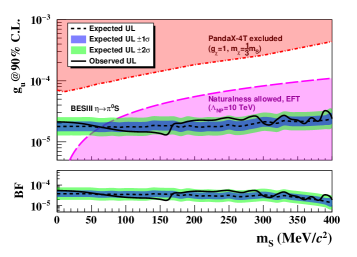
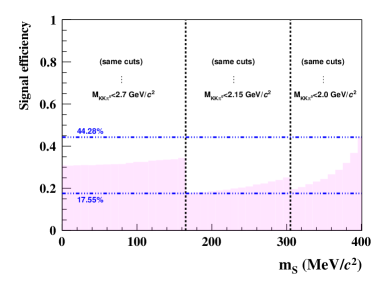
The identification of the η→π⁰S→π⁰χχ̄ decay channel relies on sophisticated analysis techniques, specifically kinematic fits constrained by Gaussian distributions to accurately reconstruct the decay chain and separate potential signal events from background noise. These fits optimize the reconstruction of particle momenta, improving the signal-to-background ratio and enabling the establishment of upper limits on the branching fraction. Current analyses, based on (10087 ± 44) × 10⁶ J/ψ events, have defined 90% confidence level (CL) upper limits ranging from 1.8 × 10⁻⁵ to 5.5 × 10⁻⁵ for the branching fraction, dependent on the sub-GeV dark matter particle (SS) mass range from 0 to 400 MeV/c².
Quantifying the Absence: Statistical Rigor and Theoretical Frameworks
Establishing definitive evidence for Dark Matter demands not simply detecting a signal, but rigorously quantifying its absence. A Bayesian statistical approach is essential, allowing researchers to calculate upper limits on the branching fraction – the probability of a particular decay occurring – of potential Dark Matter interactions. This method does not rely on observing a statistically significant excess of events; instead, it systematically incorporates prior knowledge and observed data to define the highest plausible rate at which a signal could exist without being detected. By establishing these quantitative constraints, the Bayesian framework provides crucial boundaries for theoretical models and directs future experimental searches, effectively shrinking the parameter space where Dark Matter might reside and improving the sensitivity of ongoing investigations.
The interpretation of potential dark matter signals relies heavily on theoretical frameworks, particularly Effective Field Theory. This approach allows researchers to connect observed events to the underlying properties of a potential mediator – in this case, a dark scalar boson – and quantify the strength of its interactions. By carefully modeling these interactions, studies have constrained the coupling strength g_u between dark matter particles and standard model fermions to a remarkably narrow range of 1.3 × 10⁻⁵ to 3.2 × 10⁻⁵. This precision is crucial; it not only refines the search for dark matter but also provides stringent tests of theoretical models, guiding the development of more accurate and predictive frameworks for understanding the universe’s hidden sector.
The convergence of rigorous statistical analysis and theoretical modeling is dramatically reshaping the search for Dark Matter. By employing a Bayesian framework to establish upper limits on decay branching fractions and leveraging Effective Field Theory to interpret potential signals, researchers are not simply looking for Dark Matter, but actively narrowing the possibilities. This combined approach has yielded a remarkable refinement of existing constraints, improving upon the precision of measurements concerning the DM-nucleon scattering cross-section by a factor of 100,000 – five orders of magnitude. Such advancements are pivotal, allowing scientists to discard increasingly improbable models and focus future experiments on the most promising regions of the Dark Matter landscape, ultimately accelerating the quest to understand this elusive component of the universe.
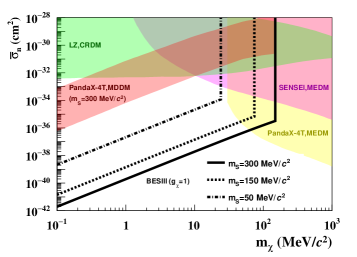
The pursuit of undetectable particles, as demonstrated in this search for sub-GeV dark matter via η meson decays, echoes a fundamental tenet of mathematical rigor. The analysis meticulously establishes upper limits on coupling strengths, effectively defining a boundary beyond which certain dark matter models are invalidated. This process mirrors the establishment of invariants in a mathematical proof-a precise delineation of permissible solutions. As Jean-Jacques Rousseau observed, “The only way to see things as they are is to look at them as they are.” This study, by rigorously defining the constraints on dark matter interactions, strives for precisely that clarity, eschewing speculation for quantifiable limits based on observed decay rates and established theoretical frameworks.
Where Does This Leave Us?
The search, as always, reveals more about the absence of confirmation than the presence of it. This analysis, while setting constraints on a specific coupling, merely defines a smaller region of parameter space where darkness continues to hide. The elegance of the η meson decay – a clean, theoretically predictable channel – is somewhat offset by the reliance on phenomenological assumptions regarding the dark sector itself. The true test lies not in refining these assumptions, but in developing a framework independent of specific particle candidates.
Future iterations must address the inherent ambiguity. The current approach, while technically sound, treats the dark sector as a ‘black box’. A provable, first-principles derivation of dark matter interactions – one rooted in a broader theoretical framework – would elevate this search from an exercise in exclusion to a genuine discovery pathway. Precision measurements of the branching ratio, coupled with a deeper understanding of potential Standard Model backgrounds, are essential, but ultimately insufficient without a more fundamental theoretical impetus.
The pursuit continues, driven by the stubborn hope that nature, at its core, adheres to a mathematical consistency that mere experimentation, however precise, can only approximate. The question is not whether darkness exists, but whether the tools currently employed are capable of discerning a truly elegant solution.
Original article: https://arxiv.org/pdf/2601.10597.pdf
Contact the author: https://www.linkedin.com/in/avetisyan/
See also:
- The Super Mario Galaxy Movie: 50 Easter Eggs, References & Major Cameos Explained
- Sydney Sweeney’s The Housemaid 2 Sets Streaming Release Date
- 10 Best Free Games on Steam in 2026, Ranked
- Welcome to Demon School! Iruma-kun season 4 release schedule: When are new episodes on Crunchyroll?
- Why is Tech Jacket gender-swapped in Invincible season 4 and who voices her?
- Highly Anticipated Strategy RPG Finally Sets Release Date (And It’s Soon)
- The Punisher: One Last Kill Trailer Review: MCU Special Could Be a Game Changer
- Every Real Housewives Series Ranked: Worst to Best
- Forza Horizon 6 ‘Prologue’ gameplay
- Joel Kinnaman Claims ‘Peacemaker’ Was His Last Time as Rick Flag Jr. in the DCU
2026-01-16 21:34