Author: Denis Avetisyan
New analyses from the ATLAS and CMS experiments continue to probe the subtle imbalances in top quark production and decay.
This review summarizes recent measurements of top quark charge, energy, and rapidity asymmetries, comparing results to Standard Model predictions and exploring potential new physics interpretations.
Precise measurements of fundamental particle properties are crucial for testing the Standard Model of particle physics, yet subtle discrepancies can reveal new physics beyond our current understanding. This paper, ‘Measurements of top quark asymmetries’, reviews recent results from the ATLAS and CMS collaborations at the LHC concerning asymmetries in the production and decay of top quarks – specifically charge, energy, and rapidity distributions. While current measurements generally align with Standard Model predictions based on quantum chromodynamics, evidence for asymmetries persists, prompting further investigation into potential new sources of charge-parity violation or modified vector boson couplings. Could a more detailed understanding of these asymmetries unlock insights into the matter-antimatter imbalance in the universe?
The Predictable Imperfections of Precision
The Standard Model of particle physics stands as one of the most successful scientific theories ever devised, consistently predicting experimental outcomes with remarkable precision. However, this very success motivates the search for physics beyond its current framework. While extraordinarily accurate within its tested range, the Standard Model fails to account for phenomena like dark matter, dark energy, and neutrino masses – hinting at a more complete, underlying theory. Consequently, physicists employ increasingly stringent tests of the Standard Model’s limits, meticulously examining known particles and interactions for deviations from predicted behavior. These precision measurements, often conducted at high-energy colliders like the Large Hadron Collider, serve not to disprove the existing model, but rather to identify subtle anomalies that could offer a crucial first glimpse of new particles and forces operating beyond our current understanding, ultimately paving the way for a more comprehensive description of the universe.
The top quark, the most massive elementary particle known, offers a unique window into physics beyond the Standard Model through precise measurements of its properties. Specifically, investigations into the top quark’s charge asymmetry-the slight preference for top quarks versus antitop quarks in high-energy collisions-can reveal subtle hints of new particles or interactions. Any deviation from the Standard Model’s prediction of near-equal production rates for these particles suggests the presence of undiscovered forces or particles influencing their behavior. These asymmetries are exquisitely sensitive to contributions from hypothetical particles that interact with the top quark, making it a powerful tool for exploring the limitations of current physics and guiding the search for new phenomena. The study of these properties, therefore, represents a crucial frontier in high-energy particle physics.
Recent investigations by the ATLAS collaboration at the Large Hadron Collider have yielded the first compelling evidence for a charge asymmetry in the production of top quarks. This asymmetry indicates a slight preference for top quarks being produced with positive electric charge compared to their anti-particle counterparts, the anti-top quarks. The measured value of this asymmetry is 0.0068, with an uncertainty of ± 0.0015, representing a statistically significant deviation – exceeding 4.7 standard deviations – from the expectation of no asymmetry. Such a phenomenon cannot be explained within the framework of the Standard Model of particle physics and suggests the potential influence of new particles or interactions, offering a tantalizing glimpse beyond current understanding of fundamental forces and matter.
Dissecting the Subtle Imbalance
The top quark charge asymmetry arises from an observed imbalance in the production rates of top quarks versus antitop quarks at high-energy proton-proton collisions. This asymmetry is quantified by examining the difference in rapidity distributions – a measure of particle velocity along the beam axis – between these particle-antiparticle pairs. Accurate determination of this asymmetry necessitates precise reconstruction of the momenta of all final-state particles, including the top quark’s decay products, due to the short lifetime of the top quark and the inherent complexities of particle detection at colliders like the LHC. Systematic uncertainties in momentum measurement directly impact the precision with which the charge asymmetry can be determined.
Analysis of the top quark charge asymmetry at the Large Hadron Collider (LHC) is performed using data from proton-proton collisions. The relatively low production rate of top quarks, coupled with complex backgrounds from other Standard Model processes, requires the examination of a large dataset of collision events. Consequently, sophisticated statistical techniques are essential for accurately reconstructing the momenta of the produced top quarks and antiquarks, identifying signal events, and quantifying the associated uncertainties. These methods include multivariate analysis, b-tagging algorithms to identify jets originating from b-quarks, and careful modeling of systematic effects arising from detector response and theoretical uncertainties in the simulation of collision events.
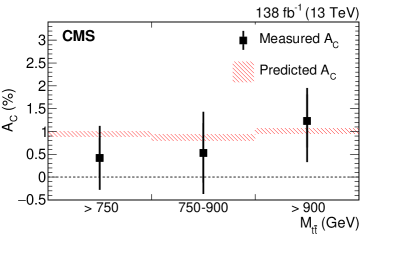
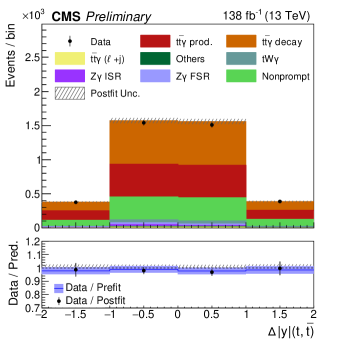
Analysis of the t\bar{t}\gamma decay channel provides differing measurements of the top quark charge asymmetry between the ATLAS and CMS collaborations. ATLAS reports a charge asymmetry of -0.003 ± 0.029, representing the difference in the production rates of top quarks versus antiquarks as a function of their rapidity. CMS, utilizing the same decay channel, measures a charge asymmetry of -1.2% ± 4.2%. While both measurements indicate a preference for top quarks over antiquarks at higher rapidities, the discrepancy between the central values and uncertainties warrants further investigation and statistical analysis to determine if the differences are statistically significant or attributable to systematic effects within each experiment.
Refining the Search for Deviation
Measurements of top quark production extend beyond inclusive samples to encompass associated production channels, specifically those involving jets or vector bosons. Analyzing asymmetries within these channels – such as the relative production rate of top quarks and anti-top quarks in conjunction with additional jets – provides a more nuanced understanding of potential new physics. These asymmetries are sensitive to different aspects of the underlying interactions and offer complementary probes compared to measurements in fully inclusive t\bar{t} production. Examining asymmetries in associated channels allows for tests of the Standard Model in different kinematic regions and with varying levels of background contamination, increasing the precision of the overall measurement and improving the ability to identify deviations from expected behavior.
The accurate measurement of particle asymmetries requires the implementation of advanced statistical techniques to effectively reduce systematic uncertainties. The Fully Bayesian Unfolding Technique, employed by the ATLAS collaboration, is one such method; it allows for the correction of detector effects and acceptance variations while rigorously propagating all sources of uncertainty. This technique differs from frequentist approaches by treating nuisance parameters – those representing systematic effects – as random variables with prior distributions, allowing for a more complete quantification of the uncertainty on the final measurement. By integrating over these prior distributions, the technique provides a robust estimate of the true underlying particle asymmetry, minimizing the impact of imperfect detector knowledge and reconstruction efficiencies.
Analysis of the t \bar{t} W production channel has yielded differing results between the ATLAS and CMS experiments. ATLAS measurements are consistent with no top quark charge asymmetry in this channel. Conversely, CMS reports a charge asymmetry of -0.19^{+0.16}_{-0.18}, representing a 1σ deviation from zero. This discrepancy warrants further investigation and data collection to determine if the observed asymmetry is statistically significant or attributable to experimental uncertainties.
The Fragile Edge of Known Physics
The top quark, the most massive elementary particle known, offers a unique window into physics beyond the Standard Model. Subtle imbalances, termed asymmetries, observed in the production and decay of top quark pairs can signal the existence of previously unknown fundamental interactions or particles. These asymmetries arise from a preference for certain decay pathways, and any deviation from the Standard Model’s precise predictions suggests that new forces or particles are influencing these decays. Researchers meticulously analyze the distribution of decay products, searching for patterns that cannot be explained by known physics; even slight variations from expected behavior could indicate the presence of additional particles interacting with the top quark, or even new spatial dimensions impacting its behavior, providing crucial clues to a more complete understanding of the universe.
Investigations into top quark asymmetries extend beyond simple charge imbalances, delving into more nuanced measurements of energy and incline within the t\bar{t}j decay channel-where t\bar{t} represents a top quark-antiquark pair and ‘j’ denotes an additional jet. Recent analyses reveal intriguing discrepancies; the ATLAS collaboration observes a 2.1σ deviation in the energy asymmetry within a specific, highly sensitive data bin, suggesting a potential imbalance in how energy is distributed amongst the decay products. Complementing this, the CMS experiment measures an incline asymmetry of 2.5% ± 2.3%, a result differing from zero by 2.7σ, hinting at a preferred direction in the decay process. These observed asymmetries, while not yet conclusive, provide compelling evidence that the behavior of top quarks may not be fully explained by the Standard Model, and warrant further, detailed investigation into potential new physics at play.
The pursuit of physics beyond the Standard Model necessitates a dual approach of increasingly precise experimental measurements and concurrent theoretical advancements. Current deviations observed in top quark asymmetries, while intriguing, require substantial statistical confirmation and a deeper understanding of potential background effects. Refinements to theoretical calculations, incorporating higher-order quantum corrections and exploring alternative models, are crucial for accurately predicting Standard Model expectations. Only through this iterative process of comparison between experimental data and theoretical predictions can physicists confidently identify genuine signals of new physics and begin to unravel the fundamental mysteries that lie beyond the established framework. Continued investigation promises to refine the search, potentially revealing previously unknown particles or interactions that reshape our understanding of the universe.
The pursuit of precision in measurements, as demonstrated by the ATLAS and CMS collaborations studying top quark asymmetries, reveals a fascinating human tendency. It isn’t simply about verifying the Standard Model-though that is the stated aim-but about imposing order on inherent uncertainty. The subtle deviations, or lack thereof, in charge and energy asymmetries aren’t merely data points; they are anxieties quantified. As John Stuart Mill observed, “It is better to be a dissatisfied Socrates than a satisfied fool.” This study, in its meticulousness, embodies that very dissatisfaction, relentlessly questioning the boundaries of known physics, even when the answers, for now, align with expectation. The persistent search for deviations hints at an unwillingness to accept comfortable certainty, a distinctly human trait mirrored in the very models physicists construct.
What’s Next?
The continued refinement of measurements concerning top quark asymmetries will likely yield diminishing returns unless theoretical frameworks adapt. The Standard Model, while remarkably resilient, provides predictions built on a foundation of symmetry-a comforting, but often illusory, construct. The observed asymmetries, even if currently aligning with expectations, demand scrutiny not of the experimental precision, but of the assumptions baked into the models themselves. Even with perfect information, people choose what confirms their belief; so too do physicists cling to structures that offer internal consistency, even when confronted with subtle discordance.
Future investigations will undoubtedly focus on higher-order corrections and the exploration of new physics through effective field theory. However, a more fruitful avenue may lie in acknowledging the inherent limitations of attempting to describe complex systems with simple parameters. The search isn’t merely for deviations from the Standard Model, but for a model that honestly accounts for the messy, incomplete nature of reality. Most decisions aim to avoid regret, not maximize gain, and theoretical physics, at its core, is a similar exercise in risk mitigation.
Ultimately, the true value of these measurements may not be in confirming or refuting specific predictions, but in forcing a re-evaluation of the questions asked. The asymmetries are not anomalies to be explained away; they are signposts indicating the boundaries of current understanding, and a gentle reminder that even the most elegant theories are, at best, provisional approximations.
Original article: https://arxiv.org/pdf/2602.12719.pdf
Contact the author: https://www.linkedin.com/in/avetisyan/
See also:
- Looks Like SEGA Is Reheating PS5, PS4 Fan Favourite Sonic Frontiers in Definitive Edition
- Pluribus Star Rhea Seehorn Weighs In On That First Kiss
- Dune 3 Gets the Huge Update Fans Have Been Waiting For
- Kelly Osbourne Slams “Disgusting” Comments on Her Appearance
- Gold Rate Forecast
- Arknights: Endfield – Everything You Need to Know Before You Jump In
- Tomodachi Life: Living the Dream ‘Welcome Version’ demo now available
- Deus Ex Remastered Delayed to “Better Meet Fan Expectations”
- Action Comics #1096 is Fun Jumping-On Point for Superman Fans (Review)
- Did The Simpsons Retire a Major Character After Nearly 30 Years?
2026-02-16 11:32