Author: Denis Avetisyan
Researchers have discovered a way to generate and control a unique form of sound wave – a phonon frequency comb – within the layered material InSiTe3.
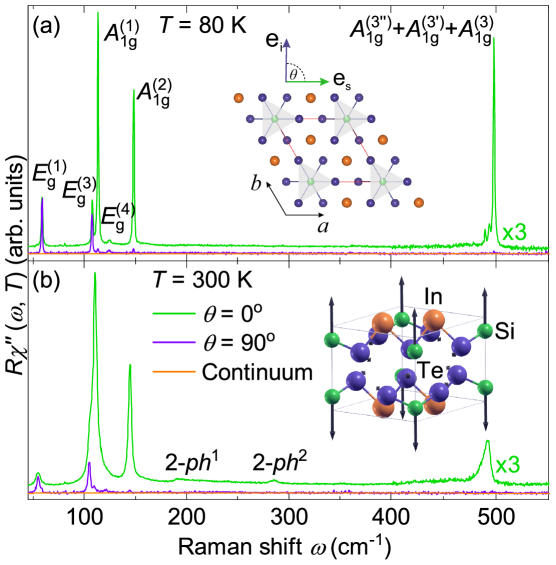
Strong anharmonicity and a localized Einstein mode in the Van der Waals material InSiTe3 enable the observation of coherent phonon phenomena and frequency comb generation.
The emergence of collective vibrational phenomena in quantum materials often relies on subtle interplay between symmetry, anharmonicity, and dimensionality. This is explored in ‘Phonon frequency comb close to an isolated Einstein mode in InSiTe3’, which reports the observation of a frequency-domain phonon comb in the layered Van der Waals compound InSiTe$_3$. These self-organized excitations arise from strong phonon-phonon coupling near a localized high-energy mode, demonstrating unusually strong anharmonic effects. Could this material serve as a novel platform for exploring coherent phonon dynamics and uncovering new emergent vibrational phenomena in low-dimensional systems?
The Whispers of Lattice Dynamics
Van der Waals trichalcogenides, a relatively new class of 2D materials, are rapidly becoming a focal point in materials science due to their unexpectedly diverse and tunable physical properties. These compounds – built from layers weakly held together by Van der Waals forces – exhibit characteristics ranging from metallic conductivity and superconductivity to semiconducting behavior and strong optical absorption. Unlike traditional 3D materials where properties are largely fixed, the layered structure of trichalcogenides allows for manipulation of their electronic and optical responses through external stimuli like strain, electric fields, or chemical doping. This tunability, combined with their inherent two-dimensionality, makes them promising candidates for next-generation electronic devices, sensors, and energy harvesting technologies, driving significant research into understanding and harnessing their unique potential.
Van der Waals trichalcogenides, with their weakly bonded layers, deviate significantly from the established principles of lattice dynamics found in conventional three-dimensional materials. Traditional models assume harmonic vibrations, where atomic displacement is proportional to the applied force; however, these layered structures exhibit strong anharmonicity. This means the vibrational modes are no longer simple sine waves, leading to complex interactions between phonons – quantized vibrations within the material. Consequently, researchers are actively investigating nonlinear phenomena such as frequency mixing, where two or more phonons combine to create new frequencies, and the emergence of solitons – self-reinforcing wave packets that maintain their shape over long distances. Understanding these nonlinear behaviors isn’t merely an academic exercise; it opens pathways to manipulate heat flow and potentially create novel devices based on phonon engineering, pushing the boundaries of materials science and condensed matter physics.
The ability to control and harness phonons – quantized vibrations within a material – represents a burgeoning frontier in technological innovation, and understanding emergent phenomena in 2D materials is paramount to realizing this potential. These materials offer unprecedented opportunities to engineer phonon behavior, moving beyond simple heat conduction towards tailored functionalities like directional heat flow, efficient thermoelectric conversion, and even novel quantum devices. Manipulating phonons at the nanoscale could revolutionize thermal management in electronics, leading to faster, more energy-efficient computing, while precise control over vibrational energy offers pathways for designing highly sensitive sensors and actuators. Further exploration promises to unlock applications ranging from improved solar energy harvesting to the creation of entirely new classes of materials with on-demand thermal and mechanical properties, solidifying the importance of this research area for future technologies.
Unveiling the full potential of two-dimensional materials hinges on the development and application of sophisticated characterization techniques. Because the intriguing properties of these materials often arise from collective atomic motions – subtle vibrational modes known as phonons – researchers require methods capable of resolving these incredibly small-scale movements. Techniques like ultrafast spectroscopy, Raman microscopy with enhanced spatial resolution, and advanced transmission electron microscopy are proving essential in mapping phonon dispersion relations and identifying nonlinear phonon interactions. These investigations aren’t merely about observing vibrations; they aim to understand how these modes couple to other material properties, like electrical conductivity or thermal response, ultimately paving the way for materials designed with specific phonon-based functionalities. The ability to ‘see’ and control these subtle vibrations represents a crucial frontier in materials science, promising breakthroughs in areas like thermoelectrics and quantum computing.
Decoding the Vibrational Fingerprint
Raman spectroscopy utilizes the inelastic scattering of photons to probe vibrational modes within a material’s crystal lattice. When light interacts with a sample, a small fraction of photons undergo a frequency shift corresponding to the energy of specific phonons – quantized lattice vibrations. Analyzing these shifts reveals information about the material’s composition, structure, and bonding. In the case of InSiTe3, Raman spectroscopy can identify and characterize the various vibrational modes present, providing insights into its structural properties and potential applications. The technique is sensitive to changes in atomic mass, bond strength, and symmetry, making it a valuable tool for characterizing materials at the atomic level.
Analysis of Raman scattered light provides information about a material’s phonon dispersion – the relationship between phonon frequency and wavevector. The frequency shift of the scattered photons directly corresponds to vibrational energy levels within the sample. Furthermore, examining the polarization of both the incident and scattered light allows researchers to determine the symmetry of specific vibrational modes and identify which modes are Raman active. By systematically measuring these frequency shifts and polarization characteristics across different wavevectors, a complete map of the phonon dispersion can be constructed, revealing critical details about the material’s lattice dynamics and structural properties.
Polarization-Resolved Raman Scattering enhances spectral analysis by exploiting the relationship between incident and scattered light polarization states. This technique allows for the determination of selection rules governing vibrational modes; modes that are Raman active in one polarization configuration may be inactive in others, revealing information about their symmetry. Specifically, by measuring the intensity of scattered light polarized parallel and perpendicular to the incident beam, researchers can distinguish between different symmetry-allowed modes and determine the tensor character of the Raman susceptibility. Analysis of these polarization dependencies provides insights into the crystal structure and bonding arrangements within the material, going beyond the information obtainable from unpolarized Raman spectra.
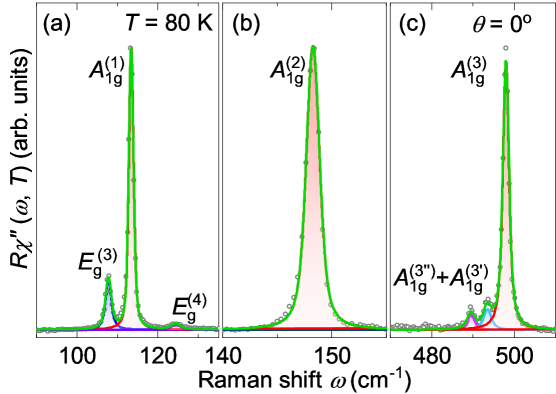
Accurate interpretation of Raman spectra requires sophisticated modeling techniques to deconvolute overlapping vibrational peaks and account for instrumental broadening. The Voigt profile, a convolution of the Gaussian and Lorentzian functions, is commonly employed as it realistically represents the observed spectral line shapes; the Gaussian component arises from natural broadening and instrumental effects, while the Lorentzian component originates from lifetime effects and homogeneous broadening mechanisms. Fitting experimental data with the Voigt profile allows for the precise determination of peak positions, intensities, and widths, which are directly related to phonon frequencies, selection rules, and lifetimes, respectively. Quantitative analysis using this approach enables the extraction of key material properties and a deeper understanding of lattice dynamics; incorrect modeling can lead to misinterpretation of spectral features and inaccurate conclusions regarding the material’s vibrational characteristics.

Witnessing the Lattice Singularity
The observation of a Phonon Frequency Comb in indium silicon telluride (InSiTe3) signifies substantial nonlinear behavior within its lattice vibrations. Frequency combs, typically associated with optical phenomena, arise when interatomic interactions deviate from simple harmonic motion. In this material, the generation of equidistant frequencies in the phonon spectrum confirms that the restoring force acting on atoms is not linearly proportional to their displacement. This departure from harmonicity indicates strong anharmonic effects, where the potential energy surface describing atomic vibrations is non-parabolic, leading to the creation of multiple phonons through four-wave mixing and other nonlinear processes. The presence of such a comb demonstrates a level of lattice nonlinearity exceeding that predicted by harmonic approximations and suggests InSiTe3 as a platform for exploring novel phonon-driven phenomena.
The A1g mode in InSiTe3 is central to the observed phonon frequency comb due to its specific vibrational characteristics. Spectroscopic analysis reveals that this mode’s frequencies are not evenly spaced as predicted by harmonic oscillator models; instead, it exhibits a series of frequencies that are equidistant, meaning the difference between successive frequencies remains constant. This equidistant spacing is a direct consequence of strong anharmonicity within the crystal lattice, leading to a repeatable frequency structure when the material is excited. The fundamental frequency of the A1g mode, along with its harmonic and subharmonic generation, contributes to the formation of this comb, and the regularity of the frequency spacing is key to its identification as a frequency comb phenomenon.
The observed nonlinearities in InSiTe3 originate from anharmonicity within the interatomic potential, representing a departure from the idealized simple harmonic oscillator model. In a harmonic potential, restoring forces are directly proportional to displacement, leading to a single resonant frequency. However, real materials exhibit anharmonicity, where the restoring force deviates from linearity, introducing frequency mixing and generating higher-order vibrational modes. This anharmonicity manifests as a dependence of the vibrational frequency on amplitude and leads to the creation of multiple phonons from a single high-energy phonon, contributing to the observed frequency comb. The strength of this anharmonicity is directly related to the steepness of the potential well and the coupling between different vibrational modes.
The phonon-phonon coupling parameter, \lambda_{ph-ph}, quantifies the strength of interactions between phonons and influences thermal conductivity. In InSiTe3, the \lambda_{ph-ph} value calculated for the A1g(3) mode is 2.8. This exceptionally large value indicates strong anharmonic interactions within the lattice, significantly impacting phonon scattering processes. This result is consistent with previously reported values for similar materials, notably CrSiTe3, suggesting a common underlying mechanism driving strong phonon-phonon coupling in this class of layered materials. A larger \lambda_{ph-ph} generally correlates with lower thermal conductivity due to increased phonon scattering.
The Klemens model describes phonon lifetimes and linewidths resulting from anharmonic decay processes within a crystal lattice. This model posits that phonon decay occurs primarily through the interaction with other phonons, specifically through the emission of two or more phonons conserving energy and momentum. The decay rate, and thus the inverse phonon lifetime Γ, is proportional to the strength of the anharmonic potential and the density of available final states. The linewidth, directly related to the decay rate by \Delta\omega = \hbar\Gamma, therefore provides a measure of the degree to which anharmonicity broadens the phonon spectrum. Applying the Klemens model allows for the quantitative assessment of phonon damping mechanisms and the determination of parameters characterizing the strength of anharmonic interactions within materials like InSiTe3.

The Dawn of Phononic Engineering
The recent detection of a phonon frequency comb within InSiTe3 signifies a potential breakthrough in manipulating heat at the atomic level. This comb, a series of evenly spaced vibrational frequencies, indicates the possibility of generating and controlling coherent phonons – vibrations that act in unison, much like the coordinated waves in a laser. Unlike typical phonon behavior, where vibrations are largely chaotic, coherence allows for the efficient channeling of energy, potentially leading to materials with dramatically enhanced thermal conductivity. Researchers posit that by precisely controlling these coherent vibrations, it may be possible to design materials that either conduct or insulate heat with unprecedented efficiency, opening doors to innovations in thermoelectric devices and advanced thermal management systems. This precise vibrational control, demonstrated in InSiTe3, represents a departure from traditional approaches to heat transfer and offers a new paradigm for materials science.
The emergence of coherent phonons within InSiTe3 holds significant promise for manipulating heat flow and improving energy conversion efficiency. These collective vibrational modes, behaving like waves, can transport thermal energy with minimal scattering, potentially leading to substantially enhanced thermal conductivity. This effect isn’t simply about moving heat faster; it opens the door to tailoring a material’s thermoelectric properties – its ability to convert temperature differences into electrical voltage, and vice-versa. By controlling phonon coherence, researchers envision materials capable of more efficient waste heat recovery, or solid-state refrigeration technologies, exceeding the limitations of current materials. The precise control over phonon behavior afforded by these coherent vibrations represents a paradigm shift in materials science, potentially enabling the creation of devices with unprecedented thermal and energy management capabilities.
The remarkable consistency of peak spacing-measured at precisely 4.2 cm-1-throughout the observed phonon frequency comb in InSiTe3 suggests a highly ordered and predictable underlying vibrational structure. This uniform spacing isn’t a random occurrence; it indicates a strong correlation between different phonon modes, hinting at a coherent interplay driving these lattice dynamics. Researchers believe this regularity arises from the specific crystallographic symmetry and bonding characteristics of the material, creating a “ruler” for phonon wavelengths. The implications extend beyond mere observation, as this controlled spacing could be harnessed for manipulating thermal energy flow and potentially designing materials with unprecedented thermoelectric efficiency, allowing for precise tuning of phonon behavior at the nanoscale.
Investigations into InSiTe3 reveal a notable shift in how phonons – quantized vibrations within a material – interact with each other. Specifically, a distinct discontinuity emerges in the linewidths of the A1g(1) and A1g(2) phonon modes at approximately 200 Kelvin. This abrupt change suggests a modification in the strength of phonon-phonon coupling – the process by which vibrations share energy and influence each other. Researchers posit that this transition indicates a change in the dominant scattering mechanisms affecting these vibrational modes, potentially linked to alterations in the material’s structural or electronic properties as temperature changes. Understanding this coupling is crucial, as it directly impacts thermal conductivity and other material properties, offering potential avenues for engineering materials with tailored vibrational characteristics.
The intriguing behaviors observed within InSiTe3 are demonstrably not isolated to this specific material. Investigations into related van der Waals materials, notably CrSiTe3 and CrGeTe3, reveal strikingly similar phenomena, including the emergence of phonon frequency combs and associated coherent effects. This suggests a fundamental underlying mechanism governing phonon dynamics within this class of materials, potentially linked to their layered structures and interlayer interactions. The consistency of these observations across multiple compounds broadens the scope of potential applications, hinting at a pathway towards designing a range of phononic devices and tailoring thermal properties in a diverse set of two-dimensional materials beyond InSiTe3.
The detailed observation of coherent phonon dynamics within materials like InSiTe3 offers a pathway toward engineering materials with unprecedented control over heat flow. By manipulating these vibrational frequencies, researchers anticipate designing advanced phononic devices – components that utilize sound waves rather than electrons – with applications ranging from highly efficient thermal management systems to novel sensors. This ability to tailor material properties extends beyond thermal conductivity; precise control over phonon behavior could also lead to materials exhibiting enhanced thermoelectric performance, converting heat directly into electrical energy with greater efficiency. The fundamental principles uncovered in this research, applicable to a range of related compounds, suggest a future where materials are designed at the vibrational level, unlocking a new era of phononic engineering and creating materials with properties specifically optimized for diverse technological applications.

The exploration of InSiTe3’s phonon frequency comb reveals a system exhibiting a complexity that, while novel in its manifestation, is hardly surprising. The material’s strong anharmonicity, leading to localized high-energy phonon modes, embodies the inevitable decay of idealized harmonicity-a principle echoed in broader systemic evolution. One witnesses not a disruption, but a transformation, as energy redistributes and new patterns emerge. This echoes Mary Wollstonecraft’s sentiment: “The mind, when once accustomed to investigate, will investigate everything.” The researchers’ pursuit of coherent phonon phenomena within InSiTe3 exemplifies this relentless investigation, demonstrating how even within seemingly stable architectures, continuous change is the only constant, and improvements age faster than one can understand them.
What Lies Ahead?
The observation of frequency comb structures within InSiTe3, while intriguing, merely illuminates the inevitable decay of simplicity. Each coherent phonon, each isolated mode, is a temporary reprieve from the entropic tide. The system doesn’t achieve stability; it stores instability, releasing it as spectral lines-a fleeting order before the return to noise. Further investigation will undoubtedly reveal the limitations of this particular material, the precise mechanisms governing comb longevity, and the point at which anharmonicity becomes a destructive force rather than a generative one.
The real question isn’t whether these combs can be maintained, but rather what can be gleaned from their transient existence. Exploring the coupling between these frequency combs and external stimuli – light, strain, even subtle temperature fluctuations – presents an avenue for probing the fundamental latency inherent in all material responses. Every interaction introduces a delay, a tax on the request for coherence.
Ultimately, this work signifies not a destination, but an invitation to map the contours of imperfection. The search for materials exhibiting similar phonon comb behavior will likely expand, driven not by a quest for perpetual motion, but by a growing recognition that the most valuable insights arise from understanding how things fall apart, and the spectral fingerprints they leave behind.
Original article: https://arxiv.org/pdf/2602.20747.pdf
Contact the author: https://www.linkedin.com/in/avetisyan/
See also:
- All 13 Smash Bros. Characters in the Super Mario Galaxy Movie
- The Super Mario Galaxy Movie: 50 Easter Eggs, References & Major Cameos Explained
- Dune 3 Gets the Huge Update Fans Have Been Waiting For
- Welcome to Demon School! Iruma-kun season 4 release schedule: When are new episodes on Crunchyroll?
- Sydney Sweeney’s The Housemaid 2 Sets Streaming Release Date
- TV legend Carol Kirkwood reveals the reasons why she decided to retire after 28 years with BBC
- Why is Tech Jacket gender-swapped in Invincible season 4 and who voices her?
- Highly Anticipated Strategy RPG Finally Sets Release Date (And It’s Soon)
- Darwin’s Paradox! drops Switch version for Switch 2, delayed to 2026
- We Need More Open World Games to Feature This Genre
2026-02-26 05:32