Author: Denis Avetisyan
New research reveals how analyzing momentum variations in high-energy collisions can provide insights into the behavior of extremely dense baryonic matter.
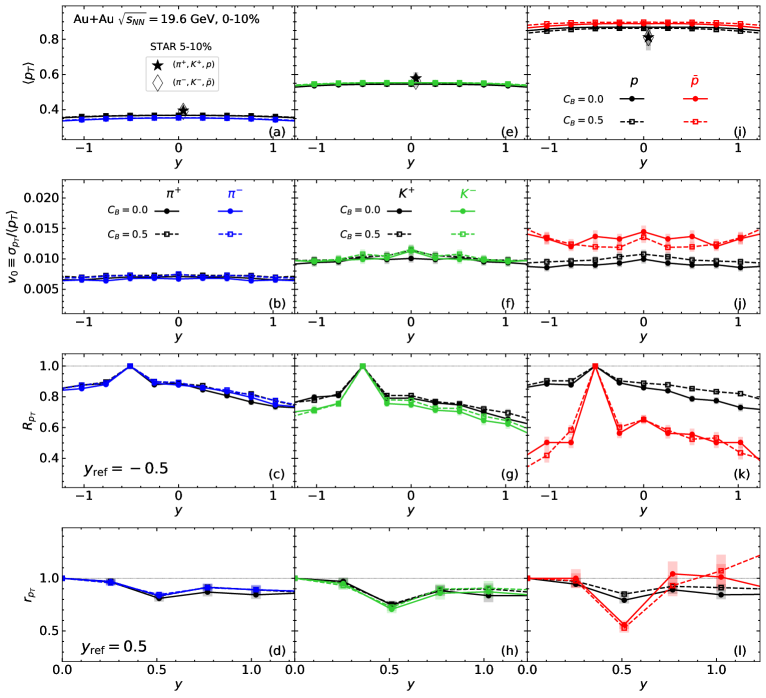
This study investigates the rapidity dependence of mean transverse momentum fluctuations and decorrelation to probe the equation of state and baryon density in relativistic heavy-ion collisions.
Understanding the equation of state and density fluctuations in extreme conditions remains a central challenge in relativistic heavy-ion physics. This study, entitled ‘Rapidity dependence of mean transverse momentum fluctuation and decorrelation in baryon-dense medium’, investigates event-by-event fluctuations of mean transverse momentum and their rapidity decorrelation as sensitive probes of the equation of state and baryon density distributions created in these collisions. We find that this observable is robust against viscosity effects and largely insensitive to baryon diffusion, revealing a pronounced rapidity-dependent splitting between proton and antiproton transverse flow. Could these findings provide a novel pathway to map the three-dimensional structure of energy and baryon density profiles in baryon-rich systems?
The Echo of Creation: Replicating the Early Universe
When atomic nuclei are collided at velocities approaching the speed of light, an extraordinary state of matter emerges – the Quark-Gluon Plasma (QGP). This fleeting phenomenon, existing for only a tiny fraction of a second, replicates conditions thought to have existed in the very early universe, moments after the Big Bang. The immense energy of these relativistic heavy-ion collisions overcomes the strong force binding quarks within protons and neutrons, liberating them into a deconfined “soup” alongside their force-carrying particles, the gluons. This results in an extremely hot and dense environment – temperatures exceeding 10^{12} Kelvin – where matter is no longer composed of hadrons, but rather a plasma of fundamental particles behaving collectively, distinct from everyday matter and providing a unique window into the nature of strong interactions.
Simulating the Quark-Gluon Plasma’s evolution presents a formidable computational undertaking, stemming from the incredibly short timescales and extreme conditions involved. The QGP, existing for only a fleeting moment after the collision of heavy ions, demands models capable of tracking the interactions of thousands of quarks and gluons. These simulations aren’t simply about calculating trajectories; they require solving complex equations of quantum chromodynamics (QCD) in a dynamic, many-body environment. The computational power needed scales dramatically with the desired precision and the size of the simulated volume, often necessitating the use of supercomputers and advanced algorithms to approximate solutions within a reasonable timeframe. Capturing the QGP’s intricate dance – from its initial formation to its eventual cooling and hadronization – remains a key frontier in computational physics, pushing the boundaries of current hardware and theoretical understanding.
The behavior of the Quark-Gluon Plasma (QGP) arises from the collective interactions of its constituent quarks and gluons, necessitating theoretical frameworks beyond simple perturbative calculations. Describing this collective behavior requires advanced techniques like lattice Quantum Chromodynamics (QCD), which discretizes spacetime to solve QCD equations numerically, and hydrodynamic models that treat the QGP as a fluid. These simulations are computationally intensive, demanding high-performance computing resources to model the rapid evolution of the QGP created in relativistic heavy-ion collisions. Furthermore, accurately capturing the transition between the QGP and hadronic matter – a phase transition – presents a significant challenge, requiring sophisticated equations of state and non-equilibrium dynamics to bridge the gap between theoretical predictions and experimental observations.
The Fluidity of the Quark-Gluon Plasma: Modeling Collective Flow
Hydrodynamic modeling of the Quark-Gluon Plasma (QGP) leverages the principles of fluid dynamics to describe its time evolution. This approach is based on the conservation of energy, momentum, and charge, expressed mathematically as continuity equations and expressed generally as \partial_{\mu}T^{\mu\nu} = 0, where T^{\mu\nu} is the stress-energy tensor. By treating the QGP as a fluid with properties like density, pressure, and temperature, these conservation laws provide a set of partial differential equations that can be solved numerically to simulate the QGP’s expansion and cooling following a heavy-ion collision. This allows researchers to predict observables such as particle spectra and flow patterns, which can then be compared with experimental data from facilities like the Relativistic Heavy Ion Collider (RHIC) and the Large Hadron Collider (LHC).
The MUSIC (Multi-Instance Unitarity Solver in C++) code utilizes the principles of relativistic viscous hydrodynamics to model the quark-gluon plasma (QGP) created in heavy-ion collisions. This approach treats the QGP as a fluid subject to conservation of energy, momentum, and baryon number, described by equations incorporating both ideal and dissipative effects. The code solves these equations numerically on a discretized spacetime lattice, accounting for the finite viscosity of the QGP which influences its flow and thermalization. By evolving the system from initial conditions through time, MUSIC simulates the expansion and cooling of the QGP, allowing for predictions of particle spectra and flow coefficients that can be compared to experimental data from facilities like the Relativistic Heavy Ion Collider (RHIC) and the Large Hadron Collider (LHC).
The precision of hydrodynamic simulations of the Quark-Gluon Plasma (QGP) is fundamentally dependent on the accurate representation of its thermodynamic properties and the conditions present at the moment of its formation. The equation of state (EoS), such as NEoS-BQS, defines the relationship between pressure, energy density, and temperature, critically influencing the predicted flow and evolution of the QGP. Equally important are realistic initial conditions, which specify the energy density distribution at the time of QGP creation-typically modeled using configurations like a ‘tilted fireball’-and directly impact the subsequent hydrodynamic expansion. Deviations in either the EoS or initial conditions from the actual system will introduce systematic errors into the simulation results, affecting quantities such as collective flow coefficients and particle spectra.
Hydrodynamic simulations of the Quark-Gluon Plasma (QGP) require the specification of initial conditions to define the energy density distribution at the time of QGP formation. A common approach utilizes a ‘tilted fireball’ model, representing an initial energy density profile resembling an ellipsoid. This ellipsoid is not necessarily aligned with the beam axis, hence the ‘tilt’, and its parameters-size, eccentricity, and orientation-influence the subsequent QGP evolution. The energy density is typically parameterized to reflect the energy deposited from the initial nuclear collision, with higher densities corresponding to regions of greater overlap. Precise definition of this initial condition is crucial, as it directly impacts the observed collective flow and particle spectra, and requires careful consideration of the collision geometry and underlying physics.
From Fluidity to Fragmentation: Modeling Hadronic Breakup
The quark-gluon plasma (QGP), created in high-energy heavy-ion collisions, is not a stable state of matter. As the system expands and cools, the energy density decreases, eventually falling below the critical temperature for the deconfinement transition. This transition results in a phase change from the deconfined quark and gluon degrees of freedom to confined hadronic matter, consisting of mesons and baryons. This process, often modeled using equations of state that incorporate the transition, leads to the creation of a dilute gas of hadrons that subsequently interact via strong interactions before being detected. The specific temperature at which this transition occurs is dependent on the baryon chemical potential and is an active area of research.
Following the stage of hydrodynamic expansion, the system transitions into a dilute hadronic phase composed of particles like pions, kaons, and baryons. To model this phase, hadronic transport approaches such as UrQMD (Ultra-relativistic Quantum Molecular Dynamics) are utilized. These approaches simulate the interactions between individual hadrons based on established cross-sections and, crucially, do not rely on the fluid dynamical assumptions of collective flow. UrQMD propagates these hadrons through spacetime, accounting for elastic and inelastic collisions, particle decays, and hadronization processes, ultimately determining the final particle distribution. This allows for a detailed description of the late-stage evolution of the collision, complementing the macroscopic picture provided by hydrodynamics and bridging the gap to observable particle spectra.
Combining hydrodynamic and hadronic transport models provides a comprehensive simulation of heavy-ion collisions. Hydrodynamic calculations accurately describe the initial, high-energy density phase of the quark-gluon plasma (QGP) and its subsequent expansion. However, hydrodynamics breaks down at lower temperatures and densities. Hadronic transport models, such as UrQMD, then take over, simulating the interactions of individual hadrons in the dilute, post-hydrodynamic phase. This combined approach begins with the initial nuclear collision and progresses through the QGP evolution, the hadronization process, and ultimately to the final state of particles detected in experiments. The hydrodynamic stage provides initial conditions – temperature, velocity, and density profiles – for the hadronic transport stage, enabling a complete and self-consistent description of the collision from impact to particle production.
Accurate modeling of the net-baryon density distribution in relativistic heavy-ion collisions requires careful consideration of baryon diffusion. Recent analyses utilizing hadronic transport approaches have demonstrated a surprisingly weak sensitivity of final-state observables to variations in baryon diffusion parameters. Specifically, results indicate minimal dependence on R_{pT} and r_{pTr}, which govern the spatial extent and strength of baryon diffusion respectively. This finding suggests that, while fundamentally important for a complete theoretical description, uncertainties in the precise modeling of baryon diffusion have a limited impact on predictions for overall particle yields and distributions in the final state.
The Imprint of Chaos: Fluctuations and Correlations in the QGP
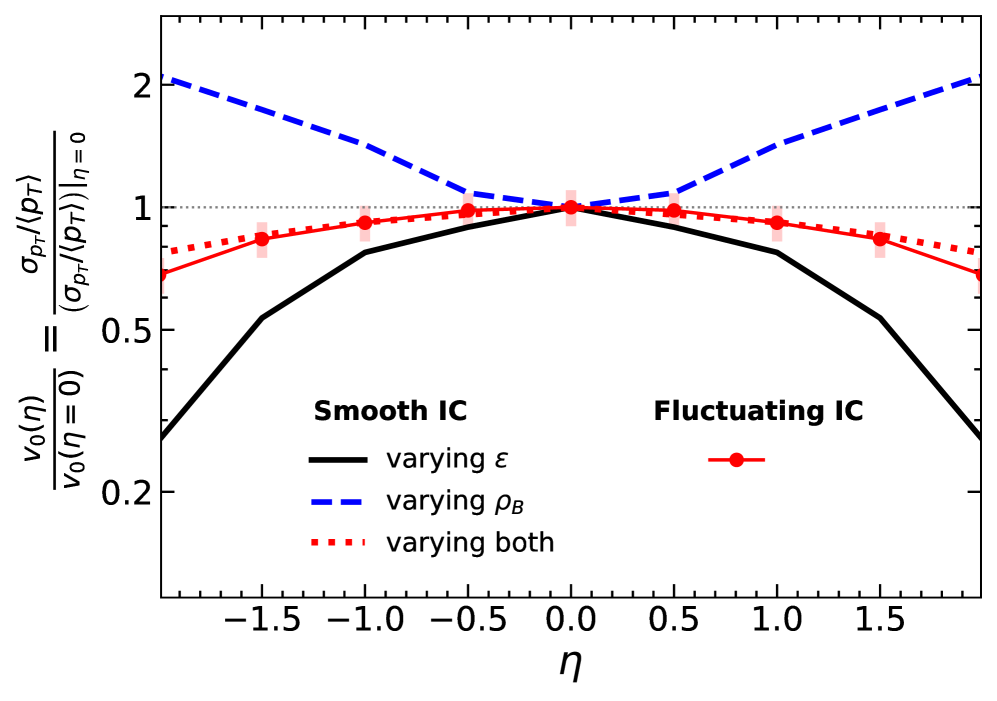
The creation of the quark-gluon plasma (QGP) is not a static, uniform process; instead, each collision exhibits unique characteristics stemming from event-by-event fluctuations in the initial energy density and subsequent dynamic evolution. These fluctuations, originating from the probabilistic nature of the underlying particle collisions, dramatically impact the final state of the system, manifesting as variations in particle production, collective flow patterns, and overall observable distributions. Consequently, understanding these fluctuations is paramount to accurately characterizing the QGP’s properties; a seemingly identical collision can yield strikingly different outcomes, necessitating statistical analyses across numerous events to reveal the underlying trends and disentangle the genuine signals of the QGP from the inherent randomness of the initial state. This sensitivity to initial conditions highlights the complex, dynamic nature of QGP formation and demands sophisticated theoretical models capable of capturing these event-by-event variations to precisely map the properties of this exotic state of matter.
The extreme conditions created in heavy-ion collisions give rise to a state of matter known as the quark-gluon plasma (QGP), and its response to the initial energy deposited in the collision manifests as collective flow. This flow isn’t simply an outward expansion; it comprises both longitudinal components – stretching the plasma along the collision axis – and transverse components, where particles move collectively perpendicular to that axis. By meticulously analyzing the strength and patterns of these flow components, physicists can reconstruct the initial energy density distribution. A greater degree of ‘collectivity’ – indicated by stronger flow – suggests a more fluid-like behavior of the QGP, while the specific anisotropy of the flow provides insights into the initial shape of the energy density. Essentially, collective flow acts as a sensitive probe, allowing researchers to map the early dynamics of the QGP and understand how the initial conditions influence the final momentum distribution of the produced particles.
The three-bin correlator offers a nuanced method for investigating the quark-gluon plasma (QGP) by quantifying the degree to which particle production at different rapidities is correlated – or ‘decorrelated’ – revealing insights into the plasma’s transport coefficients. This technique effectively maps out how quickly and efficiently momentum and energy propagate through the QGP, providing a sensitive probe of its internal structure and dynamics. By analyzing correlations across various rapidity bins, researchers can discern the extent to which particles emitted at different angles ‘remember’ their shared origin, even after interacting extensively within the dense medium. A diminished correlation suggests a more rapid thermalization and stronger interactions, implying a lower viscosity and a more perfect fluid-like behavior. Consequently, the three-bin correlator serves as a powerful diagnostic tool for characterizing the QGP’s ability to dissipate energy and momentum, thereby constraining theoretical models and furthering understanding of this exotic state of matter.
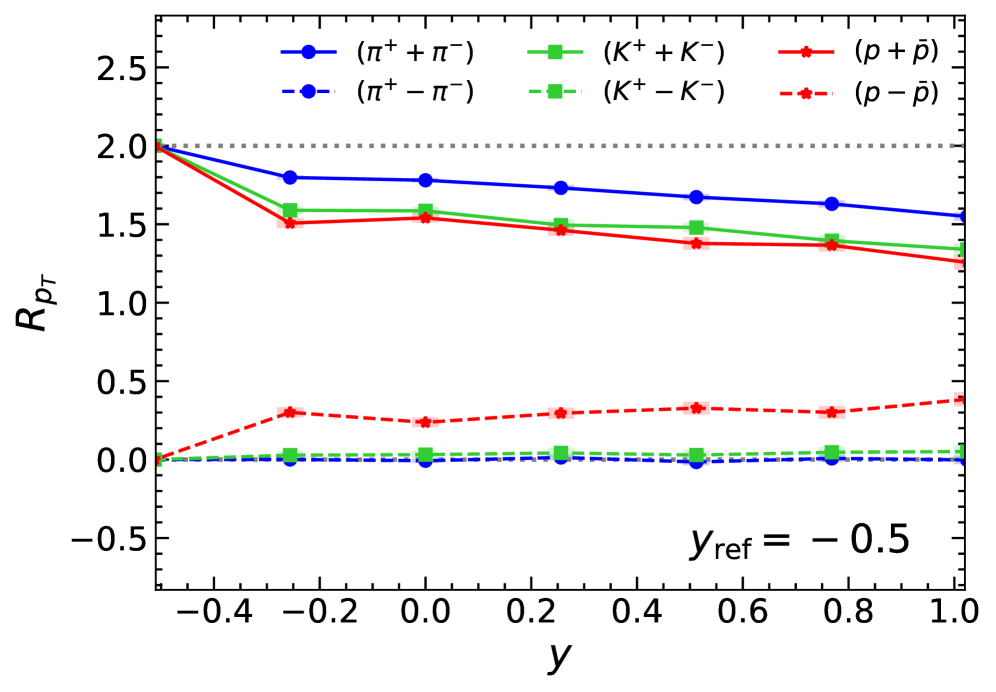
The internal friction of the quark-gluon plasma (QGP), characterized by both shear and bulk viscosity, fundamentally alters the collective motion established during heavy-ion collisions and consequently, the distribution of final-state particles. Recent analysis demonstrates a notable difference in how baryons and antibaryons flow radially outward, with baryons exhibiting approximately 30% greater radial flow – a splitting quantified by a difference in R_{pT}. This disparity isn’t merely a correlation between the two particle types; it’s primarily driven by the inherent difference in their transverse momentum (p_T) distributions, rather than a shared covariance. Further supporting this observation, a clear splitting was also identified in the standard deviation of transverse momentum (\sigma_{pT}), providing direct evidence that baryons and antibaryons experience distinct dynamical behavior within the QGP, shaped by the plasma’s viscous properties.
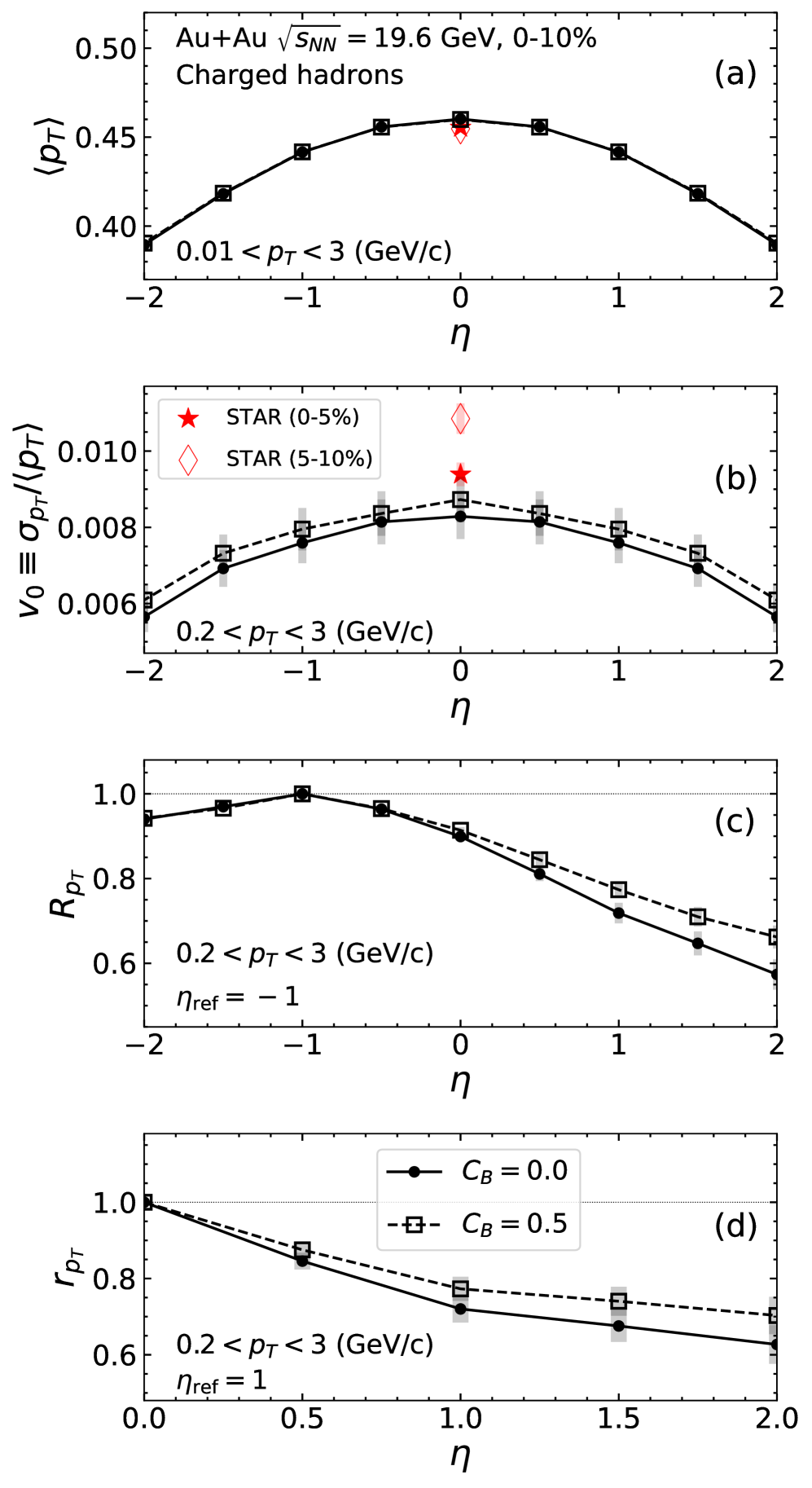
The study’s focus on mean transverse momentum fluctuations and rapidity decorrelation to understand baryon density reveals a fundamental truth about how systems respond to extreme conditions. It’s not merely about the physics of the collision, but the inherent tendencies towards order and chaos within the created medium. As Bertrand Russell observed, “The difficulty lies not so much in developing new ideas as in escaping from old ones.” This research, by seeking novel signals within the complex data of heavy-ion collisions, attempts precisely that – to escape the limitations of conventional understanding. The pursuit of the equation of state, and the delicate balance between fear of instability and hope for predictability, highlights how all behavior is a negotiation between fear and hope.
The Horizon of Fluctuations
The pursuit of the equation of state in these relativistic collisions continues, predictably, to resemble alchemy more than physics. This work, focused on the delicate dance of transverse momentum fluctuations, offers another parameter to twist, another signal to chase. It reveals, not surprisingly, that baryon density leaves a discernible mark – a predictable consequence of adding more pieces to the chaotic system. The real question isn’t whether baryon density influences these fluctuations, but whether anyone will truly believe a precise measurement when it arrives.
The observed rapidity decorrelation, a fading of patterns with distance, is a familiar story. Systems remember their origins for a time, then succumb to entropy. The challenge lies in disentangling this natural dispersal from the genuine imprints of the initial conditions, a task akin to separating the signal of a whisper from the roar of the crowd. Future work will inevitably involve more sophisticated hydrodynamic models, each one a further abstraction from the messy reality of colliding nuclei.
One suspects the true limit isn’t computational power, but the human tendency to see patterns where none exist. Bubbles are born from shared excitement and die from lonely realization. Each refined measurement, each nuanced model, will be interpreted through the lens of pre-existing beliefs. The equation of state, if it ever truly yields its secrets, will do so not through elegance, but through the slow accumulation of disillusionment.
Original article: https://arxiv.org/pdf/2602.16369.pdf
Contact the author: https://www.linkedin.com/in/avetisyan/
See also:
- Gold Rate Forecast
- Dune 3 Gets the Huge Update Fans Have Been Waiting For
- Guardians of the Globe Members We Want to See in Invincible Season 4
- What Song Is In The New Supergirl Trailer (& What It Means For The DC Movie)
- One of Hulu’s Best New Shows Lands on Disney+ Ahead of Season 2
- Kelly Osbourne Slams “Disgusting” Comments on Her Appearance
- Hideo Kojima Says He Was Never Told About The Matrix Creators Wanting Him to Make a Game
- ’90s Cartoon Reboot & TMNT Connection!
- MMOs Usually Take Up Too Much Time, But One Returning Classic Could Change That
- DC Event Are Better Than Marvel Ones for This One Little Reason
2026-02-19 18:47