Author: Denis Avetisyan
Researchers have successfully created and observed one-dimensional anyons, providing compelling evidence for their exotic quantum behavior.
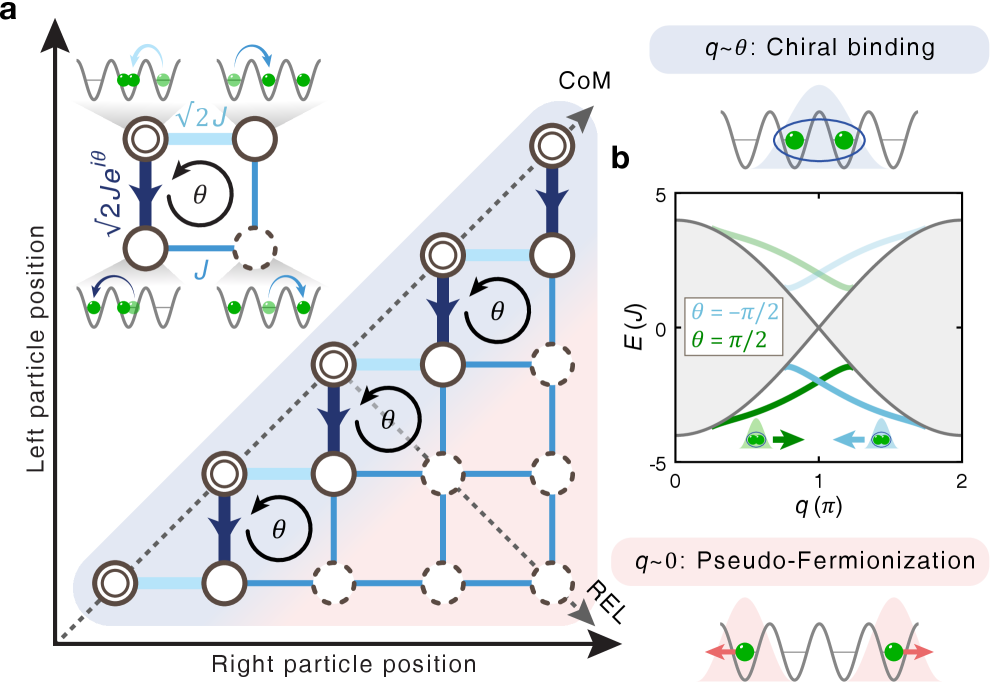
Adiabatic state preparation confirms pseudo-fermionization and chiral binding in these unique quasiparticles.
While exotic quantum statistics predict fundamentally different behaviors beyond those of bosons and fermions, realizing and characterizing one-dimensional anyons has remained a significant challenge. This work, ‘Revealing Pseudo-Fermionization and Chiral Binding of One-Dimensional Anyons using Adiabatic State Preparation’, reports the creation and observation of these elusive quasiparticles using ultracold atoms in an optical lattice. Specifically, we demonstrate the emergence of pseudo-fermionic behavior and the formation of chiral bound states, confirming the unique statistical interactions of 1D anyons. These findings bridge theoretical models with experimental realizations and pave the way for exploring complex many-body physics and topological quantum computation in these novel systems-but what new quantum phases might emerge when these anyons are driven far from equilibrium?
Unveiling the Exotic Realm of Anyons
For decades, condensed matter physics largely operated within the framework of well-defined particle statistics – bosons and fermions – dictating how particles behave in collective systems. However, a growing body of research reveals materials hosting exotic quasiparticles known as anyons, which fundamentally challenge this categorization. Unlike their more familiar counterparts, anyons don’t adhere to either bosonic or fermionic exchange statistics; instead, exchanging identical anyons introduces a phase change to the quantum wavefunction. This subtle difference has profound implications, not just for understanding the fundamental nature of matter, but also for potentially revolutionizing computation through the creation of topologically protected quantum bits, or qubits, which are far more resilient to environmental noise than conventional qubits. The discovery and characterization of these particles necessitate a departure from traditional theoretical models and the development of novel experimental techniques capable of probing these unusual quantum states.
Unlike the familiar behavior of bosons and fermions – particles that either don’t care if they switch places or strictly avoid each other – anyons exhibit a far stranger characteristic: when two identical anyons are exchanged, the wavefunction of the system acquires a phase shift. This isn’t merely a quantitative difference, but a fundamental alteration of their statistical properties; the phase acquired depends on the path taken during the exchange, creating a ‘memory’ of the braiding process. This peculiar characteristic isn’t just theoretical curiosity; it forms the basis for potential applications in topological quantum computation. Because the information is encoded in the braiding of these anyons-their paths around each other-the quantum state becomes remarkably robust against local disturbances, offering a pathway towards building more stable and reliable quantum computers, where information isn’t stored in the particles themselves, but in their intricate, interwoven dance.
The pursuit of anyons, and ultimately harnessing their potential, presents formidable experimental hurdles. These quasiparticles are not fundamental particles like electrons, but emerge from the collective behavior of electrons in carefully engineered materials, making their creation and isolation incredibly delicate. Researchers must achieve extraordinarily precise control over material purity, temperature, and external fields – often at temperatures just above absolute zero – to coax these exotic states of matter into existence. Furthermore, directly observing anyons is not straightforward; their detection relies on indirect measurements of their unique exchange statistics, demanding sophisticated theoretical models to interpret the experimental data and confirm their presence. This interplay between meticulous experimental technique and advanced theoretical understanding is crucial, as even minor imperfections in the system can obscure the anyonic signature or lead to misinterpretation of results, delaying the realization of topological quantum computation.
Constructing a Quantum Playground: Ultracold Atoms in Optical Lattices
The experimental platform employs Rubidium-87 (Rb^{87}) atoms cooled to ultracold temperatures – on the order of nanokelvins – and trapped within an optical lattice created by intersecting laser beams. This lattice acts as a periodic potential, confining the atoms at discrete lattice sites and enabling precise control over their positions and interactions. The use of a lattice allows for the simulation of anyonic systems by effectively reducing the dimensionality and controlling the interactions between the atoms, mimicking the behavior of anyons in two-dimensional systems. The lattice parameters are carefully engineered to tailor the interatomic interactions and create the desired quantum state for observing anyonic behavior.
Digital Micromirror Devices (DMDs) are utilized to spatially modulate the trapping potential of the optical lattice, enabling the isolation and manipulation of individual Rubidium-87 atoms. These devices consist of an array of microscopic mirrors, each individually controllable. By reflecting or deflecting laser beams used to form the lattice, the intensity of the light at specific locations can be precisely controlled, creating or removing potential minima that trap individual atoms. This allows for the deterministic loading of atoms into desired lattice sites, forming the initial state necessary for simulating anyonic behavior. The resolution of the DMD dictates the minimum spacing achievable between isolated atoms, and is critical for preparing well-defined initial conditions for quantum simulations.
The experimental setup utilizes the Mott Insulator state to achieve a strongly correlated atomic system, a prerequisite for observing many-body effects. This state is realized by loading Rb87 atoms into an optical lattice and controlling the lattice intensity to ensure each lattice site is occupied by, on average, one atom. The initial lattice depth was set to 45 recoil energies (ER) in the x and y directions, and 250 ER in the z direction; these parameters were selected to maximize the system’s correlation strength and minimize thermal fluctuations, effectively suppressing tunneling between lattice sites and establishing the Mott insulating behavior. This configuration allows for precise investigation of interactions between individual atoms and the emergence of collective quantum phenomena.
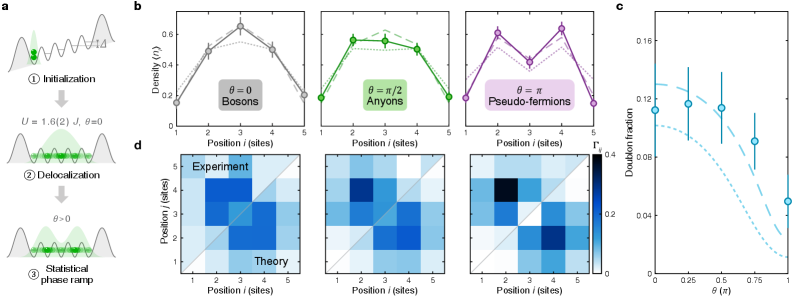
Adiabatic state preparation relies on slowly modifying the trapping potential of the optical lattice to transition the ultracold Rb87 atoms into the target configuration without significant excitation or loss. This process involves gradually changing the lattice depth and geometry over timescales much longer than the inverse of the largest energy difference between the initial and final states, ensuring the system remains close to its ground state throughout the evolution. Specifically, the lattice parameters are ramped from initial values allowing for easy loading, to the final configuration optimized for simulating the desired anyonic system, with ramp times on the order of hundreds of milliseconds to several seconds. Careful control of the ramp parameters is essential to minimize non-adiabatic excitations that would compromise the fidelity of the prepared state.
Witnessing the Dance: Asymmetric Expansion & Correlations
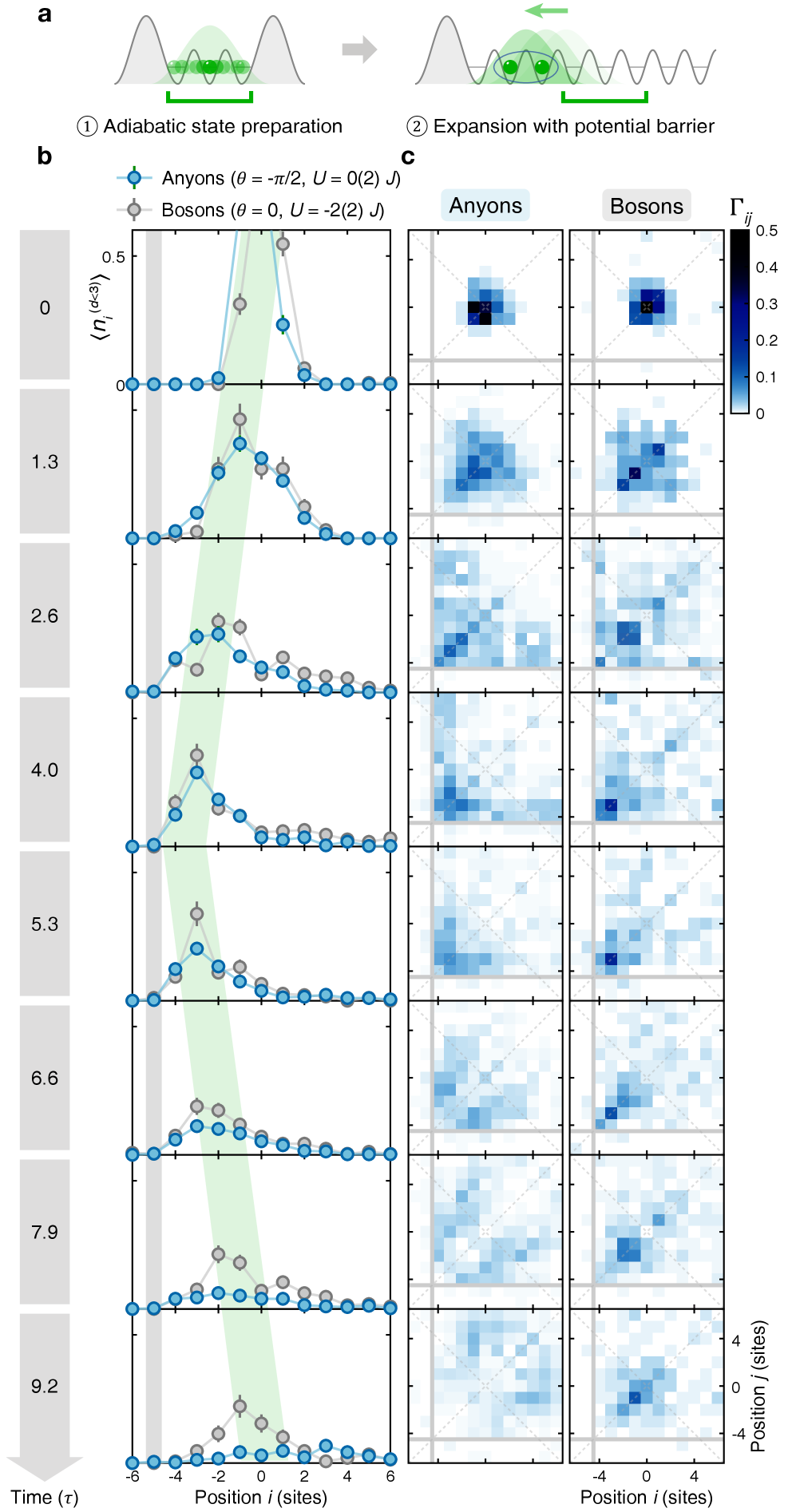
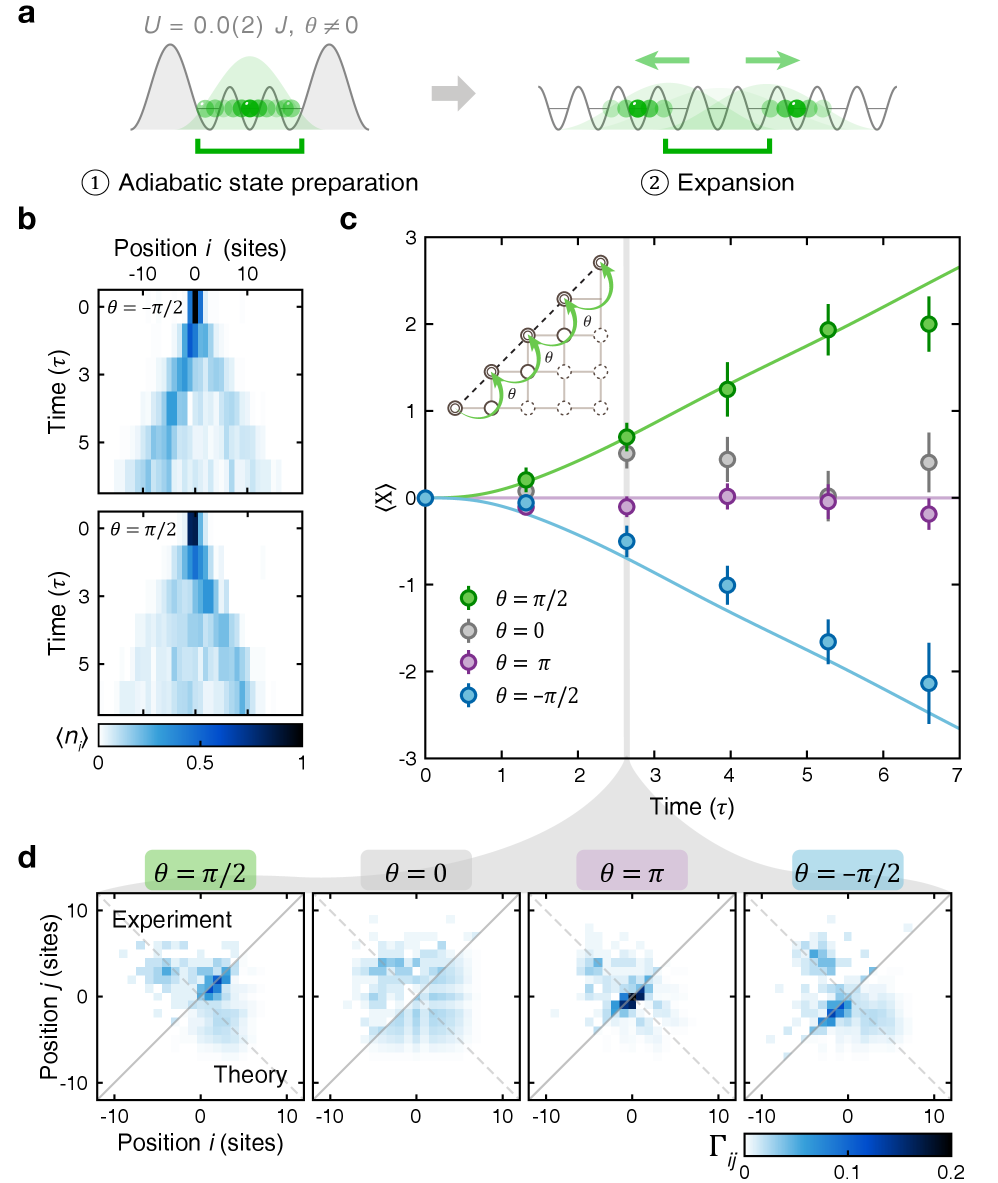
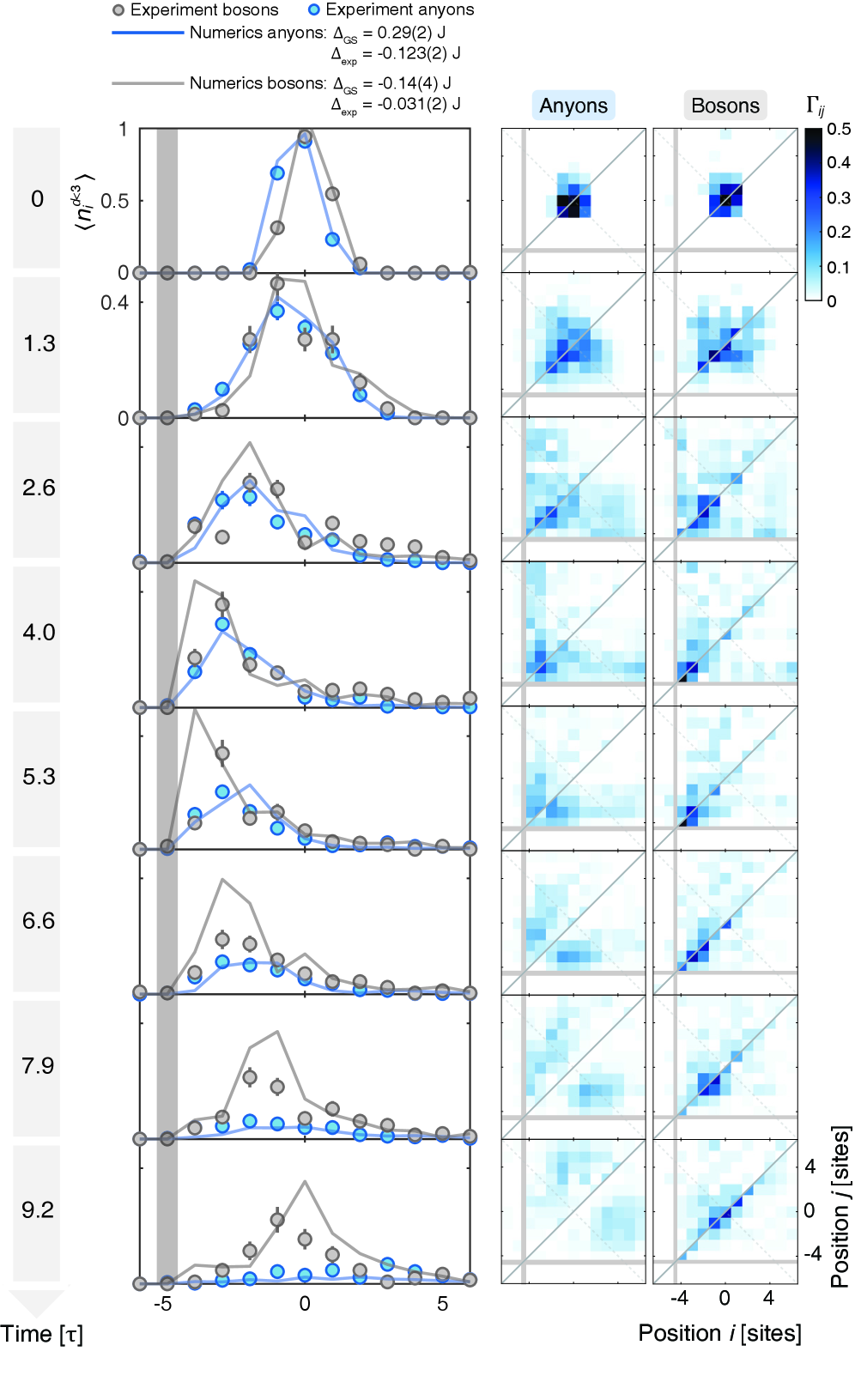
Following the release of ultracold atoms from a confining potential, asymmetric expansion of the atomic cloud was observed. This asymmetry manifests as a non-uniform distribution of atoms in momentum space, with a preferential expansion velocity along one direction relative to the initial confinement. The observed expansion dynamics are directly attributable to the formation of chiral bound states, where the atoms exhibit correlated motion dictated by their quantum statistics. Specifically, the asymmetry arises from the chiral nature of these bound states, which breaks spatial symmetry and leads to a directional preference in the expansion process. Quantitative analysis of the expansion profiles confirms a deviation from isotropic behavior, providing strong evidence for the existence of these chiral correlations.
Potential barrier reflection measurements provided additional evidence for chiral behavior in the system. Specifically, the reflection of atoms exhibited a directional dependence, indicating asymmetry in their response to the potential. This asymmetry was consistently observed at a reflection time of 4\tau, where τ represents a characteristic time scale of the experiment. The directional preference in reflection strongly suggests that the atoms are not simply reflecting specularly, but are influenced by the chiral nature of the underlying anyonic states, confirming a non-trivial response to the potential barrier.
Two-body correlation measurements demonstrated the emergence of pseudo-fermionization within the system. Specifically, the observed correlation functions exhibited characteristics consistent with particles possessing fractional exchange statistics, a hallmark of anyonic behavior in one dimension. This behavior manifests as an effective repulsion between particles, leading to anti-bunching in the correlation data; the measured correlation strength deviates significantly from that expected for bosons or fermions. The presence of these pseudo-fermionic excitations provides direct evidence for the anyonic nature of the observed quasiparticles, confirming theoretical predictions for interacting particles confined to one dimension and subjected to strong interactions.
The center-of-mass quasimomentum, k_{CM}, directly influences the formation and stability of the observed anyonic bound states. Specifically, certain values of k_{CM} promote stronger binding energies, while others suppress bound state formation. This dependence arises from the translational symmetry of the system and its effect on the overall wavefunction of the anyons. Measurements indicate a resonant enhancement of bound state probability as k_{CM} is varied, confirming the sensitivity of these states to the total momentum of the system. Furthermore, the stability of these bound states is demonstrably linked to the magnitude of k_{CM}, with higher momenta generally correlating with decreased binding energy and increased susceptibility to dissociation.
Towards a New Paradigm: Implications and Future Directions
The experimental observation of chiral bound states within this system provides compelling validation for the Anyon-Hubbard Model, a theoretical framework predicting the emergence of these unique quasiparticles. These bound states, characterized by their spatially confined nature and distinct chirality, directly correspond to the model’s predictions regarding the interactions and localization of anyons-particles exhibiting exotic exchange statistics. The confirmation isn’t merely a quantitative agreement; it demonstrates the physical realization of a system where particle identity is intrinsically linked to the way they are exchanged, offering a tangible pathway towards harnessing anyonic behavior. This provides crucial evidence that complex many-body interactions can indeed give rise to topological order, and strengthens the basis for investigating potential applications in fault-tolerant quantum computation where these chiral states act as robust building blocks.
The system’s behavior reveals a fascinating link between electron density and the fundamental statistics governing particle exchange. Specifically, the observed Density-Dependent Peierls Phase acts as a crucial mechanism for imprinting anyonic statistics – a behavior intermediate between bosons and fermions – directly into the dynamics of the electrons. This phase, which arises from the interaction between electrons and lattice vibrations, effectively modifies the wavefunction of the electrons as they move around each other, leading to the emergence of anyonic properties. Consequently, the system no longer adheres to the typical symmetrical or antisymmetrical exchange rules, instead exhibiting a phase shift that defines the anyonic character and potentially unlocking pathways toward novel quantum phenomena and technologies.
The observation of these anyonic bound states signifies a potential pathway toward realizing topological quantum computation, a paradigm promising significantly enhanced computational stability. Unlike conventional qubits, which are susceptible to decoherence from environmental noise, anyons possess a unique property: their quantum information is encoded not in local degrees of freedom, but in the topology of their worldlines. This means the information remains protected even when the anyons are perturbed or disturbed, offering inherent robustness. Leveraging anyons as qubits involves manipulating and braiding these quasiparticles – effectively weaving paths around one another – to perform quantum operations. The success of this approach could overcome a major hurdle in quantum computing, enabling the creation of more reliable and scalable quantum processors capable of tackling complex problems currently beyond the reach of classical computers.
Investigations are now shifting toward the precise control and orchestrated movement of these anyons – a process known as braiding – to realize their potential as building blocks for quantum computation. This involves carefully tuning the system’s parameters to manipulate the anyonic quasiparticles and create specific exchange patterns. Successfully braiding anyons would encode quantum information in their topological state, offering a significant advantage over conventional qubits due to inherent protection against local perturbations and decoherence. Researchers aim to develop protocols for creating and manipulating complex braid sequences, effectively implementing quantum gates and ultimately, performing intricate quantum algorithms. The ability to reliably braid anyons represents a critical step toward building a fault-tolerant quantum computer with unprecedented stability and computational power.
The pursuit of understanding one-dimensional anyons, as detailed in this work, echoes a fundamental principle of elegant design: that complex behavior emerges from underlying simplicity. Observing pseudo-fermionization and chiral bound states isn’t merely confirming theoretical predictions; it’s revealing the inherent structure governing these exotic particles. As Galileo Galilei observed, “You cannot teach a man anything; you can only help him discover it himself.” This research doesn’t impose understanding, but rather provides the experimental framework to reveal the intrinsic properties of anyons – their unique quantum statistics, and how structure dictates their observed behavior within these one-dimensional systems. The clarity of these findings highlights the power of uncovering fundamental principles.
Where Do We Go From Here?
The demonstration of controlled anyonic behavior in one dimension, and the observation of pseudo-fermionization as a consequence, is not an arrival, but a realignment. It clarifies that the elegance of theoretical prediction is merely the first iteration of a far more complex dialogue with material reality. The apparent simplicity of the one-dimensional system belies the subtle tensions introduced by even minimal perturbations; each optimization, each refined control parameter, inevitably creates new points of instability. The observed chiral bound states, while confirming predicted statistics, also highlight the difficulty of isolating truly topological protection from the surrounding environmental noise.
Future work will necessarily move beyond simply observing anyonic behavior. The focus must shift towards manipulating these states – braiding, fusing, and ultimately, utilizing them as robust qubits for quantum computation. However, the path is not merely one of increasing control, but of understanding the inherent limitations imposed by the system’s architecture. Any attempt to scale these systems will require a deep consideration of decoherence mechanisms, and a move toward architectures that actively mitigate rather than simply avoid environmental interactions.
The true challenge, then, lies not in achieving topological protection, but in designing systems where the interplay between topology and environment yields predictable, controllable behavior. It is a reminder that the system is its behavior over time, not a static diagram on paper. The pursuit of anyonic quantum computation will, at its core, be a study in complex systems, where simplicity is an illusion and every solution generates a new, more nuanced problem.
Original article: https://arxiv.org/pdf/2602.20421.pdf
Contact the author: https://www.linkedin.com/in/avetisyan/
See also:
- The Super Mario Galaxy Movie: 50 Easter Eggs, References & Major Cameos Explained
- All 13 Smash Bros. Characters in the Super Mario Galaxy Movie
- Highly Anticipated Strategy RPG Finally Sets Release Date (And It’s Soon)
- Welcome to Demon School! Iruma-kun season 4 release schedule: When are new episodes on Crunchyroll?
- Sydney Sweeney’s The Housemaid 2 Sets Streaming Release Date
- Dune 3 Gets the Huge Update Fans Have Been Waiting For
- Why is Tech Jacket gender-swapped in Invincible season 4 and who voices her?
- TV legend Carol Kirkwood reveals the reasons why she decided to retire after 28 years with BBC
- Jaleco Sports: Bases Loaded II announced for PS5, Switch; now available
- Power Rangers Just Revealed Its Brand New Ranger (And Their All-Star Ranger Team)
2026-02-25 21:10