Author: Denis Avetisyan
New research reveals an unexpected optical response in exciton-polariton systems, opening doors to exceptionally high-speed and tunable valleytronic devices.
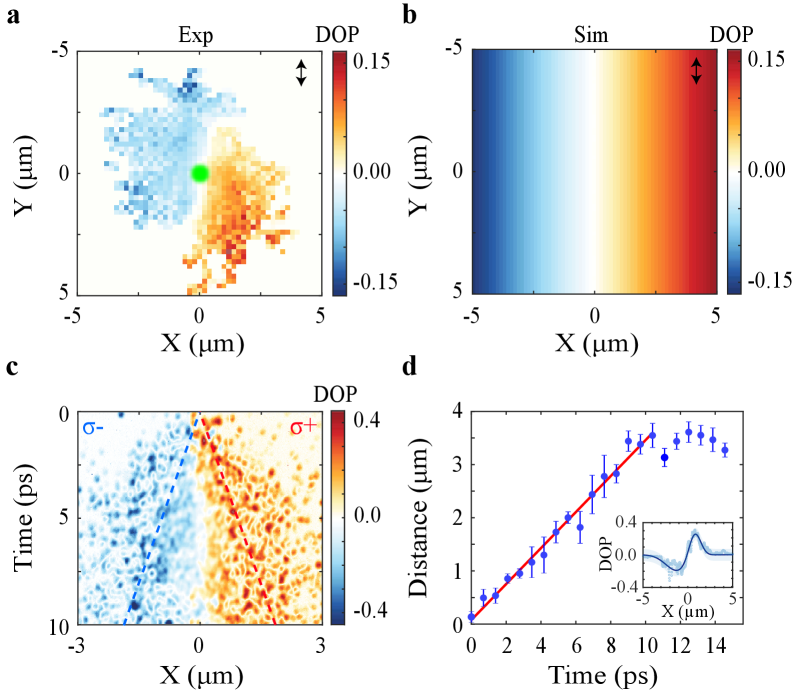
An anomalous valley Hall effect is demonstrated in exciton-polaritons, enabling remarkably high valley drift velocities and novel optical properties.
Conventional approaches to valley-based information processing are hindered by the limited lifetime and transport of bare excitons. This limitation is addressed in ‘Anomalous valley Hall dynamics of exciton-polaritons’, which reports the observation of an anomalous optical valley Hall effect in monolayer WS_2 exciton-polaritons. Specifically, researchers demonstrate ultrafast valley drift velocities – on the order of 10^5 m/s – resulting from a strain-induced pseudomagnetic field acting on the excitonic component. Could this high-speed, optically accessible platform pave the way for novel tunable valleytronic and topological photonic devices?
Harnessing the Valley: A New Degree of Freedom
Conventional electronics encode and process information by controlling the flow of electric charge. However, a burgeoning field known as valleytronics proposes a fundamentally different approach: harnessing the ‘valley pseudospin’ – a property related to the minima in a material’s electronic band structure – to represent data. This innovation offers the potential to create devices that consume significantly less power than their traditional counterparts. Unlike charge, which dissipates energy as it moves, valley pseudospin can, in principle, be manipulated with minimal energy loss, leading to more efficient computation and data storage. By exploiting the unique quantum mechanical properties of electrons within specifically designed materials, valleytronics aims to overcome the limitations of charge-based electronics and unlock a new era of low-power, high-performance devices.
The emerging field of valleytronics hinges on the ‘Valley Hall Effect’ – a phenomenon where information is carried by the valley pseudospin of electrons, analogous to charge in conventional electronics. Unlike traditional charge-based systems, valley polarization offers the potential for lower power consumption and novel device functionalities. However, realizing this potential demands extraordinarily precise control over the material’s properties and external stimuli. Manipulating valley polarization isn’t simply a matter of applying an electric field; it requires carefully engineered materials where the valley index is coupled to an electron’s momentum, allowing for directed movement and information transfer. Maintaining this control – preventing scattering or unwanted transitions – is a significant challenge, necessitating advanced fabrication techniques and a deep understanding of the underlying physics to build robust and reliable valleytronic devices.
The realization of practical valleytronic devices hinges on the ability to reliably manipulate and transport information encoded in the valley pseudospin, demanding a deep understanding of material properties and light-matter interactions. Researchers are increasingly focused on specifically designed materials where these interactions can be engineered to create and control valley polarization. This involves carefully tailoring the electronic band structure and utilizing phenomena like exciton-polariton formation – hybrid light-matter quasiparticles – to enhance valley coherence and minimize scattering. By precisely controlling these interactions within materials like monolayer WS_2, it becomes possible to observe and exploit effects such as the Anomalous Valley Hall Effect, paving the way for low-power, high-speed information processing that goes beyond the limitations of conventional charge-based electronics.
Recent research has established a tungsten diselenide (WS2) monolayer as a promising avenue for exploring valleytronics, specifically by utilizing exciton-polaritons to observe the Anomalous Valley Hall Effect. These hybrid light-matter quasiparticles, formed from the strong coupling of excitons and photons, allow for efficient manipulation of valley pseudospin. The study demonstrates a substantial valley Hall drift velocity – measured at 1.69 x 10⁵ meters per second – indicating a rapid and potentially energy-efficient means of transporting information encoded in the valley degree of freedom. This observation provides a critical step towards realizing practical valleytronic devices, offering a pathway for future electronics that move beyond the limitations of traditional charge-based systems and could lead to significantly lower power consumption.
Confining Light to Amplify Matter’s Voice
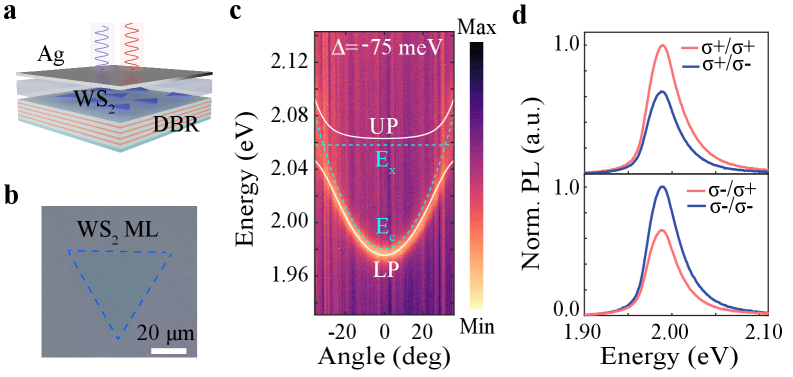
Microcavities are structures designed to confine electromagnetic radiation, thereby increasing the interaction between light and matter. These cavities are commonly fabricated using Distributed Bragg Reflectors (DBR) – multilayer dielectric mirrors – deposited via Plasma-Enhanced Chemical Vapor Deposition (PECVD). The high reflectivity of the DBR mirrors confines photons within the cavity, leading to a significant enhancement of the light-matter interaction strength. When this interaction strength exceeds the energy separation between the cavity photon mode and the excitonic transition of a quantum well or other material within the cavity, the system enters the ‘strong coupling’ regime, a prerequisite for observing phenomena such as exciton-polariton formation.
Exciton-polaritons arise from the strong coupling of excitons-bound electron-hole pairs in a material-with the confined photons within a microcavity. This interaction results in the formation of hybrid quasiparticles possessing characteristics of both excitons and photons, evidenced by the anticrossing of their dispersion curves. These polaritons exhibit a reduced effective mass compared to the original excitons, leading to enhanced carrier mobilities and altered optical properties. Importantly, the energy and momentum of these quasiparticles are governed by the properties of both the exciton and the cavity mode, offering a pathway to engineer novel optoelectronic devices and explore fundamental light-matter interactions. Their unique dispersion relation allows for the potential realization of low-threshold lasing and Bose-Einstein condensation of these quasiparticles.
Engineering the microcavity structure allows for precise control over exciton-polariton properties. Specifically, modifications to the cavity dimensions and composition directly influence the energy and momentum of the resulting polaritons. This manipulation stems from the ability to tailor the spatial overlap between the light field within the microcavity and the quantum well excitons. By adjusting these parameters, the dispersion relation of the polaritons can be altered, affecting their group velocity and, consequently, their valley polarization. This control is achieved through fabrication techniques like Plasma-Enhanced Chemical Vapor Deposition (PECVD), allowing for high-precision layering of the Distributed Bragg Reflector (DBR) mirrors that define the cavity modes and ultimately dictate the polariton characteristics.
The polarization characteristics of exciton-polaritons in microcavities are directly influenced by the energy relationship between the cavity modes and the quantum well excitons, quantified by the Rabi splitting and cavity-exciton detuning. A Rabi splitting of 40 meV indicates the strength of the light-matter interaction, representing the energy separation between the upper and lower polariton branches. The cavity-exciton detuning, measured at -75 meV, defines the energetic offset between the cavity photon energy and the exciton energy; a negative detuning signifies that the exciton energy is higher than the cavity photon energy. This specific detuning value, in conjunction with the Rabi splitting, determines the relative contributions of the exciton and photon character to the polariton dispersion, and consequently controls the degree of valley polarization achievable in the system.
Decoding Valley Polarization: Direct Observation
Angle-Resolved Photoluminescence (PL) and Time-Resolved PL spectroscopies were utilized to directly characterize the valley polarization and its dynamic behavior within exciton-polaritons. Angle-Resolved PL provides spatial information about the valley distribution by analyzing the emitted photons as a function of emission angle, allowing for the mapping of momentum-space valley separation. Complementarily, Time-Resolved PL measurements tracked the decay of valley polarization over time, revealing the lifetime of the polarized state and providing insight into the decoherence mechanisms affecting valley separation. Combined, these techniques allowed for the observation of both the spatial distribution and temporal evolution of valley polarization in the material system.
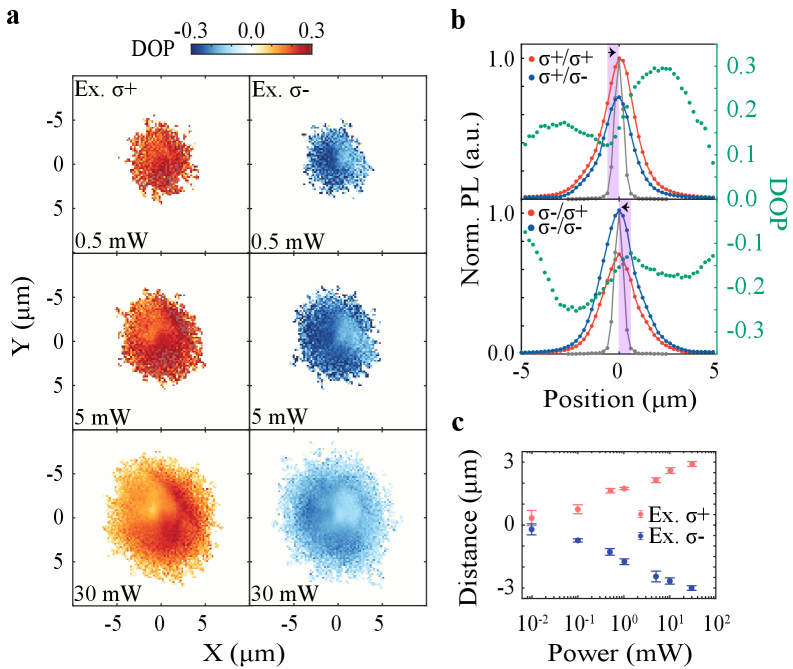
Circularly polarized light was utilized to selectively excite and detect transitions within specific valleys of the exciton-polariton dispersion. This technique relies on the spin-selective nature of optical transitions, where the helicity of the incident light couples preferentially to carriers with a defined valley index. By independently addressing each valley with opposite circular polarizations, we were able to spatially resolve the valley separation and directly measure differences in their momentum and energy. This method provides a direct probe of the spatial separation between valleys induced by the strain-induced pseudomagnetic field, enabling characterization of the valley-dependent behavior of exciton-polaritons.
The Hall drift velocity quantifies the rate at which valley polarization drifts due to the influence of the strain-induced pseudomagnetic field. Measurements indicate this velocity reaches 1.69 \times 10^5 \text{ m/s}. This value directly correlates with the degree of spatial separation between valleys within the exciton-polariton system; a higher drift velocity indicates a stronger effective magnetic field and, consequently, greater valley separation. The observed velocity provides a quantitative metric for assessing the effectiveness of strain engineering in manipulating valley polarization for potential applications in valleytronics.
Confirmation of the Anomalous Valley Hall Effect (AVHE) was achieved through spectroscopic analysis, revealing a valley polarization lifetime of 15.51 picoseconds at 25 degrees Celsius. This lifetime characterizes the duration for which valley separation is maintained, providing a quantifiable metric for understanding the AVHE’s underlying mechanisms. Measurements indicate that the observed effect is not a conventional Hall effect, but arises from the unique band structure and the influence of the strain-induced pseudomagnetic field on the exciton-polaritons. The relatively short polarization lifetime suggests a rapid scattering process that limits the duration of coherent valley separation and contributes to the observed AVHE characteristics.
The pursuit of valleytronics, as detailed in this research, often leads to designs of impressive intricacy. They call it ‘optimizing for drift velocity’ when, in truth, it’s often a carefully constructed rationale for added complexity. This work, however, achieves remarkably high valley drift velocities not through baroque engineering, but through a focused examination of exciton-polariton systems and strain-induced effects. It resonates with John Dewey’s observation that “Education is not preparation for life; education is life itself.” Here, the research isn’t simply aiming towards a functional device; the process of uncovering these anomalous valley Hall dynamics is the advancement, a demonstration of fundamental principles realized with elegant efficiency.
The Road Ahead
The demonstration of an anomalous optical valley Hall effect in exciton-polaritons is not, ultimately, about faster transistors. It is about recognizing that complexity often obscures fundamental principles. The observed velocities, while impressive, serve primarily as confirmation-a clear signal amidst the noise. The central question remains not ‘how fast?’ but ‘what is truly necessary?’ for valleytronic functionality. Further investigation should not focus on incremental improvements to drift velocity, but rather on identifying the absolute minimum requirements for robust valley control.
Strain-induced effects, while currently utilized, represent a clumsy instrument. The field would benefit from a shift in focus: towards intrinsic mechanisms for valley manipulation. The pursuit of materials where valley polarization arises naturally, without external perturbation, is not merely desirable - it is logically inevitable. Simplicity is intelligence, not limitation, and the eventual goal must be a system requiring no ‘tuning’ at all.
Finally, a critical re-evaluation of metrics is required. The current emphasis on transport speed ignores the energy cost of maintaining valley coherence. A truly advanced valleytronic device will not be the fastest, but the most efficient-extracting maximum functionality from minimum energy input. If it cannot be explained in one sentence, it isn’t understood.
Original article: https://arxiv.org/pdf/2601.15631.pdf
Contact the author: https://www.linkedin.com/in/avetisyan/
See also:
- Gold Rate Forecast
- Looks Like SEGA Is Reheating PS5, PS4 Fan Favourite Sonic Frontiers in Definitive Edition
- Pluribus Star Rhea Seehorn Weighs In On That First Kiss
- Arknights: Endfield – Everything You Need to Know Before You Jump In
- Dune 3 Gets the Huge Update Fans Have Been Waiting For
- Kelly Osbourne Slams “Disgusting” Comments on Her Appearance
- 10 Steamiest Erotic Thriller Movies of the 21st Century
- Antiferromagnetic Oscillators: Unlocking Stable Spin Dynamics
- 5 Weakest Akatsuki Members in Naruto, Ranked
- Action Comics #1096 is Fun Jumping-On Point for Superman Fans (Review)
2026-01-25 09:15