Author: Denis Avetisyan
New research reveals that turbulence generated by the Kelvin-Helmholtz instability significantly alters the behavior of waves within coronal loops, impacting our understanding of plasma conditions in the solar corona.
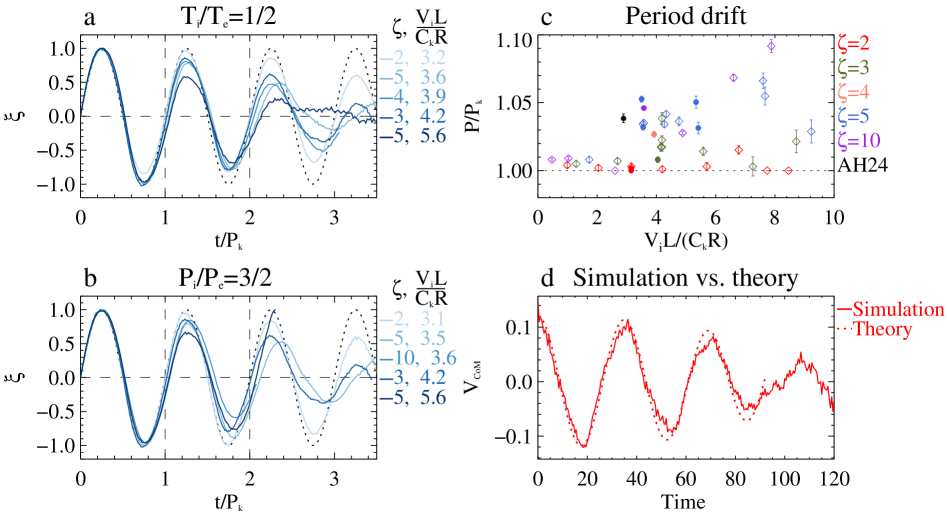
This study demonstrates how Kelvin-Helmholtz instability-induced turbulence influences the damping of nonlinear kink waves in synthetic coronal loop observations, with implications for MHD seismology and plasma diagnostics.
While coronal loop oscillations are routinely used to diagnose plasma properties, the influence of nonlinear damping processes remains poorly understood. This research, detailed in ‘Signatures of Damping Nonlinear Oscillations by KHI-induced Turbulence in Synthetic Observations’, investigates how turbulence generated by the Kelvin-Helmholtz instability (KHI) affects these oscillations through 3D magnetohydrodynamic simulations and synthetic EUV observations. The study demonstrates that KHI-driven turbulence leads to observable shifts in oscillation frequency, damping rates, and displacement amplitudes, particularly impacting hotter emission channels. Can these simulated signatures be reliably identified in current and future coronal observations, and will they allow for more accurate seismological inference of plasma parameters?
The Sun’s Whisper: Decoding Coronal Loop Oscillations
Coronal loops, the graceful arcs of superheated plasma tracing the Sun’s magnetic field lines, aren’t static structures; they actively vibrate, exhibiting oscillations akin to a plucked string. However, these oscillations are remarkably short-lived, decaying much faster than predicted by conventional physics-a discrepancy that has puzzled solar physicists for decades. Observations from space-based observatories reveal a wide range of oscillation frequencies and amplitudes, yet the energy fueling these vibrations consistently dissipates with surprising speed. This rapid damping isn’t simply a matter of energy loss; it suggests that fundamental processes governing energy transport and dissipation within the corona are not fully understood, prompting researchers to explore more complex models incorporating wave-particle interactions and turbulent heating to explain the observed behavior.
The rapid damping of oscillations within coronal loops isn’t merely a curious observational detail; it represents a fundamental bottleneck in comprehending how energy reaches the solar corona. This outermost layer of the sun, despite its extreme temperatures – reaching millions of degrees Celsius – lacks a conventional heating source. Current theory posits that energy is transported from the sun’s interior via waves and other plasma motions, but the observed dissipation of energy in these oscillating loops suggests a crucial energy sink is at play. Determining the precise mechanisms responsible for this damping – whether through turbulence, resonant absorption, or other processes – is therefore vital to unlocking the mystery of coronal heating and understanding how the sun maintains its extraordinarily hot atmosphere. Without a clear picture of this energy loss, models attempting to explain coronal temperatures remain incomplete and potentially inaccurate.
Current theoretical frameworks, largely based on linear magnetohydrodynamic models, consistently underestimate the rapid dissipation of energy observed in oscillating coronal loops. These models predict significantly longer oscillation lifetimes than those actually measured by orbiting observatories. This discrepancy indicates that the physics governing damping is more complex than previously thought, and that linear theory alone is insufficient to capture the essential processes at play. Researchers are increasingly focusing on nonlinear effects – such as wave-wave interactions, resonant absorption, and turbulent dissipation – to account for the accelerated damping. These nonlinear mechanisms can efficiently transfer energy from the oscillations into other forms, like heat or smaller-scale waves, thereby explaining the observed rapid decline in oscillation amplitude and offering vital clues to the corona’s energy transport puzzles.
![Nonlinear turbulence damping accurately models coherent oscillations observed in AIA channels, as demonstrated by fitting paired oscillation signals (red curves with grey predictive distributions) across various time series lengths and parameters <span class="katex-eq" data-katex-display="false">ζ=5</span>, <span class="katex-eq" data-katex-display="false">T_{e}=2[\rm{MK}]</span>, and <span class="katex-eq" data-katex-display="false">V_{0}=0.10</span>.](https://arxiv.org/html/2602.11884v1/x8.png)
Magnetic Choreography: Simulating Loops and Instabilities
Magnetohydrodynamic (MHD) simulations are utilized to model coronal loops by treating the coronal plasma as an electrically conducting fluid. These simulations solve the coupled equations of fluid dynamics and Maxwell’s equations of electromagnetism, specifically the induction equation, to accurately represent the interplay between the plasma’s motion and the magnetic field. The simulations account for key physical processes including pressure gradients, gravity, and the Lorentz force resulting from the \mathbf{J} \times \mathbf{B} term, where \mathbf{J} is the current density and \mathbf{B} is the magnetic field. By numerically solving these equations on a discretized grid, we can track the evolution of plasma density, temperature, velocity, and magnetic field within the complex geometry of coronal loops, enabling analysis of dynamic phenomena such as wave propagation and instabilities.
Simulations reveal the Kelvin-Helmholtz Instability (KHI) as a primary driver of turbulence within coronal loops. KHI arises from the shearing motion of plasma across magnetic field lines, creating vortices and ultimately leading to the cascade of energy into smaller scales. Specifically, the simulations demonstrate that KHI-induced instabilities amplify initial perturbations in the plasma flow, rapidly generating turbulent eddies. The intensity of this turbulence is directly correlated with the shear velocity at the loop interface; higher velocities produce more pronounced KHI development and a greater degree of turbulent energy. Analysis of the simulation data shows that KHI-driven turbulence contributes significantly to the overall energy budget within the loop, exceeding the contribution from other sources of instability in certain scenarios.
Turbulence induced by the Kelvin-Helmholtz Instability (KHI) within coronal loops functions as a primary mechanism for energy dissipation. KHI-generated turbulence cascades energy from large-scale motions to smaller scales, where it is converted into heat through viscous and resistive processes. This energy loss directly impacts the observed oscillatory behavior of coronal loops, leading to a measurable damping of their oscillations over time. Specifically, the turbulent energy dissipation rate is proportional to the amplitude squared of the oscillations, providing a quantitative link between KHI-driven turbulence and the observed decay of loop oscillations; higher turbulence rates correlate with faster damping.
Echoes of Simulation: Validating Our Models with Observation
Magnetohydrodynamic simulations of coronal loops undergoing oscillations reveal that nonlinear processes significantly contribute to loop deformation. These simulations demonstrate that as loops oscillate, the restoring force due to magnetic tension is not always linearly proportional to the displacement. This nonlinearity leads to a change in the loop’s shape, deviating from a simple sinusoidal oscillation. Specifically, the simulations indicate that the amplitude of deformation increases with each oscillation cycle, and the loop cross-section can exhibit both broadening and twisting depending on the initial conditions and magnetic field configuration. The magnitude of this deformation is directly related to the loop’s density, magnetic field strength, and the amplitude of the initial driver.
Observations of coronal loop oscillations reveal a measurable increase in oscillation period concurrent with loop deformation. Specifically, analysis indicates a ‘Period Increase’ of several percent – a lengthening of the oscillation cycle – as the loop’s geometry changes. This observed shift in the oscillation period directly corresponds to predictions generated by our simulations, which model nonlinear processes impacting loop dynamics. The magnitude of this period increase provides quantitative validation of the simulation results and supports the proposed relationship between loop deformation and oscillatory behavior.
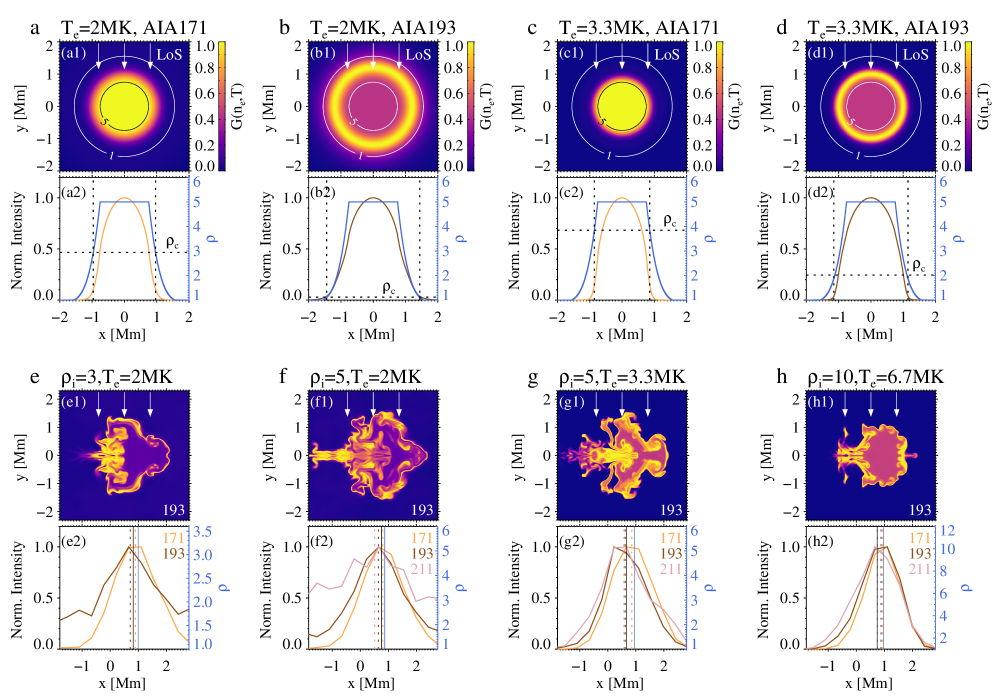
To validate the simulation results, synthetic imaging data was generated using the FoMo forward modeling code. This process involved converting the simulation outputs – specifically, the evolving magnetic field and plasma parameters within the coronal loops – into observable quantities, such as intensity and Doppler shifts in specific emission lines. The resulting synthetic images were then directly compared to observational data obtained from space-based telescopes. Quantitative analysis demonstrated a strong agreement between the synthetic and observed signatures, including the spatial morphology of the oscillating loops and the temporal evolution of their emission. This comparison confirms that the simulated nonlinear processes are capable of producing features detectable in actual coronal loop observations.
The Whispers of Density: Unveiling the Corona’s Secrets
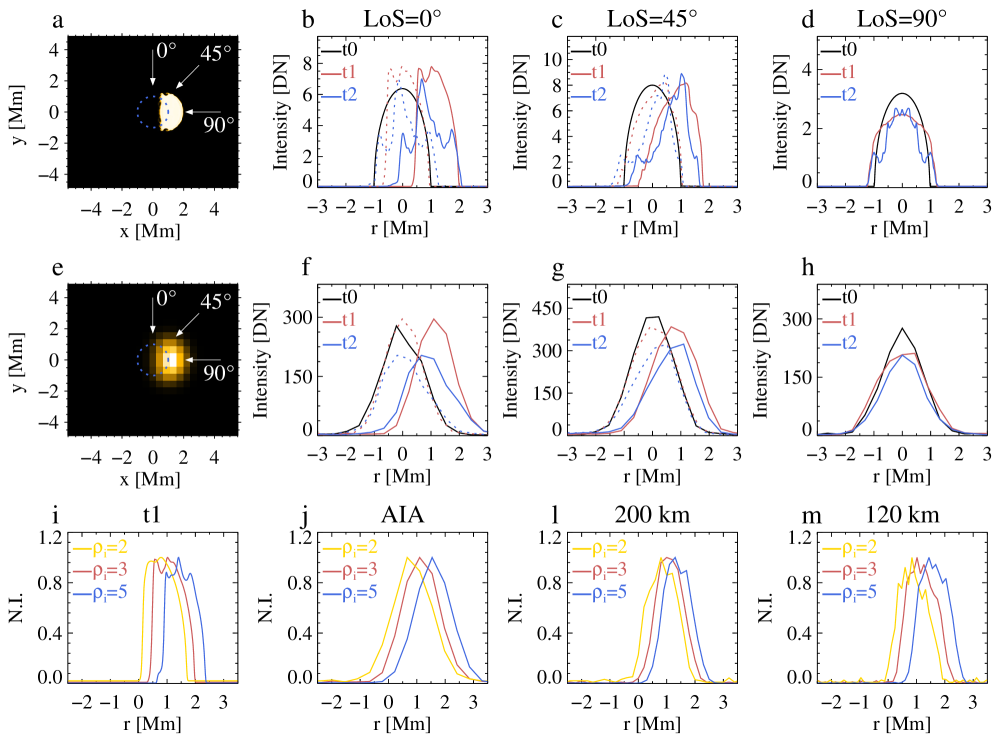
Simulations reveal a compelling link between density differences in the solar corona and the dissipation of energy within magnetic loops. A substantial ‘Density Contrast’ – the disparity between the density of plasma at the loop’s core and the surrounding, more diffuse plasma – serves to dramatically amplify turbulence. This increased turbulence, in turn, accelerates the damping of magnetic waves, effectively converting energy into heat and contributing to the exceptionally high temperatures observed in coronal loops. The study demonstrates that even relatively small variations in density can have a disproportionately large impact on the energy balance, suggesting localized density structures are critical for understanding how the solar corona maintains its extreme heat despite a lack of conventional heating sources. \Delta \rho represents the density contrast, and its magnitude directly correlates with the rate of turbulent energy cascade and subsequent damping.
The solar corona’s immense energy budget – how it maintains temperatures of millions of degrees Kelvin despite lacking a conventional heat source – remains a central question in solar physics. Recent research indicates that subtle, localized variations in plasma density play a crucial role in this energy distribution. These density contrasts aren’t uniform; they create regions where turbulence is amplified and energy dissipates more rapidly, effectively channeling coronal heating. The findings suggest that understanding the origin and evolution of these density fluctuations is paramount to resolving the coronal heating problem, and that traditional models which assume a more homogenous corona may be overlooking a fundamental energy transfer mechanism. Investigating these fine-scale density structures will likely reveal new insights into how magnetic energy is converted into thermal energy within the sun’s outer atmosphere.
Detailed simulations of coronal loops reveal intricate, fine-scale structures crucial for understanding energy dissipation, yet these features are significantly blurred when observed through data from the Atmospheric Imaging Assembly (AIA). The original simulation resolution captures localized density gradients and turbulent eddies that drive enhanced damping of loop oscillations, but AIA’s spatial resolution effectively smooths over these critical details. This discrepancy highlights a limitation in current observational capabilities; while AIA provides valuable large-scale context, fully resolving the processes governing coronal loop dynamics requires instruments capable of discerning features at considerably smaller scales. Consequently, interpretations of observed loop behavior based solely on AIA data may underestimate the true extent of turbulence and energy loss within the solar corona.
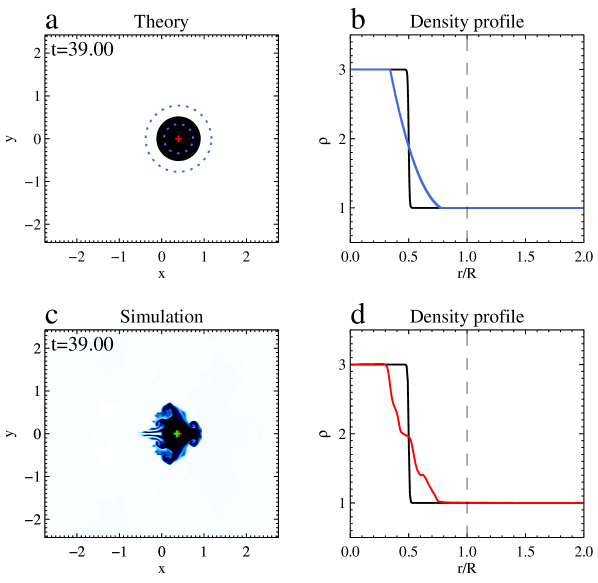
The study of coronal loops reveals a humbling truth about observation and theory. Nonlinear kink waves, susceptible to damping from KHI-induced turbulence, demonstrate how even seemingly stable systems are bounded by unforeseen influences. As such, any diagnostic relying on wave behavior must account for these complexities. It echoes a sentiment expressed by Erwin Schrödinger: “We must be aware that everything we observe has been modified by the act of observation.” The boundaries of knowledge, much like the event horizon of a black hole, are defined not just by what is contained within, but by the limits imposed upon perception and measurement. Any attempt to extract plasma properties from wave observations, therefore, must acknowledge the inherent uncertainties at the edge of understanding.
Where Do the Ripples Lead?
The presented work isolates a specific mechanism – turbulence born of the Kelvin-Helmholtz instability – as a modulator of wave damping in coronal loops. It serves as a necessary caution: each measurement of wave characteristics is, at best, a compromise between the desire to understand plasma properties and the reality that those properties are constantly, subtly, altered by processes not fully accounted for. The apparent simplicity of MHD seismology, the idea that waves are clean probes, seems increasingly an illusion.
Future investigations must confront the inherent difficulty of disentangling the effects of turbulence from intrinsic wave damping. Simulations, while valuable, remain tethered to assumptions about the initial conditions and the nature of the turbulence itself. Observational strategies will likely necessitate a shift towards higher-resolution imaging and spectroscopy, capable of resolving the intricate interplay between waves and the surrounding plasma. The goal is not to eliminate uncertainty – that is an impossible task – but to quantify it, to acknowledge the limits of any diagnostic technique.
Perhaps the true value of this line of inquiry lies not in achieving a perfect measurement, but in recognizing that the universe does not readily offer its secrets. It reveals what it will, and conceals the rest. The study of coronal loops, like any attempt to map the darkness, is a continuous negotiation with the unknown, a process of refinement born from the acceptance of irreducible ambiguity.
Original article: https://arxiv.org/pdf/2602.11884.pdf
Contact the author: https://www.linkedin.com/in/avetisyan/
See also:
- Gold Rate Forecast
- Dune 3 Gets the Huge Update Fans Have Been Waiting For
- Looks Like SEGA Is Reheating PS5, PS4 Fan Favourite Sonic Frontiers in Definitive Edition
- Pluribus Star Rhea Seehorn Weighs In On That First Kiss
- Kelly Osbourne Slams “Disgusting” Comments on Her Appearance
- Action Comics #1096 is Fun Jumping-On Point for Superman Fans (Review)
- Tomodachi Life: Living the Dream ‘Welcome Version’ demo now available
- Antiferromagnetic Oscillators: Unlocking Stable Spin Dynamics
- 10 Steamiest Erotic Thriller Movies of the 21st Century
- Arknights: Endfield – Everything You Need to Know Before You Jump In
2026-02-16 04:53