Author: Denis Avetisyan
Researchers have crafted a highly sensitive torsion pendulum using nanofabrication techniques, opening new avenues for probing fundamental gravitational effects on a laboratory scale.
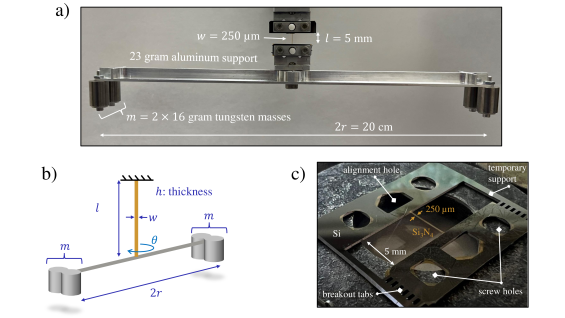
Nanofabricated torsion pendulums with thin-film resonators demonstrate dissipation dilution and pave the way for exploring gravitational entanglement between mechanical oscillators.
Measuring gravity on laboratory scales remains a significant challenge in the pursuit of theories beyond classical gravity. In ‘Nanofabricated torsion pendulums for tabletop gravity experiments’, we present a macroscopic torsion pendulum-supporting 87 grams with a 1.8-micron silicon nitride fiber-that overcomes limitations imposed by thermal noise in conventional setups. This represents, to our knowledge, the largest thin-film silicon-nitride-based oscillator demonstrated to date, achieving a critical step towards higher mechanical quality factors. Could these nanofabricated suspensions ultimately enable tabletop experiments capable of probing gravitational entanglement between mechanical oscillators and revealing new insights into fundamental physics?
The Inevitable Limits of Measurement
The quest to precisely measure gravity isn’t merely an exercise in metrology; it represents a cornerstone of modern physics, providing critical tests of general relativity and offering potential pathways to understanding dark matter and dark energy. However, these measurements are extraordinarily susceptible to external disturbances-vibrations from passing traffic, fluctuations in temperature, even subtle shifts in air currents-that introduce noise and obscure the delicate gravitational signals. These environmental factors fundamentally limit the precision achievable with current instruments, demanding increasingly sophisticated isolation techniques and data analysis methods. The challenge lies in discerning incredibly weak gravitational effects from a constant barrage of ambient noise, a task akin to hearing a whisper in a hurricane, and progress in mitigating these disturbances is directly tied to advancements in our ability to probe the universe’s most fundamental forces.
Traditional torsion balance experiments, employed to make incredibly precise measurements of gravitational forces, are fundamentally limited by thermal decoherence – a relentless source of noise arising from the random motion of atoms due to temperature. This thermal agitation introduces unwanted vibrations and distortions within the delicate balance, effectively masking the subtle gravitational signals researchers aim to detect. The effect isn’t simply additive; rather, it causes a gradual loss of the quantum coherence necessary for achieving the highest levels of precision. Consequently, even with meticulous shielding and vibration isolation, the sensitivity of these instruments is capped by the inherent thermal noise, posing a significant challenge to experiments designed to probe the very fabric of spacetime and test theories of quantum gravity. Overcoming this limitation requires innovative approaches to either dramatically cool the experiment or actively counteract the decohering effects of thermal fluctuations.
The pursuit of detecting subtle gravitational effects, crucial for probing quantum gravity, necessitates a radical departure from conventional measurement techniques. Existing limitations imposed by thermal noise-random fluctuations arising from the temperature of surrounding materials-obscure the faint signals researchers seek. Consequently, innovative strategies are being developed, including the use of cryogenically cooled detectors to reduce thermal vibrations and the exploration of novel materials with exceptionally low mechanical dissipation. Furthermore, researchers are investigating techniques like squeezed states of light and entangled particles to surpass the standard quantum limit, effectively reducing noise below levels previously thought attainable. These advancements aren’t merely incremental improvements; they represent a fundamental shift in how precision measurements are approached, paving the way for experiments capable of revealing the elusive connection between gravity and quantum mechanics.
Dissipation Dilution: Engineering Resilience Against Decay
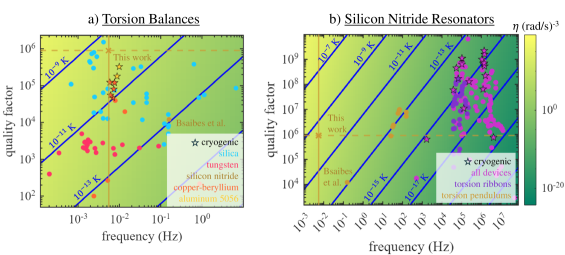
Maximizing the Mechanical Quality Factor (Q) of a torsion balance is central to improving sensitivity in precision measurements. The quality factor, a dimensionless parameter, describes the energy dissipation rate of an oscillator; a higher Q indicates lower energy loss and, consequently, enhanced sensitivity. In torsion balances, energy loss occurs through various mechanisms including air damping, material imperfections, and support losses. Increasing Q necessitates minimizing these loss contributions, allowing for detection of smaller forces or torques. Achieving high Q values is particularly crucial for instruments designed to detect extremely weak signals, such as those used in gravitational wave detection or searches for dark matter, where even minor energy dissipation can obscure the target signal.
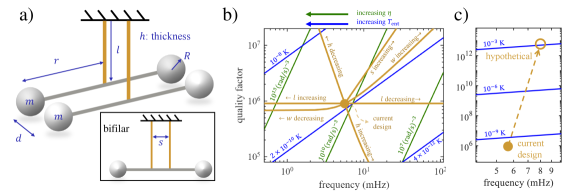
Dissipation dilution represents a technique for minimizing energy loss in mechanical resonators by supplementing the primary restoring force with effectively lossless forces. Bifilar suspensions, a common implementation of this approach, utilize two parallel, flexible supports to distribute stress and reduce internal friction compared to a single suspension. This configuration introduces a secondary restoring force that is largely independent of the primary flexure’s dissipation mechanisms. Consequently, the overall energy loss is reduced, leading to a higher Mechanical Quality Factor (Q). The effectiveness of dissipation dilution is directly related to the ratio of the added restoring force to the primary restoring force, with larger ratios yielding greater reductions in energy loss and enabling higher Q values.
The performance of torsion balance suspensions is directly correlated to their aspect ratio, defined as the length divided by the thickness. High aspect ratios minimize energy dissipation and maximize the mechanical quality factor (Q). Silicon Nitride (Si3N4) is an ideal material for constructing these resonators due to its properties allowing for the fabrication of thin-film structures with large length-to-thickness ratios. Recent advancements have resulted in macroscopic torsion pendulums utilizing Si3N4 suspensions measuring 1.8 μm in thickness, representing the largest reported to date, and facilitating significantly improved Q factors through dissipation dilution.
A macroscopic torsion pendulum utilizing a Silicon Nitride (Si3N4) suspension with a thickness of 1.8 μm has been successfully demonstrated. This represents the largest such suspension fabricated to date, enabling the construction of a significantly scaled torsion balance. The use of Si3N4 allows for the creation of thin-film resonators with high aspect ratios, crucial for maximizing sensitivity in torsion balance measurements. This design facilitates the implementation of dissipation dilution techniques and allows for increased mechanical quality factors Q by minimizing energy loss within the suspension system.
The torsion balance design successfully achieved a theoretical quality factor (Q) of 106 through the implementation of dissipation dilution techniques. This high Q-factor was facilitated by a gravitational dilution factor of 74, indicating a substantial reduction in energy loss due to the distribution of gravitational forces within the suspension system. The dilution factor represents the ratio of the effective mass contributing to energy dissipation to the total mass, effectively minimizing damping and enabling enhanced sensitivity in the device.
Stress-induced dissipation dilution provides a supplemental method for increasing the Quality factor (Q) of torsion balance systems. In the demonstrated macroscopic torsion pendulum, the 87 gram test mass induces an estimated stress of 1.9 GPa within the Silicon Nitride (Si3N4) suspension. This pre-stress alters the strain distribution, effectively reducing energy loss due to internal friction and thereby contributing to a higher Q. This mechanism is distinct from gravitational dilution and operates by modifying the mechanical properties of the suspension material itself, offering a pathway to further optimize sensitivity beyond traditional approaches.
Probing the Fabric: Experiments in Gravitational Interaction
Torsion balances, when enhanced for increased sensitivity, provide a precise methodology for both Equivalence Principle tests and verification of the Gravitational Inverse Square Law. The Equivalence Principle, positing the equivalence of gravitational and inertial mass, is tested by observing any differential acceleration between test masses of differing composition within a gravitational field; improvements in balance sensitivity directly correlate to tighter constraints on potential violations. Similarly, verification of the Inverse Square Law – stating gravitational force is inversely proportional to the square of the distance between objects – relies on detecting exceedingly small force variations with changing separation. Modern torsion balances utilize advanced materials and control systems to minimize noise and maximize precision, enabling measurements that validate these fundamental principles to increasingly high degrees of accuracy and search for deviations indicative of new physics.
Gravitational Coupling Experiments utilize highly sensitive instruments, such as torsion balances, to measure the gravitational force between test masses. These experiments are designed to detect extremely weak interactions, typically on the order of 10^{-{18}} \text{ N}. The methodology involves precisely controlling environmental disturbances – including seismic vibrations, electrostatic forces, and thermal gradients – to isolate and quantify the gravitational signal. By varying the mass, separation, and configuration of the test masses, researchers can map the gravitational field and test for deviations from Newtonian gravity, including anisotropic effects or the presence of additional forces. Successful detection of these minute interactions requires advanced data analysis techniques to distinguish the gravitational signal from background noise and systematic errors.
Exploration of Two-Way Gravitational Interaction is fundamental because current theoretical frameworks predominantly describe gravity as a one-way force. Establishing the existence of a reciprocal gravitational effect – where a test mass influences the gravitational field experienced by another – is a necessary condition for observing gravity-induced quantum entanglement. This is because entanglement, requiring correlated quantum states, cannot be mediated by a unidirectional force. Experiments designed to detect this interaction focus on identifying minute correlations between the motions of separated test masses, looking for evidence that each mass actively alters the gravitational field experienced by the other, rather than simply responding to an externally imposed field. Positive results would validate theoretical models proposing a bidirectional gravitational force and open avenues for utilizing gravity as a means to establish and manipulate quantum entanglement.
Quantum entanglement experiments focused on gravitational interaction aim to establish whether entanglement can occur between spatially separated particles via the intermediary of gravity. These experiments typically involve measuring correlations between entangled particles – often photons or massive particles – while seeking to identify correlations beyond those predicted by standard quantum mechanics and local realism. Successful demonstration of gravity-mediated entanglement would require observing a violation of Bell’s inequalities specifically attributable to gravitational interactions, thereby confirming a quantum connection established through the gravitational field and offering potential avenues for exploring quantum gravity and long-range quantum communication.
The Shadow of Measurement: Confronting Backaction Noise
The pursuit of precision in these experiments demands a relentless focus on minimizing backaction noise, a fundamental limitation arising from the very act of measurement. Any interaction with the system being observed inevitably imparts a disturbance, altering the state and introducing uncertainty – this is backaction. Unlike random noise that exists independently, backaction is directly correlated with the measurement itself, effectively masking the subtle signals researchers seek. Sophisticated techniques are therefore employed not simply to detect faint displacements, but to actively reduce the disturbance caused by the measurement process. This often involves carefully controlling the energy transferred during detection, utilizing extremely weak forces, and employing quantum-limited measurement schemes where the uncertainty is governed by the Heisenberg uncertainty principle \Delta x \Delta p \ge \frac{\hbar}{2}. By meticulously addressing backaction noise, scientists can push the boundaries of sensitivity and unlock access to previously undetectable phenomena.
To detect the minute movements of the torsion pendulum, researchers employ Optical Lever techniques, which function by directing a laser beam onto a reflective surface attached to the pendulum. Any displacement of the pendulum causes a corresponding change in the reflected beam’s position, which is then measured by a position-sensitive detector. This method offers a remarkably sensitive, non-contact means of tracking the pendulum’s motion; crucially, it avoids introducing mechanical disturbances that could mask the gravitational signals being sought. The amplification provided by the optical lever allows for the precise measurement of displacements far smaller than the wavelength of light, enabling the detection of incredibly subtle interactions and enhancing the overall sensitivity of the experiment.
To further refine sensitivity, researchers integrate optical cavities into the experimental setup. These cavities, formed by highly reflective mirrors, effectively trap and recirculate the light used to measure the torsion pendulum’s displacement, dramatically amplifying the signal. This amplification isn’t merely about making the signal stronger; it fundamentally reduces the impact of relative noise. By increasing the signal-to-noise ratio, even minute displacements become discernible, allowing for more precise measurements of incredibly weak forces. The resonant properties of the cavity enhance specific wavelengths of light, filtering out unwanted noise and focusing sensitivity on the relevant signal. This technique, akin to creating an echo chamber for light, represents a critical step in pushing the boundaries of precision measurement and enabling the detection of subtle gravitational effects.
The performance of gravitational wave detectors and precision force measurements is profoundly affected by the delicate balance of surface separation between test masses. A smaller separation enhances the gravitational coupling, strengthening the signal induced by the target phenomenon; however, it simultaneously amplifies undesirable electrostatic forces. These forces, arising from stray charges and imperfections on the surfaces, can overwhelm the gravitational signal, introducing significant noise. Therefore, meticulous control of this separation – typically on the order of microns – is essential. Researchers employ techniques like electrostatic levitation and precision spacer materials to maintain a stable, minimized gap, carefully balancing the need for strong gravitational interaction against the risk of spurious electrostatic interference, ultimately maximizing the signal-to-noise ratio and the sensitivity of the instrument.
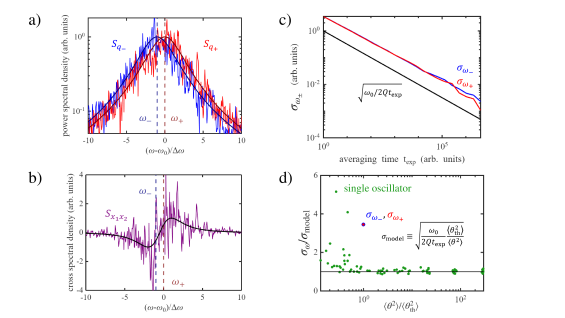
The pursuit of isolating a macroscopic system, as demonstrated by this nanofabricated torsion pendulum, inevitably courts the specter of decoherence. The researchers strive to minimize dissipation, yet a system entirely shielded from external influence would be, in essence, lifeless. It echoes a sentiment articulated by Grigori Perelman: “Perfection leaves no room for people.” The pendulum’s sensitivity isn’t achieved through flawlessness, but through a careful negotiation with imperfection-a balance between isolation and interaction. The mechanical quality factor, a measure of this balance, reveals that even in the most meticulously crafted systems, a degree of ‘failure’-of energy loss-is not an impediment, but a fundamental characteristic of existence. A system that never breaks is, indeed, a dead one.
The Horizon Beckons
The construction of a sensitive torsion pendulum is not an engineering feat, but an exercise in carefully cultivating a boundary. This work doesn’t bring one closer to a measurement, but defines the shape of the questions one can reasonably ask. The high mechanical quality factor achieved here is not a destination, but a reprieve – a temporary stay against the inevitable tide of thermal decoherence. Each oscillation measured is a borrowed moment, and the pursuit of lower dissipation is simply an attempt to extend the loan.
The prospect of observing gravitational entanglement between mechanical oscillators is alluring, but one should remember that entanglement isn’t a property of the oscillators, but a fragility between them. Resilience lies not in isolation, but in forgiveness between components – in the capacity of the system to absorb and redistribute the disturbances that will, invariably, arrive. A system isn’t a machine, it’s a garden – neglect it, and you’ll grow technical debt.
Future work will likely focus on further refinement of the materials and geometries, chasing ever-higher quality factors. But perhaps a more fruitful direction lies in accepting the inherent noisiness of reality and developing techniques to extract signals from the noise, rather than attempting to eliminate it. The true challenge isn’t to build a perfect instrument, but to learn to listen to an imperfect world.
Original article: https://arxiv.org/pdf/2601.11366.pdf
Contact the author: https://www.linkedin.com/in/avetisyan/
See also:
- The Super Mario Galaxy Movie: 50 Easter Eggs, References & Major Cameos Explained
- Surprise Isekai Anime Confirms Season 2 With New Crunchyroll Streaming Release
- ‘Project Hail Mary’: The Biggest Differences From the Book, Explained
- 10 Best Free Games on Steam in 2026, Ranked
- Silver Rate Forecast
- All 7 New Supes In The Boys Season 5 & Their Powers Explained
- Sydney Sweeney’s The Housemaid 2 Sets Streaming Release Date
- Skate 4 – Manny Go Round Goals Guide | All of the Above Sequence
- Frieren: Beyond Journey’s End Gets a New Release After Season 2 Finale
- Preview: Sword Art Online Returns to PS5 as a Darker Open World Action RPG This Summer
2026-01-19 15:18