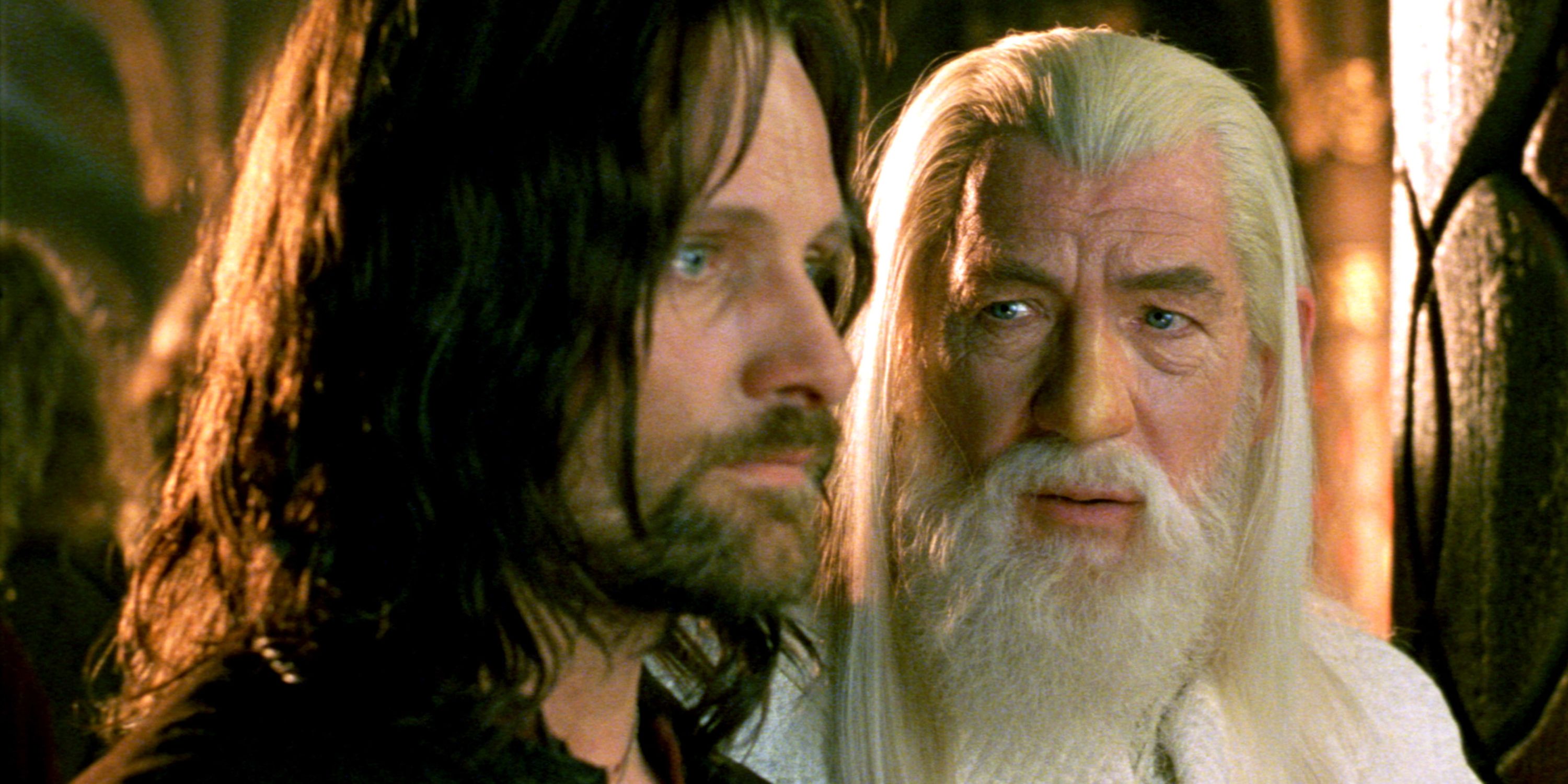
Andy Serkis’ new movie faced criticism as soon as it was announced. It attempts to expand a short section of J.R.R. Tolkien’s The Lord of the Rings into a full-length film, similar to Peter Jackson’s Lord of the Rings and Hobbit trilogies. Many fans are concerned the filmmakers will have to create new plotlines to make the movie long enough, but that isn’t their only choice.
Set between Bilbo Baggins’ 111th birthday in the year 3001 and the start of Frodo’s journey in 3018, The Hunt for Gollum takes place during a busy 17-year period in Middle-earth. As detailed in the appendices of The Lord of the Rings and books like Unfinished Tales, a lot happened during those years besides the search for Gollum, offering the filmmakers opportunities to expand the story while staying true to Tolkien’s original writings.
Saruman and Sauron Joined Forces To Dominate Middle-earth
Becoming a villain wasn’t immediate for Saruman, but a key event during The Hunt for Gollum cemented his turn to darkness. Around the year 2000, he began using the palantír—a seeing-stone—in his tower, Orthanc, to communicate with the Dark Lord Sauron. Sauron persuaded him to help conquer Middle-earth. While Sauron launched attacks from Mordor in the east, Saruman waged war from Isengard in the west.
As a longtime fan, I always found Saruman’s motivations fascinating. He pretended to be devoted to Sauron, but really, he wanted the One Ring for himself and was just waiting for the right moment to double-cross the Dark Lord. It’s a shame Sir Christopher Lee, who played Saruman so brilliantly, is no longer with us – he passed away in 2015. That means we won’t see him reprise the role in The Hunt for Gollum, but Andy Serkis, who directed the upcoming film, has shown he’s not afraid to bring in new actors for familiar Lord of the Rings characters, which is a bold move I’m curious to see play out.
Théoden’s Family Suffered Tragedies Before The Lord of the Rings
Long before Saruman launched a full-scale attack on Rohan, Orcs were a persistent danger to the kingdom. In the year 3002, Éomund, the brother-in-law of King Théoden, chased a group of Orc raiders into the East-mark. As detailed in the Appendix A of The Lord of the Rings, his anger led him to pursue them recklessly with a small force, allowing the Orcs to ambush him near Emyn Muil. He was killed in the battle, and soon after, his wife, Théodwyn, died from an unexplained sickness.
This meant Éowyn, age 7, and Éomer, age 11, were left without parents. Their uncle, Théoden, stepped in and raised them as his own children, and they both became well-known figures. Sadly, Bernard Hill, the actor who played Théoden, has passed away, but the story of Éomer’s final battle could still be told even without including the King of Rohan.
Aragorn’s Mother Died During the Hunt for Gollum
Around the same time, Aragorn, the central character in The Hunt for Gollum, also experienced the loss of a parent. His mother, Gilraen, died in the year 3007. While her death was peaceful – she lived to be 100 years old – it was still deeply upsetting for Aragorn, as she was his last remaining close family member.
Gilraen wasn’t shown in Peter Jackson’s films, but she’s mentioned briefly in the extended version of The Fellowship of the Ring. Before the Fellowship leaves Rivendell, Aragorn goes to see a secluded spot. Elrond joins him there and sadly says that Aragorn’s mother always knew he would be pursued throughout his life.
Wormtongue and Saruman Took Over Théoden’s Mind
When Théoden appeared in Peter Jackson’s The Lord of the Rings: The Two Towers, he was a weakened and corrupted king, barely able to speak without someone whispering the words to him first. As J.R.R. Tolkien detailed in Unfinished Tales, specifically the section about the Battles of the Fords of Isen, this decline started five years earlier, in the year 3014.
Théoden became sick due to a combination of natural illness and the slow-acting poisons administered by Wormtongue. While not immediately fatal like his sister’s illness, this sickness had terrible results, letting Wormtongue – and ultimately, Saruman, who was pulling the strings – gain more and more power over the kingdom of Rohan. A potential storyline in The Hunt for Gollum could explore the beginnings of this manipulation, though it would require a different actor to play Théoden than the one who portrayed him in the main films, unlike the depiction of Éomund’s death.
Gandalf Tamed the Fastest Horse in Middle-earth
In J.R.R. Tolkien’s The Two Towers, Gandalf calls for Shadowfax, a magnificent horse known as the Lord of all Horses. While the film shows Gandalf and Shadowfax are close, calling each other “friends through many dangers,” it doesn’t reveal how they first met. The book explains that Gandalf tamed Shadowfax in the year 3018, shortly after escaping from Orthanc. At the time, King Théoden was under the influence of Wormtongue and avoided Gandalf, but he did allow the wizard to borrow a horse to speed his journey.
Théoden was a bit frustrated when Gandalf selected Shadowfax, a magnificent horse from a legendary line. Shadowfax was technically Théoden’s, as he came from the same stock as a horse ridden by the kings of old, but no one had ever been able to ride him. Gandalf spent two days patiently gaining Shadowfax’s trust by following him across the plains of Rohan. This effort paid off – Shadowfax’s incredible speed proved crucial on several occasions, most notably when he carried Gandalf and Peregrin Took to Gondor in only four days.
The Nazgûl Discovered Saruman’s Treachery
In Unfinished Tales, Tolkien explains that the Witch-king and the other Nazgûl went to Isengard in 3018, a few weeks before entering the Shire to search for Frodo. They suspected Saruman knew where the One Ring was, but Saruman denied any knowledge, and the Witch-king apparently believed him.
The next day, the Nazgûl ran into Wormtongue, who was hurrying to tell Saruman news from Rohan. He was so frightened by the Black Riders that he instantly betrayed Saruman, giving away information, including the path to the Shire. Interestingly, despite being major villains in the first Lord of the Rings film, Saruman and the Nazgûl never shared a scene together, making this encounter a compelling possibility in The Hunt for Gollum.
The Battle of Osgiliath Began the Greatest Conflict of the Third Age
The extended version of The Two Towers features a scene of Gondorian soldiers celebrating a victory in Osgiliath. This takes place after Sauron attacked the city in the year 3018, an assault he mainly intended to cover up two other important events: the Nazgûl’s hunt for the One Ring and a raid on the Woodland Realm that enabled Gollum to escape from the Elves. The book depicts this battle as less of a clear win for Gondor than Peter Jackson showed in the film.
Let me tell you, the Battle of Osgiliath, as depicted in The Hunt for Gollum, was a brutal affair. Yes, they won, but at a terrible cost. Only Boromir, Faramir, and a couple of other soldiers made it out alive, and they lost a significant portion of the city. Worse still, the bridge over the Anduin was completely destroyed. But beyond the immediate losses, this attack felt…different. It wasn’t just another skirmish. Looking back, it’s clear that Sauron’s assault on Osgiliath was the moment things truly escalated – the official starting gun for the War of the Ring. It’s a pivotal event, and honestly, a really grim one to watch.
Read More
- Gold Rate Forecast
- 10 Most Powerful Versions of Superman, Ranked
- 10 Best Free Games on Steam in 2026, Ranked
- Forza Horizon 6 Car List So Far: Confirmed Highlights, Cover Cars, DLC, and Rewards
- GBP CNY PREDICTION
- 007 First Light: Release Date, Story, Gameplay, Cast, Editions, and Platforms
- 10 Greatest Manga Endings of All Time
- Black State Trailer Showcases Ray-Traced Reflections and DLSS 4 Performance
- Forza Horizon 6 PC Issues: Fix Crashes, Stuttering, Steam Errors, and Game Pass Problems
- DOGE PREDICTION. DOGE cryptocurrency
2026-05-09 13:08