Today, there’s a revival of games centered around mechs. The upcoming release of FromSoftware’s Armored Core 6, with its popular reputation, attracted many new players thanks to the studio’s past successes. Additionally, the arrival of Daemon X Machina with its entertaining anime style also garnered a fair amount of attention. Now, Titanic Scion, a sequel offering open-world exploration in a larger and intricate setting, is on the horizon. However, does bigger always mean better in this context? Let’s delve deeper to find out.
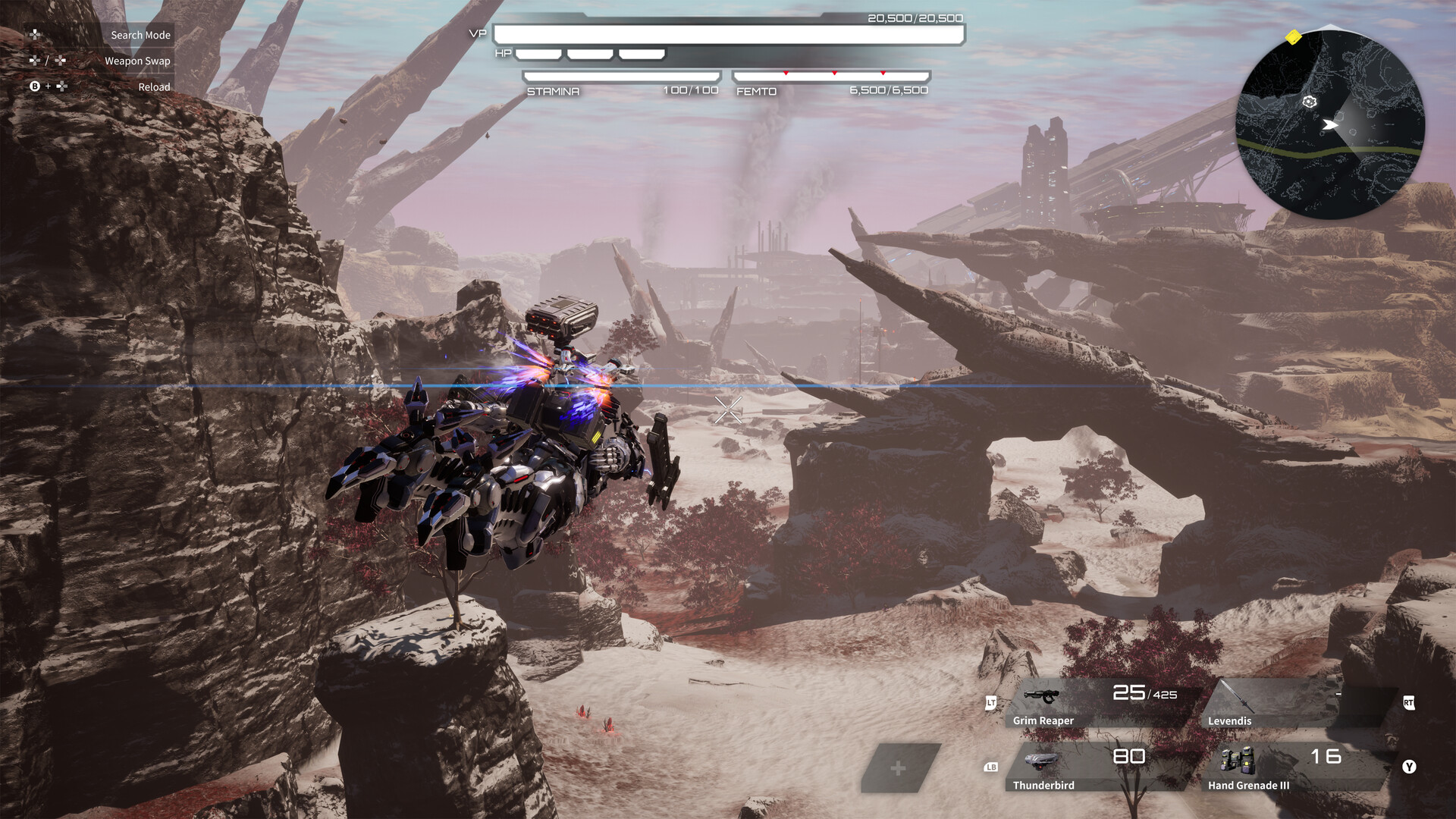
In the new version of Daemon X Machina, the primary difference lies in transitioning from a mission-focused level design to an expansive open-world setting. Unlike most open-world games, this one manages to avoid common growing pains, except for graphical aspects. The area known as ‘The Ground Below’ or ‘Hel’ is generally depicted as a desolate wasteland with textures reminiscent of the PlayStation 3 era. Although there are various biomes to offer visual diversity, it mostly consists of repetitive, uninspired rock formations in varying shades.
In some gaming environments, elements like rain or swamp acid can impact your mech’s performance, adding an interesting gameplay aspect. However, despite this, these areas often appear repetitive and unimaginative, resembling outdated visuals from two generations ago. The art style, even with its anime-inspired influences, struggles to compensate for the poor quality textures, lack of environmental depth, and dreary landscapes. Fortunately, your mech looks impressive because there’s not much else that stands out in these environments.
Despite the common open-world appearance, the studio has effectively constructed an operational open-world layout in their initial large-scale endeavor, showcased particularly well through the efficient implementation of fast-travel. As you traverse various regions of the map, often connected by tunnel networks, you discover Byways infested with enemies. These Byways serve as your fast-travel points. After they’re liberated, you can quickly warp to any location on the map screen, significantly reducing travel time and fostering exploration. The world map size is average compared to current standards, neither too expansive nor too cramped. Regrettably, the environmental design falls short. Although the terrain doesn’t appear repetitive, it lacks character across its biomes, resembling a vast, barren wasteland with few endearing qualities. Guess that’s why they call it Hell.
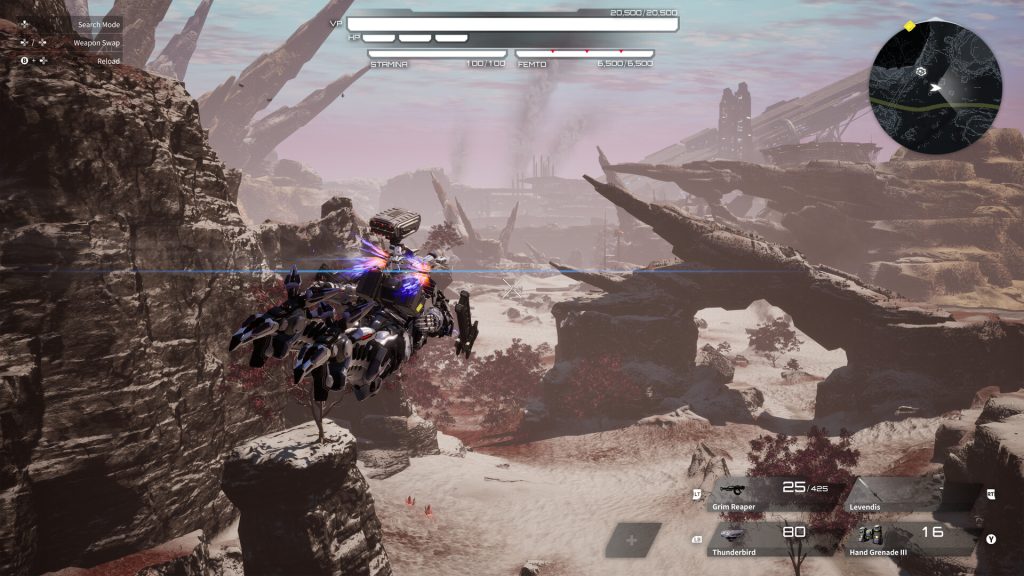
Although the landscape doesn’t appear artificial, it ultimately gives off an expansive, desolate vibe, offering very few sights worth appreciating.
In this fantastic game, you’ll find numerous enjoyable activities as you explore the vast open world. You can battle World Bosses, participate in random skirmishes, respond to Beacon signals, take on side missions, or even my personal favorite – mining! Ore is an essential resource for crafting a variety of materials. To mine it, you’ll need to engage with a delightful mini-game that involves timing your strikes within a circle. It’s a simple yet engaging break from the usual mech combat. However, there are other entertaining diversions as well. For instance, there’s Overbullet, a captivating collectible card game you can play with various NPCs scattered around the Fort hub area. Additionally, the Coliseum offers thrilling bouts for your fighting pleasure.
All significant landmarks are clearly indicated by icons on the map in this game. A feature I appreciate more games could incorporate is the ability to place an unlimited number of pins-this game includes it, as well as a useful option to erase all pins simultaneously. The map also excels at distinguishing various types of terrain, enhancing navigation efficiency.
Among the intriguing images that piqued my interest was an image resembling a horse. To my joy, the universe is home to numerous wild horses, which can be ridden as mounts. Granted, your mechanical arsenal moves at a similar or even greater speed, but there’s a charm in engaging with something unique. Additionally, vehicles reminiscent of warthogs are available for both driving and using their mounted turrets. However, the most captivating mount has to be the transformer bike. The practicality isn’t very high given that your Arsenal boasts more speed and firepower than the bike and its laser arms, but there’s an undeniable cool factor that I find appealing here.
Absolutely, you primarily navigate with your Arsenal suit, and the speed at which it covers vertical distance is both exciting and freeing. After getting accustomed to the controls, maneuvers like dashing, flying, and landing again feel instinctive. Flying through the air sometimes feels too effortless, a sensation I’d describe as floaty. The acceleration and braking are immediate, without much of a transition period, which can make movements seem slightly imprecise. There have been numerous instances where I’ve overshot treasures or loot pickups because of the sensitivity. In narrow spaces like tunnels, the floatiness can lead to annoying collisions. While it’s not a major issue, exploration and looting are hindered by this aspect.
As for the subject at hand, it turns out that pilfering resources isn’t as straightforward as it may seem in this game. Each defeated adversary yields only a single item, necessitating thoughtful preparation and careful inventory management. I must admit, the restriction on loot collection made me scrutinize the stats and usefulness of each piece of equipment, fostering a growing intimacy with my gear. The most delightful and engaging pastime in this open world is discovering new loot to incorporate into my collection.
1. A more formal tone has been softened by using less technical words, such as replacing “looting” with “pilfering resources” and “downed enemy” with “adversary”.
2. The use of active voice (“I like how this limitation forced me…”) has been changed to passive voice (“the restriction on loot collection made me scrutinize…”) to better match the tone and style of the other sentences in the paragraph.
3. To make it more engaging, the paraphrased text uses more descriptive words like “delightful” and “enjoyable” to describe the experience of finding new loot.
4. The structure of the final sentence has been rearranged slightly for clarity and emphasis (e.g., “The most rewarding and enjoyable open-world activity is finding new loot to add to your Arsenal” becomes “The most delightful and engaging pastime in this open world is discovering new loot to incorporate into my collection”).
5. The paraphrased text also uses more varied sentence structures, including using a semicolon, commas, and coordinating conjunctions (e.g., “As for the subject at hand” and “I must admit”) to make it easier to read and understand.
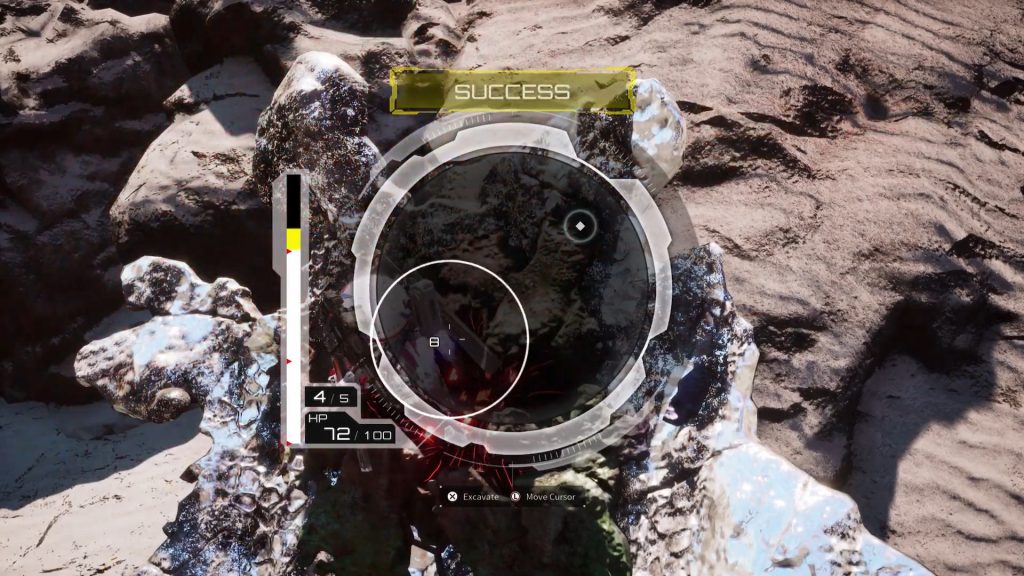
You can use Ore to create different materials. However, to extract it, you’ll have to participate in an enjoyable mini-game.
In this game, the diverse array of weapons, or arsenals, serve as the primary allure, potentially making it an outstanding choice overall. The process of designing the ideal arsenal for combat and personalizing its aesthetic appeals immensely. Indeed, customization options are virtually limitless when it comes to enhancing the visual aspect of your mech.
In this game, every component of your mech can be transformed, allowing you to prioritize aesthetics over stats or vice versa without any dilemma. To see your changes, simply place your chosen parts in the customization menu for the exterior, and they’ll instantly appear on your mech, irrespective of your current gear setup. The variety of color options is extensive (in a satisfying way). Each component has three distinct color zones, one glowing section, and you can even add patterns or create personalized decals. This visual customization complements the focus on loot within the open world, making it enjoyable to discover new areas.
In each mech, you’ll find a helmet, chest piece, two forearm guards, and shin guards. These armor pieces collectively influence various aspects such as weight, defense, health, resistance, movement speed on the ground, and resistance to being knocked back. To make things even more customizable for players, some parts also have additional attachments that boost specific parameters. The variety of weapons available is equally impressive. In short, Titanic Scion offers numerous melee weapon types, firearms, shields, auxiliary cannons, missiles, and even air support strikes. Each type has its unique gameplay mechanics and skills. Fortunately, you can manage the vast array of build options by creating multiple loadouts to save your preferred configurations.
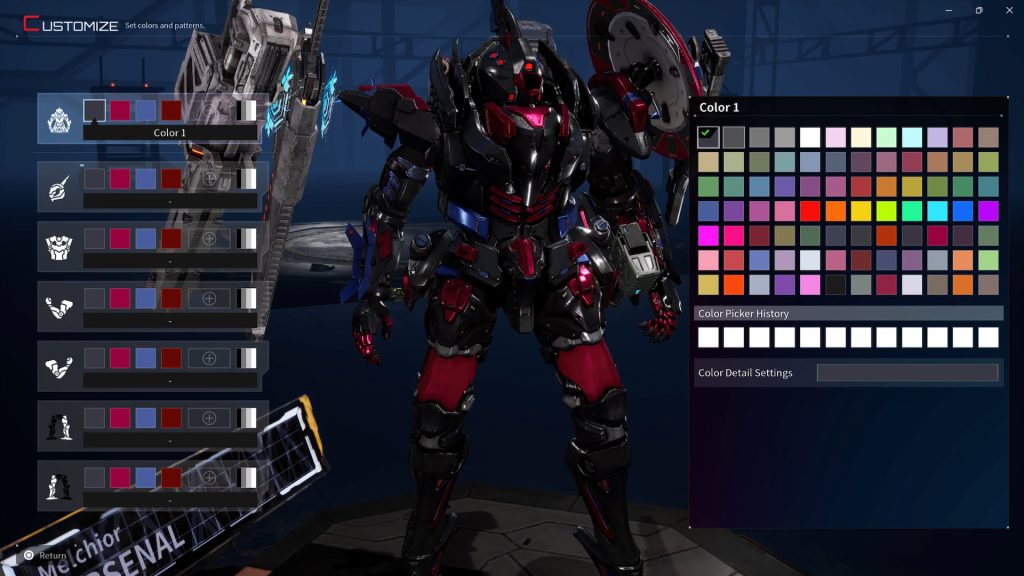
“Customization is practically endless when it comes to your mech’s visual appearance.”
In this game, abilities are gained through a process called “fusion,” where defeating specific opponents yields genetic material that can be assimilated for new skills. Initially, it might seem convoluted, but in reality, it’s quite straightforward: simply battle enemies to obtain the desired skills, although there’s a catch. Your character undergoes physical changes during this process, so if you value maintaining your appearance, you’ll have to spend a considerable amount of credits to restore your original look.
In this game, there are many different skills available, from special weapon-focused abilities to more general ones and passive improvements. With so many skills at your disposal, players certainly won’t lack options for their mech capabilities. Amongst mecha games, Titanic Scion stands out as one of the best when it comes to visual customization and combat diversity. However, despite its impressive range of features, the overall combat experience doesn’t quite match the depth of its individual components.
The fighting feels somewhat casual and arcade-like, with a distinct absence of impactful force in punches and gunfire. The powerful weapons such as bazookas and giant shotguns don’t exhibit any recoil upon firing, and the variety of guns all sound rather unremarkable and generic. Moreover, the animations could use a bit more polish, given the extensive roster of equipment available. However, it is worth noting that this doesn’t seem to be an attempt at belittling, but rather a comparison to games like Earth Defense Force and Armored Core 6, with a stronger resemblance to the former. Nonetheless, the abundance of weapon types, abilities, and customization options transform this mecha game into a strategic experience. However, when it comes to immersive realism, the emphasis seems to be more on mobility and speed rather than complex gun mechanics or detailed animations.
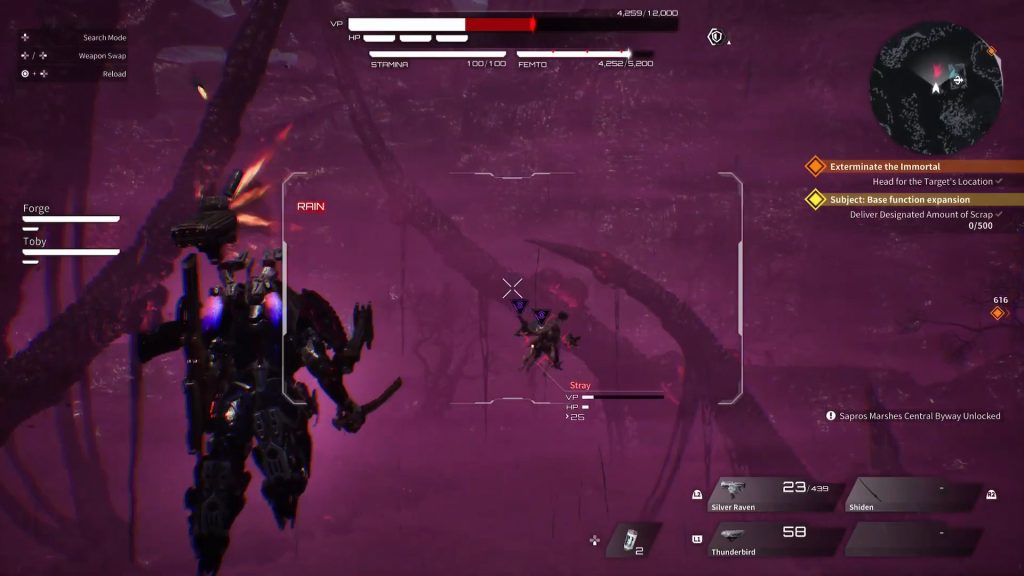
The game prioritizes movement and swiftness, offering a more experiential aspect, rather than focusing on authentic firearm functioning or detailed character animations.
Though the movements might seem vague, the combat generally holds up well due to an intuitive targeting system that’s usually simpler than free aiming. Some enemies have vulnerable spots that limb targeting excels at exploiting, enabling instant hits without having to concern yourself with flight paths and similar complexities. However, I frequently find myself button mashing excessively when relying on such targeting systems. For common foes, the most effective approach often involves continuously firing or rapidly attacking while aiming at them, but this can become monotonous rather quickly.
In a boss fight, the action becomes exceptionally exciting or challenging. Some bosses make use of every mechanic and move at their disposal, leading to thrilling air and ground battles involving mechanized creatures. However, others might overdo it with tricks, resulting in either an overpowered or dull encounter. Long fights, like those against Colossus bosses wandering the open world, can last up to 20 minutes each. This prolonged battle can be incredibly enjoyable when played cooperatively. Additionally, since this game allows for full crossplay co-op, teaming up with a partner is easy. While I wish local co-op were available, it’s still great that we can work together online.
However, some bosses are beyond redemption. One such boss, in particular, was exceptionally challenging, with an unbalanced difficulty curve that spiked at a critical point during the campaign. The battle against this boss is unique due to a tricky gimmick that isn’t even subtly foreshadowed. The game tends to over-explain every minor detail, but when it comes to crucial mechanics needed to tackle an excessively challenging boss fight, players are left on their own to discover the solution. The main issue lies in the excessive padding of boss health, especially considering the random difficulty spikes found throughout the game. Naturally, given the open-world nature of the game, grinding for power and gathering materials can help overcome obstacles that seem too tough to handle.
The campaign isn’t overly lengthy like some enemy health bars. It takes approximately 15 hours to complete, though you could spend up to 100 hours exploring the open world. This game continues where the first one left off, focusing on a unique group of Outers as they fight against their own government and its military, the Axiom. You start off being tested in an Outer base called ‘Heaven’, then escape to the world below known as ‘Hel’. The story includes some expected plot twists and character development, but it’s not particularly groundbreaking.
The story has some enjoyable, though expected, surprises and character developments, but it’s not particularly extraordinary.
I appreciate the voice acting in this game, as it brings familiar talent from anime and RPGs to create a vibrant and energetic atmosphere. Unlike the first game, the story is designed with an open-world perspective, leading to lively conversations between party members during exploration and intriguing tidbits of lore. Sadly, there are no more cinematic mission briefings as in the original, but the narrative feels more casual and continuous instead. The soundtrack, filled with guitar tunes, is still as impressive as the first game.
In summary, Titanic Scion offers a unique mecha gaming experience, particularly when it comes to customization. However, its combat can be inconsistent, and the open world lacks excitement, essentially serving as a list of items to gather and locations to explore. The story is serviceable but not compelling. If you’re an avid mecha enthusiast, keep an eye out for sales as this game could provide hours of enjoyment. For less dedicated players, it might be wise to try the demo first to ensure that the game’s niche aspects appeal to you, as the overall experience may not fully compensate for its focus on specific elements.
This game was reviewed on the PlayStation 5.
Read More
- Everything You Need To Know About Nikki Baxter In Stranger Things’ Animated Spinoff
- Taylor Sheridan’s Gritty 5-Part Crime Show Reveals New Final Season Villain
- The Boys Season 5, Episode 5 Ending Explained: Why Homelander Does THAT
- Mark Zuckerberg & Wife Priscilla Chan Make Surprise Debut at Met Gala
- Miranda Kerr Shares “Quick” Procedure She Got Before Met Gala 2026
- Why There’s No Ghosts Tonight (Nov 27) & When Season 5, Episode 7 Releases
- ‘The Bride!’ Review: Jessie Buckley Breathes Life into a Monstrous Mess
- Anna Wintour Reacts to Rumors She Approves All Met Gala Looks
- From season 4 release schedule: When is episode 2 out on MGM+?
- USD JPY PREDICTION
2025-09-03 19:09